

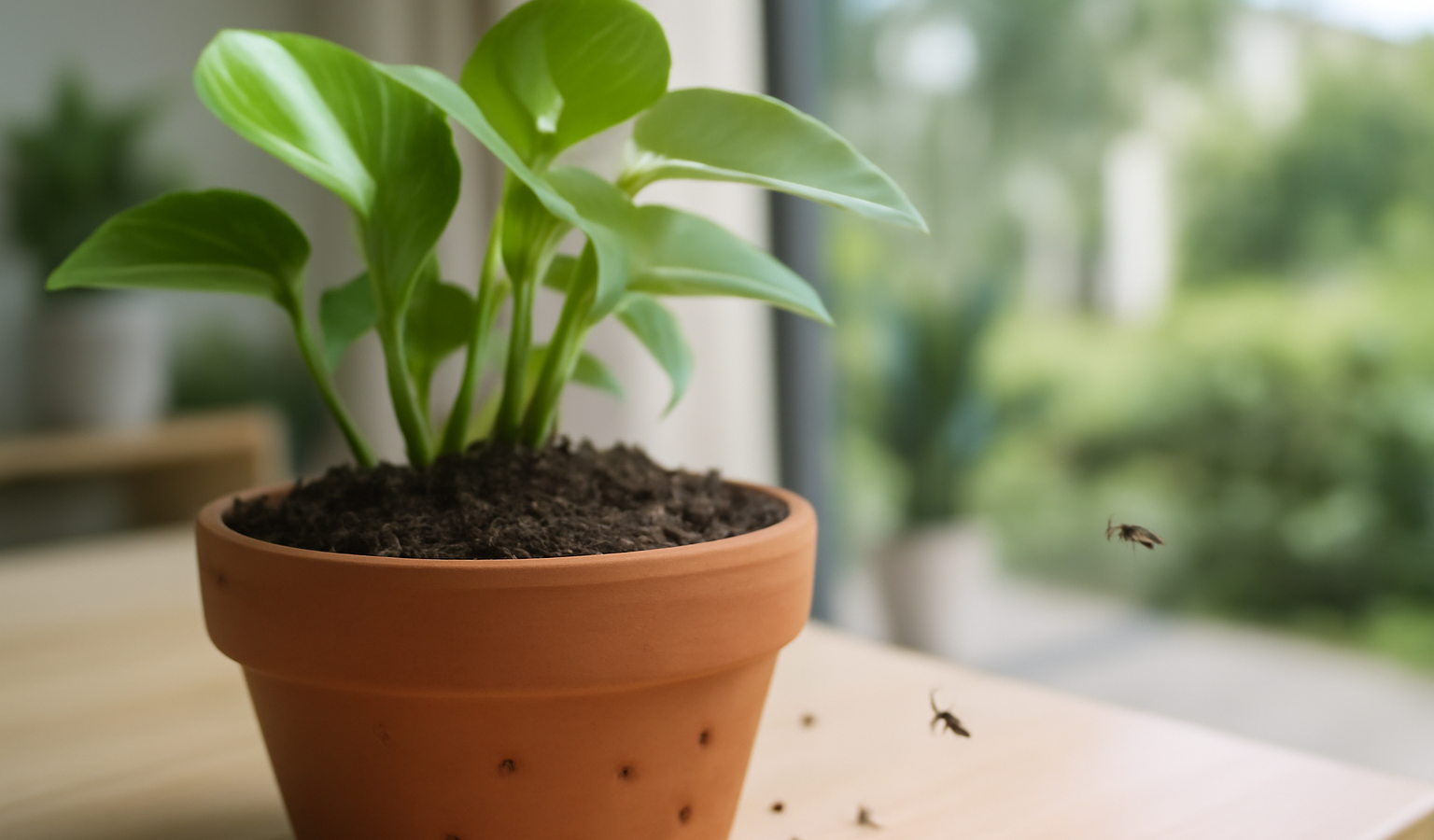
Those tiny black flies drifting up from your houseplants whenever you water are fungus gnats, and they are one of the most persistent nuisances in indoor gardening. The adults you see are harmless and short-lived, but they are only the visible tip of the problem: the real damage and the real population live in the top inch of your potting soil, where larvae feed on fungus, decaying organic matter, and tender young roots. Fungus gnats thrive for one overriding reason, consistently moist soil, so they are almost always a symptom of overwatering or poorly draining mix. Killing the adults you can see does nothing if the larvae keep hatching, which is why so many people feel they can never get rid of them. This guide explains the lifecycle, then walks through a layered treatment, sticky traps, BTI, drying the soil, and repotting, that breaks the cycle for good.
Key Takeaways
- Fungus gnats breed in consistently moist potting soil; chronic infestations almost always mean overwatering or soil that holds too much water.
- The adults you see are harmless and short-lived, but the larvae in the top inch of soil feed on fungus and fine roots and keep the population going.
- The single most effective fix is to let the top inch or two of soil dry out between waterings, which kills eggs and larvae and stops new generations.
- BTI (Bacillus thuringiensis israelensis), sold as mosquito bits, kills the larvae in the soil; yellow sticky traps catch and monitor the adults.
- For bad cases, repot into fresh, fast-draining mix, removing the infested top layer, and bottom-water to keep the surface dry.
Understand the Lifecycle You Are Fighting
You cannot beat fungus gnats without understanding why they keep coming back. The complete lifecycle, from egg to egg-laying adult, runs only about three to four weeks, and a single female lays up to a couple of hundred eggs in damp soil. Those eggs hatch into tiny, translucent larvae with shiny black heads that live and feed in the top inch or two of moist potting mix, grazing on fungi, algae, and decaying organic matter, and chewing on fine feeder roots when populations are high. After roughly two weeks the larvae pupate and emerge as the adults you see swarming when you water or walk past. The adults live only about a week, but in that time they breed and lay the next batch, so the cycle is continuous and overlapping.
The crucial insight is that swatting or trapping adults addresses only one stage and one generation. As long as the soil stays moist, eggs and larvae keep maturing into new adults faster than you can kill the old ones, which is exactly why infestations feel unkillable. An effective approach has to hit multiple stages at once: trap and remove adults, kill larvae in the soil, and, most importantly, make the soil itself uninhabitable by letting it dry. That layered attack is what finally collapses the population.
Cause: Wet Soil and Overwatering
Diagnose: The root cause of nearly every chronic fungus gnat problem is soil that stays wet. Larvae need moisture and the fungus and decaying matter that flourish in damp mix; let the surface dry and they die. So if gnats keep returning no matter how many you swat, the underlying issue is almost certainly overwatering, a moisture-retentive potting mix heavy in peat or compost, pots without adequate drainage, or saucers that stay full of standing water. Tropical houseplants kept perpetually moist, plants in oversized pots that hold water, and recently repotted plants in rich new soil are the classic victims. You can confirm the link by noticing that gnats swarm worst right after watering and that the worst-affected plants are the ones you water most often.
Fix: Let the soil dry out. This is the most important single step, and on its own it will starve out most infestations over a few weeks. Allow the top one to two inches of soil to dry completely before watering again; for many houseplants you can let even more of the pot dry. Eggs and young larvae cannot survive in dry surface soil, so each dry-down cycle wipes out a generation. Empty saucers promptly so pots never sit in water, make sure every pot has drainage holes, and consider switching chronically infested plants into a faster-draining mix. Adjusting your watering habit so plants dry between drinks not only cures the gnats but is healthier for the roots, since the same wet conditions that breed gnats also cause root rot. For more on the overwatering connection, see our guide to why a pothos turns yellow.
Knock Down Adults With Yellow Sticky Traps
Diagnose: The flying adults are the most visible and annoying stage, and while killing them does not by itself end the infestation, reducing their numbers cuts down on new eggs and lets you monitor your progress. If you are seeing a handful of gnats, you have a small population; clouds of them rising at every watering means the soil is heavily infested and larvae are abundant below. Adults are weak fliers that stay near the soil surface and are strongly attracted to the color yellow, which is what makes them easy to trap.
Fix: Place yellow sticky traps right at the soil surface or just above it, either the flat cards laid on the soil or stake versions pushed into the pot. The adults land on them and stick, removing breeding females and giving you a clear count of how bad the problem is and whether it is shrinking week to week. Traps are a control and monitoring tool rather than a cure, so use them alongside drying the soil and treating the larvae. As the trap catch falls week over week, you will know the lifecycle is breaking. Replace traps when they fill up, and keep one in each affected pot until you go a couple of weeks with no new catches.
Kill the Larvae With BTI in the Soil
Diagnose: Because the larvae are the engine of the infestation, the fastest way to crash a population is to kill them in the soil where they live. If drying the soil alone is too slow, or if your plants genuinely need to stay moist and you cannot let them dry as much as the gnats would require, you need a larvicide that targets the larvae directly without harming the plant.
Fix: Use BTI, short for Bacillus thuringiensis subspecies israelensis, a naturally occurring soil bacterium sold most commonly as “mosquito bits” or “mosquito dunks.” BTI produces a protein that is lethal to fungus gnat larvae (and mosquito larvae) but harmless to people, pets, and plants. The easiest method is to steep a measured amount of mosquito bits in your watering can for a few hours to make a “gnat tea,” then water your plants with it so the BTI soaks into the top layer where the larvae feed. Repeat with each watering for three to four weeks to cover overlapping generations and the full lifecycle. You can also sprinkle the bits over the soil surface, but watering them in delivers them where the larvae are. Combined with sticky traps for the adults and a drier soil regimen, BTI usually clears even stubborn infestations within a month. A layer of dry sand or fine gravel on top of the soil is a useful complement, since it dries fast and forms a barrier that discourages egg-laying.
For Bad Infestations, Repot Into Fresh Mix
Diagnose: Sometimes a plant arrives from the store already infested, or a pot has become so loaded with larvae that traps, BTI, and drying are losing the race. If you unpot the plant and see the top layer crawling with tiny larvae, or if the infestation simply will not relent after weeks of treatment, the soil itself is the problem and replacing it gives you a clean reset. Newly purchased plants are a common source, so it is worth inspecting and even isolating new arrivals before they seed your whole collection.
Fix: Repot into fresh, fast-draining potting mix. Remove the plant, shake or gently wash off as much of the old, infested soil as you reasonably can, especially the contaminated top few inches, and replant in clean mix amended with perlite or coarse material for sharp drainage. Choose a pot that is not wildly oversized, since excess soil holds excess water. After repotting, water carefully and adopt bottom-watering, setting the pot in a tray of water so it wicks up from below, which keeps the surface layer dry and unattractive to egg-laying females. Topping the fresh soil with sand or fine grit reinforces the dry barrier. Quarantine new plants for a couple of weeks and check them with a sticky trap before adding them to the group, so you stop reinfestation at the door. Find more indoor plant troubleshooting in the Plants & Flowers hub.
A Combined Routine That Ends the Cycle
Fungus gnats persist because most people attack only the part they can see. The reliable cure is to hit every stage at once and then change the conditions that invited them. Start by letting the top inch or two of soil dry fully between waterings, which is the foundation that starves out larvae and eggs. Add yellow sticky traps at soil level to remove breeding adults and track your progress. Water with BTI “gnat tea” at each watering for three to four weeks to kill larvae through the full overlapping lifecycle. For severe or imported infestations, repot into fresh, fast-draining mix, remove the contaminated top layer, and switch to bottom-watering with a dry sand or grit topping.
Keep it up for a full month rather than stopping the moment the swarms thin out, because lingering eggs can restart everything if you quit early. Then make the changes permanent: water only when the soil has dried, use pots with drainage and a free-draining mix, never leave saucers full, and quarantine and inspect every new plant before it joins the collection. The same drier, better-drained conditions that defeat fungus gnats also protect your plants from root rot, so this routine pays off twice. Treat moisture management as the real cure and the flies as a symptom, and your houseplants will stay gnat-free for good.
Frequently Asked Questions
Are fungus gnats harmful to my houseplants?
The adults are harmless nuisances, but the larvae feed on fungus, decaying matter, and fine feeder roots in the soil. Light infestations rarely hurt established plants, yet heavy populations can damage seedlings and young roots, and the wet soil that breeds them also risks root rot.
What is the fastest way to get rid of fungus gnats?
Attack all stages at once: let the top inch or two of soil dry out, set yellow sticky traps to catch adults, and water with BTI mosquito bits to kill the larvae. Keep it up for three to four weeks to cover the full lifecycle, and the population collapses.
Does letting the soil dry out really kill fungus gnats?
Yes, it is the single most effective step. Eggs and larvae need consistently moist soil to survive, so allowing the top one to two inches to dry completely between waterings wipes out each generation and makes the soil uninhabitable for new ones.
What is BTI and is it safe?
BTI is Bacillus thuringiensis israelensis, a natural soil bacterium sold as mosquito bits or dunks. It kills fungus gnat and mosquito larvae but is harmless to people, pets, and plants. Steep the bits in your watering can and water it into the soil for a few weeks.
Why do my houseplants keep getting fungus gnats no matter what I do?
Because the soil stays too wet and you are only killing the adults you can see. As long as the surface is moist, larvae keep hatching. Fix the watering, let the soil dry between drinks, treat the larvae with BTI, and quarantine new plants, which often bring gnats in.