

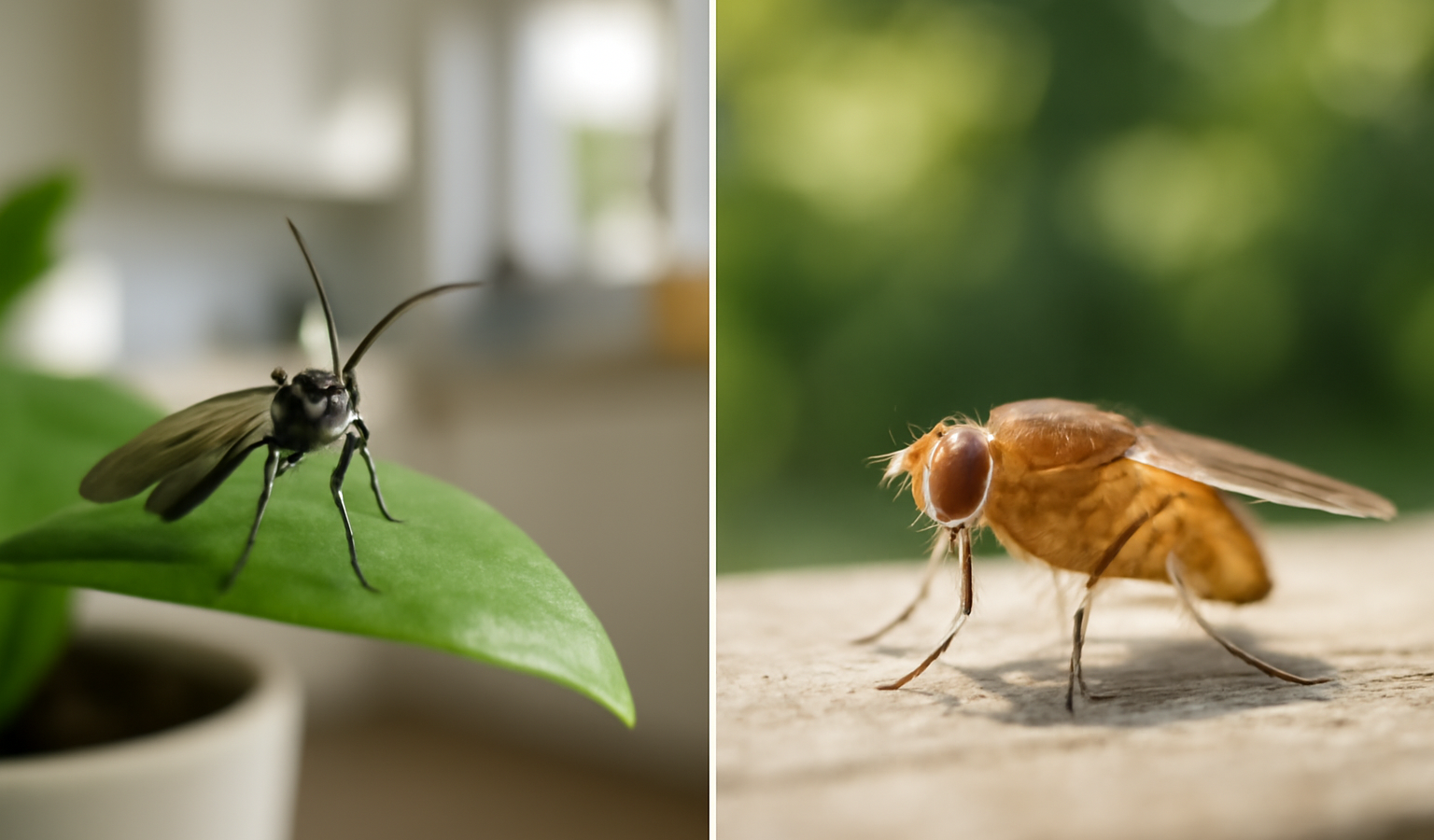
You keep swatting at little flying bugs in the kitchen or around your houseplants, and the first question is always the same: are these fungus gnats or fruit flies? They look almost identical at a glance — both are tiny, annoying, and seem to multiply overnight — but they are different insects with different homes, and the fix depends entirely on which one you have. Fungus gnats are dark, delicate, mosquito-like flies whose larvae live in damp potting soil and feed on fungi and organic matter; they hover and weave around your houseplants and run across the soil surface. Fruit flies are rounder, tan-to-brown flies with (often) red eyes that breed in fermenting fruit, spilled juice, and gunky drains; they hover around the fruit bowl, the recycling bin, and the sink. Treating a fungus-gnat problem with a fruit-fly trap (or vice versa) gets you nowhere, because you have to eliminate the breeding site. This guide shows you how to tell them apart fast and how to wipe out each one at the source.
Key Takeaways
- Fungus gnats are dark, slender, mosquito-like flies that hover around houseplant soil; their larvae live in damp potting mix.
- Fruit flies are rounder, tan-brown, often red-eyed flies that swarm ripe fruit, spills, and drains.
- Location is the fastest tell: bugs at the plant pots = gnats; bugs at the fruit bowl, trash, or sink = fruit flies.
- Kill fungus gnats by letting the top soil dry out, using yellow sticky traps, and treating soil with BTI.
- Kill fruit flies by removing breeding sources (fruit, spills, drains) and setting an apple-cider-vinegar trap.
| Feature | Fungus Gnats | Fruit Flies |
|---|---|---|
| Body shape | Slender, delicate, mosquito-like | Rounder, stouter, more “fly-like” |
| Color & eyes | Dark gray to black; small eyes | Tan to brown; often bright red eyes |
| Flight style | Weak, erratic; runs over soil | Quick, hovering around food |
| Where you see them | Around houseplant pots and soil | Around ripe fruit, drains, trash, sink |
| Breeding site | Moist potting soil (larvae in soil) | Fermenting fruit, spills, drains |
| Larvae | Tiny clear worms with black heads in soil | Maggots in rotting produce/organic film |
| Main fix | Dry out soil, sticky traps, BTI | Remove food sources, vinegar trap, clean drains |
Fungus gnats
Fungus gnats are small (about 1/8 inch), dark gray-to-black flies with long legs, slender bodies, and a faintly mosquito-like silhouette. They are weak, fluttery fliers that tend to stay close to plants — you’ll see them rising in a little cloud when you water, weaving around the foliage, and crawling across the surface of the potting mix. The adults are mostly a nuisance and don’t bite or damage plants directly. The real trouble is the larvae: tiny translucent worms with shiny black heads that live in the top inch or two of moist potting soil, feeding on fungi, algae, and decaying organic matter, and in heavy infestations nibbling on tender roots and seedlings. Their entire life cycle revolves around consistently damp soil rich in organic matter, which is why overwatered houseplants and peat-heavy potting mixes are gnat factories.
How to identify fungus gnats
The location and behavior are the giveaways. If the flies hover around your plant pots, scatter when you disturb the leaves, and run across the soil rather than zooming toward your fruit bowl, they’re fungus gnats. Confirm it by checking the soil: poke a yellow sticky trap into the pot or lay a slice of raw potato flat on the soil for a few days, then lift it to look for the small clear, black-headed larvae feeding underneath. Soggy, persistently wet topsoil with a greenish algal or fungal film is the classic habitat. Gnats most often arrive in a fresh bag of potting mix or on a newly bought plant, then bloom whenever the soil stays too wet. Overwatering is almost always the underlying cause, so if you’re battling gnats it’s worth revisiting your watering habits and checking whether your plant’s symptoms — like yellowing or wilting — point to a chronically wet, struggling plant.
How to get rid of fungus gnats
Attack the larvae in the soil, not just the adults. The single most effective step is to let the top 1–2 inches of soil dry out completely between waterings — gnat eggs and larvae can’t survive in dry topsoil, and this alone breaks the cycle for most light infestations. Water from the bottom for a while so the surface stays dry. Add yellow sticky traps at soil level to capture egg-laying adults and monitor your progress. For stubborn cases, treat the soil with BTI (Bacillus thuringiensis subsp. israelensis, sold as mosquito bits or dunks) by steeping it in your watering can or sprinkling granules on the surface — the bacteria specifically kill gnat larvae without harming the plant or you. A thin top-dressing of coarse sand or fine gravel also blocks adults from laying eggs in the mix. Repot chronically infested plants into fresh, fast-draining mix and ditch the soggy old soil. Most importantly, fix the overwatering that started it.
Fruit flies
Fruit flies (most commonly Drosophila) are also tiny — around 1/8 inch — but they’re built differently: rounder, stouter, and more obviously “fly-shaped,” in shades of tan, yellow-brown, or brown, frequently with distinctive bright red eyes. They are stronger, quicker fliers than gnats and they zero in on food, not plants. Their world is fermentation: overripe bananas and tomatoes on the counter, a forgotten onion or potato, a splash of wine or juice, the sticky film inside a recycling bin, the residue in a kitchen drain, and the bottom of the trash can. Females lay eggs on or near rotting produce and the maggots develop in that fermenting material, racing through a full generation in about a week, which is why a single overripe peach can spawn a swarm seemingly overnight.
How to identify fruit flies
Follow them to their hangout. If the flies swarm the fruit bowl, sink, drain, trash, or recycling rather than your plants, and you can see reddish eyes on a rounder, tan body, they’re fruit flies. They hover in tight clusters over ripe or fermenting food and dart away quickly when you wave at them. A telltale sign is that they appear right after you bring home a bag of soft fruit or when produce starts to turn. If you suspect a drain, tape a clear plastic bag or a piece of tape (sticky side down) over the drain opening overnight; if flies are breeding down there, you’ll catch some emerging in the morning. Unlike fungus gnats, fruit flies have essentially nothing to do with your potting soil.
How to get rid of fruit flies
The cure is sanitation first, traps second. Remove every breeding source: throw out or refrigerate overripe fruit, wipe up spills, take out the trash and recycling, rinse bottles and cans before they go in the bin, and keep the compost pail emptied and sealed. Clean the drains, since a film of organic gunk inside the pipe is a classic hidden nursery — scrub with a brush and flush with boiling water or an enzyme drain cleaner (avoid relying on bleach alone, which doesn’t remove the film the larvae feed on). Then set an apple-cider-vinegar trap: a small bowl or jar with an inch of cider vinegar, a drop of dish soap to break the surface tension, covered with plastic wrap punched with a few small holes. The flies are drawn in by the fermentation smell, dive in, and can’t escape. With the food sources gone and traps working, a fruit-fly outbreak usually clears in a week or two as the short-lived adults die off and no new generation can develop.
Prevention for both
The throughline is the same: deny them a damp, decaying place to breed. For fungus gnats, that means watering only when the topsoil has dried, using well-draining potting mix, emptying saucers so pots never sit in water, and quarantining new plants for a couple of weeks. Good watering discipline prevents the soggy soil gnats need and also keeps your plants healthier overall. For fruit flies, it means storing ripe produce in the fridge, cleaning up spills immediately, keeping drains and bins free of organic buildup, and not letting fruit sit out past its prime. Because both insects can hitchhike in — gnats in potting mix, fruit flies on store-bought produce — a little vigilance at the door (inspecting new plants, washing fruit, refrigerating quickly) heads off most infestations before they start. If your watering routine has been heavy-handed, dialing it back fixes far more than just the gnats; see our notes on diagnosing struggling, overwatered plants like the wrinkled jade plant.
The verdict: which one do you have?
Let location decide it for you. If the bugs hang around your houseplant pots, run across the soil, and rise in a cloud when you water, they’re fungus gnats — fix it by drying out the topsoil, adding yellow sticky traps, and treating with BTI. If they swarm your fruit bowl, sink, drain, or trash and have rounder tan bodies with red eyes, they’re fruit flies — fix it by removing the rotting food and grime, cleaning the drains, and setting a cider-vinegar trap. Body shape (slender mosquito-like vs. round red-eyed), behavior, and especially where they congregate will tell you instantly which one you’re dealing with. Nail the ID, eliminate the right breeding site, and the swarm disappears within a week or two.
Frequently Asked Questions
What’s the quickest way to tell fungus gnats from fruit flies?
Look at where they gather. Fungus gnats hover around houseplant pots and run across the soil; they’re slender and dark like tiny mosquitoes. Fruit flies swarm ripe fruit, drains, and trash; they’re rounder and tan-brown, often with bright red eyes.
Will a fruit-fly vinegar trap kill fungus gnats?
Not well. Fungus gnats are weakly attracted to vinegar but breed in soil, so the trap won’t stop them. Yellow sticky traps at soil level catch the adults, and you must dry out the topsoil and treat with BTI to kill the larvae and end the cycle.
Why do I keep getting fungus gnats?
Almost always overwatering. Persistently damp potting soil is exactly what gnat larvae need. Let the top inch or two of soil dry completely between waterings, improve drainage, empty saucers, and the gnats lose their nursery. New bags of peat-heavy mix can also bring them in.
Where do fruit flies come from if I have no fruit out?
Check hidden breeding sites: the film inside kitchen drains, residue in the recycling or trash bin, a splash of juice or wine, a damp sponge, or a stray onion or potato. Tape over a suspect drain overnight to test, then clean the pipe and remove any decaying organic matter.
How long does it take to get rid of either pest?
Both clear in about one to two weeks once you remove the breeding site. Adults are short-lived, so with no new larvae developing — dry soil for gnats, no fermenting food for fruit flies — the swarm dies off. Traps speed things up by catching the remaining adults.