

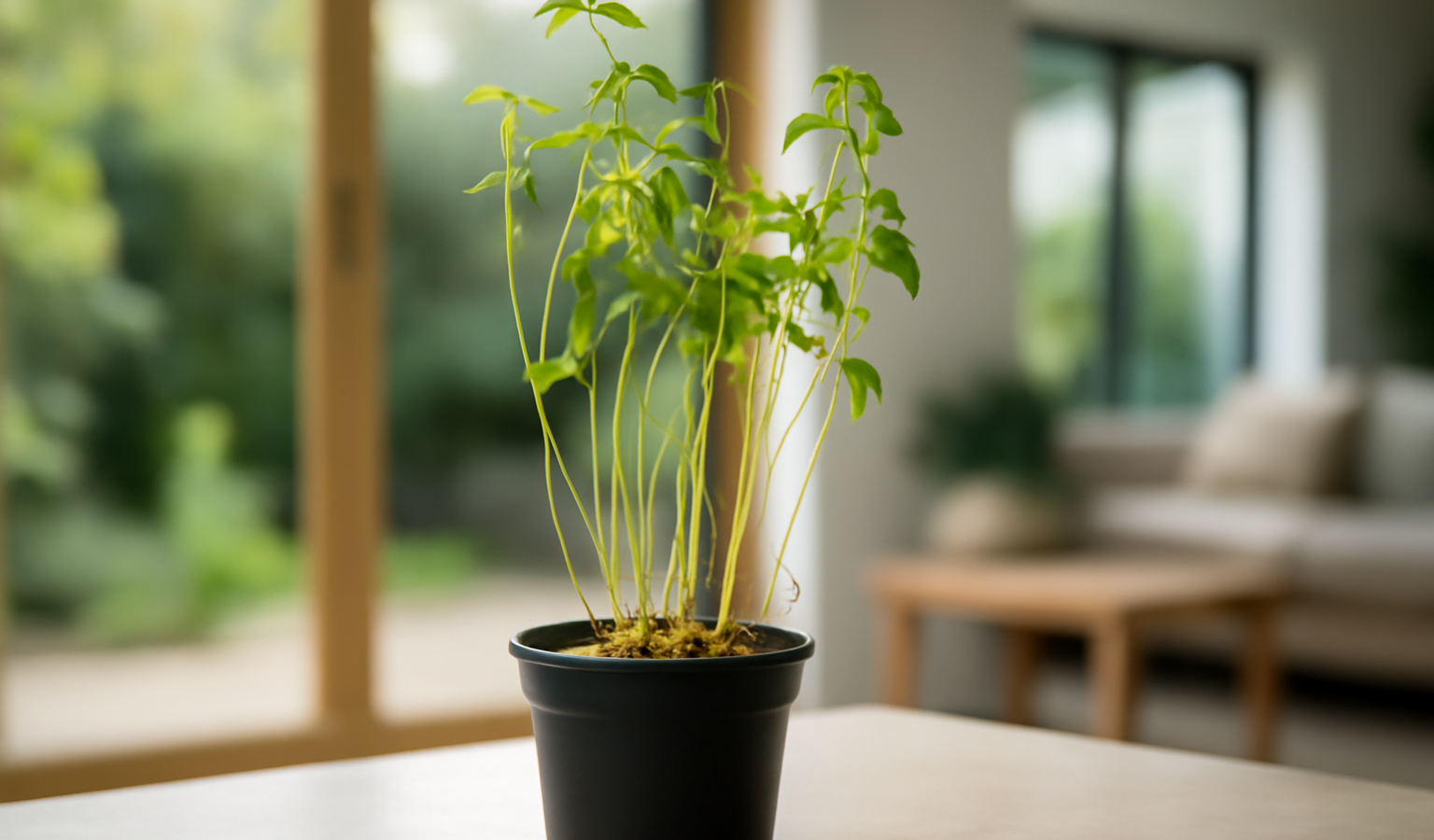
Your herbs are leggy because they are not getting enough light. That is the answer nine times out of ten. When a basil, cilantro, or oregano plant has long, bare stems with leaves spaced far apart and a thin floppy structure that leans toward the window, it is “etiolating” — stretching to reach a light source that is too weak or too far away. The plant burns energy growing taller instead of fuller because, from its point of view, it is buried in shade and needs to climb out. Pinching neglect, overcrowding, and overfeeding can make it worse, but light is almost always the root cause. The good news is that legginess is fixable, and once you understand what the plant is responding to, you can prevent it entirely on your next batch.
Key Takeaways
- Legginess is almost always a light problem — most culinary herbs need 6+ hours of direct sun or a strong grow light running 14–16 hours a day for seedlings.
- A bright windowsill that “seems sunny” often delivers far less usable light than you think; a north-facing window is rarely enough.
- Keep LED grow lights 6–12 inches above seedlings; too far and they stretch, too close and you risk scorch.
- Pinch herbs like basil, mint, and oregano above a leaf node once they have 3–4 sets of true leaves to force bushy branching.
- Overcrowding and too much nitrogen produce soft, floppy, stretched growth — thin your seedlings and ease off the feed.
- Already-leggy herbs can be rescued: pinch back hard, bury stretched stems deeper where the plant allows, and fix the light.
Cause 1: Not enough light (the primary culprit)
Most culinary herbs are full-sun plants. Basil, oregano, thyme, rosemary, sage, and dill all evolved in bright Mediterranean conditions and want six or more hours of direct sunlight a day. When they get a fraction of that, they respond by stretching. The biology is simple: a plant in shade detects that it is being out-competed and pours its resources into vertical growth, hoping to break into the light above. The result is a tall, spindly stem with long gaps between leaf pairs — the classic leggy look. The plant is not unhealthy in the way a diseased plant is; it is doing exactly what it is programmed to do in low light.
How to diagnose it
Look at the stem between leaf pairs. On a healthy, well-lit herb those gaps (the internodes) are short and the plant looks compact and dense. On a light-starved herb the internodes are long and the stem is pale and thin. The next tell is direction: leggy herbs lean and bend toward the brightest part of the room, usually a window. If you rotate the pot and the plant re-aims itself within a day or two, it is hunting for light. Finally, judge the window honestly. A north-facing window gets no direct sun at all. An east or west window gets a few hours. Only a large, unobstructed south-facing window comes close to what these plants want, and even then winter light is weak.
If you want a number, our eyes are terrible light meters because they adjust automatically. A spot that feels “bright” to you might be 500–1,000 foot-candles, while full outdoor sun is 5,000–10,000 foot-candles. Herbs really want a few thousand foot-candles for sustained hours. A cheap lux meter or a phone light-meter app will quickly show you how dim that “sunny” windowsill actually is.
How to fix it
Move the herb to the brightest window you have, ideally south-facing, and put it right up against the glass rather than a foot back on a counter — light intensity drops off fast with distance. If your home simply does not have a bright enough window, which is the reality for most indoor growers, add a grow light. That is not an admission of defeat; it is the single most reliable fix for leggy herbs and removes the seasonal and weather guesswork entirely. We cover the grow-light specifics next, because “I have a grow light” and “my grow light is set up correctly” are two very different things.
Cause 2: Grow light too far away or running too few hours
Plenty of people add a grow light and still get leggy herbs. The light is there, but it is hung too high, left on for too few hours, or both. A grow light a foot and a half above the canopy delivers a small fraction of the intensity it would at six inches, so the plant treats it as a distant sun and keeps stretching toward it. This is the most common mistake after having no supplemental light at all.
How to diagnose it
Two questions sort this out. First, how far is the light from the top of the plants? Measure it. If a standard LED grow light is more than about 12 inches above seedlings, that is likely your problem. Second, how many hours is it on? If you flip it on when you wake up and off when you go to bed, that might only be 10–12 hours, and seedlings want more. If the plants are leaning toward one edge of the fixture, the light is too small for the footprint or positioned off-center.
How to fix it
For most LED grow lights, keep the fixture 6–12 inches above seedling herbs. Start around 8–10 inches and watch the plants: if new growth stays compact, you are in the right zone; if it stretches, lower the light an inch or two. If leaves look bleached or crispy at the tips, raise it. Run the light on a timer for 14–16 hours a day while herbs are young seedlings, then you can ease back toward 12–14 hours as they mature. A cheap outlet timer removes the guesswork and keeps the photoperiod consistent, which matters more than people expect — erratic light schedules produce erratic growth. As plants grow taller, raise the light to maintain that 6–12 inch gap rather than letting them grow into it.
If your seedlings are stretching the moment they emerge, light timing is critical: the gap between germination and turning on strong light is where most legginess is born. Seedlings that pop up in a dim spot can stretch into useless threads within 48 hours. For a related seedling problem worth recognizing early, see our guide on why seedlings turn white, which often shows up alongside light issues.
Cause 3: No pinching or pruning
Some herbs grow leggy not because of light but because they were never pinched. Basil, mint, oregano, marjoram, and many other soft-stemmed herbs are naturally apically dominant — left alone, they put most of their energy into the single growing tip at the top and shoot straight up. Pinching breaks that dominance and forces the plant to push out side shoots from lower leaf nodes, which is what makes a herb bushy instead of pole-like. A basil plant that is never pinched will reward you with one tall stalk and an early flower spike; a pinched one becomes a dense, productive bush.
How to diagnose it
If the light is genuinely good — the plant is compact at the base, leaves are a healthy green, internodes are short low down — but it is still growing tall and single-stemmed up top, you have a pruning issue, not a light issue. Another clue is age: if the herb has more than three or four sets of true leaves and you have never cut it, it is overdue for a pinch. Flower buds forming at the tip of basil or mint are a clear sign the plant has decided to bolt upward and reproduce rather than bush out.
How to fix it
Pinch above a leaf node. Find a point where two leaves emerge from the stem and look for the tiny new shoots tucked in those leaf joints. Pinch or snip the main stem just above that pair of leaves, removing the top growth. Within a week or two those two dormant shoots will activate and grow into two new stems, doubling your branching at that point. Repeat as the plant grows and you build a compact, many-stemmed bush. Start once the herb has three to four sets of true leaves and keep doing it — pinching is not a one-time event, it is ongoing maintenance that doubles as your harvest. Always pinch any flower buds off basil and mint the moment you see them, since flowering signals the plant to stop producing tasty leaves.
Cause 4: Overcrowding
If you sowed a pinch of seed per cell or scattered seed thickly in a pot, your herbs are competing with each other for light, root space, and air. Crowded seedlings shade one another, and each one stretches upward trying to get above its neighbors. The result is a dense thicket of thin, weak, leggy stems that all flop over together. This is extremely common with basil and cilantro, which people tend to over-sow because the seeds are cheap and germination feels reassuring.
How to diagnose it
Count the stems in each pot or cell. If you see a tight cluster of many thin seedlings jammed together, that is overcrowding. Compare a crowded clump to a single isolated seedling grown in the same conditions — the lone one will almost always be stockier. Crowded seedlings also dry out fast and yellow at the base from poor airflow and competition.
How to fix it
Thin them. It feels brutal to sacrifice healthy-looking seedlings, but a few strong plants will out-produce a crowded mat every time. Snip the weakest seedlings off at soil level with scissors rather than pulling, which avoids disturbing the roots of the ones you keep. Aim for one strong seedling per small cell, or space them a couple of inches apart in a larger pot. Basil is a useful exception worth knowing: you can deliberately grow a few seedlings as a small clump and treat them as one plant, but even then you want a manageable group, not a dense forest. Good spacing also improves airflow, which lowers the risk of the damp, stagnant conditions that invite mold and fungal problems — the same logic that causes microgreens to mold when sown too thickly.
Cause 5: Too much nitrogen or overfeeding
Fertilizer feels like the obvious way to fix a struggling plant, but with herbs it often backfires. High-nitrogen feeding pushes fast, soft, watery growth — long stems and big floppy leaves that cannot support themselves, especially when light is also marginal. The plant grows quickly but flimsily, and you end up with a tall, weak, leggy herb that tastes blander too, since rushed growth dilutes the essential oils that give herbs their flavor.
How to diagnose it
Think about your feeding habits. If you have been giving herbs a regular dose of a strong, nitrogen-heavy fertilizer, or potted them in a very rich potting mix loaded with feed, overfeeding is a likely contributor. Lush, oversized, dark-green leaves on long weak stems point to too much nitrogen rather than too little light. Herbs are generally light feeders and many — thyme, rosemary, oregano — actually prefer lean conditions and produce more intense flavor when slightly underfed.
How to fix it
Back off the fertilizer. For most culinary herbs, a diluted balanced feed every few weeks during active growth is plenty, and Mediterranean herbs need even less. If you suspect a buildup of feed in the soil, flush the pot by watering thoroughly until water runs freely from the drainage holes a few times. Let the plant grow on lean rations and pair that with strong light, and new growth will come in tighter and sturdier. Remember that no amount of fertilizer fixes a light problem — feeding a shaded herb just makes it stretch faster.
Cause 6: High heat with low light
Warmth speeds up growth, but warmth without matching light is a recipe for legginess. A seedling tray on a heat mat, or herbs near a warm radiator or a hot kitchen window, will grow fast — and if the light cannot keep pace, all that growth goes into stretching. The plant has the energy and the temperature to grow quickly but not the light to grow compactly, so it lengthens.
How to diagnose it
This shows up most with seedlings started on heat mats. If germination was fast and vigorous but the seedlings shot up thin and pale almost immediately, the heat-without-light combination is likely. Check whether the warm spot is also a bright spot — often it is not, because radiators and the tops of appliances sit in dim corners.
How to fix it
Take seedlings off the heat mat as soon as they germinate — the mat’s job is to speed germination, not to grow the plant. Move young herbs somewhere cooler and brighter, and make sure your grow light is on and close. Slightly cooler temperatures with strong light produce stockier, tougher growth than warm temperatures with weak light. Matching heat to light is the goal; whenever one outpaces the other, growth quality suffers.
How to rescue herbs that are already leggy
You do not have to start over. Most leggy herbs can be salvaged with three moves. First, fix the light immediately — that step is non-negotiable, because anything you do next will just leggy-out again under the same dim conditions. Get the plant under strong light or in your brightest window before you do anything else.
Second, pinch back hard. Cut the stretched growth back to a lower pair of leaves or a node where you can see side shoots. It feels drastic to remove half the plant, but those lower nodes will branch out into compact new growth under good light, and the herb will come back fuller than before. Soft-stemmed herbs like basil and mint respond especially well to a hard pinch.
Third, for the right plants, bury the leggy stem deeper. Basil and other herbs in the same broad family as tomatoes can root along a buried stem, so when you transplant a stretched seedling you can sink it deeper into the soil up to its lowest healthy leaves, which both stabilizes the floppy stem and encourages new roots. This trick does not work for every herb — woody Mediterranean types like rosemary and thyme will rot if buried deep — so use it for soft-stemmed seedlings, not woody ones. For those, support the stem and rely on hard pinching and better light instead. This same “bury it deeper” logic is why leggy tomato seedlings are so forgiving, a topic we cover in our guide to why a tomato plant is not growing.
Preventing leggy herbs next time
Prevention is mostly about getting light right from day one. Start seeds under a grow light, not on a dim windowsill, and have the light on and close before the seedlings even emerge so there is no dark stretching window. Run that light 14–16 hours a day on a timer, kept 6–12 inches above the canopy, and raise it as the plants grow. Sow thinly and thin early so each plant has room and light. Begin pinching once herbs have three to four sets of true leaves and keep at it. Feed lightly, and do not let heat outrun light. Do those few things and legginess simply stops being a problem — you will grow compact, bushy, productive herbs as the default rather than the exception.
If you are building out an indoor or container herb setup, it is worth browsing our broader plants and flowers guides for companion topics on lighting, watering, and troubleshooting common seedling issues. Getting the fundamentals right once pays off across every plant you grow.
Frequently Asked Questions
Can leggy herbs recover or should I throw them out?
They can almost always recover. Fix the light first, then pinch the stretched growth back to a lower pair of leaves or a node with visible side shoots. The plant will branch out and fill in compact, healthy growth from those points. Don’t throw out a leggy herb until you’ve given it strong light and a hard pinch — most bounce back within a couple of weeks.
How much light do herbs actually need to stay compact?
Most culinary herbs want 6 or more hours of direct sun, or a strong grow light running 14–16 hours a day for seedlings. A bright-feeling windowsill is usually far dimmer than it looks — full outdoor sun is many times more intense than indoor “bright” light. If you don’t have a large unobstructed south-facing window, a grow light is the most reliable way to prevent legginess.
How far should my grow light be from herb seedlings?
For most LED grow lights, keep the fixture 6–12 inches above the seedlings. Start around 8–10 inches and watch the response: if growth stays compact you’re set, if it stretches lower the light, and if leaf tips bleach or crisp, raise it. Raise the light as the plants grow to maintain that gap rather than letting them grow into the fixture.
When and how do I pinch herbs to make them bushy?
Start once the herb has three to four sets of true leaves. Find a point where two leaves meet the stem with tiny shoots tucked in the joints, and pinch or snip the main stem just above that leaf pair. Those two shoots will grow into new stems, doubling the branching. Repeat as the plant grows, and remove any flower buds on basil or mint immediately.
Why are my herbs leggy even with plenty of fertilizer?
Fertilizer doesn’t fix legginess — it often makes it worse. High-nitrogen feeding pushes soft, fast, floppy growth, especially in marginal light, so you get tall weak stems. Herbs are light feeders; a diluted balanced feed every few weeks is plenty, and Mediterranean herbs want even less. The real fix is strong light, not more food. Feeding a shaded herb just makes it stretch faster.