

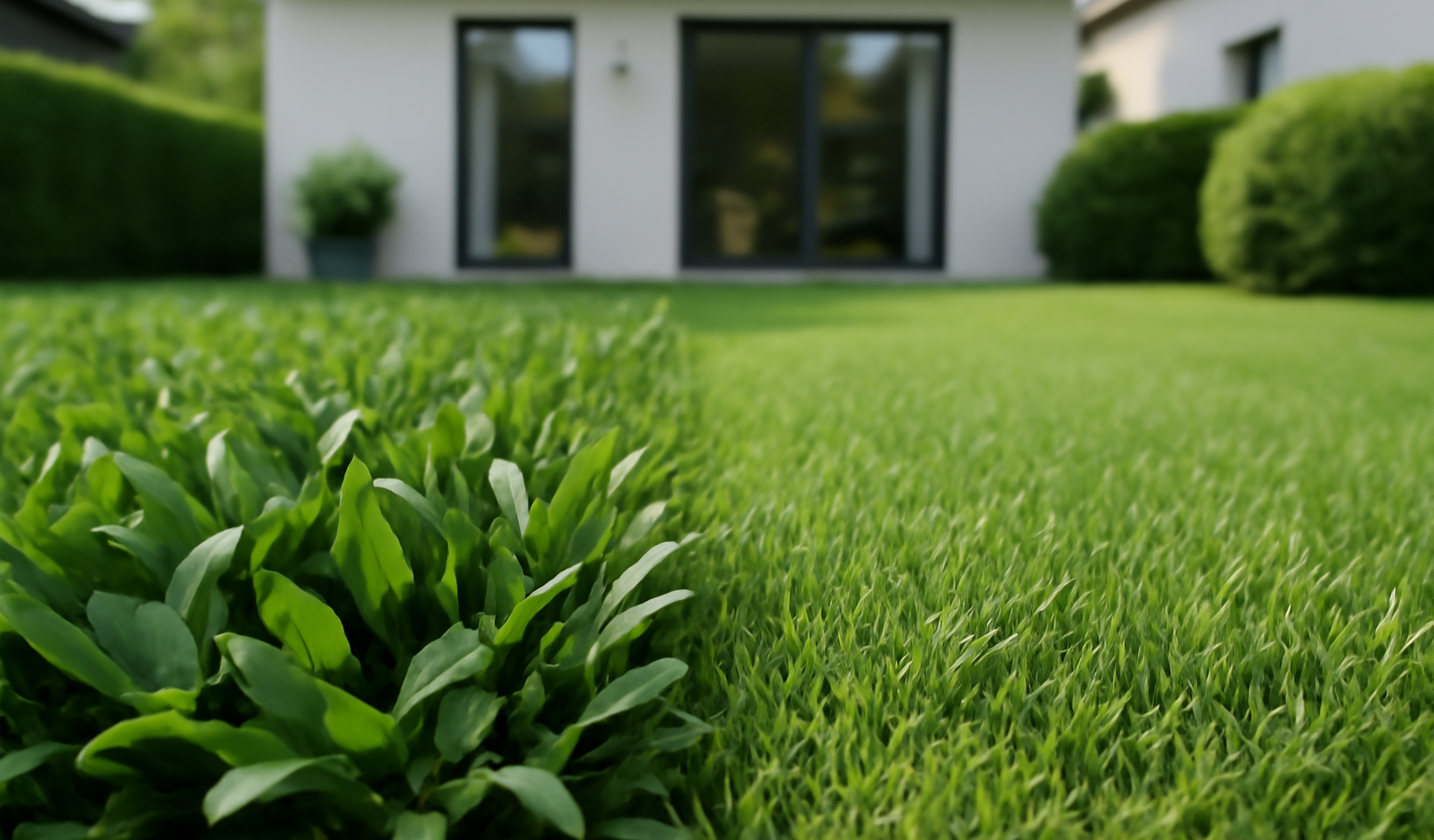
In the deep south and along the Gulf Coast, the lawn debate almost always comes down to St. Augustine versus Bermuda. Both are warm-season grasses built for heat and humidity, but they could hardly be more different in habit and use. St. Augustine is the broad-bladed, shade-tolerant grass that makes the lush, coarse-textured lawns you see under live oaks in Florida, Texas, and the coastal south. Bermuda is the fine-bladed, sun-hungry runner that takes heavy traffic and recovers fast. The right pick depends almost entirely on your shade, your soil, and how the lawn gets used.
Get it wrong and you will be frustrated: plant Bermuda under trees and it thins to dirt, or plant St. Augustine on a busy soccer-field of a backyard and it wears out faster than it can recover. This guide compares the two across the factors that decide the outcome, then gives a clear verdict for your situation.
Key Takeaways
- Both are warm-season grasses for hot climates that go dormant brown in winter.
- St. Augustine is the most shade-tolerant warm-season grass, with broad blades and a lush look, but poor traffic tolerance and no seed option (sod or plugs only).
- Bermuda needs full sun, takes heavy traffic, recovers fast, and can be grown from seed, but it has zero shade tolerance.
- St. Augustine is mowed tall (3 to 4 inches); Bermuda is mowed short (1 to 2 inches).
- For shade, choose St. Augustine. For full-sun, high-traffic yards, choose Bermuda.
| Factor | St. Augustine | Bermuda Grass |
|---|---|---|
| Type | Warm-season, stoloniferous | Warm-season, stolons + rhizomes |
| Best USDA zones | 8-10 (Gulf Coast, Florida) | 7-10 |
| Sun needs | Full sun to moderate shade (4-6 hrs) | Full sun only (6+ hrs) |
| Blade texture | Broad, coarse | Fine |
| Mowing height | 3 to 4 inches | 1 to 2 inches |
| Water per week | 1 to 1.25 inches | 0.5 to 1 inch |
| Drought tolerance | Moderate | Excellent |
| Traffic tolerance | Poor to moderate | Excellent |
| Establishment | Sod or plugs (no seed) | Seed, sod, or sprigs |
| Cold tolerance | Low | Moderate |
St. Augustine: The Shade-Tolerant Southern Lawn
St. Augustine grass (Stenotaphrum secundatum) is the signature lawn of the humid Gulf Coast and Florida. It is a stoloniferous grass, spreading only by above-ground runners (no rhizomes), and it produces a thick, coarse-bladed turf with a distinctive blue-green color. Popular cultivars include Floratam, Palmetto, and the more cold- and shade-tolerant Raleigh. Its standout trait is shade tolerance, the best of any common warm-season grass, holding up under just 4 to 6 hours of sun, which is why it dominates yards shaded by southern live oaks and pines.
Zones and climate limits
St. Augustine is best suited to USDA zones 8 through 10. It has low cold tolerance and can be damaged or killed by hard freezes, which is why it is largely absent north of the Gulf states. It also loves moisture and humidity; in the dry southwest it struggles unless irrigated generously, needing roughly 1 to 1.25 inches of water per week to stay healthy.
Establishment and maintenance
There is no practical seed for St. Augustine, so you install it from sod or plugs, which makes it more expensive to start than Bermuda. Once down, it spreads at a moderate pace by runners. Mow it tall, 3 to 4 inches, to keep it dense and shade-resilient. Its main weaknesses are pest and disease pressure: chinch bugs and the fungal disease “gray leaf spot” and “take-all root rot” are recurring problems, and it builds thatch readily. It also bruises easily and recovers slowly, so it is poor for high-traffic play areas.
Bermuda Grass: The Sun-and-Traffic Champion
Bermuda grass (Cynodon dactylon) is the opposite of St. Augustine in almost every way. It has fine blades, spreads aggressively by both stolons and rhizomes, and forms a tight, durable turf that recovers from wear faster than any other lawn grass. That makes it the standard for sports fields and busy family yards across the south. It is also the most affordable to establish because it grows readily from seed, as well as from sod or sprigs.
Sun, zones and drought
Bermuda thrives in USDA zones 7 through 10 and is slightly more cold tolerant than St. Augustine, surviving farther north. Its non-negotiable demand is full sun, 6 hours or more; in shade it thins, weakens, and surrenders to weeds. On the plus side, it is the most drought tolerant common lawn grass, getting by on 0.5 to 1 inch of water a week and going dormant rather than dying in extended dry spells.
Mowing and the aggression trade-off
Bermuda is mowed short, 1 to 2 inches, and grows fast in summer, so plan to mow often, even twice weekly at peak. It is a heavy feeder, wanting monthly nitrogen through the growing season. Its vigor makes it invasive: it creeps into beds and across edges and is difficult to remove once established. Both grasses go dormant brown in winter; Bermuda owners often overseed with ryegrass for winter color, an option St. Augustine does not handle as well.
Appearance and feel
The two grasses look and feel very different underfoot. St. Augustine has broad, flat blades and a coarse texture that reads as lush and tropical, with a blue-green color that many southern homeowners prize. Bermuda is fine-bladed and forms a tight, carpet-like surface that takes a low, manicured cut, the look you see on golf fairways. If you want that close-cropped, sports-turf finish, Bermuda delivers it; if you want a thick, plush, casual lawn, St. Augustine is the look. St. Augustine’s runners also sit higher and can feel spongy, while a tightly mowed Bermuda lawn feels firm and even.
Pests, Disease and Long-Term Care
St. Augustine carries a heavier pest and disease burden than Bermuda. Chinch bugs are its signature enemy, sucking sap and creating expanding dead patches in hot, sunny areas, and gray leaf spot and take-all root rot are recurring fungal threats in the humid south. It also builds thatch quickly because of its thick stolons, so it benefits from occasional dethatching. These issues mean St. Augustine lawns often need more active monitoring and treatment through the growing season.
Bermuda is comparatively tough and disease-resistant in full sun, its preferred condition, though it can suffer dollar spot and spring dead spot, and it is vulnerable to mole crickets and armyworms in the south. Its real long-term care burden is not pests but containment and mowing: keeping it out of beds and walkways and staying ahead of its fast summer growth. Both grasses build thatch and both can be overseeded, but St. Augustine handles ryegrass overseeding poorly, so its winter dormancy is harder to mask than Bermuda’s.
Water, Mowing and Day-to-Day Care
The two grasses pull your weekend in different directions. St. Augustine wants more water, around 1 to 1.25 inches a week, and resents drought, fading and thinning when it dries out, so it is best where rainfall or irrigation is generous. It is mowed tall, 3 to 4 inches, which suits its broad blades, and because it grows at a moderate pace you mow less often than Bermuda. Its higher cut also helps it shade out weeds and stay dense in partial shade.
Bermuda flips that profile. It needs less water, just 0.5 to 1 inch a week thanks to strong drought tolerance, but it is mowed short, 1 to 2 inches, and grows so fast in summer that twice-weekly mowing is common at peak. It is also a heavier feeder, wanting roughly monthly nitrogen through the growing season, where St. Augustine gets by on a lighter feeding schedule. So the trade is real: St. Augustine asks for more water and less mowing, Bermuda asks for less water and far more mowing. Match that to whether your limiting resource is water, time, or patience for yard work.
Cost and Establishment Compared
Cost is a clear divide. Bermuda is the cheaper grass to establish because it grows from inexpensive seed as well as sod and sprigs, and it fills in fast. St. Augustine has no practical seed, so you must buy sod or plugs, raising the upfront cost considerably, and plugs take time to spread. For a large area on a budget, Bermuda is the economical choice. Where St. Augustine earns its keep is in shaded yards where Bermuda simply will not grow, making the higher cost worthwhile because it is often the only warm-season grass that will succeed there.
Which Should You Choose?
This comparison is decided mostly by shade and traffic. Both demand a hot climate, so start there, then weigh how your yard is used.
Choose St. Augustine if…
- You live on the Gulf Coast, in Florida, or the humid coastal south (zones 8-10).
- Your yard has meaningful shade from trees where Bermuda fails.
- You want a lush, thick, coarse-textured lawn and have moisture to support it.
- The lawn is mostly ornamental, not a heavy play or sports surface.
Choose Bermuda if…
- Your yard is full sun all day with no significant shade.
- The lawn takes heavy foot traffic and needs to self-repair quickly.
- You want the most affordable establishment (seed) and best drought tolerance.
- You live at the cooler or drier edge of the warm-season range where St. Augustine struggles.
The simplest way to decide: if your problem is shade, St. Augustine is your grass; if your problem is wear and full-sun durability, Bermuda wins. Many southern yards actually use both, St. Augustine under the trees and Bermuda in the open, accepting the texture difference. If you want to weigh other warm-season options, see our comparison of zoysia vs Bermuda grass and fescue vs Bermuda grass. For more lawn and landscaping advice, visit our Outdoor Living hub.
Frequently Asked Questions
Which grass is more shade tolerant?
St. Augustine is far more shade tolerant, handling 4 to 6 hours of sun. Bermuda needs at least 6 hours of direct sun and thins out badly in any meaningful shade.
Can I plant St. Augustine from seed?
Not practically. St. Augustine seed is unreliable and rarely sold, so it is established from sod or plugs. Bermuda, by contrast, grows readily from seed, which makes it cheaper to start.
Which holds up better to kids and pets?
Bermuda. It tolerates heavy traffic and repairs damage fast thanks to its rhizomes. St. Augustine bruises easily and recovers slowly, so it is best for low-traffic, ornamental lawns.
Will St. Augustine survive a hard freeze?
It is the least cold tolerant of the two and can be damaged or killed by hard freezes, which limits it to zones 8 to 10. Bermuda is somewhat more cold tolerant and recovers from dormancy more reliably.
Will Bermuda invade a St. Augustine lawn?
In full sun, yes, aggressive Bermuda can creep into and overtake St. Augustine. In shaded areas the reverse happens, as Bermuda weakens and St. Augustine holds on. Sharp edging and spot control help keep them separate.