

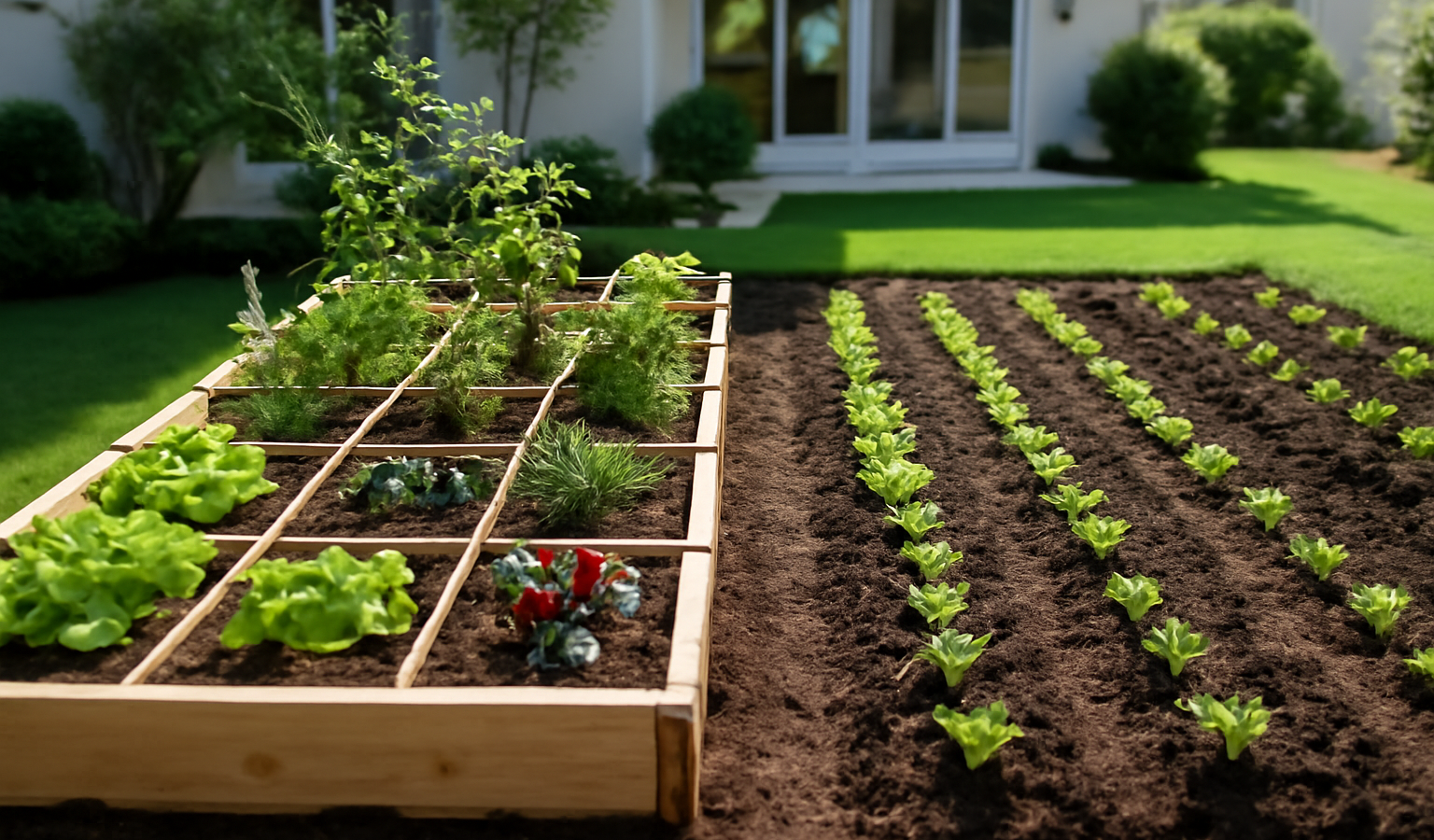
Square foot gardening and row gardening are two ways to organize the same goal — growing vegetables — and they suit very different gardeners. Square foot gardening divides a raised bed into a 1-foot grid and plants intensively within each square, packing high yields into a small footprint with little weeding and little wasted space. It is the clear winner for small yards, raised beds, and beginners who want order and big harvests from a tiny area. Row gardening plants crops in long straight rows with walking paths between, which scales effortlessly to large plots, suits machinery and sprawling crops, and costs almost nothing to lay out. If your space is small, go square foot. If you are gardening big — or growing corn, potatoes, and vining squash — rows make more sense. Plenty of gardeners blend both.
Key Takeaways
- Square foot gardening uses a 1-foot grid for intensive planting — maximum yield in minimal space, with far less weeding.
- Row gardening plants in long rows with paths between — scales to large plots and suits tools, machinery, and sprawling crops.
- Square foot wins for small yards, raised beds, and beginners; row wins for big gardens and crops that need space.
- Square foot uses less water and seed and crowds out weeds; row gardening is cheaper to start and easier to expand.
- Match the method to your space, your crops, and whether you garden by hand or with tools.
Square Foot vs Row Gardening at a Glance
| Factor | Square Foot Gardening | Row Gardening |
|---|---|---|
| Space efficiency | Very high (intensive planting) | Lower (paths between rows) |
| Yield per square foot | High | Moderate |
| Weeding | Minimal (canopy shades soil) | More (open soil between rows) |
| Water & seed use | Less | More |
| Startup cost | Higher (raised bed + grid + mix) | Very low |
| Scalability | Limited; best small to medium | Excellent for large plots |
| Tools/machinery | Hand tools only | Hoe, tiller, tractor friendly |
| Best crops | Greens, roots, herbs, compact veg | Corn, potatoes, beans, squash |
| Best for | Small space, beginners, raised beds | Large gardens, bulk harvests |
Square Foot Gardening: Maximum Harvest, Minimum Space
Square foot gardening, popularized by Mel Bartholomew, takes a raised bed — classically 4 feet by 4 feet — and divides it with a physical grid into 1-foot squares. Each square is planted with a set number of one crop based on its mature size: 1 plant per square for something large like a tomato or broccoli, 4 for leaf lettuce, 9 for bush beans or spinach, 16 for carrots or radishes. Instead of thinning out and wasting seed in long rows, you plant just what you need at the right spacing the first time.
The payoff is dramatic space efficiency. By eliminating the wide walking aisles that rows require and packing plants at optimal density, square foot gardening grows substantially more food per square foot than traditional rows. A single 4×4 bed can supply a steady stream of salad greens, herbs, and vegetables for a household. Because the plants grow close together, their foliage forms a canopy that shades the soil and crowds out weeds, so you spend far less time weeding. The dense canopy also conserves moisture, and the intensive planting means you use less water and less seed. The grid makes succession planting simple: when you harvest a square of lettuce, you replant that one square with something new.
For beginners, the structure is reassuring — you always know what to plant where and how many. It pairs naturally with raised beds, so it is the go-to method for small urban and suburban yards, balconies with large containers, and anyone short on space. If you have not yet decided on your bed style, our comparison of raised bed vs in-ground garden is the right starting point, since square foot gardening assumes a raised bed.
The Limits of the Grid
Square foot gardening costs more to start: you build a raised bed, add a grid, and fill it with a quality soil mix (the classic recipe blends compost, peat or coir, and vermiculite). It also does not scale gracefully — building enough 4×4 beds to feed a family on staples becomes expensive and space-hungry. And some crops simply do not fit the grid. Sprawling vining squash and melons, a block of corn that needs many plants for pollination, or a patch of potatoes are all awkward at best in a square foot bed. For those, rows win.
Row Gardening: Scale, Simplicity, and Sprawl
Row gardening is the traditional layout: plant crops in long straight rows with open walking paths between them. It has fed families and farms for centuries because it does two things superbly — it scales and it accommodates tools. When your garden is measured in hundreds or thousands of square feet, rows are the only practical organization. The paths let you walk, kneel, hoe, till, and even run machinery down the lines, which is exactly what large plots and bulk harvests require.
Rows also suit certain crops far better than any grid. Corn needs to be planted in blocks of multiple rows for good wind pollination. Potatoes are hilled up along their rows as they grow. Pole beans, sprawling winter squash, pumpkins, and melons all want room to run that a 1-foot square cannot give. If your goal is canning tomatoes by the bushel, freezing green beans, or storing a winter’s worth of potatoes and squash, row gardening is built for that kind of volume. And the startup cost is essentially nothing — you need no frame, no grid, and no imported soil mix, just prepared ground, seeds, and a hoe.
The Cost of All Those Paths
Row gardening’s weaknesses are the flip side of square foot’s strengths. Those walking paths are bare, unplanted soil, so a row garden produces less per total square foot and dedicates a big share of its area to aisles. That open soil between rows is also a weed nursery — sunlight hits it directly, so you weed and cultivate constantly. Wider plant spacing means you use more seed and more water to cover the same harvest. For a small yard, all that path and weeding is wasteful; for a big plot worked with tools, it is simply how efficient large-scale gardening looks.
How to Choose: Space and Crops Decide It
Choose Square Foot Gardening When…
- You have a small yard, raised beds, or limited space and want maximum yield from it.
- You are a beginner who wants clear structure and built-in spacing.
- You want to minimize weeding and watering and avoid wasting seed.
- You grow mostly greens, herbs, root crops, and compact vegetables for fresh eating.
Choose Row Gardening When…
- You have a large plot and want to grow in volume for canning, freezing, or storing.
- You grow sprawling or block crops — corn, potatoes, squash, pumpkins, melons, pole beans.
- You use tools or machinery like a hoe, wheel cultivator, or tiller.
- You want the cheapest possible startup with no bed to build.
The two are not mutually exclusive. A very common and effective setup is square foot raised beds near the house for salad greens, herbs, and the vegetables you pick daily, plus a traditional row plot out back for the space-hungry staples. You get the tidy, weed-free convenience of square foot for everyday crops and the scale of rows for bulk. To make either layout easier to maintain, pairing it with the right watering approach helps — see our guide on drip irrigation vs sprinkler.
Tips for Whichever You Choose
- Square foot: respect the spacing chart. Plant 1, 4, 9, or 16 per square by crop size, and do not overcrowd large plants — cramming reduces yield instead of raising it.
- Square foot: succession plant. Refill each square the moment you harvest it to keep production continuous all season.
- Row: orient rows north–south where possible so both sides get even sun, and space rows for whatever tool you will use between them.
- Row: mulch the paths to cut weeds and mud, turning your biggest weakness into manageable maintenance.
- Both: rotate crops each season to limit pests and disease, and feed the soil with compost annually.
The Verdict
Choose square foot gardening if your space is limited or you are just starting out: the 1-foot grid delivers remarkable yields from a small raised bed, slashes weeding and watering, wastes no seed, and gives beginners a foolproof structure. Its higher startup cost and limited scale are easy trade-offs when square footage is your constraint. Choose row gardening if you are growing big or growing sprawling, block-planted staples: rows scale to any size, welcome tools and machinery, cost almost nothing to lay out, and handle corn, potatoes, squash, and beans that a grid cannot. There is no single best method — only the one that fits your space, your crops, and how you like to work. For many gardeners, the winning move is to run both: square foot beds for fresh daily picking and rows for the bulk harvest.
Frequently Asked Questions
Is square foot gardening better than row gardening?
For small spaces and beginners, square foot gardening is usually better — it produces high yields per square foot with far less weeding and watering. For large plots and crops like corn, potatoes, and squash, row gardening is better because it scales and suits tools.
How many plants go in each square foot?
It depends on the crop’s mature size: 1 large plant like a tomato or broccoli per square, 4 for leaf lettuce, 9 for bush beans or spinach, and 16 for carrots or radishes. This optimal spacing is why square foot gardening yields so much from a small bed.
Does square foot gardening really reduce weeding?
Yes. Because plants grow close together, their foliage forms a canopy that shades the soil and crowds out weeds. Combined with a quality soil mix and a defined raised bed, square foot gardens need significantly less weeding than open rows.
What crops are not suited to square foot gardening?
Sprawling and block crops struggle in a 1-foot grid — vining squash, pumpkins, melons, a block of corn that needs many plants for pollination, and potatoes that are hilled along rows. Grow these in traditional rows instead.
Can I combine square foot and row gardening?
Absolutely. Many gardeners use square foot raised beds near the house for greens, herbs, and daily-pick vegetables, and a traditional row plot for space-hungry staples like corn, potatoes, and squash. This blend gives you both convenience and bulk harvests.