

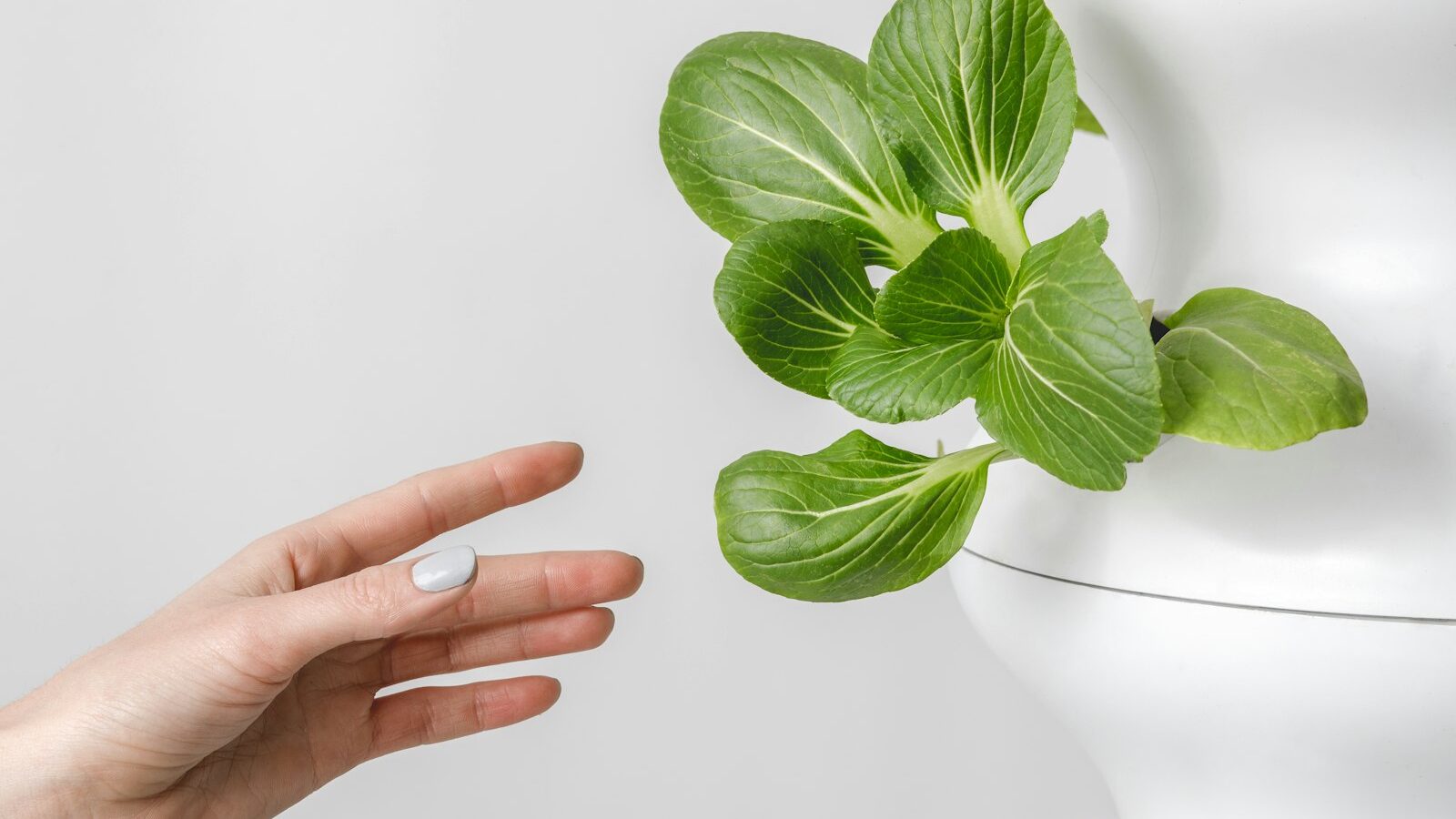
Hydroponics lets you grow fresh lettuce, basil, and leafy greens using nutrient-enriched water instead of soil, often faster and with less mess than a traditional garden. It sounds high-tech, but the beginner-friendly methods are genuinely simple, affordable, and perfect for apartments, kitchens, and small spaces. This guide breaks down what hydroponics is, the main systems, and exactly how to start growing without soil.
Key takeaways
- Hydroponics grows plants in nutrient water, no soil
- Kratky & DWC are easiest for beginners
- Watch pH & nutrient strength (EC/PPM)
- Leafy greens & herbs are the best starters
- Good light is essential indoors
As an Amazon Associate we earn from qualifying purchases.
What is hydroponics (and why bother)?
Hydroponics is the practice of growing plants without soil. Instead, roots are fed directly with water that contains dissolved mineral nutrients. The plant gets everything it needs, food, water, and oxygen, delivered straight to the root zone, so it can spend its energy on growing leaves and fruit rather than hunting through dirt for nutrients.
The result is often dramatic. Many leafy crops grow 20 to 50 percent faster than in soil, use far less water (it recirculates instead of draining away), and avoid most soil-borne pests and diseases. For city dwellers, that means a productive garden on a countertop, balcony, or shelf, no backyard required. If you are new to growing food in small spaces generally, start with our urban gardening guide, then come back here to grow without soil.
The benefits at a glance
- Faster growth: direct nutrient access speeds things up
- Less water: closed systems can use up to 90% less than soil gardens
- No weeding and fewer pests: no soil means no weeds and far fewer bugs
- Grow anywhere: kitchens, closets, balconies, year-round indoors
- Higher yields: more harvests in less space
The main hydroponic systems, explained simply
There are seven systems you will hear about. Don’t be intimidated, beginners really only need to know two or three. Here is each one in plain language.
Kratky method (the easiest)
The Kratky method is hydroponics with zero equipment, no pumps, no electricity, no moving parts. A plant sits in a net cup at the top of a container of nutrient water. As the plant drinks, the water level drops and leaves an air gap, so the roots get both water and oxygen. You essentially “set it and forget it” until harvest. It is the single best way to try hydroponics for free using a mason jar or a plastic tub.
Deep water culture (DWC)
DWC also suspends roots in nutrient water, but adds an air pump and air stone to keep the water oxygenated. That extra oxygen supercharges growth, lettuce can be ready in three to four weeks. It is cheap, forgiving, and the most popular first “real” system. Buckets or storage totes with net-cup lids work great.
Nutrient film technique (NFT)
NFT runs a thin “film” of nutrient water down a slightly tilted channel or PVC pipe, flowing past the root tips and recirculating back to a reservoir. It is space-efficient and great for lots of small plants like lettuce and herbs, but a pump failure can dry roots out fast, so it is a step up in complexity.
Ebb and flow (flood and drain)
Plants sit in a tray filled with growing media. A pump periodically floods the tray with nutrient solution, then lets it drain back, cycling oxygen and food to the roots. It handles a wide variety of plants and sizes, making it a flexible mid-level choice.
Drip systems
A pump drips nutrient solution onto the base of each plant through small tubes. Drip systems are the workhorse of commercial growing and scale beautifully, but the tiny emitters can clog and the setup is a bit fiddly for absolute beginners.
Aeroponics
Roots dangle in air and are misted with nutrient solution. It delivers maximum oxygen and very fast growth, but it is the most technical and least forgiving method, best left until you have some experience.
Wick system
The simplest mechanical system: a wick (like a cotton rope) draws nutrient water up from a reservoir into the growing media by capillary action. No pumps, but it can’t deliver enough water for thirsty or large plants, so it suits small herbs.
| System | How it works | Best for |
|---|---|---|
| Kratky | Roots in still water, no pump; air gap grows as plant drinks | Total beginners, no electricity |
| Deep water culture (DWC) | Roots in oxygenated water via air pump | Beginners wanting fast growth |
| NFT | Thin film of water flows past roots and recirculates | Lots of small leafy crops |
| Ebb & flow | Tray floods and drains on a timer | Mixed plant sizes |
| Drip | Nutrients dripped onto each plant base | Larger or fruiting plants |
| Aeroponics | Roots misted in air | Advanced growers |
| Wick | Wick draws water up by capillary action | Small herbs, hands-off |
Growing media: what holds the plant up?
Without soil, plants still need something to anchor their roots and hold a little moisture and air. These soilless media are inert, meaning they don’t add nutrients, they just provide support.
- Clay pebbles (LECA/hydroton): reusable baked-clay balls that drain well and hold air around roots. Great for net cups and ebb-and-flow. Browse clay pebbles on Amazon.
- Rockwool: spun mineral-fiber cubes ideal for starting seeds and cuttings; holds lots of water. Pre-soak and pH-adjust before use.
- Coco coir: coconut husk fiber, sustainable, holds moisture well, and works in drip and ebb-and-flow setups.
- Perlite and vermiculite: lightweight minerals often mixed in to improve drainage and aeration.
Nutrients, pH, and EC: feeding your plants
This is the part that scares beginners and it really shouldn’t. Plain water has no food, so you mix in a hydroponic nutrient solution. These come as ready-made liquids or two-part formulas you measure into water. Always follow the label dosage, then check two numbers.
pH: keep it slightly acidic
pH measures how acidic or alkaline your water is. Most hydroponic crops want a pH between 5.5 and 6.5. Outside this range, plants can’t absorb nutrients even when they are present, causing yellowing and stunted growth. A cheap pH testing kit or digital pen plus “pH up” and “pH down” solutions are all you need to adjust it.
EC/PPM: nutrient strength
EC (electrical conductivity) or PPM (parts per million) tells you how concentrated your nutrient solution is. Leafy greens like a light feed (around 560 to 840 PPM / EC 0.8 to 1.2), while fruiting plants want more. Too strong and you can burn the roots; too weak and growth stalls. A handheld EC/PPM meter takes the guesswork out. Grab a complete bottle set by searching hydroponic nutrients on Amazon.
Lighting: the make-or-break factor indoors
Outdoors or on a sunny south-facing windowsill, natural light may be enough for herbs and greens. Indoors, a windowsill rarely delivers the intensity plants need, and weak light is the number-one reason beginner setups fail with pale, stretched, leggy plants.
A modern LED grow light fixes this. Leafy greens and herbs want roughly 12 to 16 hours of light a day, positioned a few inches above the canopy. LEDs run cool, sip electricity, and last for years. For help choosing, see our guide to the best grow lights.
Best beginner crops and countertop systems
Start with fast, leafy, forgiving plants. They mature quickly, tolerate beginner mistakes, and reward you within weeks.
- Lettuce (butterhead, romaine, loose-leaf), the classic first crop, see how to grow lettuce
- Herbs like basil, mint, cilantro, and parsley, learn more in how to grow herbs indoors
- Leafy greens such as spinach, kale, Swiss chard, and bok choy
- Microgreens for the fastest harvest of all, ready in one to two weeks
If you want the absolute easiest entry point, an all-in-one countertop garden combines a small DWC or wick reservoir with built-in LED lights and a pump, you just add water, nutrients, and seed pods. They are nearly foolproof and look great in a kitchen. Compare options by searching hydroponic starter kit on Amazon.
Common beginner mistakes to avoid
- Ignoring pH: the most common failure. Check it regularly, even good nutrients are useless at the wrong pH.
- Too much nutrient: more is not better. Overfeeding burns roots; start at half-strength if unsure.
- Weak light: a windowsill alone usually isn’t enough indoors. Add a grow light.
- No oxygen: in DWC, roots need an air stone. Stagnant water suffocates and rots roots.
- Starting too ambitious: skip tomatoes and peppers at first. Master lettuce and herbs.
- Dirty reservoir: light hitting your water grows algae. Use opaque containers and refresh the solution every one to two weeks.
Frequently asked questions
Is hydroponics hard for beginners?
No. The Kratky method and deep water culture require very little equipment and are extremely forgiving. If you can mix nutrients into water and check pH, you can grow hydroponically. Start with lettuce or herbs and you’ll likely succeed on your first try.
How much does it cost to start?
You can begin with the Kratky method for under $20 using a jar, net cup, growing media, and a small bottle of nutrients. A basic DWC bucket setup runs $40 to $80, and all-in-one countertop gardens range from roughly $80 to $200.
Do I need special lights?
If you grow near a bright, south-facing window you may get by for herbs. For reliable indoor results, a dedicated LED grow light is strongly recommended, weak light is the top cause of failed setups.
Are hydroponic vegetables healthy?
Yes. Hydroponic produce is just as nutritious as soil-grown, and because you control the inputs, it is often cleaner with no soil pests or chemical runoff. Many growers find it tastes fresher because you harvest it minutes before eating.
How often do I change the water?
Top off the reservoir as plants drink, and fully replace the nutrient solution every one to two weeks to keep nutrient balance and pH stable and prevent algae buildup.