

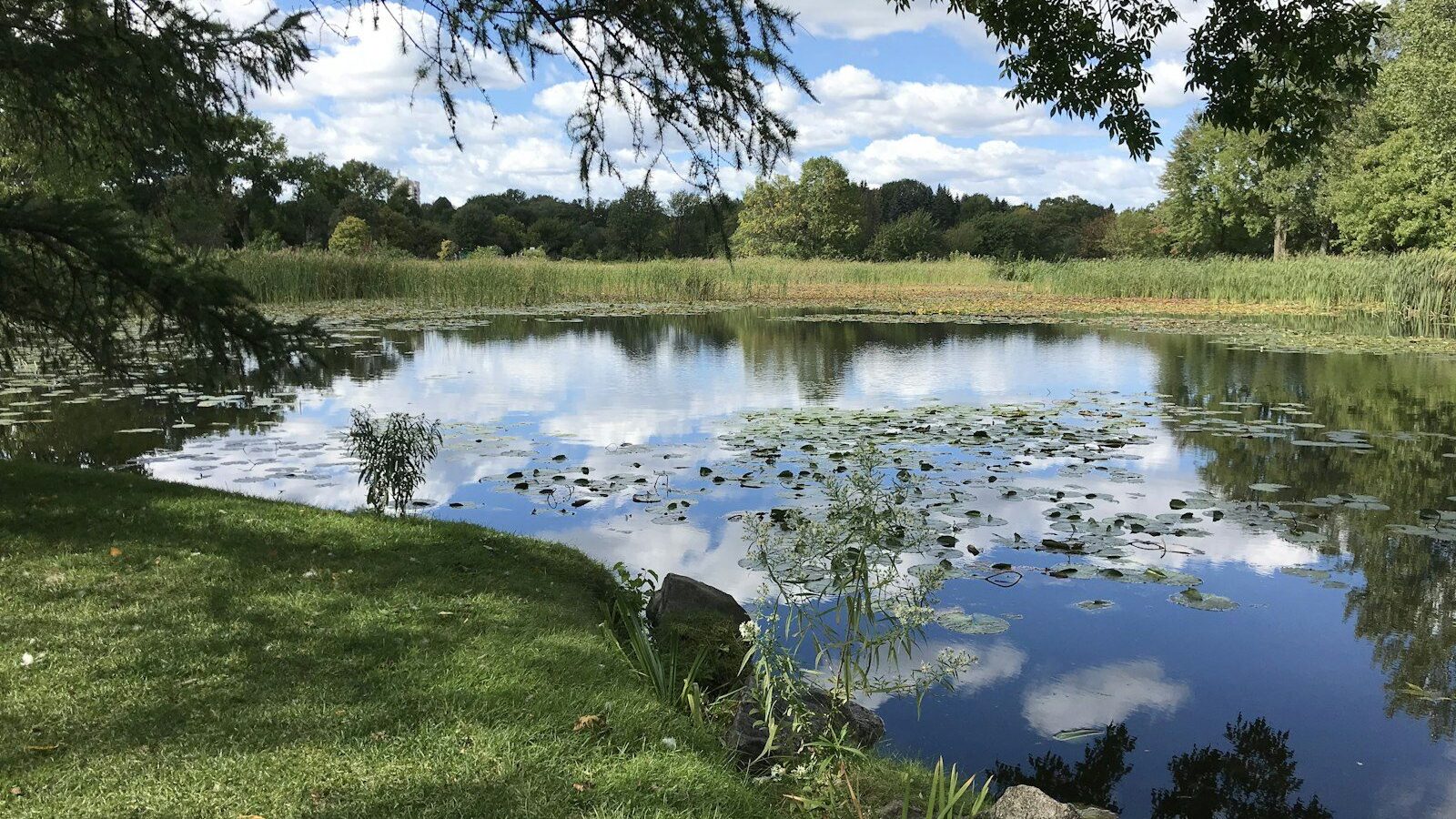
Before you reach for a bottle of pH-down, understand this: the most common cause of “bad” pond pH is not the pH itself but the buffer behind it. Carbonate hardness, or KH, is what holds pH steady between morning and afternoon. Chase a pH number while ignoring KH and you will fight the same battle every week, often shocking your fish in the process. This guide explains what a healthy pond pH actually is, why it swings, and how to nudge it up or down slowly and safely — and when the smartest move is to do nothing at all.
Key Takeaways
- A stable pH of 6.5–8.5 is fine for most pond fish; koi and goldfish prefer 7.0–8.5. Stability matters more than the exact number.
- KH (carbonate hardness) is the buffer that prevents pH crashes. Keep KH above 4 dKH (about 70 ppm) and pH usually takes care of itself.
- To raise pH, add baking soda (sodium bicarbonate) or crushed coral/aragonite; to lower it, dilute the buffer with rainwater or use buffered RO/DI and add driftwood or peat.
- Never change pH more than ~0.2 units per day — rapid swings cause pH shock and gill damage.
- Test at dawn and dusk to catch the natural daily swing before deciding anything is wrong.
What pH Is and What’s Normal
pH measures how acidic or alkaline the water is on a scale of 0 to 14, where 7 is neutral. The scale is logarithmic, so a pond at pH 6 is ten times more acidic than one at pH 7. For ornamental ponds, a stable reading anywhere from 6.5 to 8.5 supports healthy fish and plants. Koi and goldfish are happiest from 7.0 to 8.5; soft-water natives tolerate the lower end. The single most important word in that sentence is “stable.” A pond that holds at 8.2 all year is far healthier than one that yo-yos between 6.8 and 8.4 every day, even though both averages look acceptable.
Why Pond pH Swings
The daily swing is driven by carbon dioxide. Overnight, plants and fish respire and release CO2, which forms carbonic acid and drives pH down to its lowest point at dawn. Through the day, plants and algae photosynthesize and consume CO2, lifting pH to its peak in late afternoon. A swing of a few tenths is normal. A large daily swing — say 7.0 at dawn to 9.0 by evening — is the classic symptom of a heavy algae load combined with weak buffering.
Other drivers include source water (well water can be hard and alkaline, rain is soft and slightly acidic), decaying leaves and fish waste that produce acids, concrete or limestone rock that leaches calcium carbonate and raises pH, and the gradual depletion of KH by the nitrification cycle, which slowly acidifies a pond until the buffer runs out and pH crashes.
Test KH Before You Touch pH
KH, carbonate hardness, is your pond’s shock absorber. It is measured in degrees KH (dKH) or ppm of calcium carbonate. Below about 4 dKH (roughly 70 ppm), the pond has little reserve and pH can crash overnight; this is the most dangerous condition for fish. The fix for an unstable pH is almost always to raise and stabilize KH, not to dose pH chemicals.
So the correct order of operations is: test KH first, then pH, both ideally at dawn and again at dusk. A liquid test kit is more reliable than strips for KH. If your KH is healthy (5–8 dKH) and pH is stable but simply higher or lower than you would like, only then consider adjusting. For a full walkthrough of running these tests and reading the results, see our pond water testing guide.
How to Raise Pond pH
If your pH is genuinely too low or, more commonly, crashing because KH has bottomed out, raise the buffer. The everyday tool is baking soda (sodium bicarbonate). As a starting rate, add about 1 teaspoon per 100 gallons to raise KH by roughly 1 dKH; it nudges pH toward 8.0–8.2 and, crucially, rebuilds the carbonate buffer. Dissolve it in a bucket of pond water first and pour it in around the pond, never as dry powder onto fish.
For a slow, self-regulating fix, place crushed coral, aragonite, or limestone chips in a mesh bag inside the filter or a waterfall. These dissolve only when pH drops, so they top up KH gradually and resist crashes for months. Add them in small amounts and retest after a few days. Whatever you use, spread the change over several days — aim for no more than 0.2 pH units per day.
How to Lower Pond pH
Lowering pH is trickier and riskier, because a high pH is usually propped up by high KH, and forcing pH down with acid against a strong buffer leads to a sudden crash once the buffer is overwhelmed. The safest approach is dilution: replace a portion of the pond with collected rainwater or RO/DI water over several water changes (no more than 10–20 percent at a time). This lowers both KH and pH gently.
You can also add natural acids slowly — a chunk of well-soaked driftwood or a mesh bag of aquarium peat in the filter releases tannins (humic acids) that lower pH and soften water over weeks, not hours. If a hardscape is the culprit, remove limestone or untreated concrete that is leaching carbonate. Avoid commercial “pH down” acids in a fish pond unless you are very experienced; they act fast, are easily overdosed, and rebound just as fast once the buffer reasserts itself. Whatever the method, never drop pH more than 0.2 units in a day, and always check KH alongside — if KH is high, address that first or the pH will simply bounce back.
Avoiding pH Shock
Fish can adapt to a wide range of pH if the change is slow, but a rapid swing of even half a point causes pH shock: erratic swimming, gasping at the surface, clamped fins, and a slimy or excess-mucus coat. The damage is to the gills and the osmotic balance of the fish. This is exactly why hobbyists who chase a “perfect” number with chemicals often kill more fish than those who leave a stable, slightly-off pond alone.
Three rules prevent shock. First, change slowly — 0.2 units per day maximum. Second, always dissolve and dilute additives before they touch the water. Third, when adding new fish to a pond with different chemistry, acclimate them gradually so their bodies adjust; our guide on how to acclimate pond fish covers the drip-and-float method that prevents pH shock at stocking time.
Common Causes Behind a Stubborn pH
If your pH keeps drifting back no matter what you do, the cause is almost always a feature of the pond rather than a one-off. A concrete pond, mortar joints, or limestone and dolomite rock in the hardscape continuously leach calcium carbonate, pegging pH high and KH very high; sealing the concrete or swapping the rock for inert granite or slate is the only lasting fix. Hard well water used for top-ups does the same thing, slowly. On the acidic side, a thick layer of rotting leaves and sludge on the bottom releases organic acids and can drag pH down, so a fall netting and an occasional sludge clean-out do more than any chemical.
Overstocking and overfeeding accelerate everything. More fish means more waste, which means the nitrification cycle consumes KH faster and the pond acidifies sooner. A heavily planted pond with a modest fish load and restrained feeding is naturally far more stable. Before you treat the symptom, ask which of these is driving your numbers — fixing the source means you stop dosing the pond every week.
When to Leave It Alone
Here is the advice that saves the most fish: if your pond sits at a stable pH anywhere between 6.5 and 8.5, with a healthy KH above 4 dKH and fish that look and feed normally, do nothing. Pond fish are remarkably adaptable to a steady pH outside the textbook ideal. The biggest risks to a pond are not a pH of 8.4 — they are the well-meaning owner dumping chemicals to “fix” a number and triggering the very swing they feared.
Build stability into the system instead. Keep leaves and debris out, do not overstock or overfeed, plant generously to consume nutrients, and maintain a modest KH buffer so the pond resists swings on its own. For more on keeping water balanced naturally, browse the Water Gardens & Ponds hub. A pond that buffers itself is one you rarely have to adjust.
Frequently Asked Questions
What pH should a pond be?
A stable pH between 6.5 and 8.5 suits most pond life, with koi and goldfish happiest from 7.0 to 8.5. Stability matters more than hitting an exact number — a steady 8.2 is healthier than a pond swinging between 6.8 and 8.4 daily.
How do I lower pond pH naturally?
Dilute with rainwater or RO water in 10–20 percent changes, and add soaked driftwood or a bag of aquarium peat in the filter to release pH-lowering tannins. Go slowly — no more than 0.2 units per day — and check KH first, since high buffering will push pH back up.
Will baking soda raise my pond’s pH?
Yes. Sodium bicarbonate raises both KH and pH; about 1 teaspoon per 100 gallons lifts KH by roughly 1 dKH and stabilizes pH near 8.0–8.2. Dissolve it in pond water first and add it gradually over a few days.
Why does my pond pH keep dropping?
Usually because KH has been depleted by the nitrification cycle and decaying matter, leaving no buffer. Test KH; if it is below 4 dKH, rebuild it with baking soda or crushed coral rather than dosing pH chemicals, and the crashes will stop.
Can a high pH kill fish?
A stable high pH within reason is tolerated, but a rapid swing — especially upward during a heavy algae bloom — causes pH shock and gill damage. The danger is the speed of change, not a steady reading near the top of the range.