

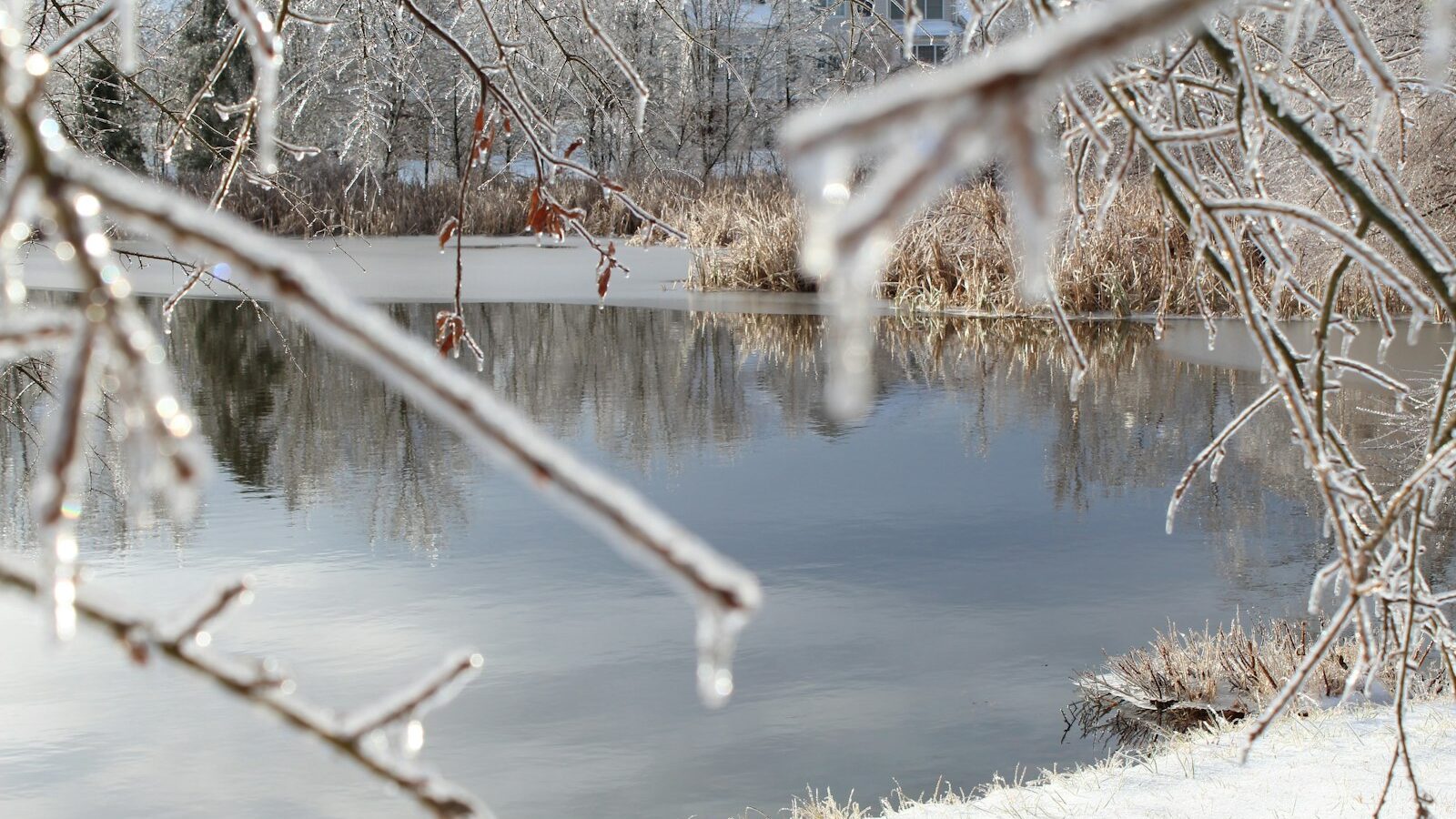
When winter clamps down and your pond surface ices over, the danger to your fish isn’t the cold water itself — it’s the lid. A fully frozen surface seals the pond like a jar, trapping toxic gases below and cutting off the oxygen exchange that fish and beneficial bacteria depend on. The good news: you don’t need to heat the whole pond. You just need to keep one small hole open, and there are several reliable, low-cost ways to do exactly that.
As an Amazon Associate we earn from qualifying purchases.
Key takeaways
- Keep a hole open for gas exchange — don’t fully heat the pond
- A floating de-icer + aerator is the reliable combo
- Never smash the ice (shock harms fish) — melt a hole
- Stop feeding once water is cold
- In hard freezes, run the bubbler near the surface
Why a Fully Frozen Surface Harms Fish
It’s a common myth that ice kills pond fish by freezing them solid. In reality, koi and goldfish are remarkably cold-tolerant. As long as the pond is deep enough that the entire water column doesn’t turn to ice — generally 18 to 24 inches minimum, deeper in harsh climates — your fish will settle near the bottom, slow their metabolism, and wait out winter in a near-dormant state. The real killer is what happens above them when the surface seals completely.
Fish, plants, and the beneficial bacteria in your filter all continue to respire through winter, just slowly. That respiration produces carbon dioxide and, as organic debris like fallen leaves breaks down on the pond floor, gases such as ammonia and hydrogen sulfide. In an open pond, these gases off-gas harmlessly into the air while atmospheric oxygen dissolves back in. A solid sheet of ice stops both processes cold.
The trapped-gas problem
- Oxygen depletion: With no surface exchange, dissolved oxygen slowly falls. Fish can suffocate even in icy water if levels drop far enough.
- Toxic gas buildup: CO2, ammonia, and hydrogen sulfide accumulate under the ice with nowhere to vent, becoming lethal over days or weeks.
- Decomposition load: A pond full of un-removed leaves and muck makes this far worse — more decay means more gas and more oxygen demand.
This is why the goal is so specific: you are not trying to warm the water or prevent ice from forming everywhere. You simply need a single opening in the surface so gases can escape and oxygen can return. Keeping that hole open is the entire job. If you’re starting from scratch on pond depth and design, our guide on how to build a backyard pond covers sizing a pond deep enough to overwinter fish safely.
The Goal: Keep a Hole Open, Not Heat the Pond
Once you understand that a single open hole is all you need, winter pond care gets a lot less intimidating — and a lot cheaper. Trying to heat an entire outdoor pond would cost a fortune in electricity and isn’t even good for the fish, who are biologically built to slow down in cold water. A small, consistently open patch of unfrozen surface does everything that matters: it vents trapped gases and lets oxygen back in.
There are four practical methods to keep that hole open, and they’re often combined. Each suits a slightly different climate and budget, so it’s worth knowing how they work before you buy anything.
- A floating pond de-icer (heater): A thermostatically controlled floater that keeps a small area ice-free.
- An aerator near the surface: An air pump pushing bubbles that disturb the surface and keep it open.
- A small pump or bubbler: Moving water resists freezing and maintains an opening.
- The hot-pan method: A manual, equipment-free way to melt a hole when the surface has already sealed.
Method 1: A Floating Pond De-Icer (Heater)
A floating pond de-icer is the most popular solution because it’s nearly foolproof. Despite the “heater” label, it doesn’t warm the pond — it draws a modest amount of electricity to keep a ring of water around it from freezing. Most models are thermostatically controlled, so they only switch on when the water near them approaches freezing, which keeps running costs reasonable even through a long winter.
For mild and moderate climates, a de-icer alone is often enough. In severe cold, you’ll want to pair it with an aerator (more on that below), since the de-icer keeps a hole open but an aerator actively adds oxygen. Look at the wattage relative to your climate: 200–300 watts suits milder regions, while northern climates with deep, prolonged freezes often need 750–1500 watt units.
How to use a de-icer well
- Place it away from the pond edge so the open hole sits over deeper water.
- Choose a thermostatic model — it only powers on when needed, saving electricity.
- Use a GFCI-protected outdoor outlet and inspect the cord before each season.
- In hard climates, combine it with aeration rather than relying on it alone.
Ready to shop? Browse floating pond de-icers and match the wattage to how cold your winters actually get.
Free, no-obligation quote · Connect with a local pro
Method 2: Running an Aerator Near the Surface
An aerator uses an air pump (sitting on dry land) connected to an air stone or diffuser in the pond. The rising bubbles do two jobs at once: they agitate the surface to keep a hole open, and they directly boost dissolved oxygen. That dual action makes aeration the single most valuable upgrade for overwintering fish, especially in climates where ice can last for weeks.
The key in winter is placement. In summer you’d put the diffuser deep, but in winter you want it positioned shallower — roughly 12 to 18 inches below the surface, not at the very bottom. Here’s why: the deepest water stays warmest in winter (water is densest at about 39°F), and your fish hang out there. If you aerate from the very bottom, you can stir that warm layer up to the surface and supercool the whole pond. Keeping the diffuser higher disturbs the surface to vent gases without chilling the fish’s refuge below.
Winter aeration tips
- Set the air stone on a shelf or raised support 12–18 inches deep, not on the bottom.
- Position it near where you want the hole — the bubbles will hold that spot open.
- Use a winter-rated air pump; some hobby pumps aren’t built for freezing outdoor use.
- Pair with a de-icer in severe climates for redundancy.
Shop pond aerators sized for your pond’s volume. For a fuller breakdown of diffuser depth and pump sizing year-round, see our guide on how to aerate a pond.
Method 3: A Small Pump or Bubbler
Moving water resists freezing, so a small recirculating pump or a surface bubbler can keep an opening clear in mild to moderate climates. A floating bubbler — essentially a small pump fountain head — gently churns the surface, while a low-flow submersible pump can be set to break the surface tension at one spot. These are inexpensive and energy-efficient, and they double as oxygenation.
One important caution: don’t run your main, full-power waterfall pump deep in the pond all winter. Running a strong pump at the bottom circulates and chills the warm deep water your fish rely on, and waterfalls can lose heat fast and ice over into a dam. The right tool here is a small dedicated bubbler near the surface — not your summer waterfall pump. In a hard freeze, this surface bubbler is exactly what keeps the hole open when a de-icer might struggle alone.
- Best for: mild and moderate winters where the pond freezes only intermittently.
- Placement: keep the bubbler at or just below the surface, away from the deepest zone.
- Avoid: running a high-output bottom pump that mixes and supercools the water column.
Browse pond bubblers for a simple, low-energy option to hold a hole open.
Method 4: The Hot-Pan Method (Never Smash the Ice)
Maybe a power outage knocked out your de-icer, or an unexpected deep freeze sealed the surface overnight. If the pond has already iced over and you need to open a hole fast, there’s one safe way and one dangerous way — and the difference matters enormously to your fish.
Never smash, hammer, or chip the ice. The shock waves travel through the water and can concuss or kill fish that are already in a fragile, dormant state. It’s the aquatic equivalent of someone banging on a wall right next to your head while you sleep — except it can be fatal. Instead, melt the ice gently.
How to melt a hole safely
- Fill a metal pot or pan with boiling or very hot water.
- Set the hot pan flat on the ice surface and let it slowly melt straight down.
- Hold it in place until it melts through — this creates a clean hole with zero shock.
- Do not pour boiling water directly into the pond; the temperature change can stress fish.
- Once a hole is open, get your de-icer or aerator running so it stays open.
The hot-pan trick is a reliable emergency fix, but it’s a stopgap. The goal afterward is always to restore a powered method that keeps the hole open continuously, so you’re not back outside with a kettle at dawn every day.
Cold-Weather Care: Pumps, Waterfalls, and Feeding
Keeping a hole open is the headline, but a few other winter adjustments protect your fish just as much. Two stand out: managing your pumps and waterfall, and stopping feeding once the water turns cold.
Lower or remove pumps in deep freezes
In regions with hard, sustained freezes, many pond keepers shut down and remove the main waterfall pump for winter. A running waterfall exposes a lot of water to frigid air, accelerating heat loss, and falling water can freeze into ice dams that divert your pond dry. If you keep a pump running for circulation, lower it to a mid-depth shelf — never the very bottom — to avoid mixing and chilling the warm water your fish are sheltering in. In mild climates where the pond rarely freezes solid, you can often leave the waterfall running, which itself helps keep water open and oxygenated.
Stop feeding once the water is cold
This one surprises new pond owners: stop feeding your fish once water temperatures drop below about 50°F. A koi or goldfish’s metabolism slows dramatically in cold water, and their digestion essentially shuts down. Food eaten at that point sits undigested in the gut, where it rots and can sicken or kill the fish. Cold fish don’t starve over winter — they live off reserves built up in fall. As temperatures fall through autumn, switch to a wheat-germ-based cold-water food, then stop entirely once you’re consistently below 50°F. A floating thermometer takes the guesswork out of it.
For the full seasonal routine — leaf netting, filter shutdown, plant care, and more — see our guides on how to winterize a pond and koi fish care.
Free, no-obligation quote · Connect with a local pro
Mild vs. Severe Climates: What to Actually Do
Your winter strategy should match your climate. The same pond in Atlanta and in Minneapolis needs very different handling, so here’s how to scale your approach.
Mild climates (occasional light ice)
- A small floating de-icer or surface bubbler is usually all you need.
- You can often leave a waterfall running, which keeps water open naturally.
- Watch for the occasional cold snap and have a de-icer ready as backup.
- Still stop feeding once water drops below 50°F.
Severe climates (weeks of solid ice)
- Run a de-icer and a near-surface aerator together for redundancy and oxygen.
- Remove or lower the main waterfall pump to prevent heat loss and ice dams.
- Keep the aerator diffuser at 12–18 inches, never on the bottom.
- Make sure your pond is deep enough (24+ inches) that it won’t freeze through.
- Keep the hot-pan method in mind for power outages, and never smash the ice.
Whatever your climate, the principle never changes: keep a hole open, keep oxygen moving, don’t overheat or overmix the water, and let your fish do what they’re built to do — quietly wait out winter at the bottom.
Frequently asked questions
Will my fish die if the pond freezes over?
Not from the cold itself, as long as the pond is deep enough not to freeze solid (generally 18–24+ inches). The danger is a fully sealed surface, which traps toxic gases and cuts off oxygen exchange. Keep one hole open and your dormant fish will be fine.
Can I just break the ice with a hammer?
No. Striking the ice sends shock waves through the water that can concuss or kill dormant fish. Always melt a hole instead — set a pot of hot water on the ice and let it melt straight through, then get a de-icer or aerator running to keep it open.
Do I need both a de-icer and an aerator?
In mild climates, one method is usually enough. In severe climates with weeks of solid ice, running a de-icer and a near-surface aerator together is the reliable combo — the de-icer holds a hole open while the aerator actively adds oxygen and provides backup.
Why shouldn’t I feed my fish in winter?
Below about 50°F, a fish’s metabolism and digestion nearly stop. Food eaten at that point sits undigested and rots in the gut, which can sicken or kill the fish. They live off fall reserves instead, so stop feeding once the water is consistently cold.
Where should I place the aerator in winter?
Keep the air stone shallow — about 12 to 18 inches deep, not on the bottom. The deepest water stays warmest in winter and shelters your fish; aerating from the very bottom can stir that warm layer up and supercool the whole pond.
Featured project by Gensou Aquascaping
Want a pro to service your pond?
Compare free, no-obligation quotes from vetted local pond pros near you.