

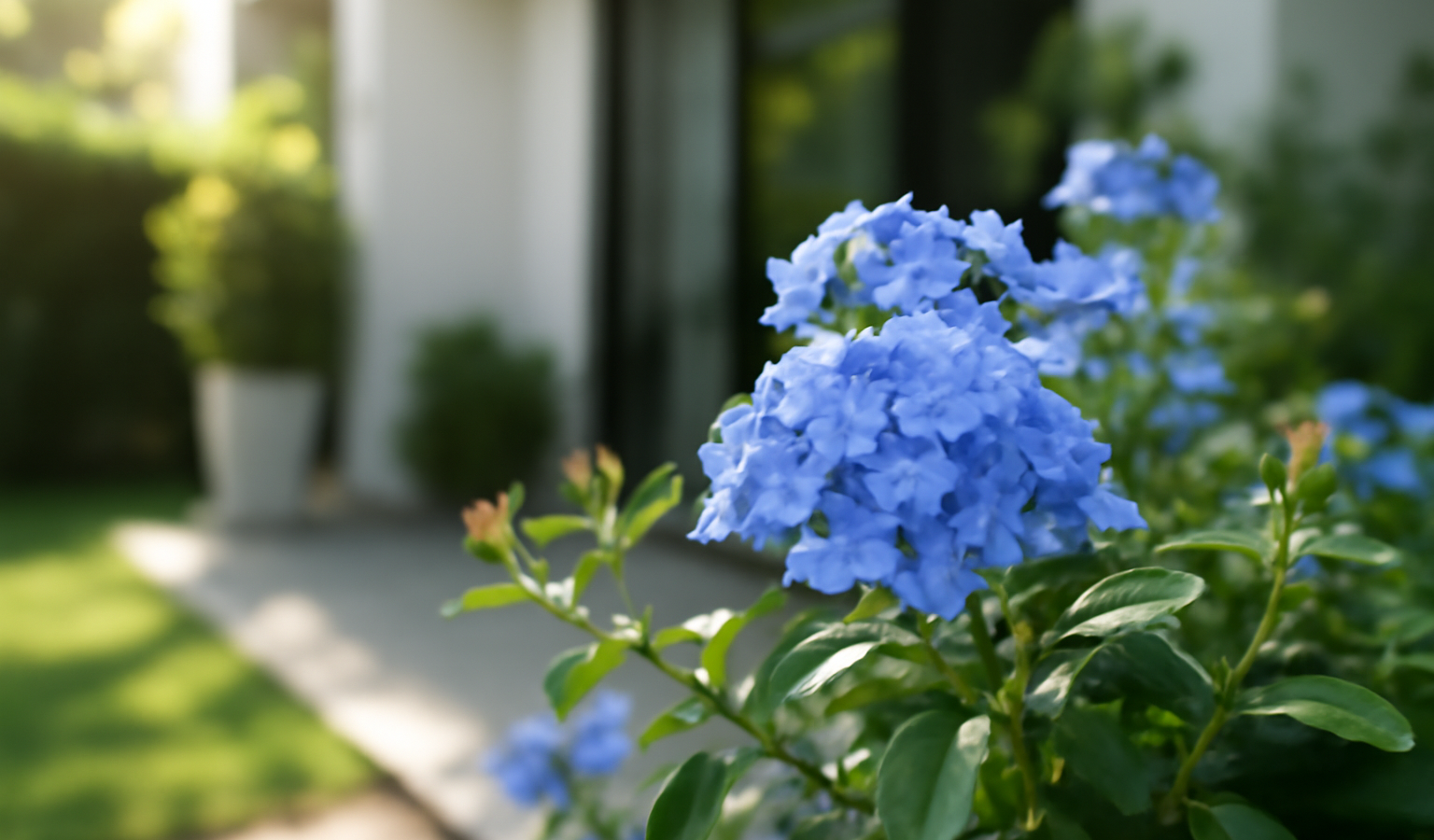
If you want a tough groundcover that saves its best show for the end of the season, leadwort is hard to beat. While most perennials are fading by late summer, this low, spreading plant fires up with electric gentian-blue flowers just as the rest of the garden winds down, then follows up with bronze-red foliage that holds well into fall. It asks for little once established, tolerates poor soil and dry spells, and knits itself into a tidy mat under shrubs and along edges. The catch is that it plays by its own calendar, and if you do not know its quirks, you can easily mistake a perfectly healthy plant for a dead one in spring. This guide walks through everything you need to grow it well.
Key Takeaways
- Grow the hardy species Ceratostigma plumbaginoides (dwarf plumbago) in USDA zones 5 to 9, not the tender Cape plumbago shrub.
- Plant in full sun to part shade, in average, well-drained soil; it tolerates poor ground but hates soggy roots.
- Space plants 12 to 18 inches apart; they spread by rhizomes into 6 to 10 inch tall mats and can be vigorous.
- Expect gentian-blue, phlox-like flowers from late summer into fall, followed by excellent bronze-red autumn foliage.
- Be patient in spring: leadwort emerges late, so mark its location and never assume it has died over winter.
- Cut plants back in late winter or early spring; propagate easily by division in spring.
Meet Leadwort: Hardy Plumbago Versus Cape Plumbago
Before you buy, get the name right, because two very different plants share the common name plumbago and confusing them leads to disappointment. The plant covered here is Ceratostigma plumbaginoides, sold as hardy plumbago, dwarf plumbago, or leadwort. It is a low, woody-based perennial groundcover that dies back to the ground each winter and returns reliably in zones 5 through 9. It rarely tops 10 inches in height but spreads outward to form dense colonies.
The other plant is Plumbago auriculata, the Cape plumbago, a sprawling tender shrub native to South Africa that grows several feet tall and wide. It carries pale sky-blue flowers and is only hardy in zones 9 to 11, where it is often used as a hedge or trained on a trellis. In colder regions gardeners grow it as an annual or in containers brought indoors. The two are not interchangeable: if you live in zone 6 and buy Cape plumbago expecting a perennial groundcover, it will not survive your winter. Everything that follows refers to the hardy Ceratostigma, the right choice for most temperate gardens looking for a permanent groundcover.
What makes leadwort special is the timing and intensity of its color. The flowers are a true, saturated blue, a shade that is genuinely rare in the garden, and they open in clusters that resemble phlox. They arrive in late summer and keep coming through fall, often overlapping with the foliage turning shades of bronze, red, and burgundy. That combination of blue blooms against reddening leaves is the plant’s signature, and it lands at a time of year when most beds have little to offer.
Where to Plant: Light and Hardiness
Leadwort is adaptable on light, which is part of its appeal. It flowers most heavily in full sun, so a spot with six or more hours of direct light gives you the densest bloom and the best fall foliage color. That said, it is noticeably more shade tolerant than most flowering groundcovers and performs respectably in part shade, making it useful in the dappled light under deciduous trees and along the north or east side of a house. In deep, dense shade it will survive but bloom sparingly and grow more open, so aim for at least a few hours of sun if flowers are your goal.
Hardiness runs from USDA zone 5 through zone 9. In the colder end of that range, a winter mulch helps protect the crowns, while in the warm end the plant appreciates a little afternoon shade to ease heat stress. It handles summer heat and humidity well, which is one reason it is so widely planted across the southeastern and midwestern United States as a reliable, low-fuss cover.
Soil Requirements
This is an easygoing plant when it comes to soil, with one firm rule: drainage matters more than fertility. Leadwort grows happily in average garden soil and tolerates poor, lean, rocky ground that defeats fussier perennials. It does not need rich earth or constant amendment. What it cannot abide is wet feet. Soggy, poorly drained soil, especially in winter, invites root rot and will kill the plant faster than any pest.
If your site holds water after rain, improve it before planting by working in compost and coarse grit to open up the structure, or choose a raised bed or slope where excess moisture drains away. A slightly acidic to neutral pH suits it best, but it is not particular. Good drainage is the single most important thing you can give it, far ahead of any fertilizer.
Planting and Timing
The best time to plant leadwort is in spring after the soil has warmed, which also gives the plant a full season to establish its rhizome system before winter. Early fall planting works in warmer zones, but allow at least six weeks before the first hard frost so roots can settle in. Avoid planting during the heat of midsummer if you can, since young plants struggle to keep up with water demand.
Dig each planting hole roughly as deep as the root ball and about twice as wide, set the plant so the crown sits level with the surrounding soil, backfill, and firm gently. Water thoroughly at planting and keep the soil evenly moist, but not waterlogged, through the first growing season while roots take hold. A two inch layer of mulch helps conserve moisture and suppress weeds, but keep it pulled back slightly from the stems to prevent rot. Patience pays off here, because leadwort often looks unremarkable its first year and then takes off in its second and third seasons.
Spacing and Groundcover Uses
Space plants 12 to 18 inches apart. Leadwort spreads by underground rhizomes, sending out runners that fill the gaps and knit individual plants into a continuous mat 6 to 10 inches tall. Closer spacing closes the canopy faster, which helps shade out weeds; wider spacing saves money but takes an extra season to fill in. Within a couple of years a well-sited planting becomes a seamless carpet.
This spreading habit makes it one of the most useful groundcovers around. It is excellent planted under roses and larger shrubs, where it covers bare ankles and bare soil while tolerating the dry, root-filled conditions found there. It works beautifully on slopes and banks, where its rhizomes help hold the soil and its low profile resists wind. As edging along a path or the front of a border, it gives a clean, finished line and a late-season burst of blue. It also fills awkward dry spots at the base of walls or between stepping stones. If your roses are struggling for unrelated reasons, it is worth checking common causes such as those covered in our guide on why roses fail to bloom, since healthy companions make the underplanting look its best.
The Late-Spring Emergence Caveat
This is the most important thing to know about leadwort, and the reason so many gardeners accidentally dig it up. It is one of the last perennials to break dormancy in spring. While everything else around it is leafing out and the soil is warm, leadwort can still show nothing but bare ground, often not emerging until late spring when nighttime temperatures are reliably warm. Every year, somewhere, a gardener decides the plant has died over winter, digs it out, and plants something else, only to find leadwort shoots pushing up weeks later.
Do not make that mistake. Mark the location clearly in fall with a label or stake, resist the urge to disturb the area in early spring, and give the plant until late spring or even early summer to appear. Its lateness is also a feature: because it emerges so late, it never gets nipped by a late frost, and it leaves room for early spring bulbs to do their thing before it fills in. Plant crocuses or daffodils among it and you get two seasons of interest from one square of ground.
Watering and Feeding
While young plants need consistent moisture to establish, mature leadwort is genuinely drought tolerant. Once the rhizome network is in place, usually by the second year, it can shrug off dry spells that would wilt thirstier groundcovers. Water deeply during prolonged drought, especially in full sun, but otherwise let the soil dry between waterings. Overwatering is a far greater threat than underwatering, so when in doubt, hold off.
Feeding needs are modest. Leadwort thrives in lean soil and rarely needs fertilizer. If your soil is very poor or growth seems sluggish, a single light application of a balanced granular fertilizer in spring as the plant emerges is plenty. Better yet, top-dress with a thin layer of compost. Avoid heavy nitrogen feeding, which pushes lush leafy growth at the expense of the flowers you actually want.
Cutting Back and Seasonal Care
Leadwort needs only one real grooming task a year. Because it dies back to the ground in winter, leave the old stems and bronze foliage standing through the cold months, where they provide a little winter interest and protect the crown. Then cut the entire planting back close to the ground in late winter or early spring, before new growth begins. A pair of hedge shears or a string trimmer makes quick work of a large patch. This clears away the spent material so the late-emerging new shoots come up clean.
There is no need to deadhead, and the plant does not require staking or any midseason pruning. If a patch starts looking thin or overgrown, you can shear it lightly after the spring cutback, but in most gardens the once-a-year haircut is the whole maintenance routine. That low demand is exactly why it earns its place in busy, low-input landscapes.
Managing the Spread
Be honest with yourself about space, because leadwort spreads by rhizomes and can be vigorous. In ideal conditions it travels steadily outward and will creep into neighboring plantings or lawn edges if left unchecked. This is a virtue when you want a groundcover to knit together quickly and a nuisance when you have squeezed it into a tight spot next to less competitive perennials.
Give it room to roam where you want coverage, and contain it where you do not. A buried edging strip, a hardscape border, or simply slicing through the rhizomes at the margin each spring with a sharp spade keeps it within bounds. It is not aggressively invasive in the way some groundcovers are, and it pulls back easily, but plan for expansion rather than fighting it later. For comparison, gardeners who like spreading mat-formers often pair it with or weigh it against creeping phlox, which blooms in spring and offers a nice seasonal contrast.
Fall Color
Do not overlook the second act. As the season cools, leadwort foliage turns striking shades of bronze, red, and burgundy, often while the last blue flowers are still open. The overlap of blue and red is unusual and eye-catching, and the colored leaves persist for weeks, extending the display well past the bloom. For a groundcover, that kind of autumn performance is exceptional and gives it a long season of interest from late summer through the first hard frosts.
Propagation by Division
Leadwort is one of the easiest perennials to multiply, thanks to its rhizomes. The simplest method is division in spring, just as new growth appears. Lift a clump with a spade, separate it into sections each with roots and shoots, and replant immediately at the same depth, watering well. Within a season the divisions establish and begin spreading on their own.
You can also take rhizome cuttings: dig down at the edge of a colony, cut a length of healthy rhizome with growth buds, and pot it up or plant it where you want a new patch. Both methods are reliable and free, making leadwort a generous plant to share. Spring is the prime window for either approach, while the plant has a full season ahead to recover and root.
Pests and Diseases
One of leadwort’s best features is that it is essentially trouble-free. It is rarely bothered by insect pests and shrugs off most problems that plague other plants. The main risk, and it is entirely preventable, is root rot in wet or poorly drained soil, which is why drainage gets so much emphasis in this guide. Keep the soil on the dry side and root rot is a non-issue.
Occasionally powdery mildew shows up on the foliage, usually in crowded plantings with poor air circulation during humid spells. It is mostly cosmetic and rarely needs treatment; improving airflow by thinning crowded growth and avoiding overhead watering keeps it in check. As a bonus, leadwort is deer resistant, so it is a smart choice in gardens where browsing deer make a meal of more tender groundcovers.
Companion Plants
Leadwort combines beautifully with plants that contrast its low blue carpet or extend the season around it. Spring-flowering bulbs such as daffodils, crocuses, and tulips are ideal partners, blooming and fading before leadwort emerges, so the two share the same ground at different times. Ornamental grasses make a fine backdrop, and the blue flowers pop against silver-leaved plants like artemisia or lamb’s ear.
For a layered planting it pairs well under roses and flowering shrubs, and alongside other tough, drought-tolerant perennials. Gardeners building a low-water bed often combine it with reliable bloomers such as Jupiter’s beard for contrasting flower form and a longer overall bloom window. For more groundcover ideas and planting inspiration, browse our full library of plants and flowers guides.
Frequently Asked Questions
Is leadwort the same as Cape plumbago?
No. Leadwort is Ceratostigma plumbaginoides, a hardy perennial groundcover for zones 5 to 9. Cape plumbago is Plumbago auriculata, a tender shrub hardy only in zones 9 to 11. They share the common name plumbago but are different plants with very different uses and hardiness.
Why has my leadwort not come up in spring?
It is probably fine. Leadwort is one of the last perennials to emerge, often not breaking ground until late spring when the soil is warm. Mark its location in fall, avoid digging in the area, and give it until early summer before assuming it has died.
How fast does leadwort spread?
It spreads steadily by underground rhizomes and can be vigorous, forming a dense mat within two to three seasons. Give it room where you want coverage, or contain it with edging or a yearly spade cut at the margins if it threatens to creep into neighboring plants.
When does leadwort bloom?
It blooms from late summer into fall, producing clusters of gentian-blue, phlox-like flowers. The blooms often overlap with the foliage turning bronze-red, giving an unusual and long-lasting display when most of the garden is fading.
Does leadwort grow in shade?
Yes, it is more shade tolerant than most flowering groundcovers and grows well in part shade. It flowers most heavily in full sun, however, so for the best bloom and fall color give it at least a few hours of direct light each day.