

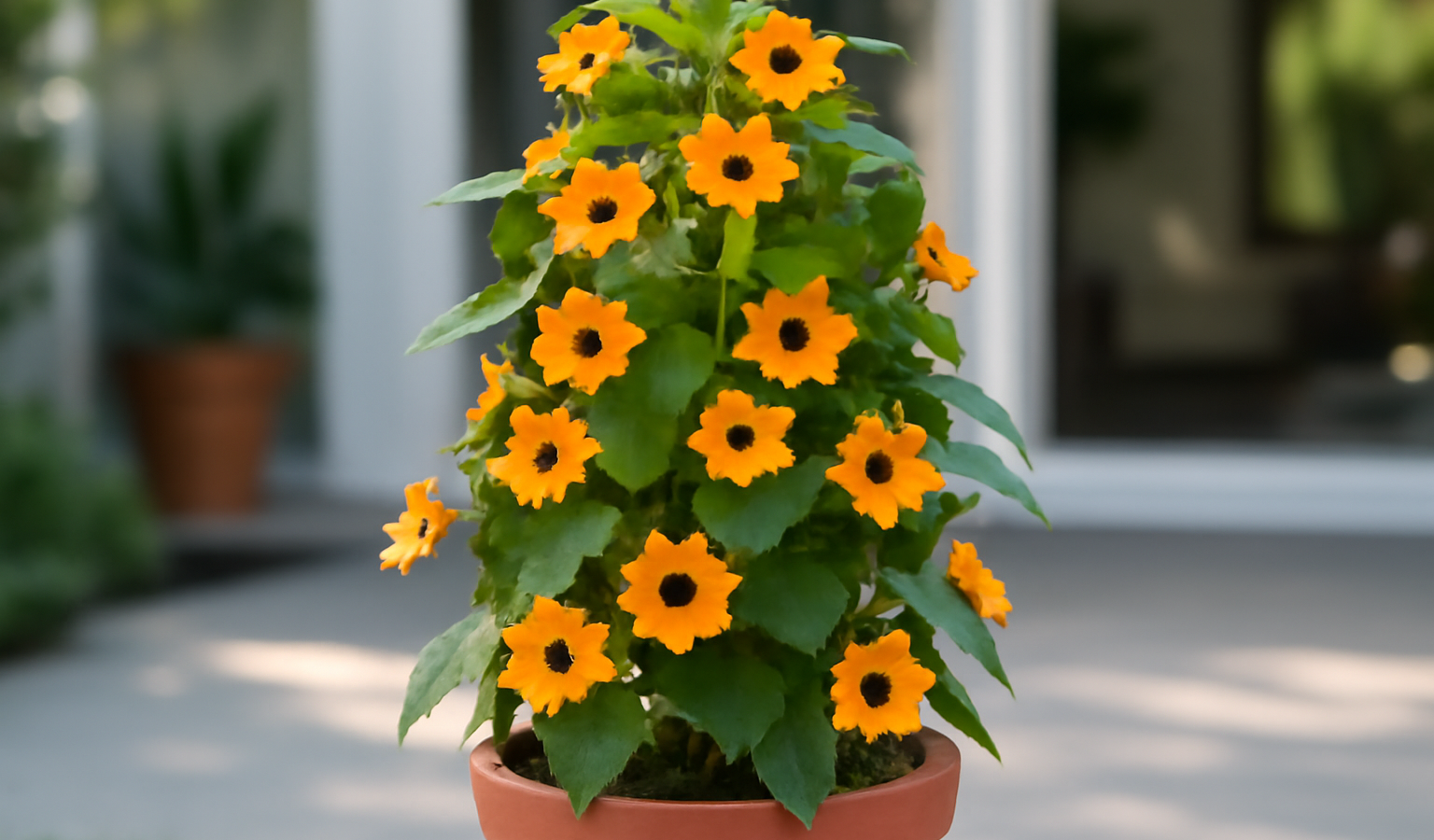
Black-eyed Susan vine (Thunbergia alata) is the cheerful, free-flowering climber that drips orange, yellow, and cream blooms — each with a dark chocolate “eye” — from late spring until frost. Unlike the rampant Ipomoea vines, it stays manageable at 6 to 8 feet, twining neatly up a trellis, spilling out of a hanging basket, or weaving through a container obelisk. It is a tender perennial grown as an annual in most of the country, asking for full sun to part shade, steady moisture, and a slim support to climb. This guide covers seed prep and soaking, planting timing, support, watering, the long bloom season, reseeding, and toxicity notes so you can grow it with confidence.
Key Takeaways
- Soak seeds 12 to 24 hours before sowing to speed germination, which can otherwise be slow.
- Plant after the last frost in full sun to part shade; it tolerates a bit more shade than morning glories.
- Give a slim support to twine around, or grow it trailing from a hanging basket.
- Keep soil consistently moist — this vine is less drought-tolerant than other annual climbers.
- Blooms nonstop from early summer to frost; deadheading and even moisture keep it going.
- Reseeds modestly and can naturalize in mild climates, but is far less aggressive than Ipomoea vines.
- Generally considered non-toxic to people and pets, though it is best not eaten.
About Thunbergia alata
Despite the common name, this vine is unrelated to the perennial black-eyed Susan daisy (Rudbeckia); the shared name just refers to the dark center of each flower. Thunbergia alata is a member of the acanthus family, native to East Africa, and grown worldwide as an ornamental annual climber. Flowers are typically 1 to 1½ inches across in warm orange, golden yellow, apricot, or white, most with a deep purple-black throat (though some modern “Susie” series colors come eyeless). The heart- to arrow-shaped leaves form a tidy backdrop.
Because it stays compact and blooms so generously, it is a favorite for containers, window boxes, and hanging baskets as well as small trellises. It pairs nicely with other warm-toned annuals and works beautifully alongside marigolds and other sun-loving bloomers for a hot-color combination.
When and Where to Plant
Sow or transplant black-eyed Susan vine outdoors after the last frost, once soil has warmed to around 60°F. It is a tender perennial in zones 10 and 11, where it may overwinter, but is grown as an annual elsewhere. Because it can be slow from seed, many gardeners in cooler zones (3 to 7) start seeds indoors six to eight weeks before the last frost to get a head start on the bloom season; nursery starts are also widely available.
This vine is more shade-tolerant than morning glories — it flowers best in full sun but performs well in part shade, especially in hot southern climates where some afternoon shade keeps it from scorching. It prefers fertile, well-drained soil that stays evenly moist, a notable difference from the lean-soil preference of Ipomoea vines. A spot with morning sun and protection from harsh afternoon heat is ideal in warm regions.
Preparing and Sowing Seeds
Black-eyed Susan vine seeds germinate somewhat slowly and unevenly, so a pre-sow soak of 12 to 24 hours in warm water helps soften the seed coat and speed sprouting. Light scarification is rarely needed since the coat is not as hard as morning glory or hyacinth bean seed, but soaking is worthwhile. Sow seeds about ¼ inch deep — they need darkness to germinate, so cover them lightly but completely.
Spacing and Depth
Space plants 8 to 12 inches apart at the base of a support, or plant two to three to a hanging basket. Germination takes 10 to 21 days even after soaking, with warm soil (around 70°F) speeding things along. Keep the medium consistently moist and warm during this period. If starting indoors, harden off seedlings before moving them outdoors after frost danger passes.
Providing Support
This vine climbs by twining, like its Ipomoea relatives, but it is far more restrained — usually 6 to 8 feet in a season. Give it strings, wire, netting, a small trellis, or an obelisk to wrap around. Its modest size makes it perfect for container culture: set a tall support in the pot, or skip the support entirely and let it cascade from a hanging basket or window box, where the trailing stems and abundant flowers look spectacular.
Guide the first growth onto the support; after that it self-climbs. Because it does not get heavy or rampant, a lightweight trellis or even a few taut strings is enough. For more ideas on compact climbers and container vines, see our plants and flowers guides.
Watering and Feeding
This is where black-eyed Susan vine differs most from other annual climbers: it likes steady moisture and does not tolerate drought well. Keep the soil evenly moist, watering whenever the top inch begins to dry, and never let container plants dry out completely — drought stress causes flowering to stall and leaves to drop. Hanging baskets in particular may need daily watering in summer heat. Mulching the soil surface helps conserve moisture.
Unlike the lean-loving Ipomoea vines, black-eyed Susan vine appreciates regular light feeding to fuel its long bloom season. Feed container plants every two to four weeks with a balanced, bloom-oriented liquid fertilizer, or work a slow-release fertilizer into the potting mix at planting. In-ground plants in decent soil need less, but a monthly feeding during summer keeps the flowers coming. Avoid heavy nitrogen, which still favors leaves over blooms.
Bloom Season and Deadheading
The great virtue of this vine is its long, nearly continuous bloom. Plants begin flowering early — often within 8 to 12 weeks of sowing — and keep going from late spring or early summer right through to the first frost. The flowers face outward and cover the vine, making for a constant display. Bloom is heaviest in full sun with steady moisture and regular feeding.
Deadheading spent flowers keeps the plant tidy and encourages more buds, though the vine will bloom well even without it. If growth gets leggy or sparse in midsummer, a light trim encourages branching and a fresh flush of flowers. In very hot climates, flowering may pause during peak heat and resume as temperatures ease in late summer — keeping the roots cool and moist minimizes this lull.
Reseeding and Spread
Black-eyed Susan vine can self-seed, and in frost-free tropical and subtropical regions (and parts of the warm South and Hawaii) it has naturalized and is considered invasive in some areas, where it can climb over native vegetation. In most temperate gardens, however, it is well-behaved: any volunteer seedlings are easy to spot and pull, and the plant is killed by frost each fall.
If you garden in a mild, frost-free climate, deadhead to prevent seed set, keep it in containers, and pull volunteers promptly. In colder zones you can let it set a little seed if you would like volunteers next spring, or simply collect ripe seed to sow deliberately. Overall it is far less of a spreading nuisance than morning glory, moonflower, or hyacinth bean.
Common Problems
Dropping leaves or stalled bloom almost always means the plant dried out — restore even moisture. Slow, patchy germination is normal for this species; soak the seeds and be patient. Spider mites are the most common pest, especially on hot, dry, stressed plants; raise humidity, keep the plant watered, and treat with insecticidal soap if needed. Whiteflies and aphids may also appear, particularly on container plants. Leggy growth with few flowers points to too much shade or nitrogen — move to brighter light and switch to a bloom-focused feed. The vine is otherwise easygoing and disease-resistant.
Toxicity Notes
Unlike the Ipomoea vines covered elsewhere in this series, black-eyed Susan vine (Thunbergia alata) is generally regarded as non-toxic to people, dogs, and cats, and it is not listed among common poisonous plants. That said, it is an ornamental, not a food crop, and no plant should be eaten unless known to be edible — chewing large amounts of any ornamental foliage can cause mild stomach upset in sensitive pets. As a sensible precaution, discourage children and animals from nibbling it, and contact a doctor or veterinarian if a large quantity is eaten. For routine growing and handling, no special precautions are needed.
Frequently Asked Questions
Is black-eyed Susan vine the same as the black-eyed Susan flower?
No. The vine (Thunbergia alata) is unrelated to the perennial black-eyed Susan daisy (Rudbeckia); they simply share a common name because both have dark flower centers. The vine is a twining tropical climber grown as an annual.
Why are my seeds taking so long to sprout?
Slow, uneven germination is normal for this species — it can take 10 to 21 days even after soaking. Soak the seeds 12 to 24 hours, sow ¼ inch deep in the dark, and keep the soil warm (around 70°F) and consistently moist to speed things up.
Can I grow black-eyed Susan vine in a hanging basket?
Yes, it is excellent in baskets and window boxes. Plant two or three per basket and let the stems trail and bloom over the sides, or add a small support for an upright form. Just keep baskets well watered, as they dry out fast in summer.
How do I keep it blooming all summer?
Give it full sun, keep the soil evenly moist (never let it dry out), feed every two to four weeks with a bloom-oriented fertilizer, and deadhead spent flowers. A light midsummer trim encourages branching and a fresh flush of blooms.
Is black-eyed Susan vine poisonous to pets?
It is generally considered non-toxic to dogs and cats and is not on common poisonous-plant lists. Still, it is an ornamental, not a food, so discourage pets from eating large amounts and consult a vet if they do. No special precautions are needed for growing or handling it.