

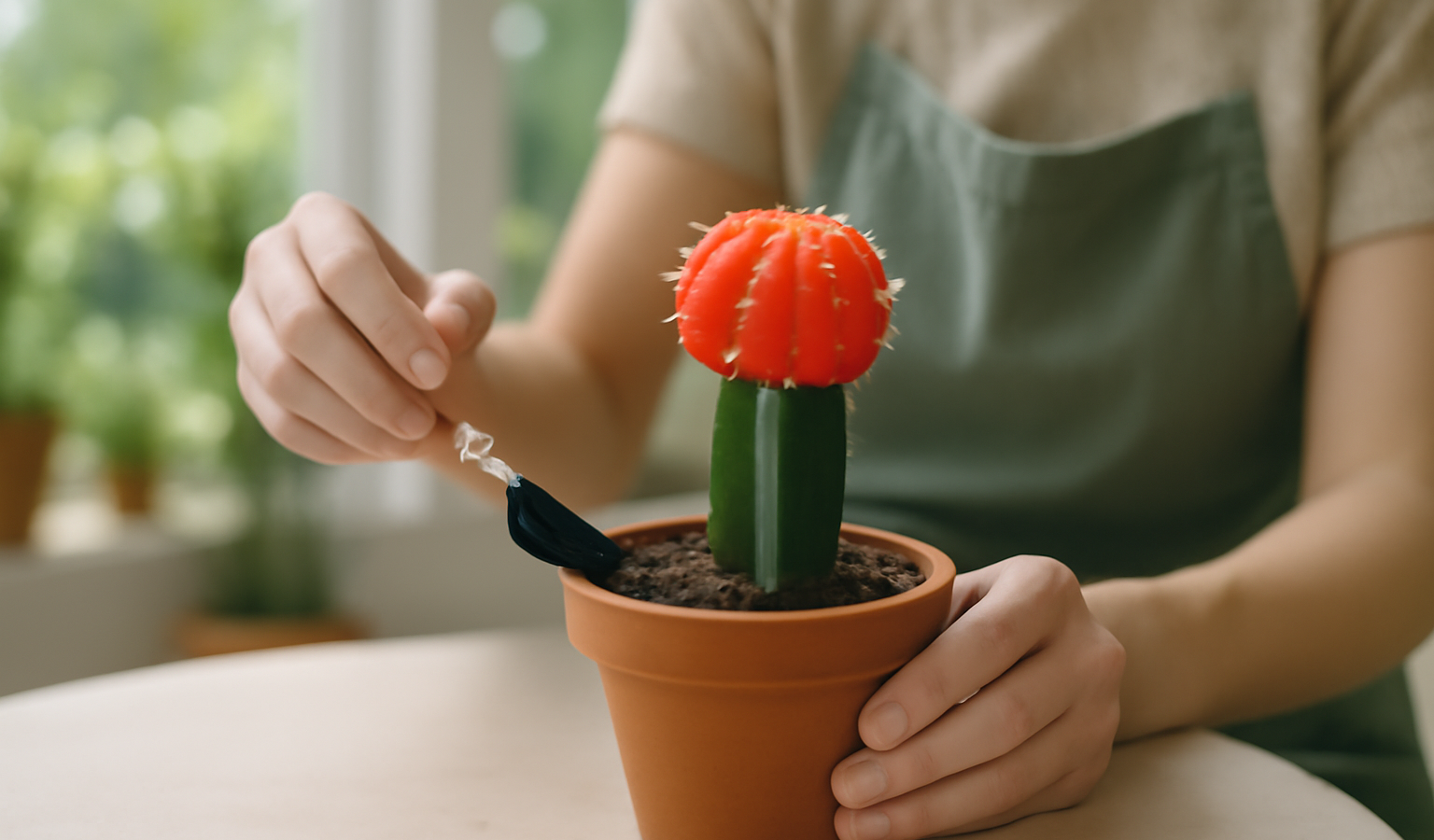
The moon cactus is one of the most eye-catching plants you can buy: a small, neon-bright ball of red, orange, yellow, or hot pink perched on top of a slim green stem. It looks almost artificial, and in a sense it kind of is, because that colorful top is a lab-bred mutant that cannot survive on its own. Once you understand what you are actually looking at, the whole plant makes more sense, and so does its care. This guide walks through realistic, experience-based instructions for keeping a moon cactus happy, while being honest about the one thing most plant tags conveniently leave off: these are grafted plants with a built-in expiration date, and no amount of perfect care makes a moon cactus immortal. The good news is that the day-to-day care is genuinely easy, and there are ways to stretch out the show.
Part of our Houseplants & Container Gardening guide →
In this guide
Key Takeaways
- It’s a grafted plant with a limited lifespan: the colorful top lacks chlorophyll and is fused onto a green rootstock; most moon cacti only last 1-3 years before the graft fails, though good care and re-grafting can extend that.
- Light: give it bright indirect to gentle morning sun; the colorless top scorches in harsh, hot afternoon rays.
- Water: treat it like a desert cactus, soaking thoroughly then letting the soil dry out completely, and watering far less in winter.
- Soil: use a fast-draining cactus mix with extra grit; soggy roots cause rot, the most common killer.
- Toxicity: generally considered non-toxic to cats and dogs, but the sharp spines are the real hazard for pets and curious hands.
Why a Moon Cactus Is Grafted (and What That Means for Lifespan)
Before anything else, you need to understand the plant’s anatomy, because it explains every care decision and every disappointment people have with moon cacti. The colorful ball on top is a cultivar of Gymnocalycium mihanovichii, a small South American cactus. Through selective breeding, growers isolated mutant forms that produce almost no chlorophyll, which is the green pigment plants use to convert light into food. Without chlorophyll, the red, yellow, or pink pigments that are normally hidden become visible, giving the plant its glowing color. But here is the catch: a plant with no chlorophyll cannot photosynthesize, which means it cannot feed itself. Left on its own roots, that vivid little ball would simply starve and die.
To keep it alive, growers graft the colorful top, called the scion, onto a separate green cactus that serves as the rootstock, most often a fast-growing Hylocereus. The green rootstock photosynthesizes for both halves and pumps sugars up into the colorful scion, essentially acting as a life-support system. When you buy a moon cactus, you are buying two different cactus species fused into one plant: the colorful, dependent top and the green, working bottom.
This arrangement is also why moon cacti have a limited lifespan, and I want to be straight with you about that. The two cacti are different species that grow at different rates and have different long-term needs. Over time the graft union becomes a bottleneck, the rootstock may outgrow or weaken, and the connection between the two simply fails. In my experience and that of most growers, a moon cactus commonly lasts only one to three years, though with excellent conditions some push longer. That is not a sign you did something wrong; it is the nature of a grafted novelty plant. Treat it as a beautiful but temporary feature rather than a lifelong companion. Later in this guide I’ll cover how to re-graft the colorful top onto fresh rootstock, which is the only real way to extend the color show, and how the green base can sometimes be grown on as a cactus in its own right.
Light
Light for a moon cactus is a balancing act between two competing needs. The green rootstock is a desert-type cactus that wants plenty of bright light to keep feeding the plant, but the colorful scion has no chlorophyll and very little natural sun protection, so it can scorch and bleach in harsh, direct sun. The sweet spot is bright indirect light with maybe an hour or two of gentle direct sun, ideally soft morning light.
In practical terms, an east-facing windowsill is close to ideal, giving cool morning rays without the brutal heat. A spot a foot or two back from a south- or west-facing window also works well, where the plant gets strong ambient light but is shielded from the most intense midday and afternoon sun beating directly on the colorful top. Avoid pressing it right against hot glass in summer, because the colorless ball can develop pale, scorched, or corky patches within days. If you see the bright color fading toward dull tan or the top looking sun-bleached, move it somewhere a little softer. On the flip side, too little light shows up as the rootstock stretching thin and pale and the whole plant looking weak, since the green base cannot make enough food. If your home is dim, a basic LED grow light a foot above the plant for ten to twelve hours a day keeps it healthy without any scorch risk.
Watering
Water the way you would for any desert cactus: soak thoroughly, then let it dry out completely before the next drink. This soak-and-dry rhythm is the single most important habit for keeping a moon cactus alive, because overwatering and rot kill far more of these plants than underwatering ever will.
When you water, drench the soil until water runs freely from the drainage hole, which fully hydrates the roots. Then do not touch it again until the potting mix is bone dry all the way through, not just on the surface. During the active growing season of spring and summer, in a small pot with gritty soil and decent light, that usually means watering roughly every one to two weeks, but always check first rather than watering on a fixed calendar. Poke a wooden skewer or your finger down into the mix; if there is any moisture or clinging soil, wait. In winter, the plant goes nearly dormant and its water needs drop dramatically. Cut back to watering just once every three to four weeks, or even less, giving only a small amount to keep the roots from completely shriveling. Cold, wet soil in winter is a near-guaranteed recipe for root rot.
Always water the soil, not the plant itself. Letting water sit in the crevices around the graft union or pooling on the colorful top invites rot at exactly the most vulnerable spot. Bottom watering, where you set the pot in a tray of water for fifteen minutes and let it wick up, is a tidy way to avoid wetting the body. And never let the pot stand in a saucer of leftover water; tip it out after a few minutes. If you are ever unsure whether a soft or discolored base is from too much water, our guide on why a cactus turns yellow walks through how to tell overwatering apart from other causes.
Humidity and Temperature
Moon cacti are refreshingly low-maintenance when it comes to humidity. They are desert plants at heart and are perfectly happy in the dry air of a normal heated or air-conditioned home, generally thriving anywhere in the broad range of about 30 to 50 percent humidity. You do not need to mist them, and in fact you should not, since extra moisture sitting on the body only raises the risk of rot and fungal spotting. If anything, good air circulation is more valuable than humidity, helping the surface dry quickly after watering.
Temperature-wise, the moon cactus likes the same comfortable range most of us keep our homes at: roughly 70 to 80 degrees Fahrenheit during the day is ideal, and it tolerates normal indoor variation without complaint. It will keep going down to around 60 degrees, but you want to protect it from genuine cold. Do not let it sit below about 50 degrees Fahrenheit, and keep it well away from frost, which will quickly turn the tissue mushy and translucent. Just as important, shield it from sudden temperature swings: cold drafts from an open winter window, the blast from an air-conditioning vent, or the dry heat directly above a radiator can all stress the plant and weaken the already-fragile graft. A stable, draft-free spot with bright light is exactly what it wants.
Soil and Potting
Because rot is the number one threat, fast-draining soil is non-negotiable. The goal is a mix that holds just enough moisture to hydrate the roots but drains and dries quickly so they are never left sitting wet. A standard houseplant potting mix on its own holds far too much water and will eventually rot the roots.
You can buy a bagged cactus and succulent mix, but I get better results blending my own. A simple, reliable recipe is two parts standard potting mix, one part coarse sand or perlite, and one part grit such as fine gravel, pumice, or crushed lava rock. That ratio of roughly half organic material to half mineral grit gives the open, airy structure desert cactus roots crave. If you want to lean even safer on the dry side, push it toward one part potting mix to one part perlite and one part grit. The mix should feel loose and crumbly, never dense or muddy.
The pot matters just as much as the soil. Always use a container with a drainage hole; decorative pots with no hole are rot traps. Terracotta is excellent because it is porous and wicks moisture away from the soil, helping it dry faster, which is exactly what you want. Choose a pot only slightly larger than the root ball, since an oversized pot holds a large volume of slow-drying soil. Moon cacti are small and slow, so they rarely need repotting more than every couple of years, and honestly many will reach the end of their graft life before they ever outgrow their original pot. When you do repot, do it in spring, let the plant dry for a few days first, handle it gently around the graft, and wait about a week after repotting before watering so any disturbed roots can callus over. Wear gloves or wrap the plant in a folded towel to protect your hands from the spines.
Propagation / Re-grafting
This is where moon cactus care gets interesting, because the usual propagation methods do not apply in the normal way. You cannot grow the colorful top from a cutting and expect it to root and live, since it has no chlorophyll and would starve. The colorful scion can only survive attached to a green host. So “propagating” a moon cactus really means grafting, and it is the only genuine way to extend the life of that vivid color.
Re-grafting the colorful top
If your rootstock is failing but the colorful top is still firm and healthy, you can sometimes cut the scion free and graft it onto a fresh green rootstock to start the clock over. Using a clean, sharp, sterilized blade, slice the colorful ball off cleanly and make a matching flat cut across the top of a healthy young rootstock cactus, such as a Hylocereus or another vigorous columnar cactus. Press the two cut surfaces together so their inner rings of vascular tissue line up as much as possible, then hold them in firm contact with a gentle rubber band or a bit of soft string stretched over the top and under the pot. Keep the freshly grafted plant warm, in bright indirect light, and dry for a week or two while the union fuses. Success is never guaranteed, and re-grafting takes a steady hand, but it is the realistic path to keeping the color going beyond the first graft’s natural life.
Growing on the rootstock
Occasionally the green rootstock itself is worth keeping. If the colorful top dies but the base is still healthy, you can sometimes let the green rootstock continue growing as a cactus on its own. It may even push out offsets or pups that you can pot up separately once they develop their own roots. It will never be as flashy as the moon cactus was, but it is a living souvenir and a way to get more from the plant. For more on caring for trailing and jungle types, browse our full library of plant and flower care guides.
Common Problems and Pests
The most common and most fatal problem is root rot from overwatering. The warning signs are a base that turns soft, mushy, brown, or black, or a colorful top that suddenly looks shriveled or discolored despite recent watering. If you catch it early, unpot the plant, cut away all the rotted tissue with a sterile blade, let the healthy remainder callus for several days, and replant in fresh dry gritty mix. Often, though, by the time rot reaches the graft it is too late, which is why prevention through dry-side watering is everything.
Sun scorch is the next most common issue: pale, bleached, or corky patches on the colorful top from too much harsh direct sun. The damage does not heal, but moving the plant to gentler light stops it from spreading. A general loss of vibrancy or a top that fades toward dull tan can also signal that the graft is simply aging and beginning to fail, which, again, is the plant’s natural arc rather than a care mistake.
As for pests, moon cacti can attract the usual cactus pests. Mealybugs are the most frequent culprits, showing up as small white cottony tufts tucked into the crevices around the spines and graft line. Spider mites can appear in hot dry conditions, leaving fine webbing and faint stippling on the surface. Scale shows up as small, hard, immovable brown bumps stuck to the body. For light infestations, dab each pest directly with a cotton swab dipped in rubbing alcohol. For anything more widespread, treat the whole plant with insecticidal soap or a neem oil spray, repeating every week or so until the pests are gone, and isolate the plant from your others while you treat it. Inspect new purchases carefully before bringing them home, since pests often hitch a ride in from the store.
Toxicity
Here is the reassuring part for pet owners: the moon cactus is generally considered non-toxic to cats and dogs. It is not listed among the plants that cause poisoning, so a curious nibble is unlikely to cause the kind of internal toxicity you would worry about with something like a lily or a pothos. That said, do not mistake non-toxic for harmless. The real and genuine hazard with this plant is physical, not chemical: the spines. Both the colorful top and the green rootstock are armed with sharp spines that can easily prick a paw, a nose, a tongue, or a small child’s fingers, and embedded spines around the mouth can become a painful problem.
So while you do not need to panic about poisoning, you should still keep the moon cactus out of reach of pets and young children, simply to avoid painful pricks. Place it on a high shelf or behind glass, and handle it yourself with gloves or a towel wrapped around the body. If a pet does chew on it and you see any irritation, mild drooling, or a spine you cannot easily remove, it is always worth a quick call to your vet to be safe.
Frequently Asked Questions
How long does a moon cactus live?
Honestly, not very long compared with most cacti. Because it is two species grafted together that grow at different rates, the graft eventually fails. Most moon cacti last about one to three years, though excellent care or re-grafting the colorful top onto fresh rootstock can extend it. Treat it as a beautiful, temporary plant rather than a lifelong one.
Why is my moon cactus turning brown or soft?
A soft, mushy, or browning base is almost always root rot from overwatering or soil that stays wet too long. Unpot it, cut away the rotted tissue with a sterile blade, let it callus for a few days, and replant in dry gritty mix. Prevent it by watering only when the soil is completely dry and cutting back hard in winter.
Can I grow a moon cactus from a cutting?
Not in the normal sense. The colorful top has no chlorophyll, so it cannot make its own food and will starve if you try to root it as a cutting. The only way to propagate the color is by grafting the scion onto a fresh green rootstock, which takes a steady hand and a clean, sharp blade.
How much light does a moon cactus need?
Give it bright indirect light with perhaps an hour or two of gentle morning sun. The green base wants plenty of light, but the colorless top has no sun protection and scorches in harsh afternoon rays, developing pale or corky patches. An east window or a spot just back from a bright south window is ideal.
Are moon cacti safe for cats and dogs?
The moon cactus is generally considered non-toxic to cats and dogs, so it is not a poisoning risk like many houseplants. The real hazard is the sharp spines, which can prick paws, noses, and mouths. Keep it out of reach of pets and children to avoid painful pricks, and see a vet if a spine gets embedded.