

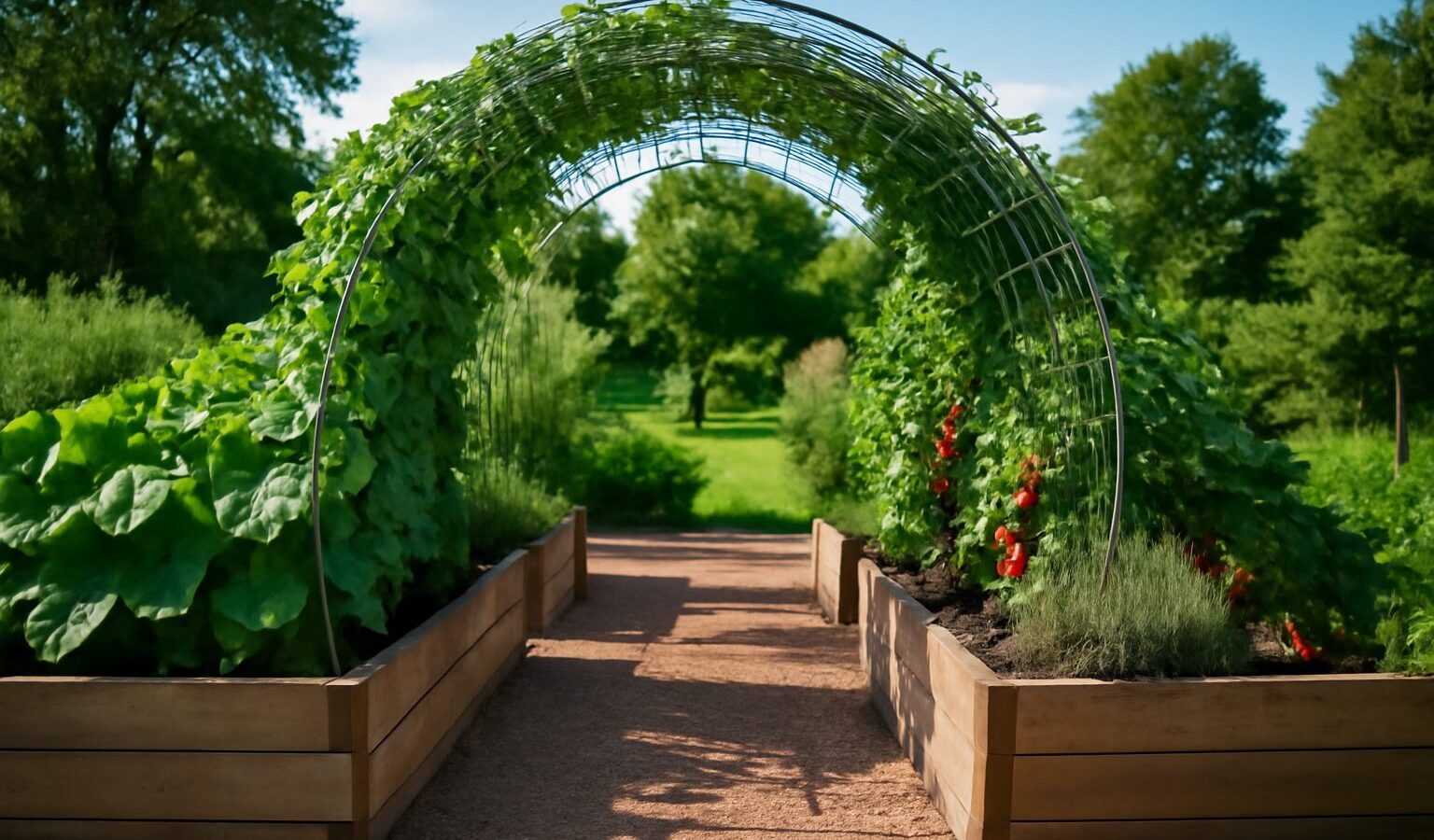
A cattle panel trellis is the best value in the vegetable garden: a single 16-foot livestock panel, bent into an arch or stood up as a flat wall, gives you a rigid, rust-resistant climbing structure that will outlast a dozen flimsy nylon nets and support the heaviest squash, gourds, and cucumbers without sagging. The 4-by-4-inch galvanized grid is the perfect size — wide enough to reach a hand through and harvest, tight enough that tendrils grab it instantly. Best of all, you can build one in an afternoon with a couple of T-posts and zip ties, no welding or carpentry required. This guide walks through both the arched-tunnel and the flat-trellis versions, with exact materials, measurements, and step-by-step instructions for bending and anchoring the panel safely, plus the best crops to grow up it.
Key Takeaways
- One panel does it: A standard 16 ft × 50 in cattle panel makes a full arch or a tall flat trellis on its own.
- Arch span sets the height: Anchor the ends 4–5 feet apart for a tall, walkable tunnel; closer for a steeper, shorter arch.
- T-posts are the anchors: Drive four T-posts and zip-tie or wire the panel to them — no concrete, no holes to dig.
- Wear protection: Cut panel ends are sharp and springy; gloves, eye protection, and a helper make the bend safe.
- It lasts for years: Galvanized steel shrugs off rain and sun and supports squash, gourds, melons, beans, and cucumbers without sagging.
- Plant both sides: An arch doubles your growing space and shades a cool, productive walkway beneath it.
What is a cattle panel and why it works
A cattle panel — sometimes sold as a livestock or stock panel — is a sheet of welded, galvanized steel rod fencing, typically 16 feet long and about 50 inches tall, with a grid of roughly 4-by-4-inch openings (some panels narrow the spacing toward one end; either works for a trellis). The rod is thick, usually around 4-gauge, so the panel is genuinely rigid: bent into an arch it holds its shape under the weight of a crop of pumpkins, and stood flat it won’t billow or sag like netting. The galvanized coating means it won’t rust through for many years of outdoor use.
You’ll find them at farm-supply stores for a modest price — far cheaper per square foot than any purpose-made garden trellis or arch. The one quirk to plan around is transport: a 16-foot panel won’t fit in most vehicles flat, but because it’s flexible along its length you can curl it into a large hoop, tie it in two or three places, and fit it in the bed of a pickup or even the back of a hatchback with the seats down. Wear gloves and eye protection when you do — a curled panel under tension can spring open.
Materials and tools
For either design you’ll need very little hardware. This list builds one arch or one flat trellis from a single panel:
- 1 cattle panel, 16 ft × ~50 in (4-gauge galvanized)
- 4 steel T-posts, 5–6 ft long (for an arch) or 6–7 ft (for a tall flat trellis)
- 1 T-post driver (the sleeve-style pounder makes this a two-minute job)
- Heavy-duty UV-resistant zip ties (50 lb rating) or galvanized fence wire
- Bolt cutters or an angle grinder, only if you need to cut the panel to length
- Work gloves and safety glasses (non-negotiable — cut ends are sharp and the panel springs)
- A helper for the arch — bending and holding a 16-foot panel solo is awkward and risky
- Tape measure and a mallet
Building the cattle panel arch (tunnel trellis)
The arch is the showpiece version — a walk-through tunnel dripping with squash, gourds, beans, or flowers. The height and steepness of the arch are set entirely by how far apart you anchor the two ends. The math is simple: the panel is 16 feet of arc, so the closer the bases, the taller and steeper the arch; the wider apart, the lower and flatter. For a tunnel you can comfortably walk through, set the bases 4 to 5 feet apart, which gives a peak height of roughly 6½ to 7 feet.
- Mark the footprint. Decide where the arch will stand — ideally spanning a path or between two raised beds. Mark two parallel lines 4–5 feet apart for the two long sides of the panel.
- Drive the T-posts. Pound in a T-post at each of the four corners, about 18–24 inches into the ground, leaving 3–4 feet above ground. The posts on each side should be roughly 14–15 feet apart along the length, just inside where the panel ends will sit. Keep them plumb.
- Stand the panel against one side. With a helper, lift the panel and rest one long edge on the ground just inside the first pair of posts.
- Bend the arch. While your helper holds the bottom edge against the inside of the first two posts, walk the top edge over and down toward the opposite pair of posts. The panel will naturally curve into an arch. Take it slow — it carries spring tension.
- Anchor both ends. Fasten the panel to all four T-posts with heavy zip ties or wire at the top, middle, and bottom of each post. Tie it tight so the arch can’t shift or kick out.
- Check stability. Push on the arch from several directions. If it racks side to side, add a fifth and sixth post at the midpoint of each side, or tie a second panel end-to-end for a longer, self-bracing tunnel.
For a longer tunnel, connect two or more panels end to end with wire before bending, and add a pair of T-posts at every panel joint. A multi-panel tunnel braces itself and becomes a striking garden feature. For more structural projects in the garden, see our Outdoor Living hub.
Building the flat cattle panel trellis
If you want a tall vertical wall for peas, beans, cucumbers, or tomatoes along the back of a bed, stand the panel up flat. This is even simpler than the arch and a great way to use a panel in a tight row garden.
- Decide the orientation. Stood on its 16-foot edge, the panel makes a long, roughly 50-inch-tall fence. For a taller trellis, stand it on the short end so it rises nearly 16 feet — though that height needs sturdy posts and is only worth it for vigorous vines.
- Drive the T-posts. For a 16-foot-long, 50-inch-tall trellis, drive three or four T-posts in a straight line, spaced about 5 feet apart, 18–24 inches deep, leaving most of the post above ground.
- Lift and attach the panel. Stand the panel against the posts on the side the plants will climb. Center it on the posts at a comfortable working height — you can sit it a few inches off the soil so the bottom rod doesn’t rust in wet ground.
- Fasten securely. Zip-tie or wire the panel to each post in at least three places — top, middle, and bottom. Pull every tie tight so the panel can’t slide down or lean.
- Brace if needed. In windy sites or for heavy crops, angle a post slightly back or add a diagonal brace at each end so the wall doesn’t lean once it’s loaded with growth.
Best plants for a cattle panel trellis
The 4-inch grid and steel strength make a cattle panel trellis especially good for heavy, vigorous climbers that would overwhelm netting or string. Top performers include:
- Cucumbers: They climb readily, and trellised fruit grows straight, clean, and easy to spot for harvest.
- Pole beans: Twine up the grid with no help and crop heavily all season; an arch of beans is a classic.
- Winter squash and small pumpkins: The grid carries the vines beautifully; support heavy fruit with a sling of fabric or old pantyhose tied to the panel.
- Gourds: Long-necked and ornamental gourds dangle dramatically through an arch and are a tunnel showstopper.
- Melons: Smaller varieties like personal-size cantaloupe work well with fruit slings.
- Peas: Spring peas grab the lower grid instantly; great for a flat trellis early in the season.
- Indeterminate tomatoes: Tie them loosely to a flat panel for a sturdy, airy support that beats a cage.
- Flowering vines: Morning glory, nasturtium, sweet peas, and even small-fruited squash turn an arch into an ornamental tunnel.
Plant along both sides of an arch to double your yield and create a shaded, productive walkway underneath — a real space-saver in a small plot. If you garden in tight quarters, our Urban Gardening guides have more vertical growing ideas, and the hugelkultur bed build pairs perfectly with a panel arch over a raised mound.
Care, longevity, and safety notes
A galvanized cattle panel needs essentially no maintenance and will last for many years outdoors. The few things worth doing: at the end of each season, cut away spent vines rather than yanking them so you don’t bend the panel, and replace any zip ties that have gone brittle in the sun with fresh UV-rated ties or switch to wire for permanence. If the arch loosens over a winter of wind, re-tighten the ties at the posts. The galvanizing protects against rust, but cut ends will eventually weather — if you trimmed the panel, those raw ends are the only spots that may show surface rust, and a dab of cold-galvanizing spray seals them.
On safety: treat cut and free panel ends with respect. They’re sharp, and a panel under bending tension stores real energy — if a tie slips or you lose your grip mid-bend, the panel can snap back hard. Always wear gloves and eye protection, work with a partner on the arch, and keep your face and body out of the path of a springing panel. Once it’s tied to four solid T-posts, though, it’s rock-stable and completely safe to garden around for years.
Frequently Asked Questions
How tall is a cattle panel arch?
It depends on how far apart you set the ends. A 16-foot panel anchored with its bases 4–5 feet apart forms a tunnel about 6½ to 7 feet tall at the peak — enough to walk through. Set the bases closer for a taller, steeper arch, or wider for a lower, flatter one.
How many T-posts do I need for a cattle panel arch?
Four T-posts is the minimum — one at each corner of the arch’s footprint. For extra stability in windy sites, with heavy crops, or for a longer multi-panel tunnel, add a pair of posts at the midpoint of each side or at every panel joint.
Will a cattle panel rust?
The galvanized zinc coating resists rust for many years, so an intact panel left outdoors holds up well. The only vulnerable spots are cut ends, where you’ve exposed bare steel — seal those with cold-galvanizing spray, and the panel will last a decade or more in the garden.
How do I transport a 16-foot cattle panel?
Because the panel flexes along its length, you can curl it into a large hoop, tie it in two or three places with rope or straps, and fit it in a pickup bed or even a hatchback with the seats folded. Wear gloves and eye protection, and keep clear of the ends, since a curled panel under tension can spring open.
What can I grow on a cattle panel trellis?
Almost any climbing crop, and especially heavy ones the steel can support: cucumbers, pole beans, winter squash, small pumpkins, gourds, and melons (use fabric slings for heavy fruit). It also works for peas, indeterminate tomatoes tied loosely to it, and ornamental vines like morning glory and sweet peas.
For the price of one panel and four T-posts, a cattle panel trellis gives you a structure that will anchor your garden for a decade — strong enough for pumpkins, tall enough to walk under, and simple enough to build in an afternoon. Drive the posts, bend the panel with a helper, tie it tight, and plant both sides. By midsummer you’ll have a living green tunnel doing the work of a far more expensive structure.