

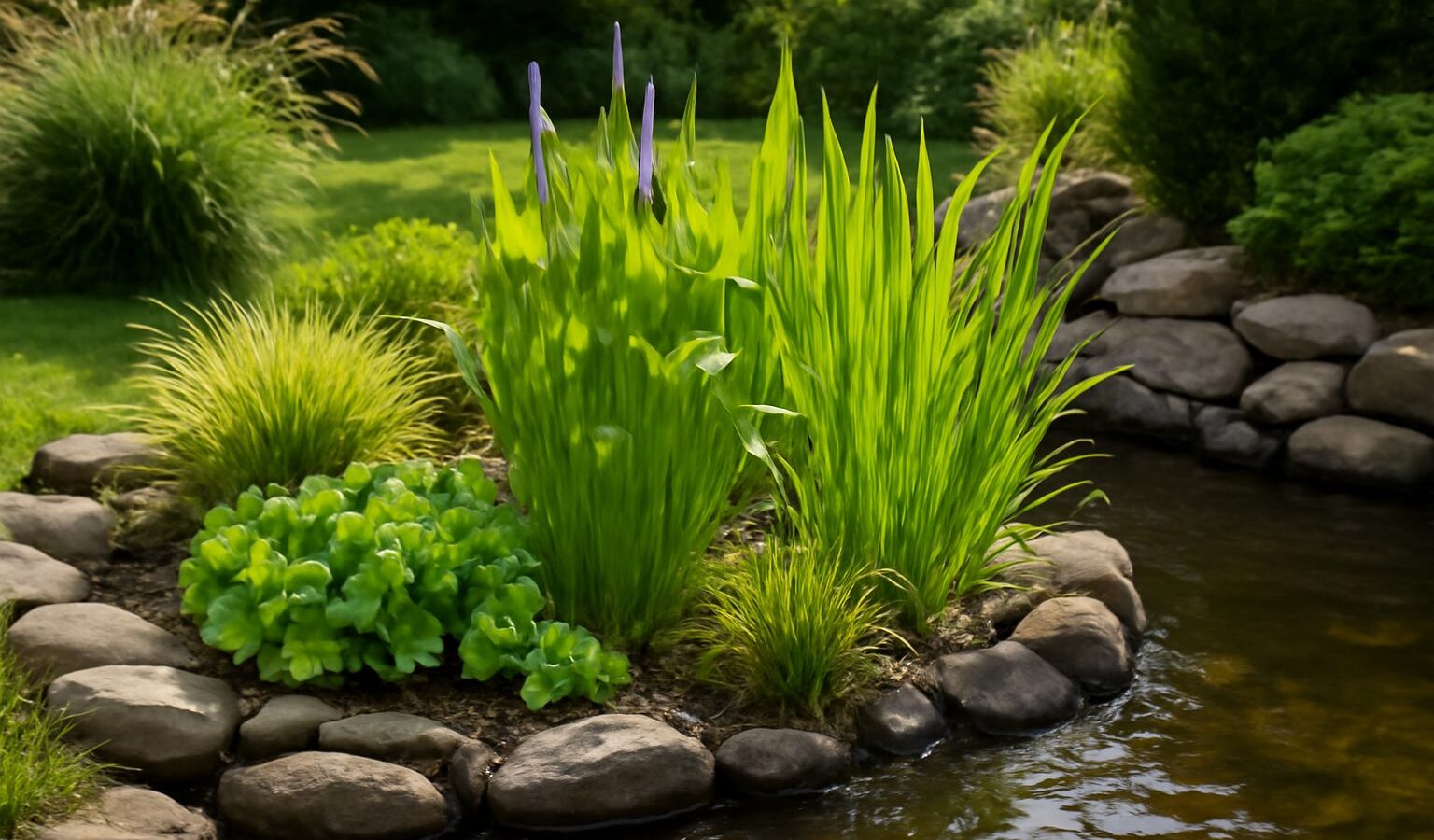
A bog filter is one of the most effective, lowest-maintenance ways to keep pond water crystal clear without relying on chemicals or fussy mechanical units. It works by pumping pond water up through a bed of gravel planted with marginal plants, which strip out the dissolved nitrates and phosphates that feed string algae and green water. Done right, a bog filter handles both biological and mechanical filtration at once, and it becomes a beautiful planted feature rather than a piece of equipment you try to hide. This guide walks you through sizing, materials, the exact plumbing layout, planting, and seasonal care so you can build one that actually performs.
Key Takeaways
- Size the bog at roughly 10-30% of the pond’s surface area for strong nutrient removal.
- Water enters at the bottom through a perforated pipe grid and flows up through gravel for even, no-clog distribution.
- Use 3/8-inch (pea) gravel, 10-12 inches deep, planted with heavy-feeding marginals.
- Aim for a turnover of about once every 1-2 hours through the bog; oversize the pump for head loss.
- Bog filters need only an annual trim and a gravel rinse every few years, not weekly cleaning.
What a Bog Filter Is and Why It Works
A bog filter is a shallow, gravel-filled basin connected to your pond. Pond water is pumped to the bottom of the gravel bed and rises slowly through it. As it travels upward, two things happen. First, the enormous surface area of the gravel hosts colonies of nitrifying bacteria that convert toxic ammonia and nitrite into nitrate. Second, fast-growing marginal plants rooted in the gravel pull that nitrate and dissolved phosphate out of the water as fertilizer. Algae compete for the same nutrients, so when your plants win, the algae starve.
Unlike a pressurized canister or box filter, a bog has no media to swap and no foam to scrub every weekend. It is essentially a constructed wetland, the same process municipalities use to polish wastewater. If you are weighing your options, compare it against the units in our roundup of the best pond filters before you commit.
Sizing Your Bog Filter
The single biggest factor in performance is surface area. As a rule of thumb, make the bog at least 10% of the pond’s surface area for a lightly stocked water garden, and push it to 25-30% for a koi pond or any heavily stocked system. A 10-foot by 15-foot pond (150 square feet) paired with a koi load should have a bog of roughly 30-45 square feet, for example a 6-by-7-foot bed.
Depth matters too. You want 10-12 inches of gravel above the distribution pipes, plus a few inches of open space below the pipes for water to spread. That puts total excavation depth around 16-18 inches. Shallower beds clog faster and hold fewer bacteria; deeper beds waste gravel without adding much benefit because most biological activity happens in the upper zone where oxygen is present.
Pump and Flow Math
Target turning the entire pond volume through the bog once every one to two hours. To find your pond volume in gallons, multiply length x width x average depth (all in feet) x 7.48. A 150-square-foot pond averaging 2 feet deep holds about 2,244 gallons (150 x 2 x 7.48). For a two-hour turnover you need roughly 1,100 GPH delivered at the bog.
That last phrase is critical. Pumps lose flow to head height (vertical lift) and pipe friction. Lifting water 3 feet to the top of the bog, plus friction through 15 feet of 1.5-inch pipe and a few fittings, can easily cost you 25-30% of the pump’s rated output. So size up: choose a pump rated near 1,500 GPH at zero head to reliably deliver 1,100 GPH at the bog. Always check the pump’s flow curve rather than its headline number. Our guide on how to choose a pond pump walks through reading those curves.
Materials You Will Need
- EPDM pond liner and underlayment sized to the bog dimensions plus overlap (or a preformed basin/stock tank)
- 3/8-inch washed pea gravel, enough for a 10-12 inch bed (roughly 1 ton per 30-40 square feet at this depth)
- 1.5-inch or 2-inch PVC for the distribution manifold, plus a tee, elbows, and end caps
- A bulkhead fitting or flexible pipe to bring water from the pump
- A pond pump sized per the math above
- Marginal bog plants (see planting section)
- A drill with a 1/4-inch bit for perforating the pipes; PVC primer and cement
Step-by-Step Construction
1. Excavate and Line the Basin
Dig the bog to your planned dimensions and depth, ideally adjacent to and slightly above the pond so treated water can spill back in over a small waterfall or stream. Remove rocks and roots, lay underlayment, then the EPDM liner. The bog can share a single large liner with the pond, separated by a berm, or sit in its own basin. For liner selection and seaming, see our pond liner guide.
2. Build the Distribution Manifold
The manifold is what makes a bog work without clogging. Build a grid or comb of PVC pipe that sits on the basin floor. Drill 1/4-inch holes every 4-6 inches along the pipes, and point the holes downward at roughly the 4 o’clock and 8 o’clock positions. Downward-facing holes push water against the liner so debris cannot settle into them, and they distribute flow evenly across the entire footprint instead of jetting it up one spot. Cap the ends and connect the manifold to your pump line via a bulkhead.
A simple comb design works for most home ponds: one main supply pipe across the back with three or four lateral pipes branching off it, spaced about 18 inches apart. The total open area of all the holes should roughly match the cross-section of the supply pipe so pressure stays even from the first hole to the last.
3. Add the Gravel
Rinse the pea gravel thoroughly before it goes in, or the first weeks will be cloudy with rock dust. Cover the manifold with a couple of inches first, run the pump briefly to confirm even bubbling across the whole bed, then fill to your full 10-12 inch depth. Do not wrap the pipes in landscape fabric or filter sock; it will clog within a season and is the most common reason home bog filters fail.
4. Set the Outflow
Water that has risen through the gravel needs to exit back to the pond. The cleanest method is a spillway or weir at the top edge of the bog set about an inch below the gravel surface, so water sheets out over rock into the pond or a short stream. This also re-oxygenates the water. Make the outflow wider than you think you need so it never backs up and floods the gravel surface.
Choosing and Planting Bog Plants
The harder a plant feeds, the better it cleans. Plant directly into the gravel, bare-root, washing off any soil first so you do not introduce nutrients you are trying to remove. Pack plants densely; full coverage within one season is the goal.
- Pickerelweed (Pontederia cordata), USDA zones 3-10, blue flower spikes, vigorous nutrient uptake
- Soft rush and corkscrew rush (Juncus), zones 4-9, evergreen structure
- Cardinal flower (Lobelia cardinalis), zones 3-9, brilliant red blooms for pollinators
- Blue flag iris (Iris versicolor), zones 3-9, early-season color and dense roots
- Watercress and water celery, fast-growing nutrient hogs ideal for the first season
- Canna and taro for zones 8-11, big tropical foliage and heavy feeding
Avoid invasive marginals like purple loosestrife or yellow flag iris, which are banned in many states. Match selections to your USDA hardiness zone so the bog stays planted year after year rather than needing replanting each spring.
Seasonal Care and Maintenance
A mature bog is remarkably hands-off. In spring, cut back last year’s dead growth before new shoots emerge and divide any plants that have become crowded. Through summer, simply top up evaporation and enjoy it; this is when nutrient stripping peaks and the water runs clearest. In fall, trim back foliage after the first hard frost and net out leaf litter so it does not sink into the gravel. In winter, in cold zones keep the pump running below the freeze line or shut it down and drain the manifold to prevent cracking.
Every two to four years the upper gravel can accumulate fine organic muck. When flow noticeably slows or plants struggle, lift a section of plants, rinse the top few inches of gravel with a hose into a bucket, and replace it. You rarely need to disturb the whole bed at once.
Troubleshooting
- Water still green after several weeks: a new bog takes 4-8 weeks for bacteria and plants to establish. Be patient, and add a UV clarifier temporarily if needed.
- Flow dropping over time: usually a clogged pump intake or a manifold packed with debris because holes faced upward. Recheck hole orientation.
- Water channeling up one spot: uneven gravel depth or too few/too large holes. Redrill more, smaller holes for even distribution.
- Plants yellowing: in a well-running bog this means low nutrients, which is the goal; supplement lightly only if growth stalls completely.
- String algae persisting: bog may be undersized for the fish load; increase bog area or reduce feeding and stocking.
Frequently Asked Questions
How big should a bog filter be compared to the pond?
Plan for 10% of the pond’s surface area for a lightly stocked water garden and 25-30% for a koi pond or heavily stocked system. Bigger is always better for clarity, never worse.
What pump size do I need for a bog filter?
Aim to turn the pond volume through the bog once every 1-2 hours, then oversize for head loss. A roughly 2,200-gallon pond needs about 1,100 GPH at the bog, so pick a pump rated near 1,500 GPH at zero head.
What gravel is best for a bog filter?
Use washed 3/8-inch (pea) gravel, 10-12 inches deep. It has enough surface area for bacteria and small enough gaps to filter debris, while still letting roots spread and water flow freely.
Do I need to clean a bog filter often?
No. A trim in spring and fall plus an occasional gravel rinse every 2-4 years is usually all it needs. That low maintenance is the main advantage over mechanical filters.
Can a bog filter handle koi?
Yes, and they excel at it, but you must size them larger (25-30% of surface area) because koi produce heavy waste. Pair the bog with a good pump and pre-skimming for best results.