


Most established perennials need less fertilizer than gardeners think. A single spring feeding with a slow-release organic product, plus a top-dressing of compost, carries the majority of perennial beds through the season. Heavy feeders such as delphinium, phlox, peonies and daylilies in sandy soil may want a second light feeding in early summer, but too much nitrogen gives floppy stems and fewer flowers. That is why a gentle, balanced, slow-release fertilizer like Espoma Plant-tone is our top pick, with a synthetic smart-release option for gardeners who want one application to last months. Below are six fertilizers worth considering and a practical feeding schedule.
Part of our Flowers & Perennials guide →
In this guide
- Our Quick Picks
- 1. Espoma Plant-tone 5-3-3 — Best Overall for Perennial Beds
- 2. Espoma Plant-tone 50 lb — Best for Large Borders
- 3. Osmocote Smart-Release Plant Food Plus — Best Slow-Release Synthetic
- 4. Espoma Garden-tone 3-4-4 — Best Lower-Nitrogen Organic
- 5. Espoma Iron-tone 3-0-3 — Best for Yellowing Leaves
- 6. Espoma Plant-tone 4 lb 3 Pack — Best Multi-Bed Supply
- How to Choose a Fertilizer for Perennials
- Frequently Asked Questions
Disclosure: Urban Lotus Project earns a commission from qualifying Amazon purchases made through links on this page, at no extra cost to you.
How we compared: we compared 16 current Amazon listings on what each listing states about analysis, ingredients, release type and application. We did not test or handle the products, and availability changes.
Key Takeaways
- Feed most established perennials once in spring as new growth emerges; add a second light feeding only for heavy bloomers or poor soil.
- Low, balanced analyses such as 5-3-3 or 3-4-4 suit perennials better than high-nitrogen lawn or houseplant formulas.
- Organic granules feed soil life and release slowly; resin-coated synthetic granules release on a predictable timer.
- Stop feeding by midsummer so plants harden off before winter.
- A soil test tells you whether you need phosphorus at all; many garden soils already have plenty.
Our Quick Picks
| Product | Best for | Key features | Buy |
|---|---|---|---|
| Espoma Plant-tone 5-3-3 4 lb | Best overall for perennial beds |
| Buy now →Check current price |
| Espoma Plant-tone 5-3-3 50 lb | Best for large borders |
| Buy now →Check current price |
| Osmocote Smart-Release Plus 8 lb | Best slow-release synthetic |
| Buy now →Check current price |
| Espoma Garden-tone 3-4-4 4 lb | Best lower-nitrogen organic |
| Buy now →Check current price |
| Espoma Iron-tone 3-0-3 5 lb | Best for yellowing leaves |
| Buy now →Check current price |
| Espoma Plant-tone 4 lb 3 Pack | Best multi-bed supply |
| Buy now →Check current price |
Prices change often; check Amazon for today’s price. As an Amazon Associate we earn from qualifying purchases.
1. Espoma Plant-tone 5-3-3 — Best Overall for Perennial Beds
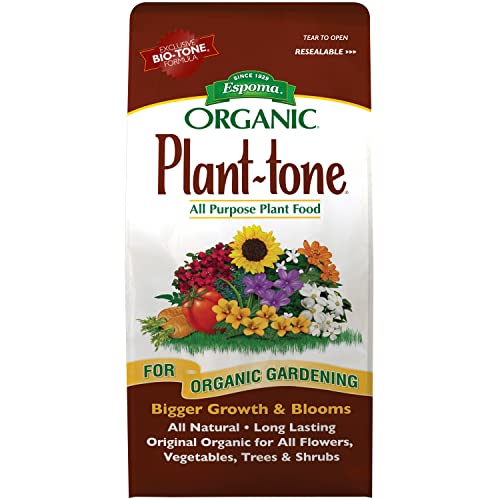
Gentle organic all-purpose granules listed for annuals, perennials, roses, shrubs and vegetables.
Check price on AmazonWhy We Like It
- Low, balanced analysis suits perennials
- Slow organic release, low burn risk
- Includes calcium and beneficial microbes
- Registered organic input material
| Specification | Details |
|---|---|
| Analysis | 5-3-3 with 5 percent calcium |
| Type | Natural and organic granular |
| Additives | Bio-tone microbial blend |
| Size | 4 lb bag |
| Listed frequency for flowers | Monthly through the growing season |
| Organic status | Approved for organic gardening |
Espoma Plant-tone 4 lb — compressed specs
Plant-tone is the fertilizer many perennial gardeners already reach for, and for good reason. The 5-3-3 analysis is low enough that you are unlikely to overdo nitrogen, the natural ingredients break down slowly, and the listing specifically names perennials alongside annuals and roses. You scatter it around the drip line of each clump and water it in; there is nothing to mix.
The label suggests monthly use for flowers through the season, but for established perennials in decent soil we suggest starting with a spring application and adding one more in early summer only for heavy bloomers. Like all organic granules, it can attract dogs and may smell earthy for a day or two after application.
Pros
- Hard to over-apply
- Feeds soil biology
- Works across the whole garden
Cons
- Earthy smell after application
- Slower to green up than synthetics
- Dogs may dig at it
Check Espoma Plant-tone 5-3-3 4 lb price on Amazon
2. Espoma Plant-tone 50 lb — Best for Large Borders

The same 5-3-3 organic formula in a 50 lb bag for big borders, foundation beds and shrub plantings.
Check price on AmazonWhy We Like It
- Identical formula to the 4 lb bag
- One bag covers a large landscape
- Also feeds shrubs and trees
- Made in the USA per listing
| Specification | Details |
|---|---|
| Analysis | 5-3-3 with 5 percent calcium |
| Type | Natural and organic granular |
| Size | 50 lb bag |
| Listed timing for shrubs | Spring and fall |
| Model | PT50 |
Espoma Plant-tone 50 lb — compressed specs
If you garden on a large lot with long perennial borders, foundation shrubs and a vegetable patch, the 50 lb bag avoids buying small bags several times a season. The formula is the same as our top pick, and the listing covers shrubs and trees in spring and fall as well as monthly feeding for flowers and vegetables.
The trade-off is storage. Organic fertilizers should stay dry and sealed, so decant into a lidded bin rather than leaving a torn bag in a damp shed. For a single bed or two, the smaller bag is the better fit.
Pros
- Covers big gardens in one purchase
- Same trusted formula
- Works on shrubs and trees
Cons
- Heavy to move
- Needs dry, sealed storage
- Too much for small gardens
Check Espoma Plant-tone 5-3-3 50 lb price on Amazon
3. Osmocote Smart-Release Plant Food Plus — Best Slow-Release Synthetic

Resin-coated granules with 11 nutrients that feed for up to six months from one application.
Check price on AmazonWhy We Like It
- One application feeds up to six months
- Resin coating controls release
- No-burn pledge when used as directed
- Works in beds and containers
| Specification | Details |
|---|---|
| Type | Resin-coated controlled-release granules |
| Nutrients | 11 essential nutrients |
| Duration | Up to 6 months per listing |
| Coverage | Up to 300 sq ft per 8 lb container |
| Size | 8 lb |
| NPK analysis | Not stated in listing |
Osmocote Smart-Release Plus 8 lb — compressed specs
Osmocote is the pick for gardeners who want to feed once and forget it. Each granule is coated with resin that meters nutrients out over time, and the listing says one application feeds for up to six months. It is the only synthetic product among our picks and the only one that states a square-foot coverage figure, up to 300 square feet per 8 lb container.
For perennials, apply it once in spring as growth emerges; in most climates that carries plants to late summer. It does nothing for soil organic matter, so pair it with compost. The listing does not state the NPK analysis, so check the container label.
Pros
- Single spring application
- Predictable release
- Good for containers too
Cons
- Not organic
- No soil-building benefit
- Analysis not in listing
Check Osmocote Smart-Release Plus 8 lb price on Amazon
4. Espoma Garden-tone 3-4-4 — Best Lower-Nitrogen Organic
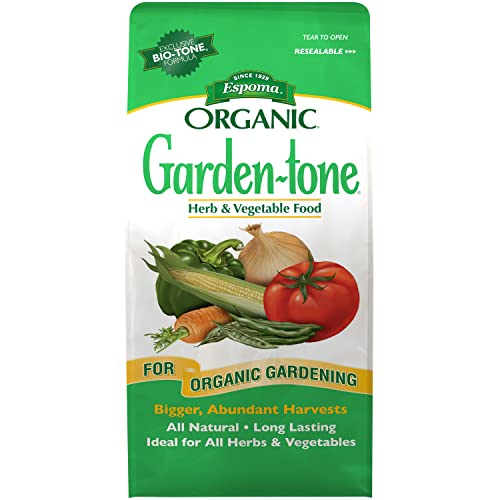
Organic 3-4-4 granules marketed for vegetables, with less nitrogen relative to phosphorus and potassium.
Check price on AmazonWhy We Like It
- Lower nitrogen than Plant-tone
- Less risk of floppy growth
- Same organic base and calcium
- Doubles as vegetable garden food
| Specification | Details |
|---|---|
| Analysis | 3-4-4 with 5 percent calcium |
| Type | Natural and organic granular |
| Listed use | Cool and warm season vegetables and herbs |
| Listed frequency | Monthly through the season |
| Size | 4 lb |
Espoma Garden-tone 4 lb — compressed specs
Garden-tone is sold for vegetables, not perennials, so the listing does not name flowers. We include it because its 3-4-4 analysis has less nitrogen relative to phosphorus and potassium than Plant-tone, which suits perennials that tend to flop or go leafy, such as asters, sedum, Russian sage and tall coreopsis, and beds in rich soil that need only a light boost.
If you grow vegetables and perennials side by side, one bag can serve both. If a soil test shows high phosphorus, which is common in gardens that have had years of manure or compost, stick with a lower-phosphorus option or just compost.
Pros
- Gentle nitrogen level
- Organic and slow release
- Useful across veg and flower beds
Cons
- Not marketed for perennials
- Extra phosphorus not always needed
- Small bag for large beds
Check Espoma Garden-tone 3-4-4 4 lb price on Amazon
5. Espoma Iron-tone 3-0-3 — Best for Yellowing Leaves
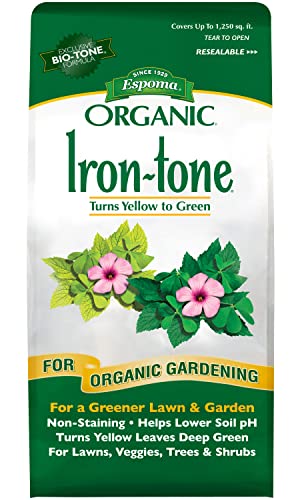
Organic iron and sulfur supplement for perennials, shrubs and lawns showing yellow leaves with green veins.
Check price on AmazonWhy We Like It
- Targets iron chlorosis specifically
- Listing names perennial flowers
- Will not stain patios or walks
- Sulfur helps in alkaline soil
| Specification | Details |
|---|---|
| Analysis | 3-0-3 with 6 percent iron and 17 percent sulfur |
| Type | Organic granular |
| Listed use | Lawns, shrubs, trees, annual and perennial flowers |
| When to use | At first sign of yellowing |
| Size | 5 lb |
Espoma Iron-tone 5 lb — compressed specs
Iron-tone is a fix, not a regular food. If perennials such as astilbe, hydrangea, clematis or bleeding heart develop yellow leaves with green veins, the problem is often iron that the plant cannot take up because the soil pH is too high. The listing pairs iron with a large dose of sulfur, which helps on alkaline soils, and notes that it will not stain hardscape, a real advantage in beds beside paths.
Use it alongside a regular fertilizer rather than instead of one, and confirm with a soil test, since yellowing can also come from overwatering, nitrogen shortage or root damage.
Pros
- Direct fix for iron chlorosis
- Safe near pavers and walks
- Organic ingredients
Cons
- Not a complete fertilizer
- Only helps if iron is the issue
- Slow on very alkaline soil
Check Espoma Iron-tone 3-0-3 5 lb price on Amazon
6. Espoma Plant-tone 4 lb 3 Pack — Best Multi-Bed Supply

Three 4 lb bags of organic 5-3-3 for several beds without storing a 50 lb sack.
Check price on AmazonWhy We Like It
- Middle ground between small and bulk
- Small bags stay sealed until used
- Same organic 5-3-3 formula
| Specification | Details |
|---|---|
| Analysis | 5-3-3 with 5 percent calcium |
| Pack | Three 4 lb bags |
| Type | Natural and organic granular |
| Organic status | Approved for organic gardening |
| Fillers | None per listing |
Espoma Plant-tone 3 Pack — compressed specs
For a typical suburban yard with three or four perennial beds, a few 4 lb bags is often the most practical format. You can keep one open in the garage and the rest sealed, which keeps the fertilizer dry and fresh into next season. The formula and instructions match our top pick.
Pros
- Easy storage and handling
- Enough for several beds
- Same proven formula
Cons
- More packaging than bulk
- Still an organic smell
- Overkill for one small bed
Check Espoma Plant-tone 4 lb 3 Pack price on Amazon
How to Choose a Fertilizer for Perennials
Read the three numbers
The NPK numbers show the percentage of nitrogen, phosphorus (as phosphate) and potassium (as potash). Nitrogen drives leafy growth, phosphorus supports roots and flowering, and potassium supports overall vigor and stress tolerance. For perennials, look for low, roughly balanced numbers under about 10 each. High-nitrogen lawn fertilizers push soft, leafy growth that flops and invites aphids. Our explainer on NPK fertilizer numbers covers label reading in detail.
Organic vs synthetic slow-release
Organic granules rely on soil microbes to break them down, so release speeds up in warm, moist soil and slows in cold. They also add organic matter. Resin-coated synthetics release on a more predictable schedule regardless of soil life. Either works; organics suit gardeners building soil, while coated synthetics suit those who want one application. For more on the trade-offs, see organic vs synthetic fertilizer.
When and how often to feed perennials
| Timing | What to do |
|---|---|
| Early spring, as shoots emerge | Main feeding: granular organic or one slow-release application, plus 1 inch of compost |
| Late spring to early summer | Optional light second feeding for heavy bloomers and sandy soils |
| After first flush of bloom | Light feeding for rebloomers you cut back, such as salvia and nepeta |
| After midsummer | Stop feeding so growth hardens before frost |
| Fall | Compost top-dressing only; no fertilizer for most perennials |
Perennials that need little or no fertilizer
Many tough perennials, including yarrow, lavender, Russian sage, coneflower, black-eyed Susan, sedum, gaillardia and most native prairie plants, grow leggy or short-lived in rich, fertilized soil. Compost alone, or nothing at all, is usually best. Heavy feeders include delphinium, peony, phlox, chrysanthemum, astilbe and daylily in poor soil. For bed planning ideas, our flowers and perennials guide groups plants by needs.
Application tips
- Scatter granules in a ring around each clump, out to the drip line, not against the crown.
- Scratch them lightly into the top inch of soil or mulch, then water thoroughly.
- Pull mulch back before applying and replace it afterward.
- Get a soil test every few years; you may not need phosphorus at all.
Frequently Asked Questions
Is Plant-tone good for perennials?
Yes. Espoma’s listing names perennials among its intended uses, and its low 5-3-3 analysis and slow organic release make it hard to overfeed established perennial beds.
How often should I fertilize perennials?
Once in early spring is enough for most established perennials. Heavy bloomers and plants in sandy soil may benefit from a second light feeding in early summer. Stop feeding after midsummer.
Can I use lawn fertilizer on perennials?
It is not a good idea. Lawn fertilizers are high in nitrogen, which produces soft, leafy growth and fewer flowers, and weed-and-feed products can damage or kill broadleaf perennials.
Should I fertilize perennials in the fall?
Generally no. Fertilizing late encourages tender growth that can be damaged by frost. A fall top-dressing of compost feeds soil without pushing new growth.
Is compost enough fertilizer for perennials?
For many perennials in reasonably fertile soil, an inch of compost each spring is enough. Heavy feeders, container perennials and plants in sandy or depleted soil usually benefit from an added slow-release fertilizer.