


Shade cloth is a knitted polyethylene mesh that cuts a set share of sunlight, and in a hot summer it can be the difference between peppers that sunscald and drop flowers and peppers that keep producing. The most important number on a listing is the shade percentage. Extension vegetable specialists generally recommend about 30 percent for fruiting crops, with heavier cloth reserved for lettuce and other heat-sensitive greens. Many shade cloths on Amazon are 55 to 90 percent, which suits patios, kennels and shade plants better than tomatoes. This guide compares current shade cloth listings by shade rate, size, grommets and hems, material and warranty, and matches each density to a garden job.
In this guide
As an Amazon Associate we earn from qualifying purchases.
How we compared: we compared 17 current Amazon shade cloth listings on what each listing states about shade percentage, dimensions, grommet type and spacing, edge reinforcement, material and warranty, and checked shade-rate guidance against university extension sources. We left out privacy fence screens and shade sails. We did not test or handle the products, and nothing here describes hands-on use. Availability and listing details change, so confirm the current listing before you buy.
| Product | Best for | Key features | Buy |
|---|---|---|---|
| SUNNY GUARD 35-45% Green 12x20 | Best overall for vegetable gardens |
| Buy now →Check current price |
| Mklsit 40% 6.5x10 ft | Best for a single raised bed |
| Buy now →Check current price |
| WindscreenSupplyCo 45% 5x10 | Best-built edges |
| Buy now →Check current price |
| LOVE STORY 55% 10x20 ft | Best for lettuce and greens |
| Buy now →Check current price |
| winemana 70% 20x30 ft | Best large cover for shade plants |
| Buy now →Check current price |
| Shade&Beyond 90% 8x12 ft | Best for patios and pergolas |
| Buy now →Check current price |
| QLOFEI 40-50% 3x6 ft | Best small piece for seedlings |
| Buy now →Check current price |
Prices change often; check Amazon for today’s price. As an Amazon Associate we earn from qualifying purchases.
The best shade cloth for gardens
1. SUNNY GUARD 35-45% Green Shade Cloth (12 x 20 ft) — Best overall for vegetable gardens

12 x 20 ft green HDPE mesh blocking about 35 to 45 percent of sunlight, UV-stabilized, with grommets on reinforced hems.
Check price on AmazonWhy we like it
- Lightest shade rate of any listing compared.
- Closest to the 30 percent vegetables prefer.
- 240 sq ft covers several beds.
- UV-stabilized, tear-resistant new HDPE.
| Specification | Details |
|---|---|
| Shade rate | About 35 to 45 percent |
| Size | 12 x 20 ft |
| Material | 100 percent new HDPE, UV-stabilized |
| Edges | Reinforced hems |
| Grommets | Aluminum, evenly spaced (interval not stated) |
| Color | Green |
SUNNY GUARD SG-XBBSC shade cloth — 35–45%, 12 x 20 ft, green UV-stabilized HDPE, aluminum grommets, reinforced hems.
The lightest shade cloth on the shelf, made for vegetables
Only five of the 17 shade cloth listings we compared are rated at 45 percent or less, and this SUNNY GUARD is the lightest, at about 35 to 45 percent. That matters because the extension guidance is consistent. University of Delaware Cooperative Extension says a 30 percent cloth gives adequate cooling without blocking too much light for most vegetables, and that it can be particularly helpful for peppers and tomatoes. New Mexico State University calls 30 percent the best rating for vegetables. Nobody on this shelf sells exactly 30 percent, so the lowest available rating is the safest choice for fruiting crops.
The listing is also explicit about its purpose: vegetables, flowers, seedlings and tomatoes that need protection without full shade. At 12 by 20 feet, it will span a pair of 4 x 8 ft raised beds on a simple frame. It is the only green cloth on the shelf; Delaware found colored cloths gave no advantage over black in their trials, so choose green for looks rather than performance.
The listing does not give grommet spacing or a fabric weight (GSM). Check the product photos if you plan to attach it at specific points on a frame.
Pros
- Lightest shade rate available here
- Large 12 x 20 ft piece
- UV-stabilized new HDPE
- Grommets on reinforced edges
Cons
- Still above the ideal 30 percent
- Grommet spacing not stated
- Fabric weight not given
Check SUNNY GUARD 35-45% Green 12x20 price on Amazon
2. Mklsit 40% Shade Cloth (6.5 x 10 ft) — Best for a single raised bed

6.5 x 10 ft, 40 percent UV-stabilized HDPE cloth with copper grommets every 20 inches and two at each corner.
Check price on AmazonWhy we like it
- Sized to drape one 4 x 8 ft bed.
- 40 percent: light enough for fruiting crops.
- Copper grommets resist bending.
- Closest grommet spacing stated, 20 in.
| Specification | Details |
|---|---|
| Shade rate | 40 percent |
| Size | 6.5 x 10 ft |
| Material | 100 percent new UV-stabilized HDPE |
| Grommets | Copper/brass, every 20 in, two per corner |
| Edges | Reinforced |
| Warranty | Not stated in listing |
Mklsit SC406x10 — 40%, 6.5 x 10 ft, UV-stabilized HDPE, copper grommets every 20 in, double corner grommets.
Copper grommets at close spacing on a bed-sized piece
Grommets are where shade cloth fails. Wind loads the corners, and thin aluminum rings can bend and tear out. Mklsit is the only brand on the shelf that uses copper grommets, with two at every corner and the rest every 20 inches, the closest spacing any listing states alongside LOVE STORY’s 19.7 inches. Close spacing spreads wind load and gives more tie points when you clip the cloth to hoops.
The 6.5 by 10 ft size suits one raised bed on hoops, with enough overhang to shade the bed from low afternoon sun. Mklsit also lists a 10 x 20 ft version. Read that listing carefully: it is sold as 40 percent but its description says it blocks up to 70 percent of sunlight, so confirm the rating before ordering the larger size.
Pros
- 40 percent shade rate
- Copper grommets every 20 in
- Double corner grommets
- Right size for one bed
Cons
- Small for multi-bed gardens
- Larger version’s rating is inconsistent
- No warranty stated
Check Mklsit 40% 6.5x10 ft price on Amazon
3. WindscreenSupplyCo 45% Heavy Duty Shade Cloth (5 x 10 ft) — Best-built edges

45 percent HDPE shade mesh with 1.5-inch polyester webbing on every hem, double-stitched sides and solid metal grommets.
Check price on AmazonWhy we like it
- Polyester webbing hems: the most detailed edge spec.
- Double-stitched sides resist fraying.
- Solid metal grommets.
- 45 percent suits fruiting crops in hot regions.
| Specification | Details |
|---|---|
| Shade rate | 45 percent |
| Size | 5 x 10 ft |
| Material | HDPE, UV resistant |
| Hems | 1.5 in polyester webbing, double-stitched |
| Grommets | Solid metal, evenly spaced |
| Grade | Described as commercial grade |
WindscreenSupplyCo 45% shade cloth — 5 x 10 ft, HDPE, 1.5 in webbing hems, double stitching, metal grommets.
The only listing with webbing-reinforced hems
Most listings say “reinforced edges” without explaining how. WindscreenSupplyCo specifies 1.5-inch polyester webbing sewn into every hem and double stitching along the sides, the construction used on commercial windscreen and truck tarps. For a cloth that will be tensioned over a frame and left up all summer in wind, that is the most reassuring edge spec on the shelf.
At 45 percent, it is a reasonable choice in very hot, high-sun regions where 30 percent is not enough. Delaware Extension’s 30 percent recommendation still applies in milder summers, so choose a lighter cloth there. The 5 x 10 ft size covers a narrow bed or one end of a larger bed. The listing does not give grommet spacing.
Pros
- Webbing-reinforced hems
- Double-stitched sides
- Metal grommets
- Moderate 45 percent rate
Cons
- Small 5 x 10 ft piece
- Grommet spacing not stated
- Slightly dense for mild climates
Check WindscreenSupplyCo 45% 5x10 price on Amazon
4. LOVE STORY 55% Shade Cloth (10 x 20 ft) — Best for lettuce and greens

10 x 20 ft, 55 percent HDPE shade mesh with aluminum grommets about every 19.7 inches and a stated 2 to 3 year life.
Check price on AmazonWhy we like it
- 55 percent suits lettuce and summer greens.
- Grommets roughly every 20 in.
- States an expected 2 to 3 year life.
- Large 200 sq ft piece.
| Specification | Details |
|---|---|
| Shade rate | 55 percent |
| Size | 10 x 20 ft |
| Material | 100 percent HDPE |
| Grommets | Aluminum, about every 19.7 in |
| Expected life | 2 to 3 years, per listing |
| Cable ties | Not included |
LOVE STORY 55% shade cloth — 10 x 20 ft, HDPE, aluminum grommets ~19.7 in apart, 2–3 year stated life.
A 55 percent cloth with grommets, for heat-sensitive crops
Fifty-five percent is the most common rating on the shelf: six listings, from Cool Area, TREEVEX, JINGLENK and LOVE STORY. That density is heavy for tomatoes, but University of Delaware Cooperative Extension notes that 50 to 70 percent shade is sometimes used for very heat-sensitive crops such as lettuce. Illinois Extension describes how heat makes broccoli, lettuce and other cool-season crops bitter, and how shade cloth lowers soil and air temperatures to help. A 55 percent cloth over a bed of lettuce, spinach or cilantro can stretch the harvest into summer.
Among the 55 percent listings, LOVE STORY is one of only two that come with grommets and state their spacing (the 6.5 x 10 ft Cool Area is the other). Two other Cool Area sizes, plus TREEVEX and JINGLENK, are meant to be tied with zip ties or rope through the mesh, or cut to size. Cable ties are not included here. The listing showed low stock at the time of the pull.
Pros
- Good density for greens
- Grommets about every 20 in
- Expected life stated
- Large piece
Cons
- Too dense for most fruiting crops
- Cable ties sold separately
- Low stock at time of pull
Check LOVE STORY 55% 10x20 ft price on Amazon
5. winemana 70% Shade Cloth (20 x 30 ft) — Best large cover for shade plants

20 x 30 ft, 70 percent black HDPE cloth with lock-stitch knit, taped edges and grommets every 40 in.
Check price on AmazonWhy we like it
- 600 sq ft, the largest piece on the shelf.
- Lock-stitch knit resists unraveling if cut.
- Taped edges and reinforced corners.
- Also sold in a 90 percent version.
| Specification | Details |
|---|---|
| Shade rate | 70 percent |
| Size | 20 x 30 ft |
| Material | HDPE |
| Construction | Lock-stitch knit, taped edges, reinforced corners |
| Grommets | Every 40 in along all edges |
| Weight | About 6.9 lb |
winemana 70% shade cloth — 20 x 30 ft, HDPE, lock-stitch knit, taped edges, grommets every 40 in.
The biggest single piece, at a density for shade lovers and structures
At 20 by 30 feet, this winemana cloth is the largest on the shelf. Seventy percent is too dense for vegetables, but it suits a lath-house style shelter for hostas, ferns and other shade garden plants, a nursery area for potted shrubs, or summer shading over a greenhouse. University of Delaware’s crop update notes that the most common use of shade cloth has been reducing greenhouse temperatures in summer and growing shade-loving ornamentals in nurseries.
Lock-stitch knitting means the cloth will not run if you cut it to fit, and taped edges with reinforced corners take the strain at the grommets. The 40-inch grommet spacing is wide, so add clips or ties between grommets on a windy site. The same listing family offers a 90 percent version for people and livestock shade.
Pros
- Largest piece compared
- Can be cut without unraveling
- Taped, reinforced edges
- Good for greenhouses and shade plants
Cons
- Too dense for vegetables
- Wide 40 in grommet spacing
- Large piece needs a strong frame
Check winemana 70% 20x30 ft price on Amazon
6. Shade&Beyond 90% Shade Cloth (8 x 12 ft) — Best for patios and pergolas
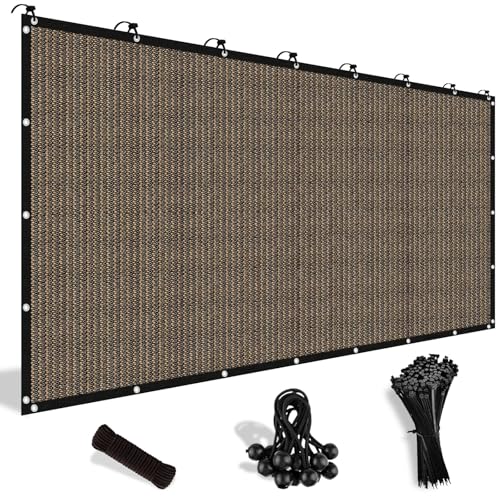
8 x 12 ft mocha 90 percent shade cover of 200 GSM HDPE with double grommets every 2 ft and a 5-year limited warranty.
Check price on AmazonWhy we like it
- Only listing with a stated warranty (5 years).
- 200 GSM: the heaviest fabric weight stated.
- Double grommets every 2 ft.
- Mocha color blends with patio furniture.
| Specification | Details |
|---|---|
| Shade rate | 90 percent |
| Size | 8 x 12 ft |
| Fabric | 200 GSM HDPE |
| Grommets | Every 2 ft, doubled on edges |
| Accessories | Fixing accessories included |
| Warranty | 5-year limited |
Shade&Beyond SBGN081270 — 90%, 8 x 12 ft, 200 GSM HDPE, double grommets every 2 ft, 5-year limited warranty.
The only shade cloth backed by a multi-year warranty
Shade&Beyond is the only listing of the 17 that states a warranty, and at five years limited it is a stronger signal of durability than the “2 to 3 years service life” that Cool Area and LOVE STORY quote. It is also the only listing that gives a fabric weight (200 GSM), a useful proxy for how dense and durable the knit is. Double grommets every 2 feet spread tension when the cloth is stretched over a pergola.
At 90 percent, this is a cloth for people, not vegetables: a pergola roof, a patio sitting area, a carport or a kennel. Under it, most edible crops would not get enough light. For a permanent shade structure over a patio, a fixed shade sail or pergola built by a contractor may suit better; our landscaping services page can connect you with local pros.
Pros
- 5-year limited warranty
- 200 GSM fabric
- Double grommets every 2 ft
- Fixing accessories included
Cons
- Far too dense for vegetables
- Smaller 8 x 12 ft piece
- Only one color in this listing
Check Shade&Beyond 90% 8x12 ft price on Amazon
7. QLOFEI 40-50% Shade Cloth (3 x 6 ft) — Best small piece for seedlings

Small 3 x 6 ft, 40 to 50 percent HDPE shade net with lock-stitch knit, reinforced corners and grommets every 40 inches.
Check price on AmazonWhy we like it
- 3 x 6 ft: the smallest piece on the shelf.
- Right for hardening off seedling flats.
- Lock-stitch knit, reinforced corners.
- Return, refund or replacement offered.
| Specification | Details |
|---|---|
| Shade rate | 40 to 50 percent |
| Size | 3 x 6 ft |
| Material | HDPE |
| Construction | Lock-stitch knit, reinforced corners |
| Grommets | Every 40 in along the edges |
| Weight | About 0.4 lb |
QLOFEI shade cloth — 40–50%, 3 x 6 ft, HDPE, lock-stitch knit, reinforced corners, grommets every 40 in.
A small cloth sized for flats, cold frames and new transplants
Every other listing starts at 5 by 10 feet or larger. The QLOFEI 3 by 6 ft piece is the right size to shade a seedling rack while it hardens off outdoors, cover a cold frame on a hot spring day, or shield a few new transplants for their first week in the ground. Its 40 to 50 percent rating gives young plants relief from midday sun while still letting them adjust to outdoor light.
New Mexico State University advises installing shade once plants are established and removing it when no longer needed. For seedlings, use the cloth for a few days during hardening off and then take it away. See our guide to row cover setups for hoops that can hold a small cloth over a bed.
Pros
- Small, handy size
- Moderate shade for young plants
- Lock-stitch knit
- Return or replacement offered
Cons
- Too small for a full bed
- Wide grommet spacing for its size
- Shade range rather than a fixed rating
Check QLOFEI 40-50% 3x6 ft price on Amazon
How to choose and use shade cloth
Choose the shade percentage first
Shade percentage is the share of sunlight the cloth blocks. A 40 percent cloth lets about 60 percent through. Too little and plants still scorch; too much and fruiting crops stall for lack of light. Extension guidance:
- About 30 percent for most vegetables, especially tomatoes and peppers (University of Delaware, New Mexico State, and Illinois Extension, which cites 30 percent black cloth).
- 40 to 45 percent in very hot, high-sun regions, or where reflected heat from walls and paving adds to the load. A UC Agriculture and Natural Resources master gardener recommends 30 or 40 percent cloth for a hot garden.
- 50 to 70 percent for very heat-sensitive crops such as lettuce, per Delaware.
- 70 to 90 percent for people, pets, patios, and shade-loving ornamentals, not food crops.
Delaware also found that colored cloths (red, silver, white, blue) gave no advantage over black in its tomato and pepper trials, so black is the practical default.
What shade cloth does for a garden
New Mexico State University says shading reduces radiation reaching plants, reduces soil moisture loss and heat stress, and cools the area around plants by about 4 to 5°F. Illinois Extension notes that heat makes cool-season crops such as broccoli, lettuce and snap peas bitter, and that shade cloth lowers soil and air temperatures to limit that. The UC master gardener measured a pepper bed’s soil surface at 110°F before the cloth went up, which shows how quickly an exposed bed heats.
Hang it above plants, not on them
Support the cloth on hoops, stakes or a frame with space above the plants for air to move. Delaware suggests stakes or hoops as support. Keeping the cloth above the foliage leaves room for air to move under it. If you already have row-cover hoops, they double as a shade frame. Fabric guides for frost are in our row cover fabric roundup.
Timing
New Mexico State University advises installing shade later in the season after plants are established, and removing it when it is no longer needed. In practice, put it up at the start of sustained heat, often when tomatoes and peppers begin setting fruit, and take it down as late-summer temperatures ease.
Watch pollinators and wind
The UC master gardener notes that surrounding a bed with shade cloth may block some pests but will almost certainly block pollinators, so leave the sides open on squash, cucumbers and melons. Wind is the other risk. A tensioned cloth acts like a sail, so take it down or secure it before storms, and choose listings with close grommet spacing or reinforced hems.
Grommets, edges and size
- Grommets make installation easy. Several 55 percent listings have none and must be tied through the mesh.
- Closer spacing (about 20 inches, as on Mklsit and LOVE STORY) spreads wind load.
- Reinforced or webbing hems resist tearing at the grommets.
- Size: buy a piece wider than the bed so it shades from low afternoon sun, and remember that knitted cloth stretches and may vary by an inch or two from the listed size.
Other uses around the yard
Shade cloth can also shade a pond to reduce algae (see how to shade a pond) or protect new plantings while they establish. Understanding your site’s light helps too; our guide to full sun versus part shade explains the categories on plant tags. For more on summer growing, visit the vegetable gardening hub.
Frequently asked questions
What shade cloth percentage is best for vegetables?
About 30 percent for most vegetables, according to University of Delaware Cooperative Extension and New Mexico State University. Lettuce and other heat-sensitive greens can take 50 to 70 percent.
Does shade cloth color matter?
Delaware’s tomato and pepper trials found red, silver, white and blue cloths offered no advantage over black, which is usually the least expensive.
When should shade cloth go up?
New Mexico State University recommends installing it after plants are established and removing it when no longer needed, typically during the hottest weeks of summer.
Can shade cloth lie directly on plants?
It is better supported above them on hoops, stakes or a frame, so air can circulate and heat does not build up against the leaves.
Is 90 percent shade cloth good for a garden?
Not for food crops; it blocks too much light. Use 90 percent for patios, pergolas, kennels and shade-loving ornamentals.
References
- University of Delaware Cooperative Extension — Protecting Your Garden Vegetables from Heat Stress
- University of Delaware Weekly Crop Update — Shadecloth for Hot Season Vegetable and Fruit Production
- New Mexico State University — Keep Veggies Cool
- University of Illinois Extension — Extreme Temperatures Impact Vegetable Gardens
- UC Agriculture and Natural Resources — Hooray for Shade!