

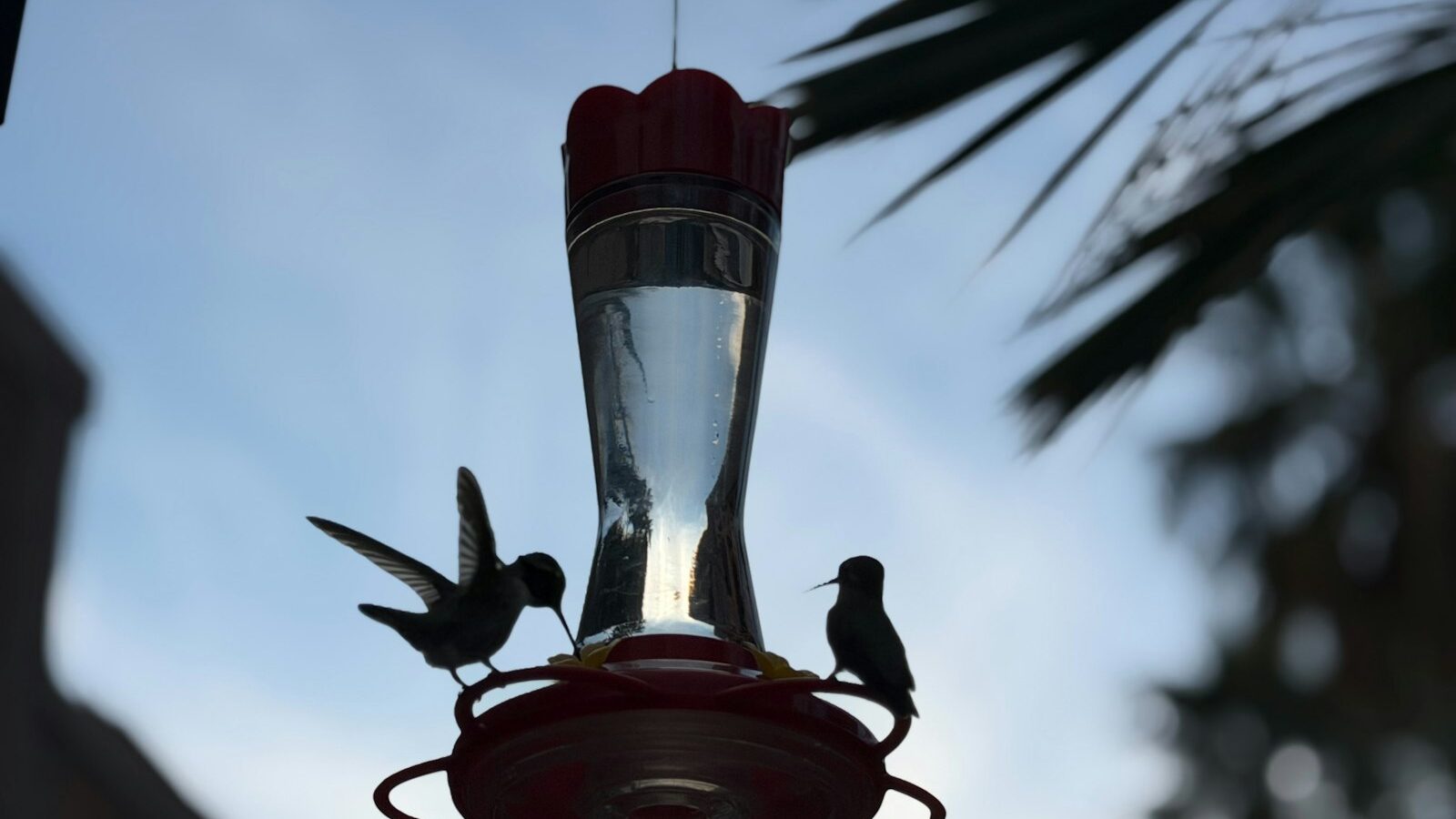
Hummingbirds will visit almost any feeder you hang, but the feeder you keep clean is the one that actually keeps them coming back. After researching the most popular models for the 2026 season, we narrowed it down to seven picks that balance the two things that matter most: how easy a feeder is to scrub free of mold, and how well it fends off ants, bees, and wasps. Below you’ll find a feeder for every situation, from a leak-proof saucer for beginners to a 32-ounce workhorse for a busy yard.
As an Amazon Associate we earn from qualifying purchases.
Our top picks
- Best overall: Aspects HummZinger HighView — leak-proof saucer with a built-in ant moat
- Best easy-to-clean saucer: More Birds Red Jewel — wide-open dish that wipes clean in seconds
- Best glass: Perky-Pet Our Best Glass (30 oz) — wide-mouth bottle with bee-guard ports
- Best window feeder: Aspects Jewel Box Window — suction-cup mount with a deep ant moat
- Best high-capacity: First Nature 32 oz — 10 ports for a crowded yard, made in the USA
- Best ant moat & bee guards: More Birds Diamond Glass — built-in moat plus five bee-guard ports
- Best budget: First Nature 16 oz (two-pack) — proven design at a hard-to-beat price
| Feeder | Type | Capacity | Best for |
|---|---|---|---|
| Aspects HummZinger HighView | Saucer / dish | 12 oz | Best overall, no-leak design |
| More Birds Red Jewel | Saucer / dish | 10 oz | Fastest, easiest cleaning |
| Perky-Pet Our Best Glass | Bottle (glass) | 30 oz | Classic glass look |
| Aspects Jewel Box Window | Window / dish | 8 oz | Close-up window viewing |
| First Nature 32 oz | Bottle (plastic) | 32 oz | High traffic / many birds |
| More Birds Diamond Glass | Bottle (glass) | 30 oz | Built-in ant & bee defense |
| First Nature 16 oz (2-pack) | Bottle (plastic) | 16 oz each | Budget / multiple feeders |
The 7 best hummingbird feeders for 2026
Aspects HummZinger HighView — best overall
The HummZinger HighView is the feeder we recommend to almost everyone, and it earns that spot by solving the two biggest headaches at once. It’s a saucer (or “dish”) feeder, which means the nectar sits in a basin below the ports instead of hanging in an inverted bottle. Because there’s no vacuum bottle pressing nectar against warm plastic, the HummZinger simply doesn’t leak — and that one fact eliminates the sticky drips that attract ants and wasps in the first place. The bright red cover pops off in one motion, the bowl is dishwasher safe, and the whole thing comes apart for a thorough scrub with nothing to get stuck in.
On top of the leak-proof basics, Aspects builds a moat right into the center post so crawling ants drown before they reach the nectar, and each port wears a Nectar-Guard tip that keeps bees and wasps out. The “HighView” design raises the perch so birds face up and toward you, which makes for noticeably better photos and viewing. It carries a lifetime guarantee, and the 12-ounce size is right for most backyards. If you only buy one feeder this year, buy this one.
Pros
- Saucer design genuinely does not leak
- Built-in ant moat plus bee-guard port tips
- Dishwasher safe and fully takes apart
- Raised perch for great viewing; lifetime guarantee
Cons
- 12 oz is modest for very busy yards
- Saucer holds less than a tall bottle feeder
More Birds Red Jewel — best easy-to-clean saucer
If your number-one priority is a feeder you can clean in under a minute, the More Birds Red Jewel is hard to beat. Like the HummZinger it’s a saucer feeder, so the basin design means it doesn’t leak and never builds the sticky film that bottle feeders do. But the Red Jewel’s real advantage is how open it is when you take the lid off: the wide, shallow dish gives you a clean surface you can wipe with a sponge or rinse under the tap, with no narrow neck to fight. For anyone who has given up on a feeder because cleaning felt like a chore, this is the reset button.
The bee-resistant ports use port size and depth to let a hummingbird’s tongue in while keeping bees out, and there’s a perch ring so birds can sit and sip. The one thing to stay on top of: the small feeding holes can hide black mold if you neglect them, so run a pipe cleaner through each port once a week — it takes about 30 seconds and is the difference between a healthy feeder and a moldy one. With that small habit, this is the lowest-effort feeder on the list.
Pros
- Wide, shallow dish wipes clean instantly
- Saucer style means no leaks
- Bee-resistant ports and a full perch ring
- Affordable and widely available
Cons
- Ports need a weekly pipe-cleaner pass to avoid mold
- No built-in ant moat (hang one separately)
Perky-Pet Our Best Glass (30 oz) — best glass feeder
Some people just love the look of a classic glass globe in the garden, and the Perky-Pet Our Best Glass delivers that with a 30-ounce capacity that cuts down on refills. The wraparound perch and six flower-shaped ports let several birds feed at once, and each port has a built-in bee guard to keep stinging insects out of the nectar. The hardened glass bottle lets you see the nectar level at a glance, and the wide-mouth opening makes filling and reaching inside to clean far easier than the pinch-waist glass feeders of old.
This is a bottle (inverted) feeder, so two cautions apply. First, bottle feeders can drip in heat as the air inside expands, so hang it in partial shade and don’t overfill on hot days. Second, a few owners have noted that the plastic perch assembly can crack after a season or two and replacement parts aren’t always sold separately — so treat it gently when you disassemble it for cleaning. For the glass aesthetic and a big reservoir, though, it’s a lot of feeder for the money.
Pros
- Beautiful hardened-glass globe; easy to read nectar level
- Large 30 oz capacity, six ports with bee guards
- Wide-mouth opening for easier filling and cleaning
Cons
- Bottle design can drip in direct heat
- Plastic perch base can crack over time; few spare parts
Aspects Jewel Box Window — best window feeder
Nothing beats a hummingbird hovering inches from your face on the other side of the glass, and the Aspects Jewel Box is the window feeder we’d trust to make that happen without a sticky mess. It’s an 8-ounce dish feeder with three feeding stations and a raised perch, mounted on a sturdy suction-cup bracket. Because it’s a saucer design rather than a bottle, the nectar can’t leak down your window pane — a common complaint with cheaper window feeders. The polycarbonate body is tough, it’s made in the USA, and it carries the same lifetime guarantee as the rest of the Aspects line.
The standout feature is the unusually wide, deep ant moat, which most ants simply cannot cross. It detaches easily if you don’t need it. One honest caveat: when the feeder is full it can tilt slightly, which makes the water in the moat uneven and occasionally lets a determined ant find a dry edge — so mount the bracket as level as you can and keep the moat topped up. For close-range viewing from a kitchen or office window, it’s the best of the bunch.
Pros
- Unbeatable close-up window viewing
- Saucer design won’t leak down the glass
- Extra-wide, deep ant moat that detaches if unneeded
- Tough polycarbonate, made in USA, lifetime guarantee
Cons
- Small 8 oz capacity needs frequent refills
- Can tilt when full, unsettling the moat water
First Nature 32 oz — best high-capacity feeder
When you have a yard full of hummingbirds — or you simply don’t want to refill every other day — the First Nature 32-ounce feeder is the obvious answer. It holds a full quart of nectar and offers ten feeding ports, each able to accommodate a couple of birds, so a small flock can feed without the squabbling you get on a three-port feeder. The red base with yellow flower ports draws birds in while the yellow accents discourage bees, and there’s a built-in ant moat plus wasp-resistant port design. It’s also made in the USA and sells at a remarkably low price for its size.
The reason owners love it is the leak-proof sealing ring and wide-mouth fluted reservoir: the two-part base twists apart so you can reach every surface for cleaning. Two things to know — it isn’t dishwasher safe (hot water can warp the jar so it won’t seat in the base), so hand-wash it; and like any tall bottle feeder it can splash in strong wind if it isn’t filled near the top. Keep it full, hand-wash it, and it’s the best value in high-capacity feeding.
Pros
- Huge 32 oz capacity with 10 feeding ports
- Built-in ant moat and wasp-resistant ports
- Leak-proof sealing ring; base twists apart for cleaning
- Made in the USA at a low price
Cons
- Not dishwasher safe — hand-wash only
- Can splash in strong wind if not kept near full
More Birds Diamond Glass — best ant moat & bee guards
If your yard is a pest battleground, the More Birds Diamond Glass feeder comes ready for the fight straight out of the box. It pairs a spiral glass nectar bottle with a built-in ant moat at the top — fill the moat with plain water and ants drown before they ever reach the nectar — plus five flower ports fitted with bee guards that stop bees and wasps while letting hummingbirds feed. That combination of moat and guards is exactly what most feeders make you buy separately, and here it’s integrated into one good-looking 30-ounce feeder.
The decorative diamond-cut glass bottle with its red top and base is genuinely attractive, and because it fully disassembles with a wide-mouth opening, filling and cleaning are straightforward. As with any bottle feeder, hang it in shade to minimize heat-driven dripping, and keep the moat topped up since it evaporates in summer. For anyone who has lost the war against ants and bees on other feeders, this is the one designed to win it.
Pros
- Built-in ant moat plus five bee-guard ports
- Attractive 30 oz spiral glass bottle
- Fully disassembles with wide-mouth opening
Cons
- Moat needs regular topping up in summer heat
- Bottle design can drip if hung in full sun
First Nature 16 oz (two-pack) — best budget
The smartest budget move isn’t buying the cheapest single feeder — it’s buying the First Nature 16-ounce in a two-pack. You get two proven feeders for roughly the price of one mid-range model, and there’s a real strategy behind it: a dominant hummingbird will guard a single feeder and chase others away, so hanging two feeders out of sight of each other lets more birds feed in peace. It’s the same trustworthy First Nature design as our high-capacity pick — leak-proof sealing ring, wasp-resistant ports, built-in ant moat, and a wide-mouth reservoir that twists apart — just in a more manageable size.
At 16 ounces, each feeder is easier to keep fresh, which matters because nectar should be changed every few days in hot weather anyway. Like its bigger sibling it’s hand-wash only and made in the USA. For a first-time feeder buyer, or for anyone who wants to cover a bigger yard without spending much, this two-pack is the best value on the list.
Pros
- Two reliable feeders for a low combined price
- Lets you split territory so more birds feed
- Ant moat, wasp-resistant ports, leak-proof ring
- Smaller size is easy to keep fresh; made in USA
Cons
- Not dishwasher safe — hand-wash only
- Plain plastic styling won’t win design awards
How to choose a hummingbird feeder
Saucer vs. bottle: the most important decision
Hummingbird feeders come in two basic styles. Bottle (or inverted) feeders hold nectar in a reservoir above the ports; gravity and air pressure feed it down. They typically hold more nectar and look more decorative, but they can drip in heat, and that dripping is what summons ants and wasps. Saucer (or dish) feeders hold nectar in a basin below the ports, so birds dip down to drink. They hold less and look plainer, but they essentially never leak and are far easier to clean. If you’re new to this, start with a saucer — it removes the single biggest source of frustration.
Easy cleaning — and the mold problem
This is the part beginners underestimate. Warm sugar water is a perfect home for mold and fermenting yeast, and a moldy feeder can make hummingbirds sick. The single best predictor of whether you’ll actually keep a feeder clean is how easy it is to take apart and reach inside. Look for wide-mouth openings, parts that fully separate, and ideally dishwasher-safe components. For any feeder with narrow ports, keep a bottle brush and a pack of pipe cleaners by the sink — a weekly pass through each port clears the tiny crevices where black mold hides. Clean with hot water and a brush; skip soap, or rinse extremely thoroughly, since residue can deter birds.
Ant moats and bee guards
An ant moat is a small water-filled cup above the feeder; ants can’t swim across it, so they never reach the nectar. Some feeders build one in; for those that don’t, you can hang an inexpensive standalone moat above the feeder. Keep it topped up, because it evaporates fast in summer. Bee guards are little plastic cages or specially shaped port tips that let a hummingbird’s long tongue through while blocking a bee’s shorter reach. Yellow attracts bees, so feeders that minimize yellow on the ports help too. Between a full moat, bee-guard ports, and a non-drip saucer design, you can keep almost any feeder pest-free.
Ports, capacity, and placement
More ports and perches let more birds feed at once and reduce territorial squabbling. Match capacity to your traffic: a small saucer is plenty for a quiet patio, while a busy yard benefits from a 30–32 ounce feeder or two smaller ones spread out. Don’t fill a big feeder more than the birds can drink in a few days, though — leftover nectar spoils. Hang feeders in partial shade to slow spoilage and dripping, near (but not crowding) flowering plants, and where you can see them from indoors. Some pairs of the right essential garden tools — a small funnel and a bottle brush — make refills and cleaning genuinely quick.
The right nectar recipe (4:1, no red dye)
You never need to buy nectar. Mix four parts water to one part plain white table sugar — for example, 4 cups water to 1 cup sugar — and stir until dissolved. That 4:1 ratio mimics the roughly 20–25% sugar concentration of real flower nectar. Warming the water helps the sugar dissolve; let it cool fully before filling. Never use honey, brown sugar, or artificial sweeteners, and never add red food dye — the dye is unnecessary and may be harmful, and a red feeder attracts birds perfectly well on its own. Change the nectar every 2–3 days in hot weather and every 5–7 in cooler weather, and give the feeder a clean each time.
A feeder is only half the equation. To pull hummingbirds in and keep them around all season, pair it with the right plants — see our guide to flowers that attract hummingbirds — and a few broader habitat tweaks from our piece on how to attract birds to your garden.
Frequently asked questions
What is the easiest hummingbird feeder to clean?
Saucer (dish) feeders like the Aspects HummZinger HighView and the More Birds Red Jewel are the easiest to clean. Because the nectar sits in an open basin rather than an inverted bottle, the parts come fully apart and you can wipe or rinse every surface in seconds. Bottle feeders with a wide-mouth reservoir, such as the First Nature 32 oz, are the next best option.
How do I keep ants and bees out of my feeder?
Use an ant moat — a small water cup above the feeder that ants can’t cross — and keep it topped up, since it evaporates in heat. For bees and wasps, choose ports with built-in bee guards and a non-drip saucer design, since leaking nectar is what attracts them. Feeders like the More Birds Diamond Glass include both a moat and bee guards out of the box.
What is the correct hummingbird nectar recipe?
Mix four parts water to one part plain white table sugar (for example, 4 cups water to 1 cup sugar) and stir until dissolved. Let it cool before filling. Never use honey, brown sugar, or artificial sweeteners, and never add red food dye — it’s unnecessary and possibly harmful. Store extra nectar in the fridge for up to a week.
How often should I change the nectar?
Change it every 2–3 days in hot weather and every 5–7 days when it’s cooler, cleaning the feeder each time. Cloudy nectar, black specks, or floating debris mean it has spoiled and should be replaced immediately. Spoiled nectar can make hummingbirds sick, so when in doubt, change it out.
Should I take feeders down in winter?
In most of the US you don’t need to. Leaving a feeder up does not stop hummingbirds from migrating — that’s driven by daylight, not food. In warmer southern regions a feeder can help late stragglers, while in freezing areas you’ll need to bring it in or swap it on cold nights to keep the nectar from freezing.