


The best grow light timer is the one that turns your lights on and off at the same time every day without you thinking about it, survives a power blip without forgetting its schedule, and is rated for everything you plug into it. For a seed-starting shelf with several fixtures, that usually means a digital timer power strip with surge protection. For a single grow light, a 7-day digital plug-in timer with battery backup is the most reliable option, and a mechanical dial timer is the cheapest. This guide sorts current Amazon timer listings into those jobs, explains how many hours seedlings and houseplants need, and covers the wattage and outlet safety basics that matter when lights run 16 hours a day.
Part of our Houseplants & Container Gardening guide →
In this guide
As an Amazon Associate we earn from qualifying purchases.
How we compared: we compared 16 current Amazon listings: 11 plug-in outlet timers (six mechanical, five digital, including two timer power strips) and five grow lights with built-in timers. We looked at what each listing states: number of timed outlets, programs and smallest time step, power-outage memory, electrical ratings, surge protection, indoor or outdoor rating and warranty. We did not test or handle the products, and availability changes, so confirm details on the listing before you buy.
Quick picks
| Product | Best for | Key features | Buy |
|---|---|---|---|
| BN-LINK 8-outlet digital timer strip | Best overall for seed-starting shelves |
| Buy now →Check current price |
| BN-LINK FD-60/U6 digital timer | Best plug-in digital timer |
| Buy now →Check current price |
| BN-LINK FD-60-U1 mechanical | Best mechanical timer |
| Buy now →Check current price |
| BN-LINK 8-outlet mechanical strip | Best budget multi-outlet timer |
| Buy now →Check current price |
| BN-LINK outdoor digital timer | Best for greenhouses and patios |
| Buy now →Check current price |
| DEWENWILS digital timer 2-pack | Best simple digital 2-pack |
| Buy now →Check current price |
| yadoker bamboo grow light | Best grow light with built-in timer |
| Buy now →Check current price |
Prices change often; check Amazon for today’s price. As an Amazon Associate we earn from qualifying purchases.
The best grow light timers, compared
1. BN-LINK 8-Outlet Surge Protector with 7-Day Digital Timer (BNC-U1S) — Best overall for seed-starting shelves

A surge-protected strip with 4 timed and 4 always-on outlets, a 7-day digital timer and battery backup.
Check price on AmazonWhy we like it
- Runs every light on a shelf from one schedule
- Four always-on outlets for fans and heat mats
- Surge protection and a circuit breaker switch
- Battery backup keeps programs through outages
- 15-month warranty, the longest stated term
| Specification | Details |
|---|---|
| Outlets | 8: 4 timed, 4 always on |
| Timer | 7-day digital, 8 on/off programs, 1-minute minimum |
| Memory | Backup battery keeps settings during outages |
| Protection | Surge protection (800V VPR), circuit breaker, ETL listed |
| Rating | 125VAC, 15A, 1875W; indoor use only |
| Warranty | 15 months |
BN-LINK BNC-U1S — 8 outlets (4 timed), 7-day digital, battery backup, surge protected, 15A/1875W.
One of only two timers that is also a power strip
A seed-starting rack usually has two or three light fixtures, plus a heat mat and a small fan that should not follow the light schedule. Two listings in the comparison solve that in one box, both from BN-LINK: this digital version and a mechanical version. Four outlets follow the timer and four stay on, and all eight are surge protected with a circuit breaker. That replaces a tangle of separate timers and a power strip.
The digital timer is the better of the two for grow lights. It sets times to the minute, supports up to eight on/off programs across the week, and has a backup battery so a power cut does not wipe the schedule. A mechanical timer keeps running after an outage, but its clock falls behind by however long the power was off, which shifts your plants’ day.
The U.S. Fire Administration advises using power strips with internal overload protection and not overloading them. The 1875W rating covers several LED fixtures with room to spare, but add up the wattage of everything on the strip. The listing says it is for indoor use only, and the cord is short, so plan where it sits.
Pros
- Timed and always-on outlets in one
- Battery-backed digital schedule
- Surge protection and breaker
- Longest stated warranty
Cons
- All four timed outlets share one schedule
- Indoor use only
- Digital buttons take a few minutes to learn
Check BN-LINK 8-outlet digital timer strip price on Amazon
2. BN-LINK FD-60/U6 Indoor 7-Day Digital Timer — Best plug-in digital timer

A 7-day digital outlet timer with 8 programs, two grounded outlets, DST mode and a backup battery.
Check price on AmazonWhy we like it
- Programs set to the minute
- Backup battery keeps settings through outages
- Daylight saving mode at the press of a button
- Two grounded outlets on one timer
| Specification | Details |
|---|---|
| Outlets | 2 grounded, switched together |
| Timer | 7-day digital, 8 on/off programs, 1-minute minimum |
| Memory | Backup battery |
| Extras | DST mode, random vacation mode |
| Rating | 120V, 15A, 1725W; ETL listed |
| Warranty | 1 year |
BN-LINK FD-60/U6 — 7-day digital, 8 programs, 2 outlets, backup battery, DST mode, 15A/1725W.
The most flexible single plug-in timer
Five of the 11 outlet timers we compared are digital, and three of those, all BN-LINK, combine a 7-day schedule, eight programs and a stated backup battery. This one-pack is the simplest way to put a single grow light or a pair of fixtures on a precise schedule. It also comes in a 2-pack, which turned up in the same search.
The DST button is a small but real advantage: mechanical timers and some digital ones need resetting twice a year when clocks change, while this shifts the schedule by an hour with one press. Programs can also differ by day, which is useful if you want to stretch day length gradually as seedlings grow.
Note the rating: 1725W rather than the 1875W many other timers list. That is still far more than LED grow lights draw, but check the label on any heater or older fixture before plugging it in. Both outlets switch together.
Pros
- Minute-precise programs
- Battery backup and DST mode
- Two outlets
Cons
- 1725W rating, lower than some
- Bulky body can block a second socket
- Outlets cannot run separate schedules
Check BN-LINK FD-60/U6 digital timer price on Amazon
3. BN-LINK FD-60-U1 Heavy Duty Mechanical Timer — Best mechanical timer

A 24-hour mechanical timer with built-in 15-minute pins, an on indicator light and a 15A/1875W rating.
Check price on AmazonWhy we like it
- Built-in pins cannot fall out or get lost
- 15-minute steps, finer than most dial timers
- Indicator light shows when the outlet is on
- Rated 15A and 1875W for resistive and tungsten loads
| Specification | Details |
|---|---|
| Type | 24-hour mechanical, built-in pin dial |
| Time step | 15 minutes; up to 96 on/off settings a day |
| Outlets | 1, grounded 3-prong |
| Rating | 125VAC, 15A, 1875W tungsten and resistive, 1/2 HP |
| Memory | Mechanical; clock stops during outages |
| Warranty | 1 year |
BN-LINK FD-60-U1 — 24-hour mechanical, 15-minute pins, indicator light, 15A/1875W, 1-year warranty.
The finest steps among the plug-in mechanical timers
Six of the outlet timers we compared are mechanical. Three of them, including two TiFFCOFiO models and BN-LINK’s mini U47, work in 30-minute steps. This heavy-duty BN-LINK uses 15-minute pins, as does BN-LINK’s mechanical power strip, so you can set a 16-hour day to start at 6:15 instead of rounding to the half hour. The pins are built into the dial, so there are no loose pieces to lose.
Mechanical timers are the simplest and cheapest way to automate a grow light: push pins down for on, pull them up for off, plug in. They also have a weakness that matters for plants. If the power goes out, the dial stops and the schedule shifts by the length of the outage until you reset the time. Check it after storms.
Some mechanical timers click audibly as the dial turns, which is worth knowing if your grow shelf is in a bedroom.
Pros
- No programming
- 15-minute steps
- Built-in pins, indicator light
- High 15A/1875W rating
Cons
- Loses time during power outages
- Same schedule every day
- Single outlet
Check BN-LINK FD-60-U1 mechanical price on Amazon
4. BN-LINK 8-Outlet Surge Protector with Mechanical Timer (BNC-U1) — Best budget multi-outlet timer
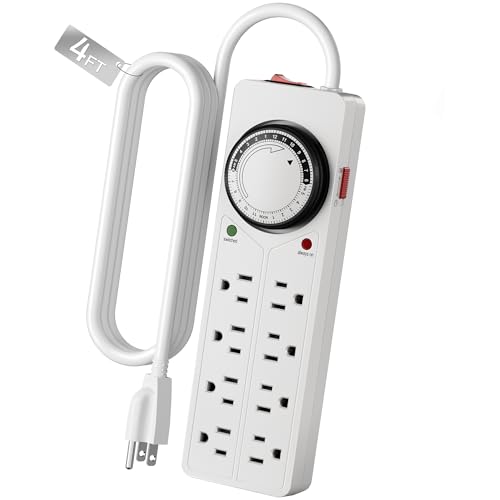
A surge-protected strip with 4 timed and 4 always-on outlets, a 15-minute mechanical dial and an override switch.
Check price on AmazonWhy we like it
- Four timed and four always-on outlets
- Override switch to turn lights on manually
- Surge protection and circuit breaker
- 15-month warranty
| Specification | Details |
|---|---|
| Outlets | 8: 4 timed, 4 always on |
| Timer | Mechanical pin dial, 15-minute steps, daily repeat |
| Controls | Override on switch, LED indicator per row |
| Protection | Surge protection (800V VPR), circuit breaker, ETL listed |
| Rating | 125VAC, 15A, 1875W; indoor use only |
| Warranty | 15 months |
BN-LINK BNC-U1 — 8 outlets (4 timed), mechanical 15-minute dial, override, surge protected, 15A/1875W.
The same strip layout with a simpler dial
This is the mechanical sibling of the top pick: the same eight-outlet layout, surge protection, breaker and 15-month warranty, with a pin dial instead of a digital clock. It is the cheaper way to run a whole seed-starting rack from one plug, and the override switch is handy when you want the lights on to check seedlings outside the schedule.
The trade-offs are those of any mechanical timer: the same schedule every day and no memory through a power cut. The listing gives the cord as 3 feet in one place and 4 feet in the title, so measure your setup. It is rated for indoor use only.
Pros
- Runs a full shelf from one plug
- Manual override switch
- Surge protection and breaker
Cons
- Loses time after outages
- Cord length stated inconsistently
- Indoor use only
Check BN-LINK 8-outlet mechanical strip price on Amazon
5. BN-LINK Outdoor 7-Day Programmable Timer — Best for greenhouses and patios

A weather-resistant 7-day digital timer with two grounded outlets, 8 programs and 1-minute settings.
Check price on AmazonWhy we like it
- Weather-resistant housing for greenhouses and patios
- 7-day schedule with 8 programs
- Settings as short as one minute
- Also runs pumps, fountains and string lights
| Specification | Details |
|---|---|
| Type | Outdoor 7-day digital |
| Outlets | 2 grounded, switched together |
| Programs | 8 on/off, 1-minute minimum; DST and random modes |
| Housing | Flame-retardant PC, weatherproof per the listing |
| Rating | 15A, 1875W, ETL listed |
| Backup battery | not stated in listing |
BN-LINK outdoor timer — 7-day digital, 8 programs, 2 outlets, weather-resistant, 15A/1875W.
The only outdoor-rated digital timer
Two listings are built for outdoor use: this digital BN-LINK and a mechanical TiFFCOFiO. In a greenhouse, a damp garage or an unheated porch where seedlings harden off, an indoor timer is the wrong tool. This BN-LINK has the same 7-day, eight-program setup as the indoor models in a weather-resistant housing, and can also run a pond pump, fountain or patio lights.
Unlike the indoor BN-LINK digital timers, this listing does not mention a backup battery, so assume a power cut may reset it and check the schedule after outages. Mount any outdoor timer so water drains away from the outlets and plug it into a GFCI-protected outdoor receptacle.
Pros
- Outdoor-rated housing
- Flexible 7-day programs
- High 1875W rating
Cons
- Backup battery not stated
- Both outlets share one schedule
- Warranty not stated
Check BN-LINK outdoor digital timer price on Amazon
6. DEWENWILS 24-Hour Digital Timer, 2-Pack — Best simple digital 2-pack

Two slim digital timers with 3 daily programs set to the minute and memory that keeps settings up to 3 months.
Check price on AmazonWhy we like it
- Simple daily programs, set to the minute
- Remembers settings up to 3 months unplugged
- Slim body leaves the second socket free
- Silent, which suits bedrooms
| Specification | Details |
|---|---|
| Type | 24-hour digital, daily repeat |
| Programs | 3 on/off sets; always on, auto, always off switch |
| Memory | Keeps settings up to 3 months without power |
| Outlets | 1 per timer, 2 timers in the pack |
| Rating | 125V, 15A, 1000W, 1/2 HP |
| Warranty | not stated in listing |
DEWENWILS HIDT22X — 2 digital timers, 3 daily programs, 3-month memory, 15A/1000W.
The longest stated memory, with a lower wattage rating
DEWENWILS is the only digital timer that puts a number on its memory: settings survive up to three months without power. It is also the simplest digital timer on the shelf, with three daily programs rather than a weekly schedule, which is all most grow lights need. A slim body that does not cover the second wall socket and silent operation make it easy to live with.
The key limit is the 1000W rating, the lowest stated in the comparison. That is still plenty for most LED grow lights, but it rules out space heaters and many older HID fixtures. Two timers in the pack let you run two shelves or rooms on separate schedules.
Pros
- Three-month memory
- Doesn’t block other socket
- Silent operation
- Two timers per pack
Cons
- 1000W rating
- Daily schedule only
- One outlet per timer
Check DEWENWILS digital timer 2-pack price on Amazon
7. yadoker Bamboo Mini LED Grow Light — Best grow light with built-in timer

A compact full-spectrum grow light with a telescoping pole and built-in 8, 12 or 16 hour timer cycles.
Check price on AmazonWhy we like it
- Timer offers a 16-hour cycle for seedlings and herbs
- Full-spectrum, warm white light
- Telescoping pole adjusts height
- Fits a countertop or desk
| Specification | Details |
|---|---|
| What it is | Grow light with built-in timer, not a separate timer |
| Timer cycles | 8, 12 or 16 hours on, then off for the rest of 24 |
| Spectrum | 380 to 780 nm, warm white |
| Height | Telescoping pole |
| Timer start | Cycle starts when plugged in or switched on |
| Wattage | not stated in listing |
yadoker bamboo grow light — full spectrum, built-in 8/12/16-hour timer, telescoping pole.
A built-in timer that reaches 16 hours
Five listings in the comparison are grow lights with a timer built in, which saves buying a separate outlet timer for one or two plants. Their cycles vary: three top out at 12 hours, while this yadoker and a Kullsinss floor lamp offer a 16-hour setting. That matters because seedlings and many herbs need long days, and a 12-hour maximum is short for them.
Built-in timers have a catch. Most, including this one, start the cycle when you plug in or switch on the light, so the lights come on at whatever time you started them. Switch it on at the time you want the day to begin. A power cut resets the cycle. For more than one light, or for exact timing, a separate outlet timer is more dependable. For other light options, see our grow light guide.
Pros
- No separate timer needed
- 16-hour option
- Compact, adjustable height
Cons
- Start time set by when it is switched on
- Small coverage area
- Wattage not stated
Check yadoker bamboo grow light price on Amazon
How to choose a grow light timer
How many hours should grow lights run?
It depends on what you are growing. Clemson Cooperative Extension says vegetable transplants grown indoors need 16 to 18 hours of bright light a day to grow stocky rather than leggy, and recommends putting lights on a timer. Iowa State University Extension suggests about 14 hours a day for most indoor plants under grow lights, and advises keeping day length between 8 and 16 hours when adjusting for flowering. Plants also need darkness: Iowa State warns that room lights or streetlights during the dark period can prevent some plants from flowering. A timer delivers the same day and night every 24 hours, which is the whole point.
Mechanical or digital?
Mechanical dial timers are cheap, simple and reliable, but they repeat the same schedule daily, work in 15- or 30-minute steps, and stop during power outages, so the schedule drifts until you reset it. Digital timers set times to the minute, can vary by day, and the better ones keep settings through outages with a backup battery. For seedlings that you check daily, either works. For a light you want to forget about, choose digital with backup.
Ratings and wattage
Every timer lists a maximum current and wattage. Most here are rated 15A, with wattage limits from 1000W to 1875W. Add up the wattage of everything on the timer and stay well under the limit. LED grow lights draw little, but heat mats, space heaters and older fixtures can add up quickly. Note that some ratings are lower for certain loads; BN-LINK’s mini U47, for example, lists 5 amps for ballast loads.
Outlets and power strips
Count your fixtures. One light needs one outlet; a three-shelf seed rack with a fan and heat mat is easier on a timer power strip with separate timed and always-on outlets. The U.S. Fire Administration advises not overloading outlets or power strips, using power strips with internal overload protection, replacing worn or damaged cords, and keeping cords out from under rugs where they can be damaged. Seed-starting setups involve water, so keep strips off the floor and away from trays.
Indoor vs outdoor
Use outdoor-rated timers in greenhouses, garages and porches, where moisture and condensation are common, and plug them into GFCI-protected outlets. Indoor timers are not designed for damp locations.
Light height and setup
A timer only controls duration; distance controls intensity. Clemson suggests keeping fluorescent tubes 2 to 4 inches above seedlings and raising them as plants grow, while Iowa State gives 6 to 12 inches for fluorescent fixtures and 12 to 24 inches for most LEDs. Follow the fixture maker’s guidance. For complete setups, see our guides to seedling grow shelves, plant stands with grow lights and seed starting kits, and for houseplant care generally, our houseplants and containers guide.
Smart plugs
Wi-Fi smart plugs add app control, but no smart plug turned up in this comparison. If you use one, check that it stores its schedule on the plug rather than only in the cloud, so the lights still switch when your internet drops.
Frequently asked questions
How many hours a day should grow lights be on?
Seedlings typically need 16 to 18 hours of light, according to Clemson Extension, while many houseplants do well with about 14 hours. Always give plants a dark period too; flowering plants may need specific day lengths.
Can any outlet timer run a grow light?
Yes, as long as the timer’s amp and wattage rating exceeds the total draw of everything plugged into it. Most timers here are rated 15A and 1000W to 1875W, which is far more than typical LED grow lights use.
Is a mechanical or digital timer better for grow lights?
Mechanical timers are cheaper and easy to set but lose time during power outages and use 15- or 30-minute steps. Digital timers are precise, can vary by day, and models with battery backup keep their schedule through outages.
Do grow lights with built-in timers replace an outlet timer?
For one small light, often yes. Built-in timers usually offer fixed cycles such as 8, 12 or 16 hours and start when the light is switched on, so they are less precise and reset after power cuts. For several lights or exact timing, use an outlet timer.
Is a timer needed if plants are near a window?
If you rely on grow lights at all, a timer keeps the schedule consistent. Manual switching is easy to forget, and a fixed daily cycle keeps plant growth steady regardless of cloudy days.