

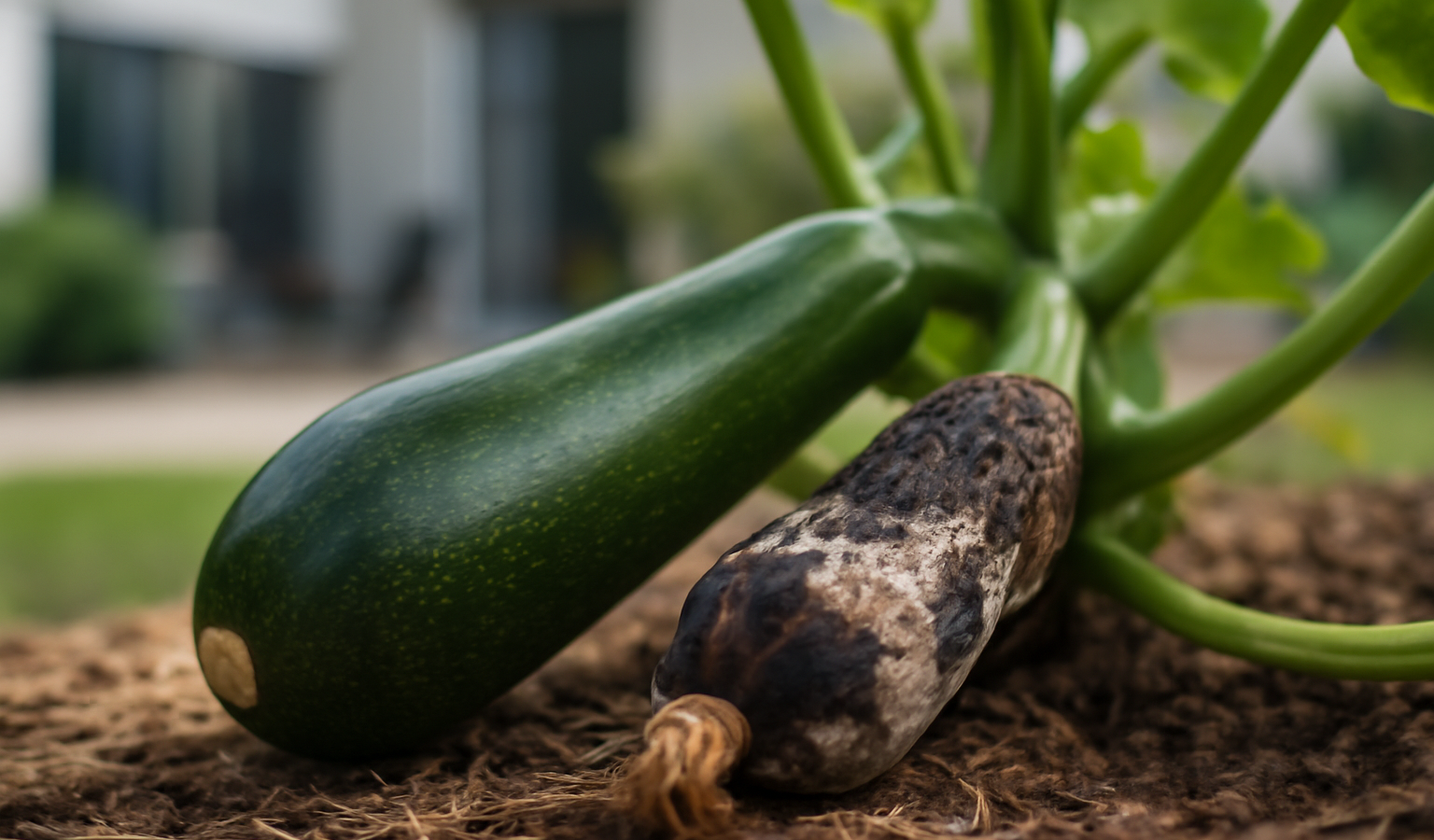
Zucchini is supposed to be the crop that overwhelms you — the one you sneak onto neighbors’ porches because the plants won’t quit. So it’s genuinely frustrating when, instead of a pile of glossy green fruit, you keep finding little zucchini that grow two or three inches long, turn yellow or brown at the blossom end, go soft and mushy, and then either shrivel on the vine or drop off entirely. The fruit that should be doubling in size every day is rotting from the tip backward before it ever reaches your kitchen.
This isn’t a disease in the usual sense, and it almost never means your plant is dying. Rotting young zucchini traces back to one of four things: blossom-end rot from calcium not reaching the fruit, incomplete pollination that leaves the fruit unable to develop, an actual shortage of available calcium in the soil, or watering and moisture problems that rot the fruit from the outside in. The good news is that these are fast-correcting issues — most respond within a week or two of fixing your watering or hand-pollinating a few flowers. This guide walks through each cause, shows you how to tell which one you’re dealing with, and gives you concrete fixes and a prevention plan so the next wave of fruit actually makes it to harvest.
Key Takeaways
- Fruit that yellows and rots from the blossom end is usually blossom-end rot or poor pollination — not a disease you can spray away.
- Blossom-end rot is a calcium-delivery problem driven by uneven watering far more often than by low soil calcium.
- Hand-pollinating with a male flower at mid-morning fixes most “fruit rots when small” cases caused by missing bees.
- Water deeply and evenly — about 1 to 1.5 inches per week with mulch — to keep calcium flowing and fruit firm.
- Keep developing fruit off damp soil and water at the base, not overhead, to stop moisture rots and mildew.
Cause 1: Blossom-End Rot
Blossom-end rot is the classic zucchini-on-the-vine rot, and it’s the same disorder that hits tomatoes and peppers. The fruit starts to develop normally, then the blossom end — the tip farthest from the stem, where the old flower hung — turns from light to dark, sinking into a brown or black, leathery-then-mushy patch. From there it spreads back up the fruit. It looks like an infection, but it’s a physiological disorder caused by calcium failing to reach the rapidly growing tip of the fruit. Calcium moves through the plant in the water stream, and it travels poorly to fruit tips, so anything that disrupts steady water uptake starves the blossom end of calcium even when the rest of the plant looks perfectly healthy. The single biggest driver is inconsistent watering — a bed that swings between bone dry and soaked — rather than a genuine lack of calcium in the soil itself.
How to diagnose it
Look at exactly where the rot starts. Blossom-end rot always begins at the blossom tip and works backward, and the spot is sunken, firm at first, and tan-to-black with a distinct dry, leathery edge before it softens. The stem end and the rest of the plant stay green and vigorous. Think back over the last two weeks of weather and watering: a heat wave, a stretch where you forgot to water, or a pattern of deep soak followed by days of drought are the tell. If your earliest fruit of the season is worst-affected and later fruit improves once the plant’s root system matures and the weather steadies, that’s a strong confirmation it’s blossom-end rot rather than rot from pollination failure, which involves the whole tiny fruit yellowing at once.
How to fix it
Stabilize the water supply first, because that fixes 90 percent of blossom-end rot. Give zucchini a deep, even soak that delivers roughly 1 to 1.5 inches of water per week, split into one or two long sessions rather than daily sprinkles, so the root zone stays consistently moist about 6 inches down without ever going soggy. Lay down 2 to 3 inches of straw, shredded leaf, or grass-clipping mulch around each plant to buffer the soil against drying out between waterings — this alone often ends the problem. Pick off any fruit already showing rot so the plant stops wasting energy on them and redirects it to healthy fruit. A drip line or soaker hose on a timer is the surest cure because it removes human forgetfulness from the equation. Calcium sprays and additives rarely help if your soil already has calcium; the fix is almost always about water delivery, not adding more calcium.
Cause 2: Poor or Incomplete Pollination
This is the cause people most often mistake for disease. Zucchini produces separate male and female flowers on the same plant, and a female flower must receive enough pollen — carried by bees from the male flowers — to fully fertilize the fruit behind it. If pollination is incomplete, the little zucchini (you can spot the female by the miniature fruit already swelling at the flower’s base) starts to grow on stored energy, reaches two or three inches, then stalls, yellows, softens at the tip, and rots or drops. The plant essentially aborts a fruit it can’t finish. Common causes are too few bees, cold or rainy mornings that keep pollinators grounded while flowers are open, very hot weather above the mid-90s°F that makes pollen unviable, and the early-season quirk where plants open a run of all-male or all-female flowers before the two sync up.
How to diagnose it
The signature is a small fruit, often the whole thing, going limp and yellow rather than a dry sunken patch confined to the tip. Cut a failed fruit open: poorly pollinated zucchini are often pale and seedless or sparsely seeded inside. Watch your flowers for a morning or two — if you see plenty of blooms but few or no bees visiting between roughly 6 and 10 a.m. when zucchini flowers are open and receptive, pollination is your problem. Note the weather, too: a run of cold, wet mornings or scorching afternoons right when the flowers opened points squarely here. Early in the season, count flower types; if you’re seeing only slim male flowers (on a plain stalk, no baby fruit) or only females, the plant simply hasn’t started producing both at once yet, and fruit will rot for lack of a pollen source.
How to fix it
Hand-pollinate — it’s quick and nearly foolproof. In mid-morning when flowers are freshly open, pick a male flower (the one on a thin stem with no swelling behind it), peel back or tear off its petals to expose the pollen-covered central stamen, and gently brush or dab that pollen directly onto the center of each open female flower (the one with a baby zucchini behind it). One male flower carries enough pollen for two or three females. Alternatively, use a small soft artist’s brush to move pollen from male to female. Do this every morning until bees show up reliably. To bring in those bees longer-term, plant flowers like borage, zinnias, cosmos, or sweet alyssum nearby and avoid spraying any insecticide while flowers are open. Extreme-heat pollen failure corrects itself once temperatures drop back into the 80s°F, so keep hand-pollinating to bridge the gap.
Cause 3: Low Calcium or pH and Soil Supply Problems
While most blossom-end rot is a delivery problem, sometimes the soil genuinely can’t supply enough calcium — this is the supply side of the same coin. If your soil is naturally low in calcium, very sandy and leached, or sitting at a pH outside the sweet spot, calcium uptake suffers even when you water perfectly. Soil pH is the quiet culprit here: zucchini prefers a pH of about 6.0 to 6.8, and when soil drifts too acidic (below about 5.5) or strongly alkaline, calcium and other nutrients lock up and become unavailable to the roots no matter how much is present. Heavy applications of high-nitrogen or high-potassium fertilizer can also compete with calcium uptake, and dense root competition from nearby plants or weeds can starve the zucchini’s roots of the steady supply they need.
How to diagnose it
The clue that you’re on the supply side rather than the watering side is blossom-end rot that persists even after you’ve made your watering rock-steady and added mulch. At that point, a soil test is worth the modest cost — it’s the only way to actually know your calcium level and pH instead of guessing. A test that comes back low in calcium, or with a pH well below 6.0 or above 7.0, confirms a true supply problem. Also reconsider your fertilizing: if you’ve been pouring on a high-nitrogen feed (the first number on the bag) and seeing lush leaves with rotting fruit, over-feeding may be crowding out calcium. Crowded beds where zucchini fights tomatoes, corn, or aggressive weeds for root space are another supply-side red flag.
How to fix it
Correct the pH first, because that unlocks the calcium that’s likely already there. If your soil is too acidic, work in garden lime (which also adds calcium) at the rate your soil test recommends — typically a few pounds per 100 square feet — ideally the season before, since lime acts slowly. For a genuinely low-calcium soil, gypsum or a dose of lime raises calcium directly, and crushed eggshells or a calcium-specific fertilizer help over time. Back off heavy nitrogen feeding and switch to a balanced or phosphorus-forward fertilizer such as a 5-10-10 once plants are fruiting. Keep the bed weeded and give each plant enough room (more on spacing below) so its roots aren’t competing for the calcium and water that need to reach the fruit. These are mostly season-to-season fixes, so pair them with steady watering for results in the current crop.
Cause 4: Overwatering and Fruit Sitting on Wet Soil
The fourth cause is plain moisture rot, and it’s distinct from blossom-end rot even though both involve mushy fruit. When zucchini gets too much water, sits in poorly drained soil, or a developing fruit rests directly on damp ground, fungi and soft-rot bacteria move in and rot the fruit from the outside. You’ll often see this on larger fruit and on the underside where it contacts the soil — a slimy, soft, sometimes fuzzy patch rather than the dry sunken tip of blossom-end rot. Overhead watering and humid, crowded canopies also invite powdery and downy mildew and fruit-surface rots, because wet foliage and wet fruit that never dry out are an open door for fungal disease. Zucchini plants are big and sprawling, and their long fruit naturally tends to lie on the ground unless you intervene.
How to diagnose it
Check where the rot is and how it feels. Moisture rot tends to be slimy, soft, and often appears on the side or underside of the fruit touching the soil, not as a clean dry tip — and it frequently smells sour. Look at your soil: if it stays soggy, puddles after watering, or you’ve been watering daily on top of rain, overwatering is likely. Powdery white patches on the leaves point to mildew riding along with the wet conditions. If you find perfectly good-sized fruit rotting on the ground side while the exposed top is fine, that’s the contact-rot signature — the fruit is simply sitting in damp dirt and decaying where it touches.
How to fix it
Water less often but more deeply, and always at the base of the plant. Switch from overhead sprinkling to a drip line or soaker hose so the foliage and fruit stay dry; if you must water by hand, water the soil and water in the morning so any splashed leaves dry by midday. Aim for that 1 to 1.5 inches per week and let the top inch of soil dry slightly between waterings rather than keeping it constantly wet. Most importantly, get the fruit up off the soil — slip a flat stone, a shingle, a board, or a piece of cardboard under each developing zucchini so it ripens on a dry surface. Improve drainage in soggy beds by adding compost or planting on raised mounds, thin crowded leaves to improve airflow, and remove any rotting fruit promptly so the decay doesn’t spread to healthy neighbors.
Prevention: Keep Every Fruit Clean to Harvest
Almost every cause above comes back to two habits — water evenly and pollinate reliably — so build your prevention around those. Set up drip irrigation or a soaker hose on a simple timer delivering 1 to 1.5 inches per week, then top the bed with 2 to 3 inches of straw or shredded-leaf mulch to lock in that moisture and keep calcium moving steadily into the fruit. Even watering is the master switch that prevents both blossom-end rot and the stress that causes flower drop. Space plants generously at 24 to 36 inches apart so each one gets full sun and airflow, has room for its roots to gather water and calcium without competing, and dries quickly after rain — crowding drives nearly every moisture and pollination problem on this list. Test your soil every couple of seasons and keep the pH between 6.0 and 6.8 so the calcium that’s there stays available.
On the pollination side, plant bee-friendly flowers nearby, skip insecticide sprays while blooms are open, and keep a small brush handy to hand-pollinate during cold snaps, heat waves, or the early-season flower mismatch — five minutes each morning is cheap insurance against a whole batch of rotted fruit. Slide a board or stone under any fruit that’s lying on the ground, and harvest young: picking zucchini at 6 to 8 inches long, every day or two at peak season, keeps the plant productive and gives rot less time to set in. If you’re choosing varieties, dependable, productive ones like ‘Black Beauty’, ‘Costata Romanesco’, or compact ‘Patio Star’ set fruit readily. For more on how zucchini fits the broader squash family and which types behave differently, see our guide on summer vs winter squash, and to plant it in the right window for your area, check warm-season vs cool-season vegetables. You’ll find more troubleshooting and growing guides in our plants and flowers hub.
Frequently Asked Questions
Why do my baby zucchini turn yellow and rot before they grow?
That’s almost always incomplete pollination. The female flower didn’t receive enough pollen, so the little fruit grows on stored energy for a few inches, then yellows, softens at the tip, and rots or drops. Hand-pollinate each morning by dabbing pollen from a male flower onto the open female flowers, and plant bee-friendly flowers nearby to draw in pollinators.
Is zucchini blossom-end rot caused by low calcium in the soil?
Usually not directly. Most blossom-end rot comes from inconsistent watering that stops calcium — which moves in the water stream — from reaching the fruit tip, even when soil calcium is fine. Fix your watering and add mulch first. Only if the rot persists after watering is steady should you test the soil for genuinely low calcium or a pH problem.
How do I hand-pollinate zucchini?
In mid-morning, pick a freshly open male flower (thin stem, no baby fruit behind it), tear off the petals to expose the pollen-covered center, and gently brush that pollen onto the center of each open female flower (the one with a tiny zucchini behind it). One male flower pollinates two or three females. A small soft brush works too. Do it daily until bees are active.
How much should I water zucchini to prevent rot?
Aim for about 1 to 1.5 inches of water per week, delivered in one or two deep soakings rather than daily sprinkles, so the root zone stays evenly moist without going soggy. Use drip or a soaker hose at the base to keep foliage and fruit dry, and mulch with 2 to 3 inches of straw to hold moisture steady. Even watering is the single best defense against rot.
Why is my zucchini rotting where it touches the ground?
That’s contact rot from the fruit sitting on damp soil, where fungi and soft-rot bacteria attack the underside. Slip a flat stone, board, shingle, or piece of cardboard under each developing fruit so it ripens on a dry surface, water at the base instead of overhead, improve drainage with compost, and remove any rotting fruit promptly so decay doesn’t spread.