

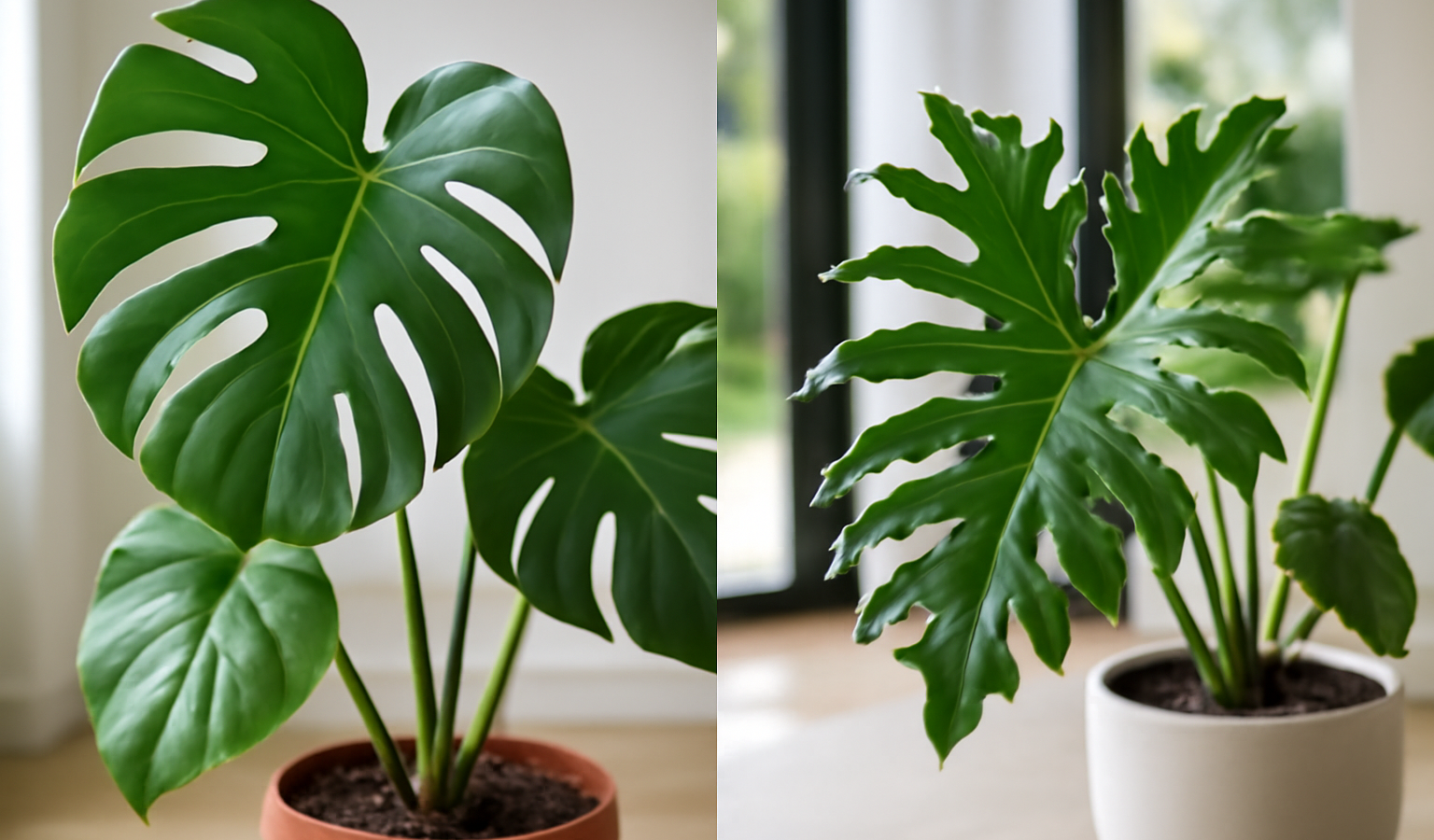
Few houseplant questions cause as much confusion as the monstera vs split leaf philodendron debate, and honestly, that confusion is earned. The names overlap, the leaves look superficially similar from across the room, and decades of garden-center labeling have muddied the water so thoroughly that even experienced growers occasionally mix them up. The phrase “split-leaf philodendron” has been slapped onto two genuinely different plants for years: sometimes it refers to Monstera deliciosa (which isn’t a philodendron at all), and sometimes it refers to the plant botanists now call Thaumatophyllum bipinnatifidum, long sold as Philodendron bipinnatifidum or Philodendron selloum. If you have ever stood in front of a nursery shelf squinting at two big-leaved aroids and wondering which is which, this guide will give you a reliable, repeatable way to tell them apart and to care for whichever one you bring home.
The good news is that once you know what to look at, these two plants are easy to separate. The split in their leaves forms in completely different ways, they grow in completely different shapes, and they want slightly different things from you as a caretaker. We’ll walk through the naming history (because it explains the whole mess), then move into a side-by-side comparison, a section on how to identify each plant in person, and finally the practical care differences that matter once the plant is on your windowsill or in your living room.
Key Takeaways
- “Split-leaf philodendron” is an ambiguous name. It gets applied to both Monstera deliciosa and to Thaumatophyllum bipinnatifidum (the old Philodendron selloum), so the term alone tells you almost nothing.
- The split tells the story. Monstera develops enclosed oval holes (fenestrations) inside the leaf plus splits to the edge; the split-leaf philodendron is cut into deep finger-like lobes from the edges inward with no enclosed holes.
- Growth habit differs. Monstera is a climbing vine that wants a moss pole; the split-leaf philodendron is a self-heading shrub that builds a thick, trunk-like base and spreads outward like a rosette.
- Check the petiole. Monstera has a geniculum, a flexible knee-like joint where the leaf stalk meets the blade. The split-leaf philodendron lacks this distinctive joint.
- Care overlaps but isn’t identical. Both want bright indirect light and both are toxic to pets (calcium oxalate), but the climbing monstera and the spreading philodendron need different support and spacing.
The Naming Mess, Explained
Before you can compare these plants, you have to untangle their names, because the labels in stores are part of the problem. Both plants belong to the arum family, Araceae, the group of “aroids” that also includes pothos, anthurium, peace lily, and elephant ear. Being aroids, they share a family resemblance: large glossy leaves, a climbing or clumping tendency, and a flower structure made of a spathe and spadix. But they sit in different genera, and that’s where the trouble starts.
Monstera deliciosa is, and has always been, a true Monstera. It is native to the tropical forests of southern Mexico and Central America, where it climbs tree trunks toward the canopy. Its common names include Swiss cheese plant, split-leaf philodendron, ceriman, and Mexican breadfruit. Notice that “split-leaf philodendron” is in that list even though the plant is not a philodendron. That single piece of folk naming is responsible for most of the confusion you’ll encounter.
The other plant has had a rougher taxonomic ride. For decades it was sold as Philodendron selloum and later as Philodendron bipinnatifidum. In 2018, botanists revising the genus moved a group of self-heading South American species (including this one) into a resurrected genus, Thaumatophyllum. So the plant’s current accepted name is Thaumatophyllum bipinnatifidum. Nurseries are slow to relabel, so you’ll still see “Philodendron selloum,” “tree philodendron,” “lacy tree philodendron,” and yes, “split-leaf philodendron” on the tag. It is genuinely a philodendron relative, native to southeastern Brazil, Paraguay, and northern Argentina.
So when someone says “split-leaf philodendron,” they could mean either plant. The rest of this guide treats the comparison as Monstera deliciosa on one side and the Thaumatophyllum bipinnatifidum / selloum plant (the one people most often mean as a distinct species from monstera) on the other. If you want a deeper look at how philodendrons relate to their look-alikes, our guide on how to distinguish pothos from philodendron covers another classic aroid mix-up that uses the same identification logic.
Monstera vs Split-Leaf Philodendron at a Glance
Here is the side-by-side comparison. If you only remember three rows from this table, make them fenestration type, growth habit, and the geniculum, because those three traits will let you identify either plant with confidence even when the labels are wrong.
| Feature | Monstera deliciosa | Split-Leaf Philodendron |
|---|---|---|
| Botanical name | Monstera deliciosa | Thaumatophyllum bipinnatifidum (formerly Philodendron selloum / bipinnatifidum) |
| Genus / origin | Genus Monstera; Mexico and Central America | Genus Thaumatophyllum; southeastern Brazil and neighbors |
| Leaf split type | Enclosed oval holes inside the blade plus splits reaching the edge (fenestrations) | Deep finger-like lobes cut from the edge inward; no enclosed holes |
| Leaf shape | Broad, heart-shaped to rounded, leathery | Elongated, feathery, deeply pinnately lobed |
| Growth habit | Climbing vine; wants vertical support | Self-heading shrub; spreads outward in a rosette |
| Base / stem | Vining stem with prominent aerial roots | Thick, woody trunk-like base as it ages |
| Petiole geniculum | Present (flexible “knee” joint) | Absent |
| Support needed | Moss pole or trellis for best leaves | Floor space; no climbing support |
| Edible fruit | Yes, ripe fruit is edible (unripe is not) | No edible fruit |
| Mature indoor size | 2-3 m tall on a pole, wide leaves | 1.5-2 m tall and often just as wide |
| Toxicity to pets | Toxic (calcium oxalate) | Toxic (calcium oxalate) |
How to Tell Them Apart
The table gives you the summary, but in person you’ll want a quick mental checklist. Walk through the leaf split, the growth shape, and the petiole, in that order. Each plant has a couple of signature traits that are hard to fake, so let’s look at them one plant at a time.
Monstera deliciosa
Look for enclosed holes
The single most diagnostic feature of Monstera deliciosa is its fenestration pattern. A mature monstera leaf has actual holes punched into the interior of the blade, oval windows surrounded on all sides by leaf tissue, in addition to splits that run from the midrib out to the leaf margin. Those interior holes are the “Swiss cheese” effect, and no philodendron in the comparison produces them. If you can see daylight through a window in the middle of the leaf that is completely ringed by green, you are looking at a monstera.
Important caveat: young monstera plants do not have fenestrations at all. A juvenile monstera puts out solid, heart-shaped leaves with no holes or splits, and it only begins to fenestrate as it matures and receives enough light. So the absence of holes on a small plant doesn’t rule out monstera. Look instead at the overall leaf shape (broad and rounded) and check the petiole, which we’ll cover below. If your established monstera is producing solid, unsplit leaves and a sparse, reaching habit, that’s usually a light and maturity issue. Our article on why a monstera grows leggy and stops fenestrating walks through the fixes in detail.
Find the geniculum
Run your fingers along the petiole, the stalk that connects the leaf blade to the main stem. On a monstera you’ll find a geniculum: a slightly swollen, flexible joint right where the petiole meets the blade. It works like a knee, letting the leaf pivot to follow light. This geniculum is a reliable monstera marker and the split-leaf philodendron does not have one. It’s a small detail, but it’s the kind of trait that survives even when the leaves are damaged or immature, so it’s worth learning to feel for it.
Climbing habit and aerial roots
Monstera is a climber by nature. In the wild it scrambles up tree trunks, and indoors it will lean, sprawl, and send out thick aerial roots looking for something to grip. Those aerial roots are normal and healthy; they’re how the plant anchors itself and, in nature, draws extra moisture. If you see a big-leaved aroid with long rope-like roots emerging from the stem and a clear tendency to climb rather than stand on its own, that’s a monstera. The plant looks its best when those climbing instincts are supported with a moss pole, which encourages larger, more heavily fenestrated leaves.
One more monstera-specific quirk: in humid conditions or after a deep watering, you may notice droplets forming at the leaf tips. That’s guttation, a normal process, though sometimes it signals overwatering. If you’re seeing it, our guide on why a monstera drips water from its leaves explains when it’s harmless and when to ease off the watering can.
Split-Leaf Philodendron (Thaumatophyllum / Selloum)
Lobes cut from the edges, never holes
The split-leaf philodendron earns its name through deep lobing, not fenestration. Its leaves are elongated and feathery, divided into many finger-like lobes that are cut from the leaf edge inward toward the midrib. Crucially, those cuts open all the way to the margin, so they create gaps rather than enclosed windows. Hold a leaf up to the light and you’ll see that every split connects to the outer edge; there is no spot where green tissue completely surrounds a hole. That edge-to-margin lobing is the dead giveaway that you’re looking at the selloum-type plant and not a monstera.
The overall leaf silhouette is different too. Where a monstera leaf is broad, rounded, and almost shield-shaped, the split-leaf philodendron leaf is longer and more lance-like, with a ruffled, lacy outline created by all those lobes. People often describe the texture as more delicate or “feathery,” and that impression comes directly from the deep, repeated lobing.
Self-heading, not climbing
This is the trait that changes how you’ll live with the plant. The split-leaf philodendron is self-heading, meaning it doesn’t climb. Instead it produces leaves in a spreading rosette from a central growing point, and over time the lower part of the stem thickens into a woody, trunk-like base that can look almost like a small tree trunk. Mature specimens spread wide, often as wide as they are tall, and they hold themselves up without any pole or trellis. If you see a sprawling, free-standing shrub with a chunky base and leaves radiating outward, that’s the philodendron, not the climbing monstera.
Because it spreads rather than climbs, the split-leaf philodendron is a floor plant that demands horizontal space. A monstera can be trained upward to stay relatively compact in footprint; a selloum-type plant will eventually claim a corner of the room. Plan for that when you choose where to put it.
No geniculum, no edible fruit
Check the petiole and you won’t find the swollen, flexible geniculum joint that marks a monstera; the leaf stalk attaches more directly. And while a healthy monstera in good conditions can produce its edible ceriman fruit (ripe only, never unripe), the split-leaf philodendron does not produce an edible fruit. These two traits, taken together with the lobing pattern, make for a foolproof identification.
Care Differences That Actually Matter
The two plants come from similar tropical environments, so their basic needs overlap a great deal. Both are forgiving, fast-growing aroids that reward decent light and consistent (not soggy) moisture. But because one climbs and one spreads, and because their leaf structures differ, a few care details diverge in practice.
Light
Both want bright, indirect light. An east-facing window with gentle morning sun, or a few feet back from a south- or west-facing window where the harsh midday rays are filtered, suits either plant well. For monstera specifically, light is directly tied to fenestration: the more bright indirect light it gets, the larger and more split its leaves become. A monstera kept in a dim corner will keep producing smaller, solid, holeless leaves no matter how mature it is. The split-leaf philodendron also fenestrates more dramatically in good light, but it tolerates a slightly broader range and can cope with somewhat lower light without becoming as leggy as a monstera does. Keep both out of direct, unfiltered sun, which scorches the leaves.
Watering
Water both plants when the top 2-3 cm (roughly the top inch or two) of the soil has dried out. In a typical home that lands somewhere around once a week in the warm growing season and less often in winter, but go by the soil rather than the calendar. Both plants prefer to dry out a little between waterings and both resent sitting in waterlogged soil, which invites root rot. Use a chunky, well-draining aroid mix (potting soil with added bark, perlite, and a little coco coir) and a pot with drainage holes. The larger, denser split-leaf philodendron in a big pot may hold moisture longer, so check before you water rather than assuming both plants are on the same schedule.
Support and training
This is where the routines really part ways. A monstera should be given a moss pole, coir pole, or trellis early. As the plant climbs, gently tie the stem to the support and keep the moss pole damp so the aerial roots attach. A well-supported monstera produces noticeably bigger, more fenestrated leaves and stays upright and tidy instead of flopping. The split-leaf philodendron needs no such thing; it supports itself. Your job with the philodendron is simply to give it room and occasionally rotate the pot so it grows evenly toward the light rather than leaning.
Humidity and temperature
Both are tropical and appreciate humidity in the 50-60% range, though both tolerate average household humidity reasonably well. If your air is very dry in winter, grouping plants together or running a humidifier helps both species keep their leaf edges from browning. Keep them in normal room temperatures (roughly 18-27 degrees C) and away from cold drafts, heating vents, and frosty windows. Neither plant tolerates frost.
Size and spacing
Indoors, a monstera trained up a pole commonly reaches 2-3 metres tall while keeping a fairly contained footprint, since you’re guiding it vertically. The split-leaf philodendron tends to top out a bit shorter (around 1.5-2 metres indoors) but spreads outward to a similar width, so it occupies more floor area. Factor that into your room plan: the monstera is the better choice for a narrow space you can train upward, while the philodendron suits an open corner where it can fan out.
Toxicity to pets
Here the two plants are identical, and not in a good way. Both contain insoluble calcium oxalate crystals throughout their tissues. If a curious cat, dog, or child chews a leaf, the crystals cause oral irritation, drooling, and swelling of the mouth and throat. Neither plant is a safe choice for a home where pets reliably nibble greenery, so place them out of reach. There’s no difference between the two on this front; treat both as toxic and keep them off the floor where a pet can reach if that’s a concern.
The Verdict: How to ID Them at the Nursery
Standing in the garden center, ignore the label entirely; it may say “split-leaf philodendron” on either plant. Instead, run this quick three-step check. First, look at the leaf split: enclosed oval holes ringed by green mean monstera, while lobes cut all the way to the edge with no interior holes mean the selloum-type philodendron. Second, look at the overall shape: a plant that wants to climb, with a vining stem and thick aerial roots, is a monstera, while a self-standing shrub with a thickening woody base that spreads outward is the philodendron. Third, if you’re still unsure, feel the petiole for the geniculum, that flexible knee joint; its presence confirms monstera and its absence points to the philodendron.
For most homes, the choice comes down to space and growth style rather than care difficulty, since both are easygoing. Pick the monstera if you want a trainable climber with that iconic Swiss-cheese silhouette and you’re happy to maintain a moss pole. Pick the split-leaf philodendron if you want a dramatic, free-standing, feathery-leaved shrub for an open corner and you’d rather not fuss with vertical support. Either way, give it bright indirect light, water when the topsoil dries, and keep it away from pets. For more side-by-side plant comparisons and care guides, browse our full plants and flowers resource library.
Frequently Asked Questions
Is a monstera the same as a split-leaf philodendron?
Not quite. “Split-leaf philodendron” is a common name that gets applied to two different plants: Monstera deliciosa (which is not actually a philodendron) and Thaumatophyllum bipinnatifidum, the plant long sold as Philodendron selloum. So the name alone is ambiguous, and the two species are botanically distinct with different leaves, growth habits, and support needs.
What is the easiest way to tell them apart?
Look at how the leaf splits. A monstera develops enclosed oval holes inside the leaf blade (the Swiss-cheese windows) in addition to edge splits. The split-leaf philodendron has deep finger-like lobes cut from the edge inward, with no enclosed holes. If light shows through a hole completely surrounded by green, it’s a monstera.
Does a split-leaf philodendron climb like a monstera?
No. The split-leaf philodendron (selloum type) is self-heading: it grows leaves in a spreading rosette from a central point and develops a thick, woody, trunk-like base, standing up without support. A monstera is a climber that wants a moss pole or trellis to produce its largest, most fenestrated leaves.
Why doesn’t my monstera have holes yet?
Young monsteras produce solid, heart-shaped leaves and only begin fenestrating as they mature and get enough bright indirect light. If an established plant still isn’t splitting, it usually needs more light and possibly a moss pole. Be patient with juveniles, and improve light for older plants that stay solid.
Are both plants toxic to cats and dogs?
Yes. Both Monstera deliciosa and the split-leaf philodendron contain insoluble calcium oxalate crystals, which cause mouth irritation, drooling, and swelling if chewed. Neither is pet-safe, so keep both out of reach of cats, dogs, and small children.