

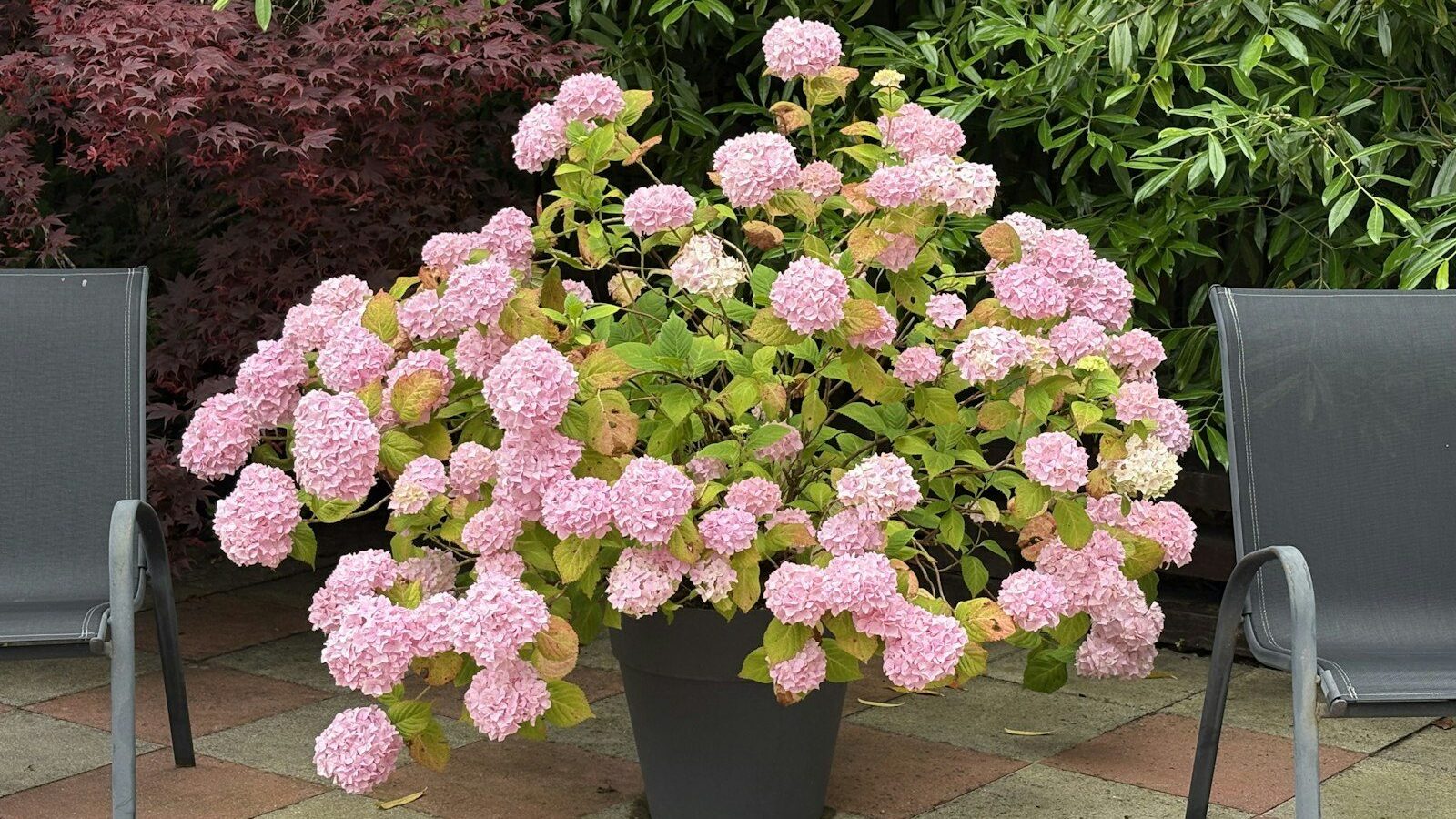
Hydrangeas grow well in pots if you start with a compact variety, a container at least 18 to 24 inches wide, a quality potting mix and a watering routine that never lets the root ball dry out. The two things that trip people up are summer water stress, because hydrangeas wilt fast in containers, and winter cold, because roots in a pot are far more exposed than roots in the ground. Get those right and a potted hydrangea can bloom on a porch or patio for many years. Here is how to choose the plant and pot, care for it through the season and get it through winter.
Part of our Houseplants & Container Gardening guide →
In this guide
Key Takeaways
- Choose dwarf varieties that mature at 2 to 4 feet, such as Bobo, Little Lime or compact reblooming bigleaf types.
- Use a pot at least 18 inches wide for small types and 24 inches or more for larger ones, with drainage holes.
- Expect to water daily in summer heat; containers dry out much faster than garden soil.
- Morning sun and afternoon shade suit most potted hydrangeas, though panicle types take more sun.
- Container roots are about two zones less hardy than in-ground roots, so protect pots in winter.
Best Hydrangeas for Containers
Compact varieties are the key to long-term success. A standard bigleaf or panicle hydrangea that wants to be 6 to 8 feet wide will quickly outgrow a pot and need constant water. These types and cultivars stay in proportion:
| Type | Compact examples | Mature size (approx.) | Zones (in ground) | Light |
|---|---|---|---|---|
| Panicle (H. paniculata) | Bobo, Little Lime, Little Quick Fire, Fire Light Tidbit | 2 to 5 feet | 3 to 8 | Full sun to part shade |
| Bigleaf (H. macrophylla) | Compact reblooming types such as some Endless Summer and Let’s Dance selections, Cityline series | 1 to 3 feet | 5 to 9 | Morning sun, afternoon shade |
| Mountain (H. serrata) | Tuff Stuff series | 2 to 3 feet | 5 to 9 | Part shade |
| Smooth (H. arborescens) | Compact Invincibelle types | 2 to 4 feet | 3 to 9 | Part shade to sun |
| Oakleaf (H. quercifolia) | Dwarf selections such as Ruby Slippers or Pee Wee | 3 to 4 feet | 5 to 9 | Part shade |
Panicle hydrangeas are the most forgiving in pots for most of the country. They tolerate more sun and cold, and they bloom on new wood, so winter damage to stems does not cost you flowers. Bigleaf hydrangeas give the classic blue and pink mopheads but are more sensitive to cold and drought. For variety-specific care, see our guides to Bobo hydrangea care and Little Lime hydrangea care.
Choosing the Right Container
Size
- Dwarf types (under 3 feet): at least 16 to 18 inches wide and deep, roughly 10 to 15 gallons.
- Compact types (3 to 5 feet): 20 to 24 inches wide, roughly 15 to 25 gallons.
- Bigger is better for water. A larger soil volume holds more moisture and buffers temperature swings. Moving up one size from what seems right usually pays off.
When potting up a nursery hydrangea, choose a container 4 to 6 inches wider than the nursery pot, then pot up again every two to three years as roots fill it.
Material
- Plastic and resin: lightweight, hold moisture well and are less likely to crack in frost. Good default.
- Glazed ceramic: attractive, holds moisture, but heavy and can crack in freezing weather unless rated frost-proof.
- Terra cotta: breathes, but dries out fast. Fine in cool, shady spots; frustrating in hot sun.
- Wood or fiberglass: good insulation, suitable for large pots.
- Metal: heats up in sun, which stresses roots; avoid dark metal in hot climates.
Whatever you choose, drainage holes are essential. Raise the pot slightly on pot feet so water can drain freely.
Potting Mix and Planting
Use a quality bagged potting mix, not garden soil, which compacts in containers. Mixes with bark fines, peat or coir and perlite work well. Blending in about 20 to 25 percent compost adds nutrients and helps hold moisture. Skip gravel in the bottom of the pot; it raises the water table in the pot rather than improving drainage.
- Water the hydrangea in its nursery pot an hour before planting.
- Add mix to the new container so the top of the root ball sits about 1 to 2 inches below the rim.
- Loosen circling roots gently.
- Fill around the root ball, firming lightly, and keep the crown at the same level it grew in the nursery.
- Water slowly until it drains from the bottom, then top up any settled mix.
Spring and early fall are the best times to pot hydrangeas, when temperatures are mild.
Light and Placement
Most bigleaf, mountain, smooth and oakleaf hydrangeas in pots do best with four to six hours of morning sun and shade in the afternoon. In the North, they handle more sun if well watered. In the South and hot inland West, afternoon shade is essential. Panicle hydrangeas take full sun in most regions, but in a pot even they appreciate afternoon shade in extreme heat because the container heats up. A spot near the house protected from strong wind also reduces water loss.
Watering Potted Hydrangeas
This is where most container hydrangeas struggle. Their large leaves lose water quickly, and the name hydrangea literally refers to water.
- Check soil daily from late spring through summer. Water when the top inch feels dry.
- Water deeply until it runs from the drainage holes, which wets the whole root ball.
- In hot weather expect to water once a day, and sometimes twice for smaller pots in full sun.
- Water in the morning so leaves dry and plants start the day hydrated.
- Midafternoon wilting on hot days is often temporary. If the plant is still wilted in the evening or early morning, it needs water.
A 1 to 2 inch layer of shredded bark mulch on top of the pot slows evaporation. Drip irrigation on a timer, or a self-watering container with a reservoir, makes summer care much easier, especially if you travel. Never leave the pot standing in a saucer full of water for days; constantly soggy roots rot.
Feeding
Nutrients wash out of pots with frequent watering, so container hydrangeas need regular feeding. Mix a slow-release granular fertilizer into the top of the mix in spring, following label rates, and supplement with a half-strength liquid fertilizer every two to four weeks through midsummer. Stop feeding by about August so new growth can harden off before cold weather. Avoid very high-nitrogen fertilizers, which give lush leaves at the expense of flowers. Our guide on how to fertilize hydrangeas covers products and timing in more detail.
Controlling Flower Color in a Pot
Pots make it easier to control bigleaf and mountain hydrangea color, because you control the mix. For blue flowers, use an acidic potting mix (pH around 5.0 to 5.5) and a low-phosphorus feed, and apply aluminum sulfate at label rates if needed. For pink, keep the mix closer to neutral or slightly alkaline, around 6.0 to 6.5, and use a fertilizer with more phosphorus. White hydrangeas and panicle types do not change color with pH. See how to change hydrangea color for step-by-step methods.
Pruning Potted Hydrangeas
- Panicle and smooth hydrangeas bloom on new wood. Prune in late winter or early spring, cutting back by a third to a half to keep the plant compact.
- Bigleaf, mountain and oakleaf hydrangeas bloom mostly on old wood. Prune lightly just after flowering, removing spent blooms and dead stems only. Cutting back hard in fall or spring removes next year’s flower buds.
- Reblooming bigleaf types flower on both old and new wood, so they are more forgiving, but light pruning still gives the best display.
Our full guide to pruning hydrangeas explains how to identify your type.
Overwintering Hydrangeas in Pots
Roots in containers are exposed to air temperature on all sides, so they are much less cold-hardy than the same plant in the ground. A good rule of thumb is that a potted plant needs to be rated about two zones colder than your zone to survive outdoors without protection.
Zones 7 and warmer
Most potted hydrangeas can stay outdoors. Move them close to the house, out of the wind, and group pots together. Water during dry spells when the soil is not frozen.
Zones 5 and 6
- Panicle and smooth hydrangeas in large pots often survive if pots are grouped against a sheltered wall and wrapped with burlap or bubble wrap.
- Bigleaf types are safer in an unheated garage, shed or cold basement where temperatures stay above about 20°F but below about 45°F, so the plant stays dormant.
- Alternatively, sink the pot into the ground or a mulch pile for winter.
Zones 3 and 4
Move all potted hydrangeas into a cold but protected spot such as an unheated garage. Water lightly about once a month so roots do not dry out completely. Do not bring dormant hydrangeas into a warm house; they need a cold rest period to bloom well.
In spring, bring plants back outside gradually after the last hard frost, and resume watering and feeding when new leaves appear.
Common Problems
| Problem | Likely cause | Fix |
|---|---|---|
| Wilting daily | Pot too small, too much sun | Pot up, move to afternoon shade, mulch |
| No flowers on bigleaf type | Pruned at wrong time or buds killed by cold | Prune after bloom only, protect in winter |
| Yellow leaves with green veins | pH too high, iron unavailable | Acid fertilizer, iron chelate |
| Brown, crispy leaf edges | Drought or fertilizer burn | Water consistently, flush pot, feed at label rate |
| Leaves yellowing and dropping, wet mix | Overwatering, poor drainage | Check holes, raise pot, water less often |
| White powder on leaves | Powdery mildew | Improve airflow, water at the base |
For general hydrangea care beyond containers, see our hydrangea care guide and the flowers and perennials hub.
Frequently Asked Questions
What size pot does a hydrangea need?
At least 16 to 18 inches wide for dwarf varieties and 20 to 24 inches or more for compact types that reach 3 to 5 feet. Larger pots hold more water and protect roots from heat and cold.
Can hydrangeas stay in pots permanently?
Yes, if you choose a compact variety, pot up every two to three years and protect roots in winter. Eventually you may need to divide or root-prune older plants, or move them into the ground.
How often should I water a hydrangea in a pot?
Check daily in warm weather and water whenever the top inch of mix is dry. In midsummer heat that usually means every day, and sometimes twice a day for small pots in sun.
Do potted hydrangeas come back every year?
Yes, they are woody shrubs that go dormant in winter and regrow in spring. The main risk is roots freezing in the pot, so protect containers in zones 6 and colder.
Can I keep a gift hydrangea from the florist?
Florist hydrangeas are often forced bigleaf types that may not be very cold-hardy. Keep it in bright indirect light indoors while it blooms, then move it outdoors in spring and treat it like a potted bigleaf hydrangea. It may take a season to bloom again.