

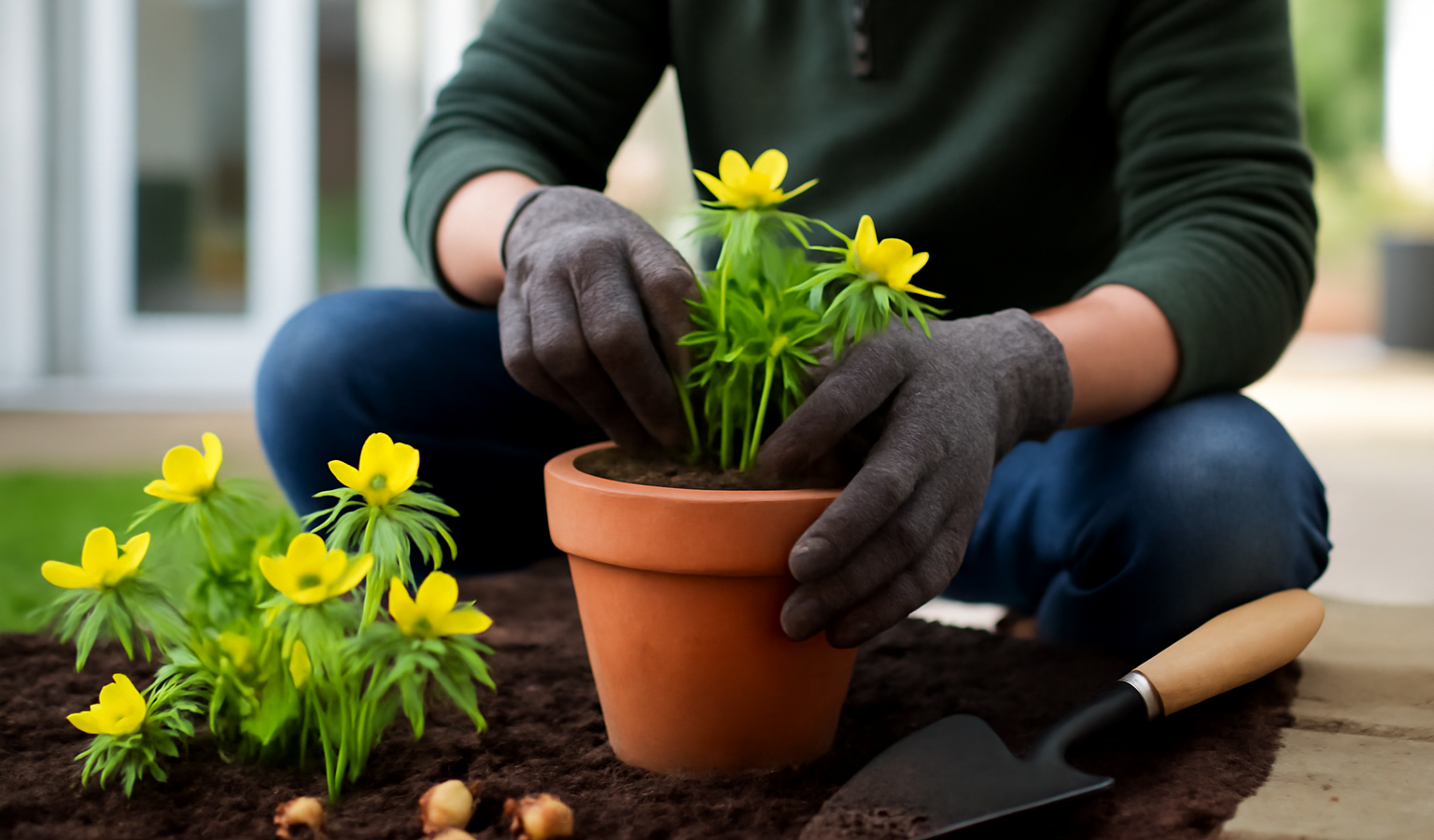
If you want color in your garden before almost anything else has woken up, winter aconite (Eranthis hyemalis) is the plant that delivers. While the rest of your beds are still brown and frozen, these buttercup-yellow cups push up through the cold ground, sometimes right through a late dusting of snow, often a week or two ahead of snowdrops. Each flower sits on a short stem with a frilly green collar of bracts, so the whole plant looks like a tiny golden saucer set on a ruff. Where it is happy, it does not stay polite for long: a handful of tubers turns into a sheet of yellow under deciduous trees within a few years, blooming and then disappearing underground long before the tree canopy fills in. The catch is that winter aconite has a reputation for being temperamental at planting time, and most of that reputation comes down to one thing that nurseries rarely explain on the package. Get the start right and it will outlive you. This guide covers what winter aconite actually is, when and where it blooms, the zones it tolerates, the soaking trick that makes or breaks establishment, planting depth and spacing, soil and light, naturalizing, dividing, the pests and problems you will run into, what to plant alongside it, and how to handle it in containers or forced indoors.
Key Takeaways
- Winter aconite is one of the earliest bulbs to bloom, often opening in late winter (February into March in much of the US) ahead of snowdrops and crocus.
- It grows from a knobbly tuber, not a true bulb, and tubers dry out fast in storage, so soak them 12 to 24 hours in water before planting.
- Plant tubers in fall, 2 to 3 inches deep and about 3 inches apart, in humus-rich, moisture-retentive soil under deciduous trees.
- Hardy in USDA zones 3 through 7; it needs cold winters and does poorly in hot, dry climates.
- It naturalizes by self-seeding and offsets, spreading into golden carpets; pair it with snowdrops, crocus, and other woodland early bulbs.
- The whole plant is toxic if eaten, which is why deer and rodents largely leave it alone.
What Winter Aconite Actually Is
Winter aconite belongs to the genus Eranthis, in the buttercup family (Ranunculaceae). The species you will almost always find sold is Eranthis hyemalis, native to woodlands of southern Europe, with a closely related Asian species, Eranthis cilicica, and a garden hybrid called Eranthis x tubergenii that produces slightly larger, sterile flowers. The common name is misleading in one respect: despite “aconite” appearing in the name, it is not the same plant as monkshood (Aconitum), though both are toxic. The flowers are bright yellow, roughly an inch across, cup-shaped, and held just a few inches off the ground, each ringed by a deeply cut leaflike collar that gives the plant its distinctive look.
The most important thing to understand about Eranthis is that it grows from a tuber, not a true scaly bulb like a tulip or a daffodil. The tubers are small, dark, knobbly, and irregular, often no bigger than the end of your thumb. That tuberous structure has a practical consequence that defines the whole growing experience: these tubers do not hold moisture well once lifted, and they desiccate quickly in the dry conditions of a retail display. A shriveled, rock-hard tuber may never sprout, which is the single most common reason gardeners declare winter aconite “impossible.” It is not impossible. It is just thirsty.
When and Where It Blooms
Winter aconite is, by most reckonings, the earliest flowering bulb in the temperate garden, frequently beating snowdrops to the punch by a week or more. In the southern and middle parts of its range, flowers can open in late January or February; further north, expect late February into March. The exact timing depends on your winter, but the pattern is consistent: it blooms when the soil first begins to thaw, during that stretch when nothing else is happening and even a single yellow flower feels like an event.
The flowers respond to temperature and sun. On a cold, gray day they stay shut, looking like little green-collared buds; on a mild, sunny afternoon they fan wide open and turn toward the light. This sensitivity is part of why winter aconite handles snow so gracefully. A late storm that buries the blooms does little harm. The flowers simply close and wait, then reopen once the snow melts off. Each individual flower lasts a surprisingly long time in the cold, and a good patch can stay in color for three to four weeks. Bloom happens before the trees overhead leaf out, so a planting under oaks, maples, or beeches gets full late-winter sun even though it sits in deep shade by midsummer.
USDA Zones and Climate
Winter aconite is reliably hardy in USDA zones 3 through 7. It is a cold-climate plant at heart and actually requires a genuine winter chill to perform; the tubers need that period of cold dormancy to set buds and bloom on schedule. This makes it an excellent choice for the upper Midwest, the Northeast, the Great Lakes, the Mountain West, and the colder parts of the Pacific Northwest.
Where it struggles is the warm end of the scale. In zone 8 and warmer, especially in the hot, dry, or humid summers of the South and Southwest, winter aconite tends to limp along, bloom weakly, and fade out after a season or two. The combination of insufficient winter cold and summers that are too hot and dry for the dormant tubers simply does not suit it. If you garden in those regions and want very early bloom, you will get more reliable results from crocus or certain narcissus. But anywhere with a real, cold winter and reasonable summer moisture, Eranthis is one of the toughest, most permanent things you can plant.
Soaking the Tubers Before Planting
This is the step that matters most, and the one most people skip. Because Eranthis tubers dry out so badly in shipping and storage, the ones you buy in fall are often partly desiccated by the time they reach you. Planting them dry, straight from the bag, frequently leads to disappointing germination, sometimes only one tuber in five comes up. The fix is simple: soak them.
Before you plant, put the tubers in a bowl of room-temperature water and let them soak for 12 to 24 hours, ideally overnight. They will plump up noticeably, drinking back some of the moisture they lost in storage. After soaking, plant them immediately while they are still hydrated, do not let them sit out and dry again. You will sometimes find it hard to tell which end is up on these irregular knobs of tissue; do not agonize over it. Like many tubers, winter aconite is forgiving about orientation and will right itself underground. Just lay each one in its hole and move on. If you can identify a slightly concave side or any sign of old root growth, set that side down, but it is not worth obsessing over. The soaking is what counts.
When to Plant
Plant winter aconite tubers in fall, the same general window you would use for daffodils and tulips, roughly September through November depending on your zone. The goal is to get them in the ground while the soil is still workable but cooling down, so the tubers can begin rooting before deep frost. Earlier is generally better with Eranthis precisely because of the drying issue: the sooner you buy and plant fresh tubers, the less time they spend desiccating in a bag. If you see them offered for sale, snap them up and get them soaked and planted promptly rather than waiting.
Once established, the entire life cycle compresses into late winter and early spring. The plant emerges, blooms, sets seed, and the foliage yellows and dies back, all typically wrapped up by late spring. After that it goes completely dormant underground for the rest of the year, which is exactly why it pairs so well with later perennials that fill the same space once it has gone to sleep.
Planting Depth and Spacing
Plant the soaked tubers 2 to 3 inches deep and about 3 inches apart. Because the tubers are small and irregular, depth is measured to the top of the tuber rather than the bottom; aim to have a couple of inches of soil covering them. In looser, sandier soil you can go to the deeper end of that range; in heavier soil, stay shallower.
- Depth: 2 to 3 inches of soil over the tuber.
- Spacing: about 3 inches apart, or roughly 3 to 4 inches center to center.
- Quantity: plant in generous groups, not singles. A drift of a few dozen reads far better than scattered individuals, and the more you start with, the faster a colony establishes.
Do not fuss over precise grid spacing. Winter aconite looks best when it appears to have arrived on its own, so scatter the tubers across the planting area and plant them more or less where they land. They will fill in the gaps themselves over time. Water the area thoroughly after planting to settle the soil and give the freshly soaked tubers a strong start on rooting.
Soil and Light
The natural home of Eranthis is the deciduous woodland floor, and replicating that is the surest path to success. It wants humus-rich, moisture-retentive but well-drained soil, the kind you get under trees where years of leaf litter have built up a soft, organic layer. If your soil is lean or heavy clay, work in compost or leaf mold before planting. A neutral to slightly alkaline pH suits it well, and a top-dressing of leaf mold each year keeps it thriving.
For light, think about the timing. Because winter aconite blooms before deciduous trees leaf out, a spot under oaks or maples that reads as deep summer shade is actually flooded with sun during the plant’s active season. That is the ideal: part shade to full shade in summer, bright light in late winter. It will also grow in more open, sunnier positions as long as the soil does not bake dry in summer, but the classic naturalized planting is beneath and around deciduous trees and shrubs, where it can spread without competing with anything during its short window of growth.
Watering and Seasonal Care
During its growing season in late winter and early spring, winter aconite appreciates consistent soil moisture, which is rarely a problem at that time of year given snowmelt and spring rains. The critical period is establishment: water well after planting in fall and again if the autumn is dry, so the tubers can root in before freeze-up.
In summer the plant is dormant and dislikes being baked bone-dry, which is another reason the woodland setting works so well, the tree canopy and leaf litter keep the soil from drying to dust. You do not need to irrigate dormant aconite actively, but avoid planting it in a spot that turns into a sun-blasted desert in July and August. As for feeding, it is undemanding. A yearly mulch of leaf mold or compost supplies everything it needs; heavy fertilizer is unnecessary and unhelpful. Let the foliage die back naturally after bloom rather than cutting or pulling it, since those weeks of photosynthesis are what recharge the tuber and feed next year’s flowers.
Naturalizing and Self-Seeding
Naturalizing is where winter aconite earns its keep. Once a colony settles in, it spreads two ways: by offsets from the tubers themselves, and far more dramatically, by self-seeding. After bloom, each flower produces a small cluster of seeds that ripen as the foliage yellows. Those seeds scatter, germinate, and over several years thicken a modest planting into a continuous golden carpet. It is genuinely one of the best self-sowing early bulbs you can grow, and in a hospitable woodland setting it can spread surprisingly far.
To encourage this, do not deadhead and do not rush to clean up the dying foliage; leave the plant to complete its cycle and drop seed. Avoid disturbing the soil surface where it grows, since aggressive raking or hoeing destroys the seedlings before they can take hold. Patience is the main ingredient. The first couple of years can look unimpressive, with the same modest clump you planted. By year three or four, if it is happy, you will start seeing tiny first-year seedlings appearing at the edges, and from there the carpet builds on its own. The same self-seeding habit means you should site it where spreading is welcome; it is not invasive in any problematic sense, but it does roam. For broader guidance on living with bulbs that multiply over time, our overview at the Plants & Flowers hub covers the wider family of naturalizing spring bloomers.
Dividing and Moving
You rarely need to divide winter aconite, but if a clump has become congested or you want to spread it to a new area, the trick is to move it “in the green.” Rather than lifting dry, dormant tubers in summer, which reintroduces the very drying problem that plagues purchased tubers, lift and divide established plants right after flowering while the foliage is still green and the soil is moist. Dig up a clump, gently tease it apart, and replant the divisions immediately at the same depth in their new home, then water in.
Moving in the green dramatically improves survival because the tubers never get a chance to desiccate. This is also the most reliable way to acquire winter aconite in the first place: if a gardening friend or local plant sale offers it as growing plants rather than dry tubers, that material will establish far more readily than anything from a packet.
Pests and Problems
The good news is that winter aconite is largely pest-free and unappealing to the usual bulb-eaters. Because the entire plant is toxic, deer, rabbits, voles, and mice generally leave it alone, which is a major advantage in gardens where tulips and crocus get devoured. The main animal nuisance is squirrels, which will occasionally dig at freshly planted tubers, more out of curiosity or because they are digging anyway than because they want to eat them. A layer of mulch, or a temporary cover of chicken wire over a new planting, discourages this until the soil settles.
The real problems are cultural rather than biological:
- Dried-out tubers failing to sprout. By far the most common complaint. The cause is desiccated tubers planted without soaking. Always soak overnight, plant fresh, and buy early in the season.
- Rot. Tubers sitting in cold, waterlogged soil over winter can rot. Winter aconite wants moisture-retentive soil, not a swamp; ensure reasonable drainage and amend heavy clay before planting.
- Poor performance in warm climates. In zone 8 and up, weak bloom and disappearance usually trace to insufficient winter chill or hot, dry summers, not anything you did wrong.
- No spread. If a planting never naturalizes, the culprit is often too much cleanup, deadheading, or disturbing the soil before seedlings establish. Leave it alone and let it self-sow.
Companion Planting
Winter aconite is a team player in the early-spring garden, and the most rewarding way to grow it is in combination with other small woodland bulbs that bloom in the same window. The classic pairing is with snowdrops (Galanthus): the yellow cups of aconite against the white nodding bells of snowdrops, often blooming together at winter’s tail end, is one of the great sights of the season. Crocus follows close behind and extends the show with purples, whites, and additional yellows.
Other excellent companions include glory-of-the-snow, with its starry blue flowers, and early dwarf narcissus. If you are assembling a succession of very early bulbs, it is worth reading up on a few of these neighbors: our guide to growing glory-of-the-snow covers a bulb that interplants beautifully with aconite and blooms just slightly later, carrying the color forward. Because all of these go dormant by late spring, you can layer them under hostas, ferns, hellebores, or other shade perennials that emerge later and cover the ground for summer, giving you two seasons of interest from the same square footage. Hellebores in particular make a fine backdrop, blooming at roughly the same early time in a complementary palette.
A Note on Toxicity
All parts of winter aconite are toxic if ingested, a trait it shares with many members of the buttercup family. This is precisely why deer and rodents avoid it, and it is generally not a hazard in normal gardening, but it is worth knowing if you have young children or pets that chew on plants. The tubers in particular should not be eaten and have occasionally been mistaken for edible bulbs, so keep them out of reach and label storage clearly. Wash your hands after handling, especially after dividing plants, as the sap can irritate sensitive skin. None of this should deter you; countless gardens grow winter aconite without incident. It simply belongs in the same common-sense category as foxglove, daffodils, and many other beautiful, toxic ornamentals.
Containers and Forcing Indoors
Winter aconite can be grown in containers, though it is less commonly forced than tulips, hyacinths, or paperwhites because its flowers are small and its real magic is the late-winter outdoor display. If you do want to try it in pots, treat it like other hardy bulbs that need a cold period: pot the soaked tubers in fall in a humus-rich, free-draining mix, then give them a long, cold, moist dormancy outdoors or in an unheated space, somewhere that stays cold but not deep-frozen for several weeks. Bringing them into a cool, bright room toward late winter coaxes them into early bloom, after which you can plant the contents of the pot straight out into the garden to naturalize.
Keep expectations realistic: forced aconite is charming but modest, more of a windowsill curiosity than a showstopper. If you enjoy bringing spring bulbs indoors, the same chilling principles apply across the board, and our walkthrough on how to force bulbs indoors explains the cold-treatment timing in detail. For most gardeners, though, the best use of winter aconite is right where it belongs: tucked under the bare branches of a deciduous tree, soaked well at planting and then left to its own devices, lighting up the cold ground year after year before anything else dares to bloom.
Frequently Asked Questions
Why didn’t my winter aconite come up?
By far the most common reason is dried-out tubers. Eranthis tubers desiccate quickly in storage, and shriveled ones often never sprout. Always soak them in water for 12 to 24 hours before planting, plant them fresh and promptly, and buy early in the fall season when tubers have spent less time drying out in the bag.
When does winter aconite bloom?
It is typically the earliest bulb in the garden, blooming in late winter, often February into March in much of the US, frequently a week or more ahead of snowdrops. It opens as soon as the soil begins to thaw and will happily flower through a light late snow, closing in cold and reopening in sun.
How deep do I plant winter aconite tubers?
Plant the soaked tubers 2 to 3 inches deep, measured to the top of the tuber, and space them about 3 inches apart. Plant in generous groups for the best effect, water well after planting, and do not worry about orientation since the tubers right themselves underground.
Is winter aconite invasive or toxic?
It self-seeds readily and can form large carpets where it is happy, but it is not considered an aggressive or problematic invasive. All parts of the plant are toxic if eaten, which is why deer and rodents avoid it; keep tubers away from children and pets, and wash your hands after handling.
What grows well with winter aconite?
It pairs beautifully with other early woodland bulbs, especially snowdrops, crocus, and glory-of-the-snow, and with later shade perennials like hostas, ferns, and hellebores that fill the space after the aconite goes dormant in late spring. The classic combination is yellow aconite cups beside white snowdrops at the very end of winter.