

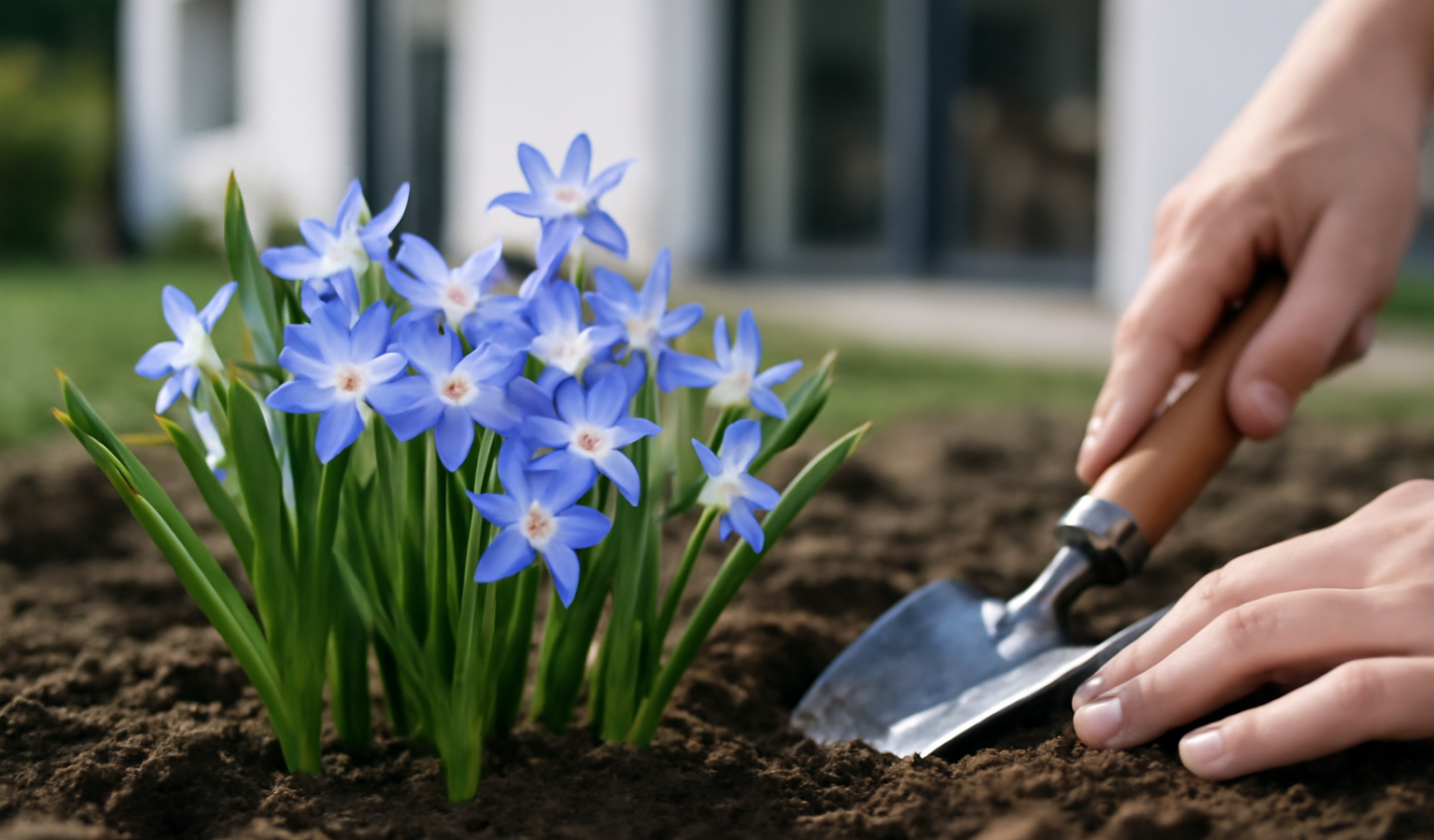
Glory of the snow earns its name honestly. While most of the garden is still locked in brown dormancy, this little bulb sends up clusters of star-shaped blue flowers that often push straight through a late dusting of snow, arriving alongside or even a touch before crocus and snowdrops. It is one of the very first things to bloom each year, a 4-to-6-inch-tall jolt of color in late winter that tells you spring is genuinely on its way. Better still, plant a handful in fall and within a few seasons you will have hundreds: Chionodoxa multiplies by underground offsets and seeds itself around freely, knitting into spreading carpets under deciduous trees, across rock gardens, and even through lawns. It is cheap, cold-hardy, deer- and rodent-resistant, and about as low-maintenance as a flowering bulb gets. This guide covers exactly how to plant it in fall, where it thrives, how to let it naturalize, and how to divide it when the colonies get crowded.
Key Takeaways
- One of the earliest bulbs to bloom: star-shaped blue (also pink or white) flowers open in late winter to early spring, often through snow, before or alongside crocus and snowdrops.
- Plant the bulbs in fall: September through November, 2 to 3 inches deep and 1 to 3 inches apart, in generous clusters rather than rows.
- It naturalizes beautifully: offsets plus self-seeding spread it into drifts and carpets over the years—ideal for lawns, woodland gardens, rock gardens and under deciduous trees.
- Tough and undemanding: hardy in USDA zones 3-8, only 4 to 6 inches tall, deer- and rodent-resistant, and squirrels largely ignore it unlike tulips.
- Needs a cold winter and natural dieback: a chilling period triggers bloom, and you must let the foliage yellow on its own before mowing or trimming to feed next year’s bulb.
- Early pollinator food: the flowers are an important early nectar source for the first bees of the season.
Meet Glory of the Snow
Glory of the snow is a small, hardy, spring-flowering bulb long known as Chionodoxa—a name that comes from the Greek for “snow glory.” Botanists have recently reclassified it into the genus Scilla, so the plant you buy as Chionodoxa luciliae or Chionodoxa forbesii may now appear on labels as Scilla luciliae or Scilla forbesii. The genetics are the same charming plant either way; if you shop by either name you will end up with the right bulb. It is closely related to true scilla (squill) and shares their toughness and willingness to spread.
Each bulb produces a tuft of two or three narrow, strappy leaves and short stems carrying several upward-facing, six-petaled stars about an inch across. The classic color is a clear gentian blue with a white eye at the center, which is what makes a mature drift glow almost electric in low late-winter light. Pink-flowered forms such as ‘Pink Giant’ and pure white selections are also available and look lovely interplanted with the blue. The whole plant tops out at just 4 to 6 inches tall, which is why it belongs at the front of beds, in rock gardens, and anywhere it can be seen from close up before taller perennials wake.
The defining trait of this bulb is timing. It is among the earliest of all the spring bulbs to flower—a group gardeners call the “minor bulbs” or “early bulbs”—blooming in late winter or very early spring, frequently while snow still lingers. In most of its range that means February into March, weeks ahead of tulips and daffodils. Because it flowers so early and so low to the ground, it provides some of the first nectar and pollen of the year for emerging bees and other pollinators, making a naturalized patch genuinely valuable beyond its looks.
When and Where to Plant
Like nearly all spring-flowering bulbs, glory of the snow is planted in autumn, not spring. Aim for September through November, after the worst summer heat has passed but while the soil is still workable and several weeks of cool weather remain before the ground freezes hard. That window lets the bulbs settle and grow roots before winter. The cold months that follow are not just tolerated—they are required. Chionodoxa needs a genuine cold winter to trigger flowering, so it performs in regions with real winters and will not reliably rebloom in frost-free climates.
Choosing the right spot is where this bulb really shines. It is happiest in full sun to part shade, and it has a clever ecological trick: because it blooms so early, it does brilliantly under deciduous trees and shrubs. In late winter those canopies are still bare, so the bulbs get full sun for their entire flowering and leafing period; by the time the trees leaf out and cast shade, the bulbs have already done their work and are dying back for the year. That makes a thin woodland floor, a tree lawn, or the ground beneath open shrubs nearly ideal—exactly the kind of spot where many other plants struggle.
Good places to plant include rock gardens, the front edges of borders, along paths and steps where the early flowers can be appreciated, in woodland and shade gardens, and scattered through lawns for a naturalized meadow effect. Wherever you put it, plant in clusters or sweeping drifts rather than tidy single-file rows—glory of the snow reads as a carpet, and even your first planting will look more natural in irregular groups.
How to Plant the Bulbs
These are tiny bulbs and planting them is fast and forgiving. The standard rule of thumb for any bulb—plant it two to three times as deep as it is tall—lands glory of the snow at roughly 2 to 3 inches deep, measured to the base of the bulb. Space them 1 to 3 inches apart. That is much closer than you would plant a tulip, and the tight spacing is deliberate: dense clusters read better and the colony fills in faster. Set each bulb with the pointed nose up and the flatter, rooty basal plate down. If you genuinely cannot tell which end is which, plant it on its side; the shoot will find its own way up.
- Loosen the soil. Work the planting area to a depth of about 4 to 6 inches so roots establish easily and drainage improves. Mix in a little compost if the ground is heavy.
- Dig clusters, not rows. For a natural look, excavate a few shallow patches and plant 10 to 25 bulbs in each, or simply scatter a handful and plant them where they land.
- Set the depth and spacing. Place bulbs noses up, 2 to 3 inches deep and 1 to 3 inches apart.
- Backfill and firm. Cover with soil, firm gently to remove air pockets, and water thoroughly once to settle them in and kick-start root growth.
- Leave them be. No mulch is strictly needed in milder zones, though a light layer of leaf litter mimics their woodland home. There is no need to water again until growth appears in late winter.
Because the bulbs are inexpensive and small, buy more than you think you need—a few hundred is not extravagant for a drift, and they will only multiply from there. If you have leftover bulbs you cannot plant immediately, keep them cool, dry and dark; our guide on how to store flower bulbs over winter covers the conditions that keep them viable until you can get them in the ground.
Soil, Sun and Hardiness
Glory of the snow is hardy across USDA zones 3 through 8, which covers most of the temperate United States and Canada. That zone-3 cold tolerance is exceptional—it shrugs off bitter winters—but the flip side is that it needs those cold winters to set buds, so gardeners in zone 9 and warmer generally cannot grow it as a perennial without artificially chilling the bulbs each year. Within its range it is one of the most reliable and permanent bulbs you can plant.
The single most important soil requirement is drainage. Like most bulbs, Chionodoxa rots in ground that stays wet, particularly during its summer dormancy when the bulbs are resting underground. It wants well-drained soil that does not puddle. Beyond that it is unfussy about soil type and pH, tolerating everything from sandy loam to ordinary garden soil, and it appreciates the humus-rich, leafy ground found naturally beneath deciduous trees. If your site is heavy clay or low and soggy, amend generously with compost and grit, plant on a slope, or choose a raised bed or rock garden instead.
For light, full sun to part shade both work. The richest flowering comes with good sun during the bloom period, which—thanks to its early timing—you get even in spots that are shady later in the season. It needs no fertilizer to thrive; a thin topdressing of compost in fall is more than enough, and over-feeding does nothing useful. This is a plant that wants to be left alone, and rewards neglect.
Care After Blooming: Let the Foliage Die Back
The one rule that matters for keeping glory of the snow going year after year concerns the foliage after the flowers fade. Do not cut, mow, pull, braid or tidy the leaves while they are still green. Those leaves are busy photosynthesizing and channeling energy back down into the bulb to build next year’s flower. Remove them early and you starve the bulb, and the colony slowly weakens and stops blooming. Patience here is the whole secret to a long-lived naturalized patch.
Let the leaves ripen on their own schedule. They will yellow, then brown, then wither away completely, usually within about four to six weeks of flowering—and only then is it safe to remove or mow them. Because the plant is so short and goes dormant so early, this dieback period is brief and barely noticeable; by late spring the bulbs have vanished underground entirely, leaving the space for summer perennials. You can deadhead spent flowers if you want a tidier look, but resist the urge if you are hoping the plants will self-seed and spread, since the seeds form in those faded blooms.
That is genuinely the extent of the maintenance. No staking, no spraying, no regular feeding, no lifting for winter. Plant it once, leave the foliage alone each spring, and it carries on by itself indefinitely.
Naturalizing and Growing It in Lawns
Naturalizing is the reason most experienced gardeners plant glory of the snow. The plant spreads two ways at once. Underground, each bulb produces small offset bulblets that multiply the clump from below. Above ground, the flowers set seed that drops, germinates, and produces new plants a short distance from the parent. Over a few years those two mechanisms combine to turn a modest planting into a steadily widening drift, and eventually into a sheet of blue that returns reliably every late winter with zero extra effort from you. It is one of the best-value naturalizing bulbs in the catalog.
Lawns are a particularly rewarding place to naturalize it. Because the bulbs bloom and finish so early—before the grass needs its first real mow—you can enjoy a flowering meadow effect in late winter and still have a normal lawn by late spring. The key is timing your mowing around the bulbs rather than against them. Hold off on the first mow until the glory-of-the-snow flowers have faded and their foliage has yellowed and started to wither, which usually lines up with when cool-season turf is just getting going anyway. Once the leaves have browned, mow as usual and the bulbs sit dormant and safe below for the rest of the year. If the early bulbs and your grass schedule clash some seasons, simply mow around the patches or set the deck high for the first cut.
To naturalize a lawn or woodland area, scatter bulbs by the handful in fall and plant them roughly where they fall to avoid an artificial pattern, or lift small plugs of turf, tuck bulbs underneath, and replace the sod. Within a couple of springs the self-seeding takes over and the colony begins to wander on its own. Avoid herbicides and heavy fertilizers on lawns where you want bulbs to seed, since both can interfere with the seedlings.
Dividing and Multiplying
Glory of the snow rarely needs intervention, but if a clump becomes so crowded that flowering thins out, or if you simply want to spread it to new areas faster than it manages on its own, you can divide it. The right time is right after the foliage has died back—in late spring to early summer—when the bulbs are dormant but you can still find them. Trying to divide while the leaves are green sets the plants back and risks the foliage-feeding problem above.
To divide, lift a clump gently with a fork, working wide of the center so you do not slice through bulbs. Tease the cluster apart and you will see the original bulbs surrounded by smaller offset bulblets clinging to them. Separate these offsets, then replant them immediately at the usual 2-to-3-inch depth and 1-to-3-inch spacing in a fresh spot, or pot them up to grow on. The smallest offsets may take a year or two to reach flowering size, but they establish readily. Because the plant also self-seeds, you will frequently find tiny volunteer seedlings around the edges of a colony, which can be lifted and moved the same way once they are large enough to handle.
Pests, Problems and Resilience
One of the great practical advantages of glory of the snow is how little wildlife bothers it. Unlike tulips, which deer treat as a salad bar and squirrels dig up and eat by the dozen, Chionodoxa is both deer-resistant and rodent-resistant. Squirrels, voles, chipmunks and mice generally leave the bulbs alone, so you can plant them without the cages, repellents or chicken wire that tulip growers resort to. This resistance, combined with its toughness, is exactly why it naturalizes so dependably—nothing is steadily eating the colony from below.
Genuine pest and disease problems are few. The main risk is bulb rot caused by poor drainage and waterlogged soil, which is entirely preventable by planting in well-drained ground and not watering during summer dormancy. Slugs may occasionally nibble emerging growth in very wet springs, but damage is usually cosmetic and rarely worth treating. There are no significant insect pests to spray for. If a long-established patch ever flowers poorly, the cause is almost always overcrowding or foliage that was cut too soon—both fixable with division and patience rather than chemicals.
Companion Bulbs and Design Ideas
Glory of the snow is a team player, and it looks its best woven among other minor and early bulbs that share its season and conditions. The most natural companions are the other early risers: crocus, snowdrops (Galanthus), and squill (Scilla siberica), all of which bloom at the same moment and combine into a tapestry of blue, white and purple across the late-winter ground. Interplant the gentian-blue glory of the snow with white snowdrops and golden crocus for a classic early-spring carpet, then follow it with early daffodils, which take over just as the minor bulbs begin to fade and extend the show into mid-spring.
Because everything in this group is short and early, you can layer it under and among later, taller plantings without conflict. Scatter it through a bed of hostas, ferns or daylilies that emerge later in spring: the bulbs flower and die back before the perennials fill in, so the same square foot of soil does double duty across the seasons. The same logic makes it perfect beneath deciduous shrubs and small trees, in the gaps of a rock garden, and threaded along the front of a mixed border. For containers and indoor color, many of these same early bulbs can also be coaxed into bloom ahead of schedule—see our guide on how to force bulbs indoors for winter blooms. To plan a fuller succession of early-spring color, browse the plants and flowers hub for companion species and pairings.
Frequently Asked Questions
When should I plant glory of the snow bulbs?
Plant in fall, generally September through November, while the soil is still workable but several weeks before it freezes hard. The bulbs need autumn to root and then a cold winter to trigger their late-winter or early-spring bloom. Set them 2 to 3 inches deep and 1 to 3 inches apart in clusters.
Does glory of the snow really spread on its own?
Yes. It naturalizes in two ways: each bulb produces offset bulblets underground, and the flowers self-seed above ground. Over a few years a small planting widens into drifts and carpets, which is why it is prized for lawns, woodland gardens, rock gardens and the ground under deciduous trees. Leave the spent flowers in place if you want it to seed.
Do deer and squirrels eat the bulbs?
Rarely. Unlike tulips, glory of the snow is both deer-resistant and rodent-resistant, and squirrels, voles and chipmunks generally ignore the bulbs. That resistance is a big reason it naturalizes so reliably and needs no cages, wire or repellents at planting time.
Why is it sometimes called Scilla instead of Chionodoxa?
Botanists have reclassified the plant from the genus Chionodoxa into Scilla, so you may see it labeled Scilla luciliae or Scilla forbesii rather than Chionodoxa luciliae or Chionodoxa forbesii. It is the same plant either way, and shopping by either name will get you the right bulb.
Can I plant it in my lawn and still mow?
Yes, and it is one of the best bulbs for naturalizing in turf. Because it blooms and finishes so early, you simply delay the first mow until the flowers have faded and the foliage has yellowed and withered—then mow as normal. The dormant bulbs sit safely below for the rest of the year.