

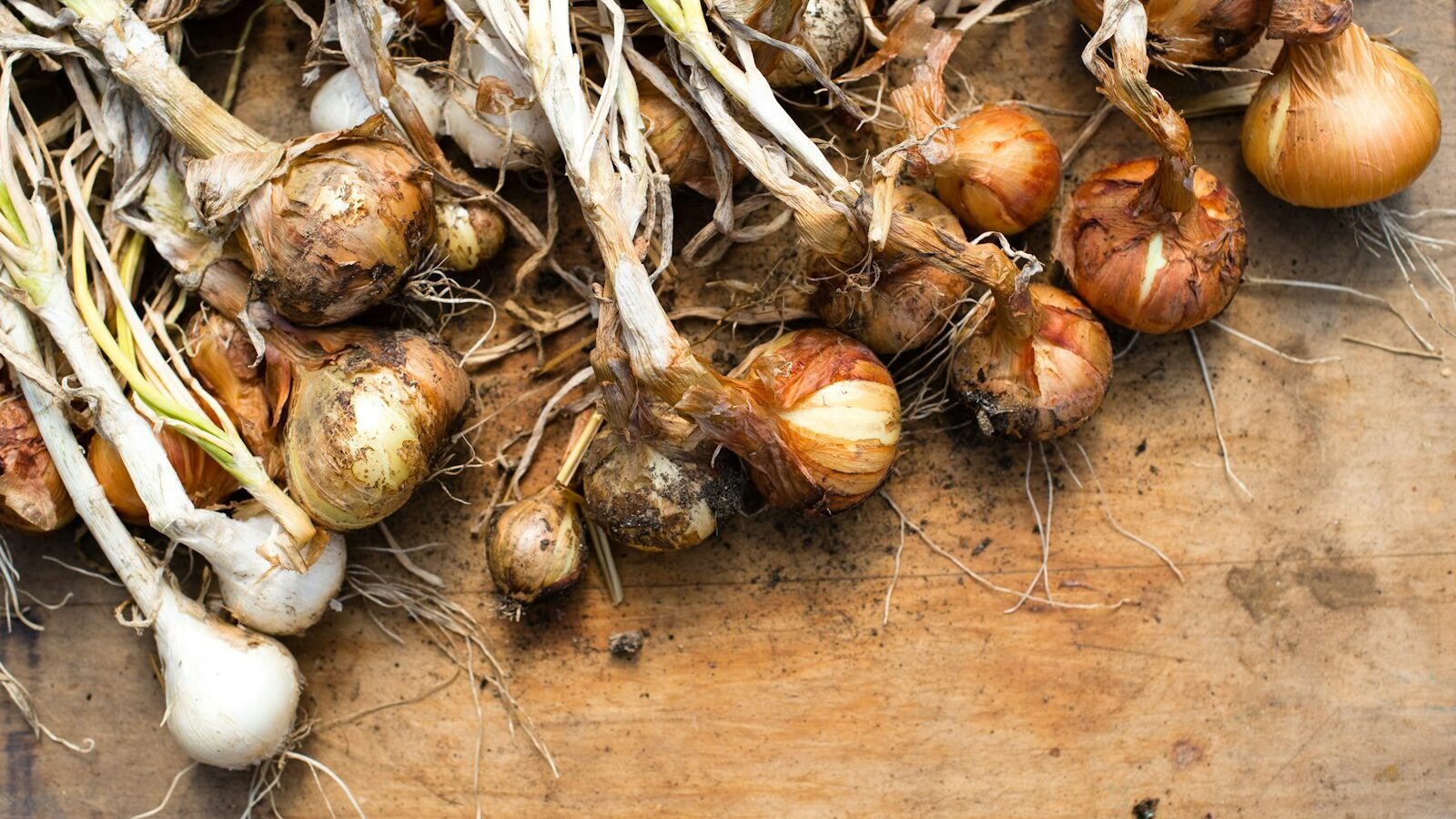
Onions are one of the most rewarding crops you can grow, but success hinges on a detail many gardeners miss: day-length. Choose the right type for your latitude, give them full sun and loose, fertile soil, and feed them early, and you’ll pull plump, well-cured bulbs that store for months. This guide walks you through sets, seeds, and transplants, timing, care, harvesting, curing, and the common problems that trip people up.
Onion quick facts
- Match the type to your latitude (long/short/day-neutral)
- Sets are easiest; seeds give more variety
- Full sun, loose fertile soil, even moisture
- Feed nitrogen early for big bulbs
- Cure in a dry, airy spot before storing
As an Amazon Associate we earn from qualifying purchases.
Day-length is the rule that decides everything
Onions form their leafy tops first, then switch to building a bulb when the days reach a certain length. Plant the wrong type for your region and you’ll get either tiny bulbs or all top and no bottom. This single decision matters more than soil, water, or fertilizer combined, so get it right before you buy a thing.
The three types, by latitude
- Long-day onions bulb when days hit roughly 14 to 16 hours. Grow these in the northern US and Canada (above about 37 degrees latitude). Examples: Yellow Globe, Walla Walla, Patterson, Copra. These tend to store the longest.
- Short-day onions bulb at about 10 to 12 hours of daylight. Grow these in the southern US (below about 35 degrees) where they’re planted in fall or late winter. Examples: Texas Grano, Georgia Sweet, Red Burgundy. Sweet, but they store poorly.
- Day-neutral (intermediate-day) onions bulb at 12 to 14 hours and perform well across the central US and most of the country. Examples: Candy, Super Star, Cabernet. A safe bet if you’re unsure of your latitude.
Rough rule of thumb: if you’re north of a line through San Francisco, Denver, and Washington DC, choose long-day. South of a line through Los Angeles, Dallas, and Atlanta, choose short-day. In between, day-neutral varieties are your friend. International readers should match by latitude rather than country, since the same logic applies worldwide.
Sets vs. seeds vs. transplants
There are three ways to start onions, and each suits a different kind of gardener. Whichever you choose, the day-length rule still applies.
Onion sets (easiest)
Sets are tiny dormant bulbs grown the previous year. Just push them into the soil, root-end down, and they’re off. They’re the most forgiving option, shrug off cold, and mature fast, which makes them ideal for beginners and short seasons. The trade-off is limited variety and a slightly higher tendency to bolt. Pick sets smaller than a dime for bulbing and larger ones for green onions. Browse onion sets to see what’s available for your region.
Seeds (most variety)
Starting from seed unlocks dozens of varieties you’ll never find as sets, and it’s the cheapest route per plant. The catch is time: onions from seed need 10 to 12 weeks indoors before transplanting, so start them in mid-winter. Sow into trays, keep them at 65 to 75 degrees F, and trim the tops to pencil thickness to encourage stocky growth. Explore onion seeds if you want unusual colors or long-storing heirlooms.
Transplants (a middle path)
Transplants are pencil-thick seedlings, often sold in bunches, that give you seed-level variety without the indoor work. They establish quickly and produce large bulbs. They cost more than seeds or sets but save weeks of effort. This is a great option if you missed the indoor seed window.
When and where to plant
Onions are cool-season growers that need a head start while the weather is mild, then warmth and lengthening days to bulb up. Getting the timing and site right sets the whole crop up for success.
Timing by region
- Northern gardeners (long-day): plant sets, transplants, or seedlings outdoors as soon as the soil can be worked in early spring, typically 4 to 6 weeks before your last frost.
- Southern gardeners (short-day): plant in fall or late winter so plants are well-established before days lengthen.
- Central gardeners (day-neutral): plant in early spring, similar to the northern schedule.
Sun and soil
Give onions full sun, at least 6 to 8 hours a day, because every hour of light feeds bulb growth. They demand loose, fertile, well-drained soil with plenty of organic matter; compacted or heavy clay soil produces small, misshapen bulbs. Work in compost before planting and aim for a slightly acidic to neutral pH of 6.0 to 6.8. Raised beds are excellent for onions because they stay loose and drain freely. For more on building good beds, see our how to start a vegetable garden guide.
Spacing, watering, and feeding
Spacing
- For full-size bulbs, space plants 4 to 6 inches apart in rows 12 to 18 inches apart.
- For green onions, plant just 1 to 2 inches apart and harvest young.
- Set or transplant only about 1 inch deep; planting too deep restricts bulb swelling.
Watering
Onions have shallow roots and can’t chase down deep moisture, so they need consistent, even watering, roughly 1 inch per week. Uneven moisture leads to splitting and stunted bulbs. Water at the base to keep foliage dry and reduce disease, and mulch lightly to hold moisture and suppress weeds.
Feeding nitrogen early
Bulb size is set by how many large, healthy leaves a plant grows before bulbing begins, since each leaf becomes a ring. That means nitrogen early is critical. Feed every 2 to 3 weeks with a nitrogen-rich fertilizer through the leafy growth phase, then stop once bulbs start to swell so the plant shifts energy into the bulb. A balanced vegetable fertilizer with extra nitrogen works well early in the season.
Weeding for shallow roots
Onions are poor competitors. Their sparse, shallow roots lose out to weeds for water and nutrients, so keep beds weed-free. Pull or hoe weeds while they’re small, and hoe shallowly to avoid nicking onion roots. Mulch makes this far easier. Onions also make good neighbors for many crops; see our companion planting guide for pairings that deter pests.
Harvesting, curing, and storing
Knowing when to stop watering
As bulbs mature, the green tops naturally yellow and flop over at the neck. When about half the tops have fallen, stop watering. The bulbs are sizing up and excess moisture now only invites rot and shortens storage life. Let the soil dry out for the final week or two.
Harvesting
Once most tops have fallen and started to brown, gently lift the bulbs with a fork on a dry day. Don’t bruise them; damaged onions rot in storage. Brush off loose soil but don’t wash them.
Curing and storing
- Cure onions for 2 to 4 weeks in a warm, dry, airy spot out of direct sun, such as a covered porch or garage. Spread them in a single layer or hang them in bunches.
- They’re cured when the necks are completely dry and the outer skins are papery.
- Trim roots and cut tops to about an inch (or braid them), then store in a cool, dry, dark place at 32 to 40 degrees F with good air flow.
- Long-day storage varieties can keep for several months; sweet short-day onions should be used within a few weeks.
Common problems and fixes
Bolting (flower stalks)
When onions send up a hard flower stalk, the bulb stops growing and won’t store. Bolting is usually triggered by a cold snap after planting or by using oversized sets. Prevent it by planting smaller sets, avoiding too-early planting in cold soil, and choosing the right variety. If a plant bolts, snap off the stalk and use that onion fresh soon.
Thrips
Thrips are tiny insects that rasp silvery streaks into the leaves and weaken plants in hot, dry weather. Knock them back with a strong spray of water, insecticidal soap, or by keeping plants well-watered and unstressed. Reflective mulch can deter them too.
Rot
Neck rot and basal rot show up as soft, browning tissue, usually from overwatering, poor drainage, or storing bulbs that weren’t fully cured. Plant in well-drained soil, water at the base, stop watering as tops fall, cure thoroughly, and store only firm, dry bulbs. Rotate where you plant onions each year to limit soil-borne disease.
Keep learning
Onions are just one piece of a productive plot. For the full picture, start with our urban gardening guide, and if you enjoy growing alliums, try our companion crop next with how to grow garlic.
Frequently asked questions
How do I know whether to plant long-day or short-day onions?
Go by your latitude. North of roughly 37 degrees (the northern US and Canada) choose long-day; south of roughly 35 degrees (the southern US) choose short-day; in between, day-neutral varieties work well anywhere.
Are sets or seeds better for beginners?
Sets are easiest and most forgiving, making them ideal for first-timers and short seasons. Seeds give far more variety and cost less per plant but need 10 to 12 weeks of an indoor head start.
Why are my onion bulbs small?
The most common causes are the wrong day-length type for your area, too little nitrogen early on, crowding, weed competition, or planting too deep. Feed nitrogen during leafy growth and give each plant 4 to 6 inches of space.
When should I stop watering onions?
Stop watering when about half the green tops have yellowed and flopped over. The bulbs are finishing up, and extra water now causes rot and shortens storage life.
How long do cured onions keep?
It depends on the type. Pungent long-day storage varieties can last several months in a cool, dry, dark place, while sweet short-day onions are best eaten within a few weeks.