

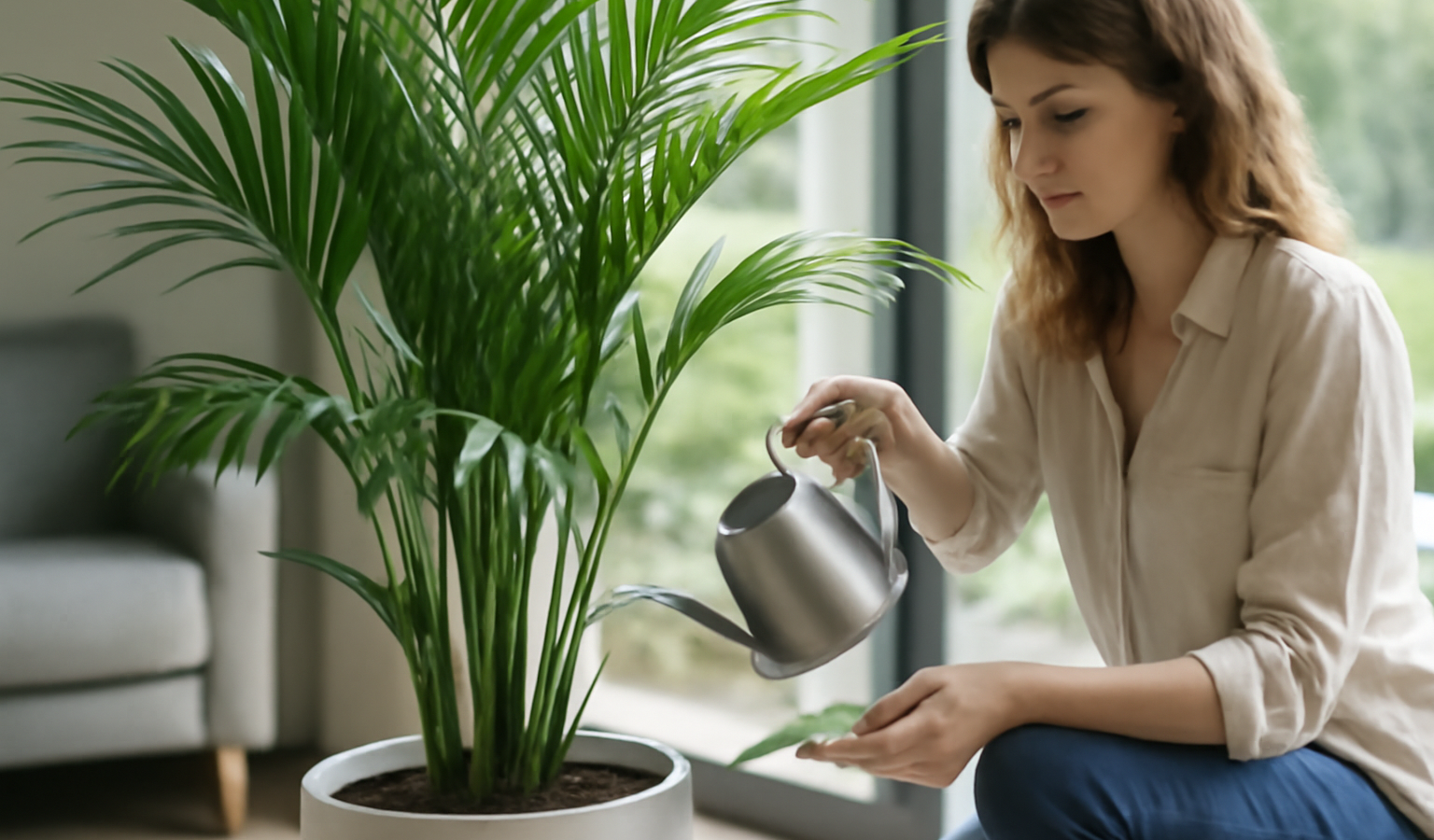
The Kentia palm (Howea forsteriana) is the rare indoor palm that earns its keep in a dim corner without sulking. Native to a single speck of land in the South Pacific—Lord Howe Island, off Australia—it evolved under the dappled shade of taller trees, which is exactly why it tolerates the low light most homes offer. Victorian parlors were full of them, and a century later they are still the palm interior designers reach for when they want height, arching fronds and almost no drama. Get the watering rhythm right and keep it out of scorching sun, and a Kentia will quietly grow into a six-foot centerpiece that lasts decades.
Key Takeaways
- Light: Bright, indirect light is ideal, but Kentias tolerate medium-to-low light better than almost any palm. Keep them out of direct midday sun.
- Water: Let the top 1–2 inches of soil dry, then water thoroughly. Roughly once a week in summer, every 10–14 days in winter.
- Soil: A fast-draining mix—standard potting soil cut with perlite and a little coarse sand or bark.
- Humidity: Average home humidity is fine; 40–60% keeps frond tips from browning.
- Pet-safe: Non-toxic to cats and dogs per the ASPCA.
- Slow but steady: Expect only 6–12 inches of growth per year—patience is part of the deal.
Light: the Kentia’s superpower
If you have struggled to keep palms alive because your home is short on sun, the Kentia is your plant. It performs best in bright, indirect light—think a spot a few feet back from an east- or north-facing window, or near a bright window screened by a sheer curtain. But unlike a majesty palm or an areca, it will hold its color and keep growing in genuinely medium to low light, the kind you find in the middle of a living room or a north-facing office.
The one thing it will not forgive is harsh direct sun, especially through south- or west-facing glass in summer. Direct rays scorch the fronds, leaving bleached or crispy patches that never recover. If you are moving a plant that has lived in low light into a brighter spot, do it gradually over a couple of weeks so the foliage can acclimate. Rotate the pot a quarter-turn every week or two so the plant grows evenly rather than leaning toward the window.
Watering without root rot
More Kentia palms die from overwatering than from anything else. The roots are sensitive to sitting in soggy soil, so the goal is consistent moisture without waterlogging. Wait until the top 1–2 inches of the mix feel dry to your finger, then water thoroughly until it runs from the drainage holes, and empty the saucer 10–15 minutes later. Never let the pot stand in collected water.
In practice that usually means watering about once a week in spring and summer and stretching to every 10–14 days in fall and winter, when growth slows and the plant drinks less. The exact cadence depends on your pot size, light and home temperature—always check the soil rather than watering on a fixed schedule. Kentias are also a little sensitive to fluoride and salts in tap water, which can contribute to brown leaf tips. If your water is heavily treated, let it sit out overnight before using, or switch to filtered or rainwater.
Soil and potting
Drainage is everything. Use a well-draining, peat-based potting mix and lighten it with roughly one part perlite to three parts potting soil; a handful of coarse sand or orchid bark improves aeration further. The mix should hold some moisture but never stay swampy. Always plant in a container with drainage holes—a beautiful cachepot with no drainage is a slow death sentence for the roots.
Kentias actually prefer to be slightly root-bound and resent frequent disturbance, so repot only every 2–3 years, or when roots circle the bottom or push out the drainage holes. Move up just one pot size at a time. The best time to repot is spring, at the start of the growing season. Be gentle with the root ball—damaged roots set the plant back for months. If the plant is too large to repot comfortably, simply top-dress instead: scrape off the top inch or two of old soil each spring and replace it with fresh mix.
Temperature and humidity
Kentia palms are comfortable in the same range people are: 65–80°F (18–27°C) during the day. They tolerate brief dips but should be protected from anything below about 55°F (13°C) and from cold drafts near doors, windows and air-conditioning vents. Equally, keep them away from the dry, hot air blasting out of heating vents and fireplaces, which scorches foliage and crisps the tips.
They handle average household humidity better than most palms, but they look their best at 40–60%. In dry winter rooms—or anywhere with running heat—you may notice brown frond tips. To raise humidity, group plants together, set the pot on a tray of pebbles and water, or run a small humidifier nearby. A periodic misting won’t hurt but does little on its own. Wiping the fronds with a damp cloth every few weeks removes dust, lets the leaves breathe and helps you spot pests early.
Feeding
Kentias are light feeders. During the active growing season—spring through early fall—feed with a balanced liquid houseplant fertilizer diluted to half strength, about once a month. A formula labeled for palms, or one supplying magnesium and potassium, helps prevent the yellowing those nutrients address. Stop feeding in late fall and winter while growth is dormant. Over-fertilizing causes salt buildup that burns root tips and browns the foliage, so when in doubt, feed less. Flushing the soil with plain water every couple of months leaches out accumulated salts.
Propagation: what’s actually possible
Here is the honest answer most care guides bury: you cannot propagate a Kentia palm from cuttings or division. It grows from a single central growing point and does not produce offshoots or pups you can split off. The only way to make new plants is from seed, and that is a slow, finicky process—seeds can take two to twelve months to germinate, often needing bottom heat around 80–85°F and steady moisture, and seedlings grow at a glacial pace.
This is why nurseries plant several seedlings together in one pot to create a fuller, bushier specimen. If your Kentia looks like a multi-stem clump, those are separate plants grown together, not stems you should try to divide—pulling them apart usually damages the intertwined roots. For nearly all home growers, the practical move is to simply buy a mature plant rather than start from seed.
Common problems and how to fix them
Brown leaf tips
The most common Kentia complaint, usually caused by low humidity, salt or fluoride buildup, or inconsistent watering. Raise humidity, switch to filtered or rainwater, and keep your watering rhythm steady. Trim crispy tips with clean scissors, following the natural leaf shape and leaving a thin margin of brown so you don’t open a fresh wound.
Yellowing fronds
An occasional lower frond yellowing and dying off is normal aging—just trim it at the base. Widespread yellowing points to overwatering (check for soggy soil and a sour smell), or a nutrient deficiency, especially magnesium or potassium. Correct the watering first, then feed lightly through the growing season.
Spider mites and scale
Dry indoor air invites spider mites—look for fine webbing and faint yellow stippling on the fronds. Scale shows up as small brown bumps along the stems and leaf undersides. Treat both by wiping the plant down, then spraying thoroughly with insecticidal soap or a diluted neem oil solution every 7–10 days until they are gone. Raising humidity makes the plant far less inviting to mites.
Drooping or mushy base
A soft, mushy, foul-smelling base signals root rot from chronic overwatering or poor drainage. Unpot the plant, trim away blackened roots, repot in fresh fast-draining mix, and water far less going forward. Learn more in our guide to indoor plant and flower care.
Is the Kentia palm pet-safe?
Yes. The Kentia palm is listed as non-toxic to both cats and dogs by the ASPCA, which makes it one of the safest large statement plants for a home with pets. That said, no plant is meant to be eaten—a curious animal chewing the fronds may still get an upset stomach, and shredded leaves are no fun to clean up, so it’s worth placing the plant where it won’t become a snack. If you’re building out a pet-friendly collection, pair it with other safe choices and see our broader small-space and indoor gardening ideas.
A realistic growth timeline
Kentias are famously slow, adding only 6–12 inches a year indoors, but they are also long-lived—decades, with good care. A young plant might be a tabletop size; given time, light and patience, it matures into a graceful 6–10 foot indoor tree with arching, deep-green fronds. Because growth is gradual, the same plant can hold its spot in a room for years without outgrowing it, which is part of why decorators love them. Don’t chase faster growth with heavy feeding; you’ll just risk salt burn. Steady, modest care wins.
Frequently Asked Questions
How often should I water a Kentia palm?
Water when the top 1–2 inches of soil are dry—roughly once a week in spring and summer and every 10–14 days in fall and winter. Always check the soil before watering rather than following a fixed schedule, and never let the pot sit in standing water.
Can a Kentia palm survive in low light?
Yes. The Kentia is one of the most shade-tolerant indoor palms and grows well in medium to low light, though it grows fastest and looks fullest in bright, indirect light. Avoid harsh direct sun, which scorches the fronds.
Why are the tips of my Kentia palm turning brown?
Brown tips usually come from low humidity, salt or fluoride buildup in the soil, or inconsistent watering. Raise humidity, use filtered or rainwater, water on a steady rhythm, and flush the soil occasionally to clear accumulated salts.
Are Kentia palms toxic to cats and dogs?
No. The ASPCA lists the Kentia palm as non-toxic to both cats and dogs, making it a safe statement plant for pet households. Even so, discourage pets from chewing the fronds to avoid mild stomach upset.
How do you propagate a Kentia palm?
You can’t propagate it from cuttings or division—it grows from a single point and produces no pups. The only method is from seed, which is slow and difficult, taking months to germinate. Most growers simply buy an established plant instead.
Treat the Kentia palm as a patient, low-maintenance roommate rather than a project. Give it bright indirect light, water only when the top of the soil dries, keep it out of cold drafts and scorching sun, and it will reward you with years of elegant, arching greenery. For more indoor and tropical plant guides, browse our Plants & Flowers collection.