

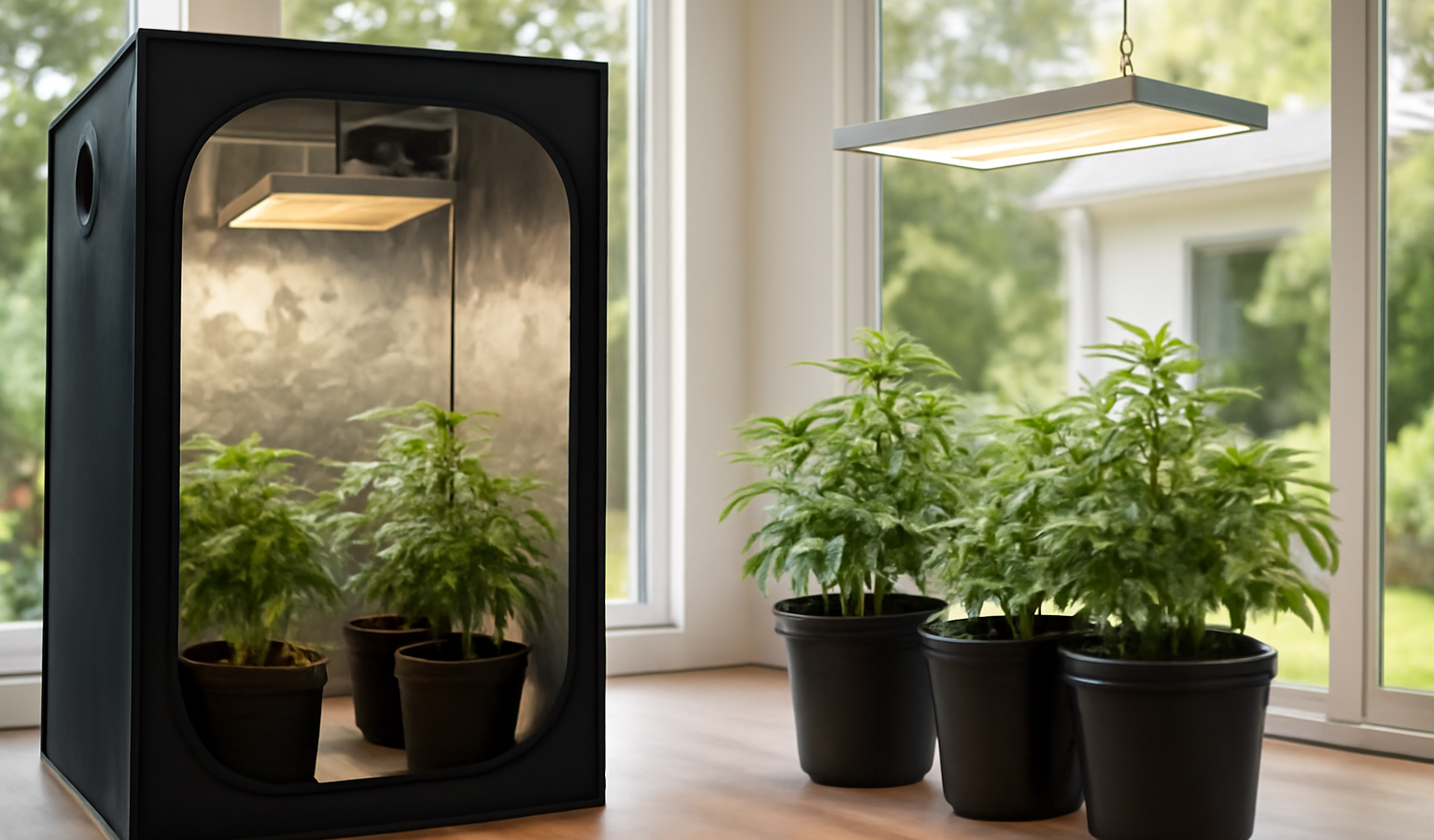
If you want to grow plants indoors with full control over light, temperature, and humidity, you face an early fork in the road: buy a ready-made grow tent, or convert a spare room, closet, or basement corner into a grow room. A grow tent is a self-contained, reflective fabric enclosure with a frame, ports for ducting and cables, and everything sized to drop in lights, fans, and filters. A grow room is a permanent space — part of your home’s structure — that you outfit with the same equipment but on your own terms. The tent wins on speed, simplicity, and contained climate control; the room wins on scale, cost-per-square-foot at size, and permanence. For a first-time indoor grower or anyone with one or two plants, a tent is almost always the right call. For someone running a large, ongoing operation who wants maximum space and does not mind the build, a dedicated room earns its keep. This guide compares the two on cost, setup, climate control, scale, and stealth so you can match the choice to your space, budget, and ambitions.
Key Takeaways
- Grow tents are fast to set up, self-contained, and excel at controlling climate in a small footprint.
- Grow rooms offer more space and lower cost per square foot at scale, but demand building, sealing, and proofing work.
- Tents come with reflective walls and ready-made ports; rooms need you to add reflective surfaces and ducting.
- Climate is easier to dial in within a small sealed tent than across a large room.
- Choose a tent for beginners, small grows, and renters; a room for large, permanent operations.
- Both need proper lighting, ventilation with a carbon filter, and humidity control.
Quick Comparison: Grow Tent vs Grow Room
| Factor | Grow Tent | Grow Room |
|---|---|---|
| Setup time | An hour or two | Days to weeks |
| Upfront effort | Minimal — assemble & hang gear | High — seal, line, wire, duct |
| Reflective walls | Built in | You add (Mylar, panda film, paint) |
| Climate control | Easy in small sealed space | Harder across large volume |
| Scale | Limited to tent size | As large as the room |
| Cost per sq ft (at scale) | Higher | Lower |
| Portability | Movable, removable | Permanent |
| Best for | Beginners, renters, small grows | Large, permanent operations |
Grow Tents: Contained, Quick, and Beginner-Friendly
A grow tent is essentially a growing environment in a box. You buy it in a standard size — common footprints run from 2×2 feet up to 5×5 feet and larger — and within an hour or two you have a fully enclosed space with reflective interior walls, a sturdy frame rated to hang lights and filters, mesh vents, and pre-cut ports for ducting and power cables. Everything is designed to work together, which removes most of the guesswork that trips up first-time indoor growers. You hang a light, mount an inline fan and carbon filter, add a small clip fan for air movement, and you are growing.
The tent’s biggest practical advantage is climate control. A small, sealed, insulated volume is far easier to keep at the right temperature and humidity than an open room, because the equipment only has to condition a few cubic feet of air. The reflective lining also bounces light back onto your plants, so none of your expensive lighting is wasted on bare walls. Tents contain odor when paired with a carbon filter, keep dust and pests out, and protect your home from the moisture that indoor growing produces. They are also removable and portable — a major plus for renters, who can take the whole setup down without altering the property. The trade-offs are scale and durability: you are limited to the tent’s footprint, fabric and zippers wear over a few years, and at large sizes a tent costs more per square foot than simply building out a room. For small-space growers, a tent pairs naturally with the techniques in our growing vegetables indoors in winter guide.
Grow Rooms: Spacious, Permanent, and Scalable
A grow room turns part of your home — a spare bedroom, basement, closet, or garage section — into a permanent cultivation space. Nothing comes ready-made; you build the environment yourself, which is both the burden and the appeal. You seal the room to be light-tight and pest-tight, line the walls with a reflective surface like Mylar, panda film, or flat white paint, run dedicated ducting for intake and exhaust, mount lights, and wire in enough power. The payoff is space: a room can be far larger than any tent, letting you run more plants, taller canopies, or separate areas for different growth stages.
At scale, a grow room is also cheaper per square foot, because you are paying for paint and film instead of repeated tent fabric, and you can lay it out exactly to your space rather than to a manufacturer’s standard size. A permanent room can integrate with your home’s HVAC and electrical in ways a tent cannot, which helps when conditioning a large volume of air. But that same large volume is the catch: climate control is genuinely harder in a big open room, where temperature and humidity drift more and demand more powerful, more expensive equipment to manage. The build itself takes days or weeks of real work and often money for materials, sealing, and wiring. And because it is permanent, it suits homeowners and serious growers far more than renters. Done right, though, a grow room is the most capable and economical option for anyone growing at volume long-term — and it dovetails with broader urban gardening setups for small homes.
Cost, Climate, and Scale Compared
On upfront cost and effort, the tent wins decisively for small and medium grows — you buy one box and you are running the same day, with no construction. The room costs less per square foot only once you scale up, and only after you invest the labor and materials to build it out. On climate control, the tent’s small sealed volume is simply easier to keep stable, while a room rewards you with space but punishes you with harder, costlier conditioning of a large air volume. On scale, the room is unlimited where the tent is fixed; if you expect to expand from a couple of plants to a serious canopy, the room scales with you while tents force you to buy progressively larger units.
Two factors cut across both. Permanence: tents come and go and leave no trace, ideal for renters or temporary setups, whereas a room is a fixture of the home. And stealth and protection: both contain odor and light well when properly equipped with a carbon filter and sealing, but the tent does it out of the box while the room requires you to engineer it. Whatever you choose, the core equipment list is identical — adequate full-spectrum lighting, active ventilation with an inline fan and carbon filter, internal air circulation, and humidity and temperature control. The enclosure is just the shell around that gear.
The Verdict: Which Should You Choose?
Choose a grow tent if you are new to indoor growing, running one to a handful of plants, renting your home, or you simply want the fastest, lowest-effort path to a controllable environment. The built-in reflective walls, ready-made ports, easy climate control in a small sealed space, and full portability make it the right default for the vast majority of home growers. Choose a grow room if you are a homeowner planning a large, permanent, ongoing operation, you want maximum space and the best cost-per-square-foot at scale, and you are willing to invest the days of building, sealing, and wiring it takes to do it properly. Many growers actually start in a tent and graduate to a room as they scale — the tent teaches you how the equipment and climate behave in a forgiving small space, and that knowledge transfers directly when you build out something bigger. Match the enclosure to your scale, budget, and how permanent you want the setup to be, and either one will grow excellent plants.
Frequently Asked Questions
Is a grow tent or grow room better for beginners?
A grow tent is better for beginners. It comes ready-made with reflective walls and ports, sets up in an hour or two, and its small sealed space makes temperature and humidity far easier to control.
Why is climate easier to control in a grow tent?
A tent encloses only a small, sealed, insulated volume of air, so your fans, heaters, and humidifiers have far less space to condition than an open room, keeping temperature and humidity more stable.
When does a grow room make more sense than a tent?
A grow room makes sense for large, permanent operations where you want maximum space and the lowest cost per square foot, and you own your home and can invest in sealing, lining, and wiring it.
Can renters use a grow room?
It is usually better for renters to use a grow tent, since it is portable and leaves no trace. A grow room is a permanent modification to the property that most leases will not allow.
What equipment do both setups need?
Both need full-spectrum lighting, active ventilation with an inline fan and carbon filter, internal air circulation, and temperature and humidity control. The enclosure differs, but the core gear is the same.