

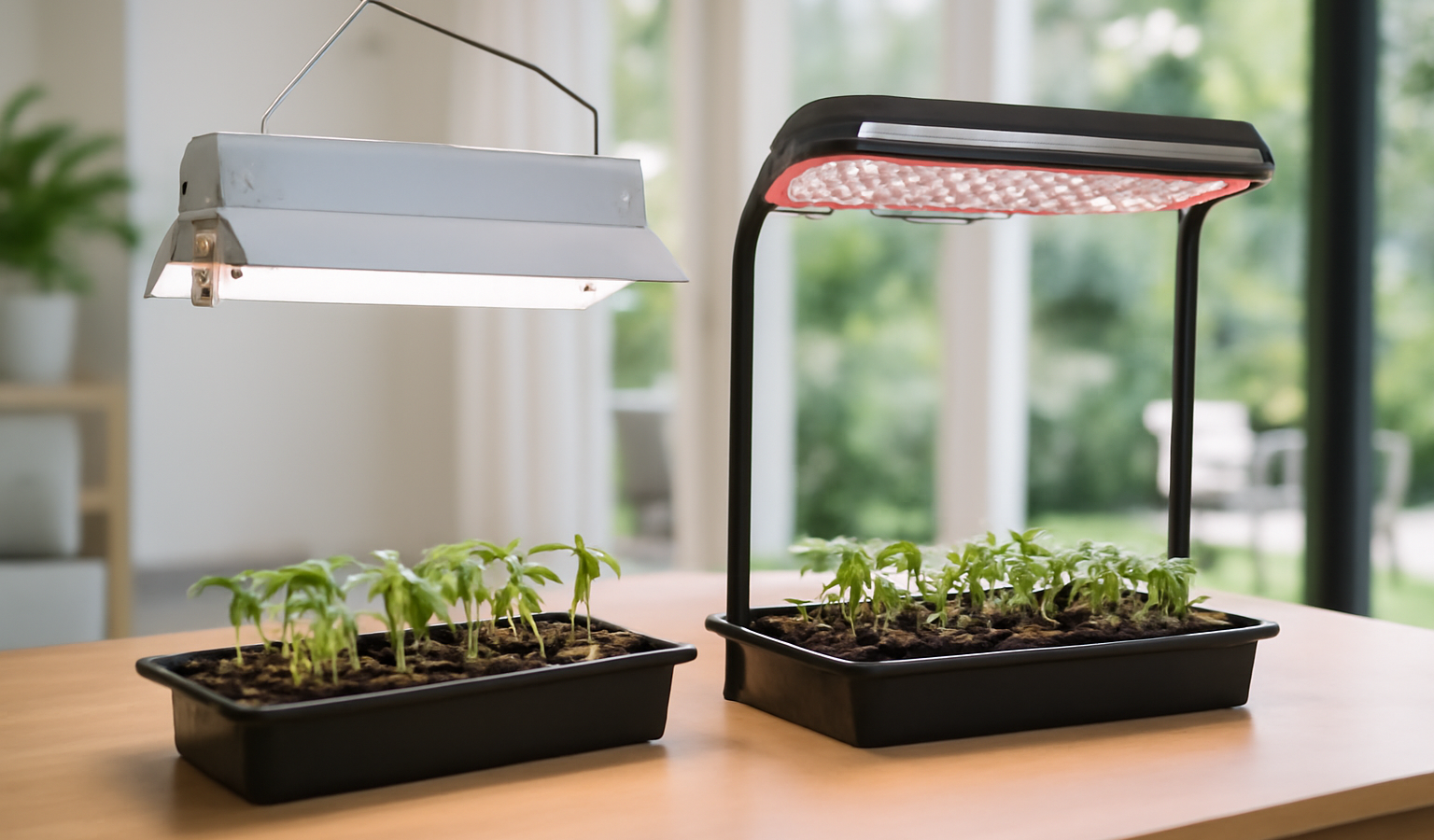
If you start seeds indoors or keep plants going through a dark winter, you eventually have to choose a light, and the choice almost always comes down to T5 fluorescent tubes versus LED panels and bars. For a decade T5s were the indoor-gardening default, and they still do a fine job for seedlings and leafy greens. But LEDs have taken over for good reasons: they use far less electricity, run cooler, last several times longer, and now deliver a tunable spectrum that fluorescents cannot match. This guide compares the two on the factors that actually affect your plants and your power bill.
Key Takeaways
- Efficiency: Modern LEDs convert far more electricity into usable plant light than T5s, often using 30-50% less power for the same output.
- Lifespan: LEDs last roughly 50,000+ hours; T5 tubes degrade noticeably after about 10,000-20,000 hours and need replacing.
- Heat: LEDs run cooler, so you can place them closer to seedlings; T5s are cool by HID standards but still warmer than LED.
- Upfront cost: T5 fixtures are cheaper to buy; LEDs cost more initially but win on running cost and replacement over time.
- Best overall today: LED for almost everyone; T5 still makes sense for cheap, simple seed-starting setups.
Quick Comparison at a Glance
| Factor | T5 Fluorescent | LED |
|---|---|---|
| Energy efficiency | Moderate | High (best available) |
| Lifespan | ~10,000-20,000 hrs | ~50,000+ hrs |
| Heat output | Low-moderate | Low |
| Upfront cost | Lower | Higher |
| Running cost | Higher | Lower |
| Spectrum control | Fixed (bulb color temp) | Tunable, full-spectrum |
| Hanging distance | A few inches above canopy | Varies; can be close |
| Best use | Seedlings, greens, cheap setups | Seedlings through flowering, long-term |
T5 Fluorescent Grow Lights
T5 refers to a high-output fluorescent tube about 5/8 inch in diameter, sold in 2-foot and 4-foot lengths and mounted in reflector fixtures holding two to eight tubes. For years they were the gold standard for seed starting because they are inexpensive, spread light evenly over a wide bench, and run cool enough to sit just a few inches above tender seedlings without scorching them. A 4-foot, 4-tube T5 fixture covers a standard 1020 propagation tray beautifully and produces sturdy, compact transplants.
T5 tubes come in color temperatures: 6500K (“daylight,” cool blue) light promotes compact vegetative growth and is ideal for seedlings and leafy greens, while 3000K (“warm”) tubes lean red and support flowering and fruiting. Many growers mix the two in one fixture to approximate full spectrum. The light is gentle and forgiving, which is part of why T5s remain popular for beginners: it is hard to burn a plant with them.
Where T5s fall short
The limitations are mostly about efficiency and lifespan. Fluorescent technology converts a smaller share of electricity into usable photosynthetic light than modern LEDs, so a T5 setup costs more to run for the same growing area. The tubes also lose output as they age and should be replaced every 10,000-20,000 hours (roughly every one to two seasons of heavy use) even though they still light up, because their usable intensity drops. They contain a small amount of mercury, so spent tubes need proper disposal, and the light does not penetrate deeply, making T5s best for short plants rather than tall, fruiting crops. Our urban gardening guides cover seed-starting setups where T5s still hold up well.
LED Grow Lights
LED (light-emitting diode) grow lights have become the standard for nearly every indoor application, and the gap over fluorescents has only widened. Modern horticultural LEDs, sold as bars, panels, and quantum boards, convert a far higher fraction of electricity into the wavelengths plants actually use, which is the metric that matters. In practical terms, an LED fixture delivering the same light to your plants as a T5 setup typically draws 30-50% less power, and that difference compounds over years of daily 14-16 hour runtimes.
Lifespan is the other headline advantage. Quality LEDs are rated for 50,000 hours or more, several times a T5 tube, so you rarely replace them. They run cooler at the diode-to-plant level, which means less heat stress and, in many designs, the ability to position lights close to the canopy. Crucially, LEDs offer real spectrum control: full-spectrum white LEDs supplemented with specific red and blue diodes can support a plant from germination through flowering and fruiting, something a fixed-color fluorescent tube cannot do as well.
The catches with LED
The main downside is upfront cost: a good LED fixture costs more than a comparable T5, and the market is flooded with cheap, overrated panels that exaggerate their wattage and output. Read actual power draw and, if available, PPF (photosynthetic photon flux) numbers rather than marketing “equivalent watts.” Some inexpensive blurple (red-blue only) panels also make it hard to spot pests and nutrient problems because everything looks purple; full-spectrum white LEDs avoid that. Finally, because some LEDs are intense, you can burn or bleach plants if you hang a powerful fixture too close, so follow the maker’s hanging-height and dimming guidance. For comparing fixtures and seedling setups, see our plant care articles.
Cost Over Time: The Real Comparison
The sticker price favors T5, but the lifetime cost favors LED. A T5 fixture is cheaper to buy, but you pay for that in higher monthly electricity and in replacement tubes every season or two. An LED costs more at checkout, then quietly saves money every month through lower draw and almost never needs a new bulb. For a small seed-starting shelf run a few weeks each spring, the T5’s running cost barely matters and the cheaper fixture can be the smart buy. For a year-round indoor garden running 14-16 hours a day, the LED’s efficiency and longevity pay back the difference and then keep saving.
Heat is a hidden cost factor too. T5s add some warmth to a closed grow tent or closet, which can mean more cooling in summer; LEDs add less, simplifying climate control. In a cold basement in winter, a little T5 warmth can actually be welcome, so context matters.
Practical Setup Tips for Both
Whatever you choose, the fundamentals are the same. Run lights 14-16 hours a day for seedlings and leafy greens, on a timer so you never forget. Keep T5 tubes 2-4 inches above the seedling canopy and raise them as plants grow; follow the manufacturer’s distance for LEDs, which varies by intensity. Light intensity falls off fast with distance, so close-but-safe beats high-and-weak. Watch your plants for the answer: leggy, stretching seedlings mean the light is too far or too weak; bleached, curling, or crispy tops mean a strong LED is too close.
For either technology, a reflective surface around the growing area (white walls, a reflective tent, or even foil) bounces stray light back onto plants and improves efficiency. And remember that no light replaces good airflow and proper watering; a gentle fan strengthens stems and prevents the damp, still air that breeds fungal problems under any light.
Verdict: Which Should You Buy?
For almost everyone, buy LED. The lower running cost, the 50,000-hour lifespan, the cooler operation, and the tunable full spectrum make modern LEDs the better long-term value and the more capable light, able to take a plant from seed all the way to fruit. Just buy a reputable full-spectrum fixture and judge it by real power draw, not inflated “equivalent” claims.
T5 still makes sense if you only start seeds for a few weeks each spring, want the cheapest possible entry, or like the broad, gentle, hard-to-burn light over a propagation bench. It is a proven, forgiving seed-starting tool. But if you are setting up anything you will run for years, or you want to grow fruiting and flowering plants indoors, LED is the clear winner.
Frequently Asked Questions
Are LED grow lights worth the higher price over T5?
For long-term or year-round use, yes. LEDs use much less electricity, last several times longer, and never need tube replacements, so they pay back the higher upfront cost. For a few weeks of spring seed-starting, a cheaper T5 can still be the sensible choice.
Can T5 lights grow flowering or fruiting plants?
They can support some flowering with warm (3000K) tubes, but their light does not penetrate deeply and they are best for short, leafy crops and seedlings. Full-spectrum LEDs handle flowering and fruiting far better.
How close should grow lights be to seedlings?
Keep T5 tubes about 2-4 inches above the canopy. LED distance varies by intensity, so follow the maker’s guidance. Leggy seedlings mean the light is too far; bleached or crispy tops mean it is too close.
What spectrum is best for seedlings?
Cool, blue-rich light (6500K T5 tubes or full-spectrum white LEDs) promotes compact, sturdy seedlings. Add warmer red wavelengths later if you want to support flowering and fruiting on the same plants.
How long do T5 tubes and LEDs last?
T5 tubes lose useful output after roughly 10,000-20,000 hours and should be replaced even if they still light. Quality LEDs are rated for 50,000 hours or more, so you rarely replace them.