

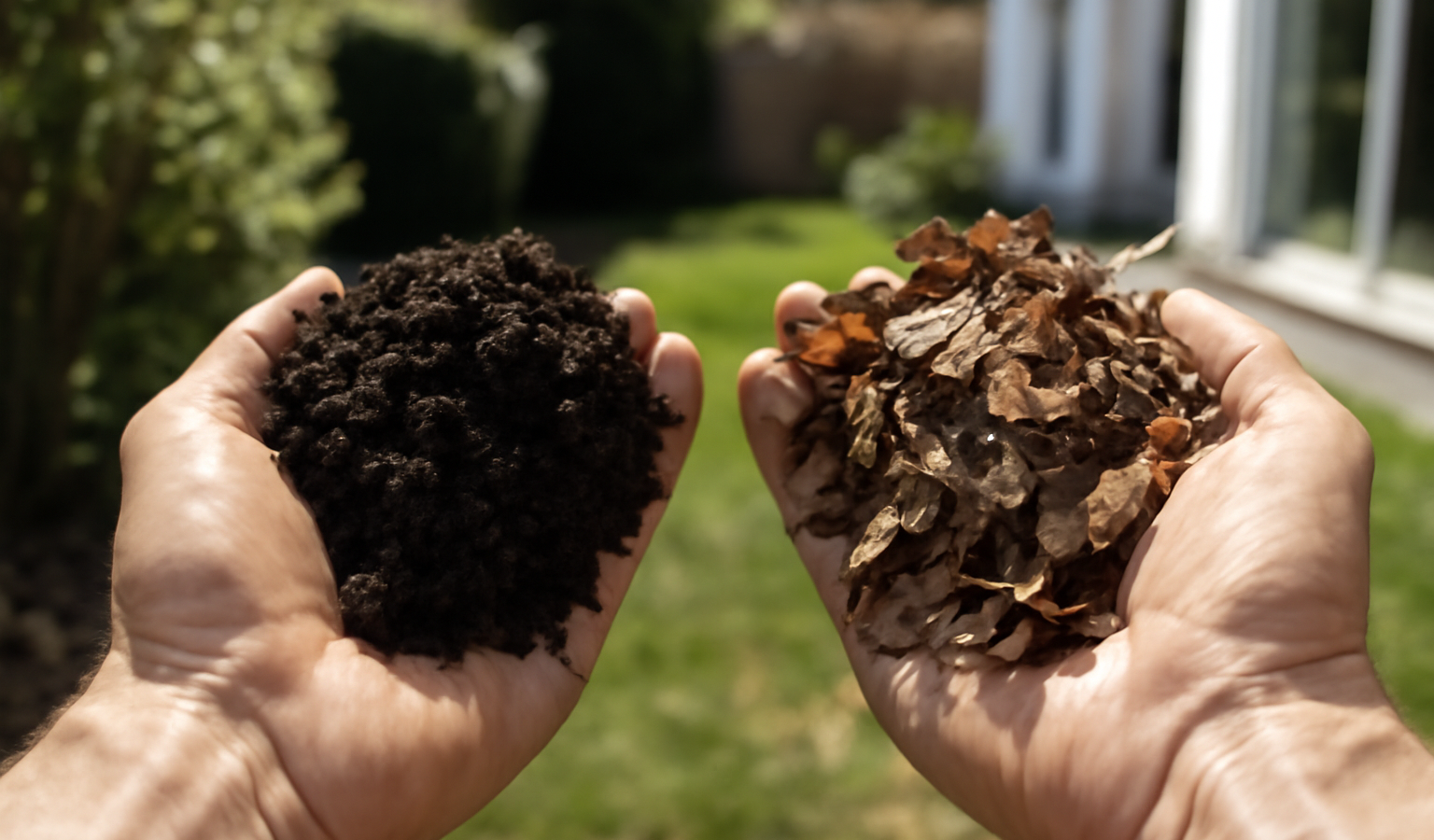
The short answer: compost is a balanced, nutrient-rich amendment made from a mix of “greens” and “browns” that breaks down through hot, bacterial decomposition in 2 to 6 months, while leaf mold is made from leaves alone, breaks down slowly and cold through fungal action over 1 to 2 years, and is prized not for nutrients but as an unbeatable soil conditioner that holds water like a sponge. You don’t have to choose one over the other — most serious gardeners make both, because they do different jobs. Compost feeds plants; leaf mold builds soil structure. Below is exactly how each forms, what’s in it, and where to use it.
Key Takeaways
- Compost is a balanced mix (greens + browns, roughly 25–30:1 carbon-to-nitrogen), decomposed by heat-loving bacteria at 130–160°F, and is usually ready in 2–6 months.
- Leaf mold is leaves only (50–80:1 carbon-to-nitrogen), broken down cold by fungi, and takes 1–2 years (6–12 months if shredded and kept moist).
- Compost is the better fertilizer — meaningfully higher in nitrogen, phosphorus, and potassium plus a broad set of micronutrients.
- Leaf mold is the better soil conditioner — it can hold roughly 500% of its weight in water and dramatically improves structure.
- Use compost as an all-purpose amendment and feed; use leaf mold as mulch, in seed-starting mixes, and in woodland and shade beds.
- Speed up leaf mold by shredding leaves with a mower, keeping the pile damp, and adding a little nitrogen or finished compost.
| Feature | Compost | Leaf Mold |
|---|---|---|
| Main ingredients | Mixed greens + browns (kitchen scraps, grass, leaves, straw) | Deciduous leaves only |
| Decomposition type | Hot, bacterial (thermophilic), 130–160°F | Cold, fungal |
| C:N ratio (start) | Balanced, ~25–30:1 | High carbon, ~50–80:1 |
| Time to finish | 2–6 months | 1–2 years (6–12 months if shredded) |
| Nutrient value | Moderate, balanced N-P-K + micronutrients | Low in nutrients |
| Water-holding capacity | Good | Excellent (~500% of its weight) |
| Best use | Fertility, all-purpose amendment | Mulch, seed-starting, structure |
Compost: The All-Purpose Feeder
Compost is what most people mean when they talk about “feeding the soil.” It’s produced by mixing nitrogen-rich materials (greens — grass clippings, vegetable scraps, coffee grounds, fresh garden trimmings) with carbon-rich materials (browns — dried leaves, straw, shredded cardboard, woody prunings). When you get the ratio right, the pile heats up. That heat is the signature of compost, and it’s driven by colonies of bacteria multiplying explosively as they consume the easy nitrogen and carbon.
The target carbon-to-nitrogen ratio for an active hot pile is roughly 25–30:1. Below that (too much green) the pile goes anaerobic and smells of ammonia; far above it (too much brown) it stalls and sits cold for months. When the balance is right and there’s enough moisture — the classic “wrung-out sponge” feel, around 50–60% moisture — thermophilic (heat-loving) bacteria push the core to 130–160°F. That temperature range matters: it’s hot enough to kill most weed seeds and many pathogens but not so hot that you sterilize the pile of the very microbes doing the work. If your pile climbs past about 160°F, turn it to introduce air and cool it down.
How long it takes
A well-managed hot pile — built all at once at the right ratio, kept moist, and turned every week or two to reintroduce oxygen — can finish in 2 to 3 months. A passive “cold” compost pile that you simply add to over time and never turn will still produce finished compost, but it can take 6 to 12 months and won’t reach weed-killing temperatures. Finished compost is dark, crumbly, and smells like a forest floor; you should no longer recognize the original ingredients.
What’s in it and how to use it
Compost is the more nutritionally complete of the two products. It supplies a modest but balanced dose of nitrogen, phosphorus, and potassium plus a broad spectrum of micronutrients and, just as importantly, a living population of beneficial microbes. The numbers are gentle compared with synthetic fertilizer — that’s a feature, not a flaw, because it releases slowly and won’t burn roots. Use compost as a 1–2 inch top-dressing on beds in spring, as a side-dressing for hungry crops mid-season, mixed into planting holes, or screened and blended into potting and raised-bed mixes. For fall planning and bed prep, it pairs naturally with your other fall garden tasks like clearing spent crops and building next year’s piles.
Leaf Mold: The Soil Conditioner
Leaf mold is humbler and, in a way, lazier — it’s simply what happens when a pile of fallen leaves is left to rot on its own. Because leaves are almost entirely carbon (a C:N ratio of 50–80:1) and contain very little nitrogen, they don’t heat up the way a balanced compost pile does. Instead of fast-acting bacteria, the decomposition is led by fungi, which patiently colonize and break down the tough, carbon-heavy leaf tissue in a cool, slow process. The end product is a dark brown to black, crumbly, sweet-smelling material that looks a lot like the duff layer on a forest floor — which is exactly what it is.
That fungal, cold pathway is why leaf mold takes so long. Left whole and undisturbed, a leaf pile commonly needs 1 to 2 years to become usable leaf mold. The trade-off for that patience is a material that does something compost can’t do nearly as well: hold water. Well-made leaf mold can retain on the order of 500% of its own weight in water, acting like a reservoir in the soil. Worked into a bed, it loosens heavy clay, helps sandy soil hold moisture, and creates the open, spongy structure that roots and earthworms love.
Low nutrients, big structure
Don’t expect leaf mold to feed your plants. Its nutrient content is low — it’s primarily stable carbon and humus, not a source of nitrogen. Think of it as the thing that makes the soil a better home rather than the meal itself. That low-nutrient, water-holding, structure-building profile makes it ideal for jobs where you want conditioning without a fertility spike: as a moisture-retaining mulch around shrubs and perennials, as a key ingredient in seed-starting and potting mixes (where you specifically don’t want a hot, salty medium near tender seedlings), and as a top-dress for woodland, fern, and shade beds that naturally evolved under a layer of decomposing leaves.
How to make it (and speed it up)
Making leaf mold is almost embarrassingly simple: rake leaves into a contained pile or a wire bin, or stuff them into perforated plastic bags, dampen them, and wait. To dramatically shorten the timeline, shred the leaves first — running a mower over them or using a leaf shredder increases the surface area fungi can work on and can cut the process down to 6 to 12 months. Keep the pile consistently moist (fungi stall when it dries out), and adding a shovelful of finished compost or a light sprinkle of nitrogen introduces microbial helpers and nudges the C:N ratio downward without turning it into a hot compost pile. Building and storing these leaf piles is a natural part of seasonal yard work and ties into broader outdoor living and yard care routines in autumn.
The Verdict: How to Choose (or Use Both)
Frame the decision around the job, not the material. If you need to feed — a hungry vegetable bed, container plants, a spring top-dress to push growth — reach for compost. Its balanced nutrients and active microbiology make it the all-purpose workhorse. If you need to condition — break up clay, help sandy soil hold water, mulch a shade border, or blend a gentle seed-starting medium — reach for leaf mold, where the water-holding and structure-building strengths shine and the lack of nutrients is actually an advantage.
Practically, the two are complementary, and the smartest setup is to run both systems in parallel. Use your green kitchen and garden waste, plus a portion of your leaves, to build hot compost for fertility. Divert the rest of your fall leaf haul — and most yards produce far more leaves than a balanced compost pile can absorb without going carbon-heavy — into a dedicated leaf mold pile or bin. A year later you’ll have a steady supply of both: compost to feed and leaf mold to build soil. For zone-specific plant choices to use these amendments on, browse our plants and flowers guides.
One caution that applies to both: be careful with diseased material and with leaves from plants like walnut that contain growth-inhibiting compounds, and keep persistent herbicides out of either pile. A hot compost pile will neutralize many weed seeds and pathogens because of its temperature; a cold leaf mold pile will not, so don’t add anything you wouldn’t want spreading later.
Frequently Asked Questions
Can I just add leaves to my regular compost pile instead of making leaf mold?
Yes — dried leaves are an excellent “brown” and provide the carbon a hot compost pile needs. The catch is balance: a typical yard produces far more leaves in fall than your greens can offset, so dumping them all in pushes the C:N ratio too high and stalls the pile. Use as many leaves as your greens can balance (roughly equal volumes works for many people), and divert the surplus to a dedicated leaf mold pile.
Why doesn’t my leaf pile heat up like compost?
Because leaves are nearly all carbon (50–80:1) with very little nitrogen, the bacteria that generate heat don’t have the fuel to multiply rapidly. Leaf mold is a fungal, cold process by design. If you want heat, you need to add nitrogen-rich greens — but then you’re making compost, not leaf mold.
How can I make leaf mold faster than two years?
Shred the leaves first (a lawn mower pass works well) to expose more surface area, keep the pile consistently moist like a wrung-out sponge, and mix in a shovelful of finished compost or a light dusting of a nitrogen source. Together these steps can bring a whole-leaf timeline of 1–2 years down to roughly 6–12 months.
Is leaf mold acidic?
Fresh, partially decomposed leaves can be slightly acidic, but finished leaf mold is generally close to neutral and is fine for the vast majority of garden plants. Its real value is structure and water retention rather than any pH effect, so you rarely need to worry about it acidifying your beds.
Which one should I use to start seeds?
Leaf mold, blended into a seed-starting mix, is the better choice. It’s low in nutrients and salts (so it won’t burn tender seedlings) while providing excellent moisture retention and a light, open texture. Straight compost can be too rich and variable for delicate seedlings, though screened compost is great once plants are larger and transplanted out.