


Fertilizer spikes are compressed sticks of slow-release fertilizer that you drive into the ground around a tree or shrub. They are popular because there is nothing to measure, spread or water in, and they keep fertilizer off lawns, sidewalks and storm drains. They are also not a perfect solution: nutrients stay concentrated in small pockets of soil rather than spreading across the root zone. Below are seven spike products currently listed on Amazon, for shade trees, evergreens, fruit trees and bulk landscape use, followed by an honest look at when spikes beat granular fertilizer and when they don’t.
Part of our Trees & Shrubs guide →
In this guide
- 1. Miracle-Gro Tree and Shrub Plant Food Spikes — Best Overall for Mixed Yards
- 2. Jobe’s Tree Fertilizer Spikes 16-4-4 — Best for Deciduous Shade Trees
- 3. Old Farmer’s Almanac Evergreen Tree and Shrub Spikes 10-4-10 — Best for Evergreens
- 4. Jobe’s Evergreen Tree Fertilizer Spikes 13-3-4 — Best Value Evergreen Multi-Pack
- 5. SimplyGro Tree and Shrub Fertilizer Spikes 8-8-8 — Best Balanced Formula
- 6. Miracle-Gro Fruit and Citrus Plant Food Spikes — Best for Fruit and Citrus Trees
- 7. Winchester Gardens Landscaper Pack 15-10-9 — Best Bulk Pack
- Spikes vs Granular Fertilizer: When Each Makes Sense
- What to Look for in Fertilizer Spikes
- How to Use Fertilizer Spikes
- Frequently Asked Questions
Urban Lotus Project is reader-supported. When you buy through links on our site, we may earn an affiliate commission at no extra cost to you.
How we compared: we compared 7 current Amazon listings on what each listing states about NPK, spike count, intended plants and feeding schedule. We did not test or handle the products, and availability changes.
| Product | Best for | Key features | Buy |
|---|---|---|---|
| Miracle-Gro Tree and Shrub Spikes | Best overall for mixed yards |
| Buy now →Check current price |
| Jobe's Tree Spikes 16-4-4 | Best for deciduous shade trees |
| Buy now →Check current price |
| Old Farmer's Almanac Evergreen 10-4-10 | Best for evergreens |
| Buy now →Check current price |
| Jobe's Evergreen Spikes 13-3-4 | Best value evergreen multi-pack |
| Buy now →Check current price |
| SimplyGro Tree and Shrub 8-8-8 | Best balanced formula |
| Buy now →Check current price |
| Miracle-Gro Fruit and Citrus Spikes | Best for fruit and citrus trees |
| Buy now →Check current price |
| Winchester Gardens Landscaper Pack | Best bulk pack |
| Buy now →Check current price |
Prices change often; check Amazon for today’s price. As an Amazon Associate we earn from qualifying purchases.
1. Miracle-Gro Tree and Shrub Plant Food Spikes — Best Overall for Mixed Yards

12 slow-release spikes for deciduous, flowering and evergreen trees plus acid-loving shrubs like hydrangeas and azaleas.
Check price on AmazonWhy We Like It
- Covers deciduous, evergreen and acid-loving plants
- Clear coverage guidance by drip line size
- Simple spring and fall schedule
- Spacing instructions on the listing
| Specification | Details |
|---|---|
| Spikes per pack | 12 (3 lb) |
| NPK | Not stated in listing |
| Plants | Deciduous, flowering, evergreen trees; hydrangeas, azaleas, magnolias |
| Schedule | Once in spring, once in fall |
| Coverage stated | 3 trees with 4 ft drip line diameter or 1 tree with 12 ft |
| Spacing | Around drip line, at least 3 ft apart |
Miracle-Gro Tree and Shrub Plant Food Spikes — compressed specs
Most yards have a mix of shade trees, evergreens and flowering shrubs, and this is the one spike in the group that lists all of them, including acid-loving hydrangeas, azaleas and magnolias. The listing is also unusually clear about coverage: a 12-spike pack feeds three small trees with a 4-foot drip line diameter or one tree with a 12-foot drip line diameter, which helps you buy the right amount.
It does not state the NPK ratio in the listing, so check the package if you need to match a soil test. That coverage figure also highlights the limitation of spikes for big trees: a mature shade tree with a 30-foot canopy would need several packs per feeding.
Pros
- Works across many tree and shrub types
- Helpful coverage chart
- Easy twice-a-year schedule
Cons
- NPK not shown on listing
- Only 12 spikes per pack
- Large trees need many spikes
Check Miracle-Gro Tree and Shrub Spikes price on Amazon
2. Jobe’s Tree Fertilizer Spikes 16-4-4 — Best for Deciduous Shade Trees

High-nitrogen 16-4-4 time-release spikes for deciduous trees and shrubs, sold as two 15-spike packages.
Check price on AmazonWhy We Like It
- Nitrogen-focused for leafy growth
- Two packages, 30 spikes total
- Listing says it will not burn trees
- Feeds all season per listing
| Specification | Details |
|---|---|
| NPK | 16-4-4 |
| Spikes | 15 per package, 2 packages |
| Plants | All deciduous trees and shrubs |
| Release | Time release, feeds all season |
| Listed weight | About 8.3 pounds |
Jobe’s Tree Fertilizer Spikes 16-4-4 — compressed specs
Jobe’s is the most familiar spike brand, and this 16-4-4 formula is aimed squarely at deciduous trees such as maples, oaks and ornamental flowering trees. The high nitrogen supports leaf growth and color. With 30 spikes across two packages, it covers a medium-size shade tree or several smaller trees at one feeding.
Low phosphorus is a plus in many US soils, which already contain enough, and in areas with phosphorus restrictions. Compared with the balanced 8-8-8 SimplyGro, this formula pushes foliage harder and is a poor match for fruit trees, where the Miracle-Gro Fruit and Citrus formula is better suited.
Pros
- Good nitrogen-heavy ratio for shade trees
- Generous two-pack
- Simple, mess-free application
Cons
- Not ideal for fruiting trees
- Coverage per spike not stated
- Short feature list
Check Jobe's Tree Spikes 16-4-4 price on Amazon
3. Old Farmer’s Almanac Evergreen Tree and Shrub Spikes 10-4-10 — Best for Evergreens

10-4-10 evergreen spikes with 6% magnesium in a hammer-in TruSpike design; 24 spikes.
Check price on AmazonWhy We Like It
- Added magnesium for needle color
- Higher potassium than most spikes
- Hammer-in design, no cap needed
- Optional summer feeding guidance
| Specification | Details |
|---|---|
| NPK | 10-4-10 plus 6% magnesium |
| Spikes | 24 (6 lb per title) |
| Plants | Evergreen and fir trees and shrubs |
| Schedule | Early spring and late fall; optional summer feeding |
| Design | TruSpike, hammered in directly; listed as unbreakable |
The Old Farmer’s Almanac Evergreen Tree and Shrub Spikes — compressed specs
Magnesium is a central part of chlorophyll, and evergreens short on it often show yellowing older needles. This formula adds 6% magnesium to a 10-4-10 base, and its higher potassium is meant to support roots and winter hardiness. The TruSpike design is the other selling point. The listing says you can hammer it straight in without a protective cap, and that it won’t crush or break, a common complaint with traditional crumbly spikes in hard soil.
Compared with the Jobe’s evergreen spikes below, this has more potassium and the magnesium boost but fewer total spikes per purchase. If you have arborvitae hedges or a row of spruces, it is a strong choice. The same brand also lists a 12-spike version.
Pros
- Magnesium for evergreen color
- Sturdy hammer-in spikes
- Balanced N and K
Cons
- Evergreen-specific formula
- Listing weight details inconsistent
- Fewer spikes than bulk packs
Check Old Farmer's Almanac Evergreen 10-4-10 price on Amazon
4. Jobe’s Evergreen Tree Fertilizer Spikes 13-3-4 — Best Value Evergreen Multi-Pack
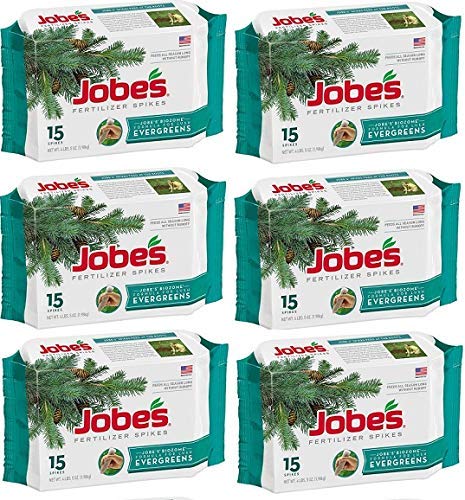
13-3-4 evergreen spikes sold as a case of six packages for hedges and multiple conifers.
Check price on AmazonWhy We Like It
- Case quantity suits long hedges
- Evergreen-targeted 13-3-4 formula
- Pre-measured to limit over-feeding
| Specification | Details |
|---|---|
| NPK | 13-3-4 |
| Quantity | Case of 6 packages; listing describes 15 spikes per package |
| Plants | Evergreen trees and shrubs |
| Schedule | Early spring and late fall |
| Release | Slow release |
Jobe’s 01611 Evergreen Tree Fertilizer Spikes — compressed specs
If you are feeding a long row of arborvitae, junipers or yews, buying spikes a pack at a time adds up. This listing is for a case of six Jobe’s evergreen packages in a 13-3-4 formula, applied in early spring and late fall. The listing text is a little inconsistent about total count, mentioning both 15 spikes per package and “6 count total,” so confirm the quantity on the product page before ordering.
Compared with the Old Farmer’s Almanac evergreen formula, this is higher in nitrogen but lower in potassium and lists no added magnesium. It is the better pick when you need volume; the Almanac spikes are better when needle color is your main concern.
Pros
- Bulk quantity for hedges
- Trusted brand formula
- Easy twice-yearly routine
Cons
- Count wording is confusing
- No magnesium listed
- No coverage chart in listing
Check Jobe's Evergreen Spikes 13-3-4 price on Amazon
5. SimplyGro Tree and Shrub Fertilizer Spikes 8-8-8 — Best Balanced Formula
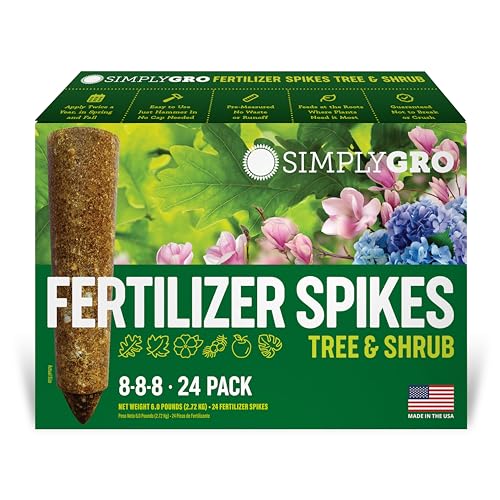
Balanced 8-8-8 hammer-in spikes for deciduous, coniferous, flowering and fruiting trees; made in the USA.
Check price on AmazonWhy We Like It
- Balanced ratio for almost any tree
- Each spike feeds up to 3 months
- Hammer-in TruSpike design
- Made in the USA
| Specification | Details |
|---|---|
| NPK | 8-8-8 |
| Spikes | 24 (6 lb per title) |
| Spike length | 5 inches |
| Feeding duration | Up to 3 months per spike |
| Plants | Deciduous, coniferous, decorative, flowering, fruiting |
SimplyGro Tree and Shrub Fertilizer Spikes — compressed specs
A balanced 8-8-8 formula is a safe default when you are feeding a mix of trees and shrubs and haven’t done a soil test. SimplyGro lists everything from conifers to fruiting trees and says each 5-inch spike feeds for up to three months, with feedings in spring and fall. It uses the same TruSpike hammer-in design as the Old Farmer’s Almanac line, so you can skip the plastic cap.
Lower nitrogen than the Jobe’s spikes means less push for leaf growth, but less risk of excess soft growth too. If your soil test shows plenty of phosphorus already, choose a lower-phosphorus option instead. A 12-spike version is also on the shelf.
Pros
- Versatile balanced ratio
- Durable hammer-in spikes
- Clear feeding duration
Cons
- Lower nitrogen than tree-specific spikes
- Phosphorus may be unnecessary
- Listing weights inconsistent
Check SimplyGro Tree and Shrub 8-8-8 price on Amazon
6. Miracle-Gro Fruit and Citrus Plant Food Spikes — Best for Fruit and Citrus Trees
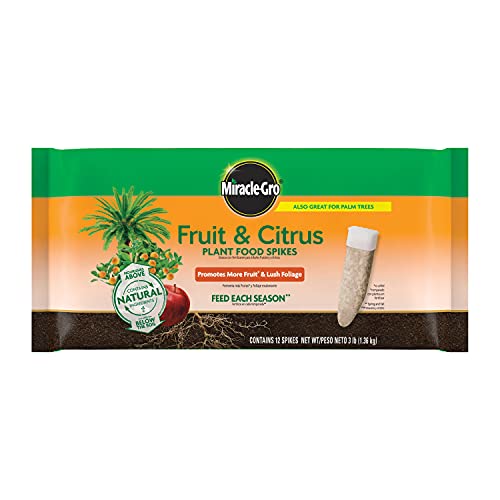
10-15-15 spikes for apple, orange, lemon, lime, avocado and palm trees; 12 spikes per 3 lb pack.
Check price on AmazonWhy We Like It
- Higher phosphorus and potassium for fruiting
- Lists citrus, apple, avocado and palms
- Spring and mid-fall schedule
- Label chart for quantity
| Specification | Details |
|---|---|
| NPK | 10-15-15 |
| Spikes per pack | 12 (3 lb) |
| Plants | Apple, orange, lemon, lime, avocado, palm |
| Schedule | Early spring and mid-fall |
| Installation | Drive below surface around drip line with mallet or by stepping |
Miracle-Gro Fruit and Citrus Plant Food Spikes — compressed specs
Fruit trees need potassium and phosphorus to flower and set fruit, and too much nitrogen can produce leafy growth with fewer blooms. This 10-15-15 spike is the only fruit-specific option on our list and names citrus, apples, avocados and palms. It is a good fit for backyard orchards and in-ground citrus in warm climates.
Citrus in particular is a heavy feeder and often needs more frequent feeding than spikes alone provide, especially for micronutrients like iron, zinc and manganese. For more options, see our roundup of the best fruit tree fertilizers.
Pros
- Fruit-focused NPK ratio
- Covers citrus and palms
- Easy seasonal routine
Cons
- Only 12 spikes per pack
- Micronutrients not detailed
- Citrus may need extra feeding
Check Miracle-Gro Fruit and Citrus Spikes price on Amazon
7. Winchester Gardens Landscaper Pack 15-10-9 — Best Bulk Pack

Case of 70 pre-measured 15-10-9 tree and shrub spikes with less packaging per spike.
Check price on AmazonWhy We Like It
- 70 spikes in one case
- All-around 15-10-9 ratio
- Less packaging per spike
- Pre-measured dosing
| Specification | Details |
|---|---|
| NPK | 15-10-9 |
| Spikes | 70 per case |
| Listed weight | 18 pounds |
| Plants | Trees and shrubs |
| Schedule | Not stated in listing |
Winchester Gardens Landscaper Pack Tree and Shrub Spikes — compressed specs
For large properties, small orchards or anyone feeding dozens of trees and shrubs, the Winchester Gardens Landscaper Pack is the most practical buy. Seventy spikes in a single case is far more than any other listing here, and the 15-10-9 ratio works for most trees and shrubs. The listing also describes the spikes as child- and pet-friendly, though as with any fertilizer, store it out of reach.
The listing is short on application details, so follow the rates on the case. If you only have one or two trees, the 12- to 30-spike packs above are a better fit.
Pros
- Largest quantity on the shelf
- Versatile general ratio
- Less packaging waste
Cons
- Overkill for small yards
- Few details in listing
- Heavy case to store
Check Winchester Gardens Landscaper Pack price on Amazon
Spikes vs Granular Fertilizer: When Each Makes Sense
Tree roots spread well beyond the drip line, and most of the fine feeder roots are in the top 12 inches of soil. Granular fertilizer broadcast over the root zone reaches far more of those roots than a handful of spikes. Spikes concentrate nutrients in small pockets, and roots near the spikes benefit most. Broadcasting granular fertilizer over the whole root zone, or having an arborist inject liquid fertilizer into the soil, spreads nutrients more evenly. That said, spikes have real advantages in the right situations.
| Factor | Spikes | Granular |
|---|---|---|
| Ease of use | Very easy; no measuring or spreading | Requires measuring and even spreading |
| Nutrient distribution | Concentrated pockets | Even across the root zone |
| Runoff risk | Low; fertilizer is below the surface | Higher if spread on hard surfaces or before heavy rain |
| Effect on lawn | Minimal | Feeds the lawn too |
| Cost per tree | Higher for large trees | Lower for large areas |
| Best for | Small trees, shrubs, trees in lawns or beds near pavement | Large trees, orchards, deficient soils |
Spikes beat granular when the tree is in a lawn and you don’t want to stimulate a flush of grass, when the tree is near water or pavement where runoff is a concern, and for small trees and shrubs where a few spikes cover most of the root zone. Granular is better for large mature trees, for correcting a deficiency found in a soil test and for orchards. For a broader comparison of release types, see our guide to the best slow-release fertilizers.
What to Look for in Fertilizer Spikes
- NPK ratio: nitrogen-heavy for shade trees and evergreens, more phosphorus and potassium for fruit trees, balanced for mixed plantings. Our NPK fertilizer explainer breaks down the numbers.
- Plant type: evergreen and acid-loving formulas often include sulfur or magnesium. For evergreens, compare with granular options in our best evergreen fertilizers roundup.
- Spike durability: traditional spikes can crumble when driven into hard or dry soil. Hammer-in designs like TruSpike avoid that.
- Quantity: count spikes needed based on the label chart and your trees’ drip line diameter.
How to Use Fertilizer Spikes
- Measure the drip line diameter (the width of the canopy) and check the package chart for how many spikes to use.
- Space spikes evenly around the drip line, typically at least 3 feet apart, not against the trunk.
- Water the soil the day before if it is dry, to make installation easier.
- Drive spikes just below the soil surface using the cap provided or a mallet.
- Feed in early spring as growth starts and again in fall, following the label. Avoid late-summer feeding in cold climates, which can push soft growth before frost.
- Never use more spikes than the label recommends. More is not better and can damage roots.
For newly planted trees, wait until the second growing season before using spikes, unless the label says otherwise. For more soil and fertility guides, see the composting and soil hub.
Frequently Asked Questions
Do tree fertilizer spikes really work?
Yes, but nutrients stay concentrated around each spike instead of spreading evenly. They work best for small trees and shrubs, or where you want to avoid feeding the lawn or causing runoff.
How often should I use fertilizer spikes?
Most labels recommend twice a year, in early spring and in fall. Always follow the specific product label for timing and rates.
Where should fertilizer spikes go around a tree?
Around the drip line, the outer edge of the canopy, spaced evenly and usually at least 3 feet apart. Do not place them right next to the trunk.
Can fertilizer spikes burn trees?
Using too many spikes or placing them too close to the trunk can damage roots. Follow the label chart for your tree’s drip line diameter.
Are fertilizer spikes better than granular fertilizer?
Not always. Granular spreads nutrients more evenly over the root zone and is better for large trees. Spikes are more convenient and reduce runoff and lawn feeding.