


A good slow-release fertilizer is the closest thing gardening has to set-and-forget feeding. You mix a measured amount into the soil at planting, water it in, and the granules feed for two to six months instead of the one to two weeks you get from a liquid feed. For most container gardens, mixed beds and shrub borders, our top pick is Osmocote Smart-Release Plant Food Plus, a resin-coated granule that the listing says feeds for up to six months indoors or out. For vegetable beds, Osmocote’s 14-14-14 Flower & Vegetable formula is the stronger choice. Below are seven picks for different jobs, and how to use them so they actually last as long as the label says.
Part of our Composting & Soil guide →
In this guide
- 1. Osmocote Smart-Release Plant Food Plus — Best Overall
- 2. Osmocote Smart-Release Flower & Vegetable — Best for Vegetable Beds
- 3. Miracle-Gro Shake ‘N Feed All Purpose — Best Easy Shaker for Containers
- 4. Scotts All Purpose Flower & Vegetable — Best for In-Ground Flower Beds
- 5. GroMaster 10-10-10 All Purpose — Best Value for Large Gardens
- 6. The Grow Co Indoor Plant Food — Best Granules for Houseplants
- 7. RAINFLOW Plant Fertilizer Sticks — Best Spikes for Potted Plants
- What to Look for in a Slow-Release Fertilizer
- How to Use Slow-Release Fertilizer
- Frequently Asked Questions
Disclosure: Urban Lotus Project earns a commission from qualifying Amazon purchases made through links on this page, at no extra cost to you.
How we compared: we compared 13 current Amazon listings for slow- and controlled-release fertilizers on what each listing states about release duration, NPK, coverage and intended plants. We did not test or handle the products, and availability changes.
Key Takeaways
- Resin-coated granules (Osmocote) release by soil temperature and feed longest, up to 6 months per the listing.
- Uncoated “slow-release nitrogen” blends feed for roughly 2 to 3 months and are better value for big vegetable gardens.
- Mix granules into the top 1 to 3 inches of soil; on the surface they release unevenly.
- Release speeds up in hot weather, so a 6-month label may mean 3 to 4 months in a Southern summer.
- Use a separate houseplant formula or spikes indoors, where you want gentler feeding.
| Product | Best for | Key features | Buy |
|---|---|---|---|
| Osmocote Plus Outdoor and Indoor | Best overall for pots and beds |
| Buy now →Check current price |
| Osmocote Flower and Vegetable | Best for vegetable beds |
| Buy now →Check current price |
| Miracle-Gro Shake N Feed | Best easy shaker for containers |
| Buy now →Check current price |
| Scotts Flower and Vegetable | Best for in-ground flower beds |
| Buy now →Check current price |
| GroMaster 10-10-10 | Best value for large gardens |
| Buy now →Check current price |
| The Grow Co Indoor Plant Food | Best granules for houseplants |
| Buy now →Check current price |
| RAINFLOW Fertilizer Sticks | Best spikes for potted plants |
| Buy now →Check current price |
Prices change often; check Amazon for today’s price. As an Amazon Associate we earn from qualifying purchases.
1. Osmocote Smart-Release Plant Food Plus — Best Overall

Resin-coated granules with 11 nutrients for containers, raised beds, shrubs and in-ground plants.
Check price on AmazonWhy We Like It
- Longest stated feeding window on the shelf
- Resin coating meters out nutrients gradually
- Labeled for indoor and outdoor plants
- No-burn pledge when used as directed
| Specification | Details |
|---|---|
| Release type | Resin-coated granules |
| Duration | Up to 6 months |
| Nutrients | 11 essential nutrients; NPK not stated in listing |
| Coverage | Up to 300 sq ft per 8 lb |
| Use | Containers, raised beds, in-ground, houseplants |
| Sizes on shelf | 1 lb, 2 lb and 8 lb |
Osmocote Smart-Release Plant Food Plus — compressed specs
Osmocote Plus is the benchmark controlled-release fertilizer. Each granule is coated in resin; water moves through the coating and dissolved nutrients seep out at a rate governed mostly by soil temperature. That means feeding picks up as plants grow faster in warm weather and slows in cool weather, which is exactly what container plants want. The “Plus” formula adds micronutrients, which matters in soilless potting mixes that contain few on their own.
It’s the only pick here that the listing describes as suitable for virtually everything: houseplants, patio pots, roses, shrubs, raised beds. Three sizes of the same formula appear on this shelf; the 8 lb tub is the practical choice if you fill more than a handful of containers each spring, while the 1 or 2 lb size suits a balcony. Compared with the Flower & Vegetable version below, it feeds longer but the listing doesn’t state the NPK ratio.
Pros
- Up to six months from one application
- Micronutrients included
- Indoor and outdoor use
- Several sizes available
Cons
- NPK not stated in listing
- Releases faster in hot climates
- Synthetic, not for organic growers
Check Osmocote Plus Outdoor and Indoor price on Amazon
2. Osmocote Smart-Release Flower & Vegetable — Best for Vegetable Beds
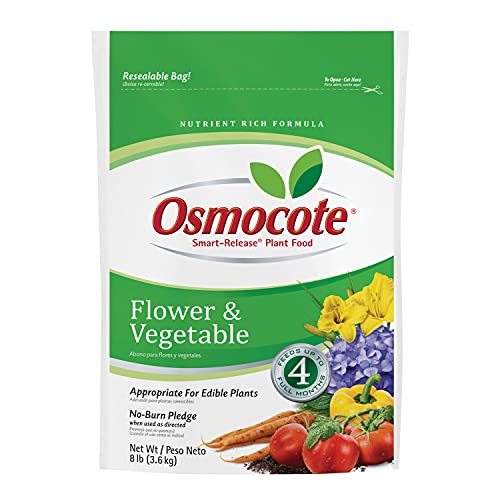
Balanced 14-14-14 controlled-release granules with a scoop, for vegetables, perennials and shrub beds.
Check price on AmazonWhy We Like It
- Highest total nutrient formula Osmocote lists
- Clear rate: one scoop per 4 sq ft
- Listing says up to 3x over-application won’t burn
- Good for mulched shrub and tree beds
| Specification | Details |
|---|---|
| NPK | 14-14-14 |
| Release type | Temperature-controlled coated granules |
| Rate | 1 scoop per 4 sq ft, mixed into top 1 to 3 in |
| Coverage | 1 lb per 40 sq ft; 8 lb covers 320 sq ft |
| Duration | Up to 4 months stated on the 4.5 lb listing |
Osmocote Flower & Vegetable — compressed specs
Vegetables are heavy feeders, and a balanced 14-14-14 gives tomatoes, peppers, squash and leafy greens a solid base without the nitrogen overload that pushes leaves at the expense of fruit. The listing gives one of the clearest application rates on the shelf, which helps avoid the most common mistake with granular feeds: guessing. It’s also listed for mulched areas around ornamental trees and shrubs, so one tub covers the vegetable patch and the foundation beds.
The same formula is also sold in 2 lb and 4.5 lb sizes on this shelf. Against GroMaster’s 10-10-10, it has more nutrients per pound and coated release, while GroMaster is the simpler, cheaper-per-bag option for large plots.
Pros
- Balanced, high-analysis formula
- Measuring scoop included
- Very forgiving if over-applied
- Covers vegetable and shrub beds
Cons
- Shorter stated duration than Osmocote Plus
- Not organic
- Duration not stated on the 8 lb listing
Check Osmocote Flower and Vegetable price on Amazon
3. Miracle-Gro Shake ‘N Feed All Purpose — Best Easy Shaker for Containers

Continuous-release granules in a shaker jar, feeding containers and beds for up to three months.
Check price on AmazonWhy We Like It
- Shaker lid makes spot feeding pots easy
- Includes micronutrients
- Natural ingredients feed soil microbes
- Simple reapply-every-3-months schedule
| Specification | Details |
|---|---|
| Release type | Continuous release granules |
| Duration | Up to 3 months |
| Coverage | Up to 30 sq ft per 1 lb |
| Use | Containers, in-ground and raised beds |
| NPK | Not stated in listing |
Miracle-Gro Shake ‘N Feed — compressed specs
Shake ‘N Feed is the most convenient pick for people who feed a few pots, hanging baskets and window boxes by hand. You shake granules over the soil, scratch them into the top inch, water, and repeat every three months. Its blend also includes natural ingredients intended to feed soil microbes, which sets it apart from the pure resin-coated Osmocote products.
The trade-off is duration and coverage: three months rather than Osmocote Plus’s six, and a 1 lb jar covers about 30 square feet versus Osmocote’s 37 for the same weight. For a summer of annuals in pots, three months is often all you need.
Pros
- Easy shaker application
- Feeds soil biology as well as plants
- Good for established container plants
- Widely sold, familiar brand
Cons
- Three-month duration
- Lower coverage per pound
- NPK not stated in listing
Check Miracle-Gro Shake N Feed price on Amazon
4. Scotts All Purpose Flower & Vegetable — Best for In-Ground Flower Beds

Continuous-release nitrogen for in-ground annuals, perennials, vegetables, trees and shrubs.
Check price on AmazonWhy We Like It
- Good coverage, about 150 sq ft per bag
- Labeled for flowers, vegetables, trees and shrubs
- Sprinkle-and-rake application
- Steady feed through a growing season’s peak
| Specification | Details |
|---|---|
| Release type | Continuous release nitrogen |
| Duration | Up to 2 months |
| Coverage | About 150 sq ft per 3 lb bag |
| Use | Outdoor in-ground plants |
| NPK | Not stated in listing |
Scotts All Purpose Flower & Vegetable — compressed specs
This is a straightforward bed fertilizer for borders of annuals and perennials, vegetable rows and shrubs. Its two-month feeding window is the shortest on our list, but it covers more ground per pound than the Osmocote and Miracle-Gro products, which makes it practical for large in-ground beds you feed in spring and again in early summer.
The listing is specifically for outdoor in-ground plants, so for containers we’d pick Osmocote Plus or Shake ‘N Feed instead.
Pros
- High coverage per bag
- Works across flowers, vegetables and shrubs
- Simple sprinkle-and-rake use
Cons
- Shortest feeding window here
- Not labeled for containers
- NPK not stated in listing
Check Scotts Flower and Vegetable price on Amazon
5. GroMaster 10-10-10 All Purpose — Best Value for Large Gardens

Balanced 10-10-10 with half its nitrogen in slow-release form, in a resealable 5 lb bag.
Check price on AmazonWhy We Like It
- States its slow-release share: 50 percent of nitrogen
- Low chlorine, low salt blend
- Micronutrients included
- Resealable bag keeps granules dry
| Specification | Details |
|---|---|
| NPK | 10-10-10 |
| Release type | 50% slow-release nitrogen |
| Duration | Up to 3 months |
| Size | 5 lb resealable bag |
| Use | Vegetable gardens and mixed plantings |
GroMaster 10-10-10 — compressed specs
Many “slow-release” fertilizers are really blends: part of the nitrogen is in a fast form for an immediate green-up, and part is in a slow form that feeds over weeks. GroMaster is upfront about the split, listing half its nitrogen as slow-release. That gives vegetables a quick start plus steady feeding for up to three months. Its low-chlorine, low-salt formula is a plus around seedlings and salt-sensitive crops.
Compared with the GARDENWISE 10-10-10 on the same shelf, which is sold in a 1 lb size and lists about 8 weeks of feeding, GroMaster lasts longer and comes in a more practical quantity for a full vegetable garden.
Pros
- Transparent slow-release share
- Quick start plus sustained feeding
- Gentle low-salt formula
- Practical bag size
Cons
- Half the nitrogen releases fast
- Shorter feeding than coated granules
- Not labeled for houseplants
Check GroMaster 10-10-10 price on Amazon
6. The Grow Co Indoor Plant Food — Best Granules for Houseplants
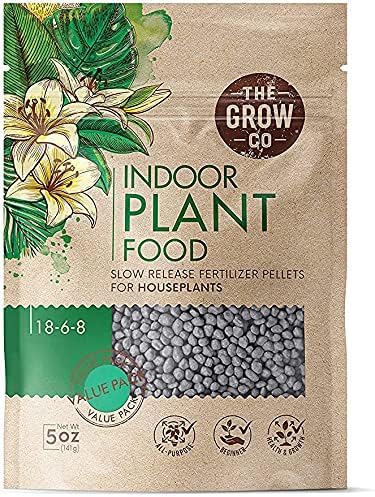
Urea-free slow-release granules for potted houseplants, including chunky bark and moss mixes.
Check price on AmazonWhy We Like It
- Urea-free balanced macro and micro nutrients
- Suited to bark, moss and perlite mixes
- Small 5 oz size fits a houseplant collection
- Sprinkle or poke into holes
| Specification | Details |
|---|---|
| Release type | Slow-release granules |
| Duration | Months at a time (exact period not stated in listing) |
| Formula | Urea-free, macro and micronutrients |
| Size | 5 oz |
| Use | Indoor and outdoor potted plants |
The Grow Co Indoor Plant Food — compressed specs
Houseplants grow slowly and sit in small volumes of mix, so they need gentle feeding. This urea-free granule is pitched at exactly that, and the listing specifically mentions pots with bark, sphagnum moss and perlite, which covers the chunky aroid and orchid mixes that many general fertilizers don’t address. Osmocote Plus is also labeled for indoor plants and is a fine alternative if you already own a tub.
Pros
- Gentle urea-free formula
- Works with chunky mixes
- Right-sized for indoor collections
Cons
- Exact duration not stated
- NPK not stated in listing
- Too small for outdoor beds
Check The Grow Co Indoor Plant Food price on Amazon
7. RAINFLOW Plant Fertilizer Sticks — Best Spikes for Potted Plants
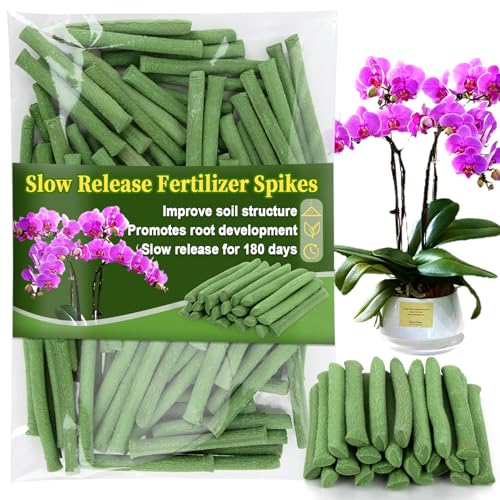
90 slow-release fertilizer sticks you push into potting soil, listed to feed for up to six months.
Check price on AmazonWhy We Like It
- No measuring, no spilled granules
- Listed to feed for up to 6 months
- 90 sticks cover a big plant collection
- Gentle no-burn formula claimed
| Specification | Details |
|---|---|
| Form | Fertilizer sticks |
| Count | 90 |
| Duration | Up to 6 months |
| Use | Houseplants, orchids, herbs, potted vegetables and flowers |
| NPK | Not stated in listing |
RAINFLOW fertilizer sticks — compressed specs
Spikes are the tidiest way to feed potted plants: push one or more into the mix near the pot edge and forget about it. They’re popular for indoor plants because there’s no dust or loose granules. The limitation is that nutrients concentrate around each stick rather than spreading evenly through the root zone, so use more sticks spaced around larger pots. If you prefer granules, The Grow Co is the comparable indoor option.
Pros
- Clean, mess-free feeding
- Long stated duration
- Large count per pack
Cons
- Uneven nutrient distribution in big pots
- NPK not stated in listing
- Not for in-ground beds
Check RAINFLOW Fertilizer Sticks price on Amazon
What to Look for in a Slow-Release Fertilizer
Coated vs uncoated release
Coated (controlled-release) fertilizers wrap each prill in resin or polymer; release depends mainly on soil temperature and lasts the longest, typically 3 to 6 months or more. Uncoated slow-release products rely on less soluble nitrogen forms or organic materials broken down by soil microbes, so they feed for weeks rather than months and depend on soil warmth and moisture. If you want one feeding per season in containers, choose coated. If you feed big beds twice a year, an uncoated blend is fine and often cheaper per square foot. For a deeper look at the trade-offs, see our slow-release vs quick-release fertilizer guide.
NPK and micronutrients
Balanced formulas like 10-10-10 and 14-14-14 suit mixed plantings and vegetables. Potting mixes are mostly peat, coir and bark with almost no micronutrients, so container plants benefit from formulas that list iron, manganese, zinc and the like. Our explainer on NPK fertilizer numbers covers how to read the bag.
Duration in real conditions
Label durations assume moderate temperatures. In a hot climate, or in black plastic pots baking on a patio, coated granules release faster, so a six-month product may be spent in three to four months. In cool spring soil they release slowly, which is why some gardeners give spring transplants a single dose of liquid feed to get going.
Granules vs spikes vs shakers
Granules mixed into the root zone give the most even feeding. Shakers are best for topdressing established pots. Spikes are clean and convenient indoors but feed unevenly. For trees and large shrubs, spread granules across the area under the drip line rather than piling them at the trunk.
How to Use Slow-Release Fertilizer
- Containers: mix the label rate into fresh potting mix at planting, or scratch it into the top inch of established pots, then water well. Don’t double up with a mix that already contains fertilizer until it’s spent, usually after about two to three months.
- Vegetable and flower beds: broadcast at the label rate per square foot and rake into the top 1 to 3 inches before planting. Reapply mid-season if the product’s duration is shorter than your season.
- Shrubs and roses: apply in spring as growth begins, spreading granules evenly from near the stem out to the drip line, then mulch. Avoid feeding woody plants after late summer in cold zones so new growth can harden off.
- Houseplants: feed in spring and early summer when plants are growing; skip winter feeding for most species.
Slow-release granules pair well with an occasional liquid feed when plants need a fast boost, such as heavy-fruiting tomatoes in midsummer. Our comparison of slow-release vs liquid fertilizer explains when each makes sense, and the composting and soil guide covers building fertile soil so you need less fertilizer overall.
Frequently Asked Questions
How long does slow-release fertilizer last?
Uncoated slow-release blends typically feed for about 2 to 3 months. Resin-coated products such as Osmocote Plus are listed for up to 6 months, though hot weather shortens that because release speeds up as soil temperature rises.
Can you use slow-release fertilizer on vegetables?
Yes. Mix a balanced slow-release product into beds or containers at planting and it will cover most of the early season. Heavy feeders such as tomatoes and peppers may need a second application or a liquid boost once they start fruiting.
Should slow-release fertilizer be mixed into soil or left on top?
Mix it into the top 1 to 3 inches where roots are. Granules left on the surface can dry out and release unevenly, or wash away. Topdressing established pots is fine if you scratch the granules in lightly and water afterward.
Can slow-release fertilizer burn plants?
It’s far less likely than fast-release fertilizer because nutrients come out gradually, and several listings here include a no-burn pledge when used as directed. Over-applying any fertilizer can still raise salt levels in containers, so stick to the label rate.
When should I apply slow-release fertilizer?
Apply it at planting time or in spring as plants begin active growth. For long-season containers, a second application in midsummer is common with shorter-duration products. In cold zones, stop feeding shrubs and perennials by late summer.