

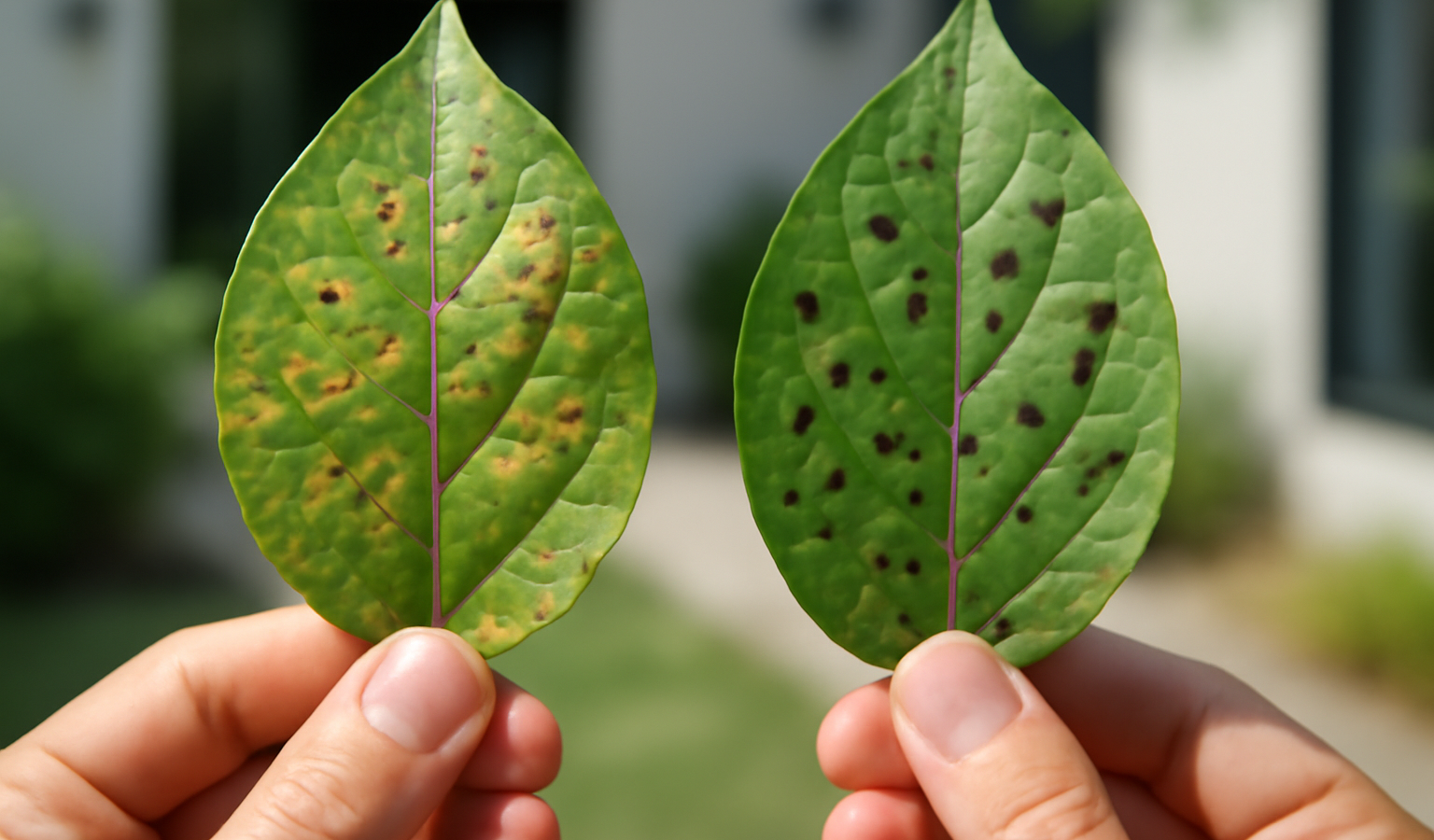
Brown or black spots on leaves are one of the most common things gardeners notice — and one of the most commonly misdiagnosed. The trouble is that two completely different culprits, bacteria and fungi, both produce spotted foliage, and they require opposite treatments. A copper spray that helps a bacterial infection does little against many fungi, and a fungicide aimed at a fungal pathogen is useless against bacteria. Spray the wrong product and you lose time while the disease spreads. This guide walks through the visual and physical clues that separate bacterial leaf spot from fungal leaf spot, then covers how to treat and prevent each so you can act with confidence.
Key Takeaways
- Bacterial spots are usually angular (bounded by leaf veins), often water-soaked and translucent, frequently have a bright yellow halo, and may ooze or feel slimy in wet weather.
- Fungal spots are typically round with defined edges, can show concentric rings or a target pattern, and often carry visible fungal structures — tiny black dots, gray centers, or fuzzy growth.
- The “backlight test” helps: hold the leaf to the light. Translucent, greasy, angular spots point to bacteria; opaque, round spots with texture point to fungi.
- Bacterial spots respond to copper and strict sanitation; fungal spots respond to fungicides matched to the pathogen plus airflow and dry foliage.
- Both spread by water splash and thrive in wet conditions, so dry foliage, spacing, and clean tools prevent both.
Before diagnosing, gather context: which plant, what the weather has been (warm and humid favors bacteria; cool damp or warm humid favors various fungi), and how the spots are arranged. Then examine individual lesions closely — ideally with a hand lens. The table below lays out the differences, and the sections after it explain how to identify, treat, and prevent each type.
| Feature | Bacterial Leaf Spot | Fungal Leaf Spot |
|---|---|---|
| Spot shape | Angular, bounded by veins | Round to oval, defined margins |
| Texture | Water-soaked, greasy, translucent | Dry, papery, sometimes raised |
| Halo | Bright yellow halo common | Halo less common; may have ring pattern |
| Center | Smooth, may fall out (“shothole”) | Often shows black dots, gray center, or fuzz |
| Backlit | Translucent / see-through | Opaque |
| Ooze | May ooze sticky bacterial slime when wet | No ooze; powdery or fuzzy spores instead |
| Spread pattern | Water-soaked margins advance fast in warmth | Spreads via spores, often spotty distribution |
| Best treatment | Copper + sanitation (no fungicide cure) | Targeted fungicide + airflow |
Bacterial Leaf Spot: How to Identify It
Bacterial leaf spots are caused by genera such as Xanthomonas and Pseudomonas, and they attack a huge range of plants — tomatoes, peppers, lettuce, beans, ornamentals like geranium and ivy, and many shade trees. The defining trait is that bacteria spread through the leaf in the moisture between cells, so the spots take on a water-soaked, greasy, almost translucent quality, especially when young and viewed against the light.
Shape is the next big clue. Because bacteria are stopped by the leaf’s larger veins, the spots are often angular — they look blocky or geometric, with straight edges following the vein network, rather than perfectly round. A bright yellow halo frequently rings the spot as the bacteria release toxins. As lesions age they turn brown to black, and the dead center may dry, crack, and drop out, leaving a “shothole” appearance. In warm, humid weather you may see a sticky exudate or even feel a slimy film — that ooze is the bacteria themselves, and it is diagnostic. Bacterial spots tend to advance quickly during warm, wet spells and concentrate on lower or splash-exposed leaves.
How to Treat Bacterial Leaf Spot
There is no spray that cures bacterial leaf spot once a leaf is infected, so the strategy is to stop the spread and protect healthy tissue. Begin with ruthless sanitation: pinch off and bag infected leaves, clear fallen debris, and avoid handling plants while they are wet because that is exactly how bacteria hitch a ride to clean leaves. Disinfect pruners between plants with 70% alcohol or a 10% bleach solution.
For protection, copper-based bactericides are the standard tool — they coat healthy tissue and suppress bacterial populations, but they must be applied preventively and repeatedly (every 7-10 days, reapplying after rain) rather than as a one-time cure. Some products combine copper with mancozeb for broader coverage. Critically, switch to bottom watering or drip irrigation and water in the morning; eliminating leaf wetness does more to halt a bacterial outbreak than any spray. If a plant is severely infected and the bed is at risk, remove it entirely. For lawn and landscape plantings, our notes on outdoor living and landscape care cover spacing and irrigation timing that limit splash spread.
Fungal Leaf Spot: How to Identify It
Fungal leaf spots come from a long list of pathogens — Septoria, Cercospora, Alternaria, anthracnose fungi, and many more — and they are even more common than bacterial spots. The key difference is that fungi grow as threads and reproduce by spores, which leaves visible texture and structure in the lesion that bacteria never produce.
Most fungal spots are round to oval with a clearly defined margin, not angular, because the fungus grows outward in a circle rather than being hemmed in by veins. Held to the light they are opaque, not translucent. Look closely at the center: you will often find tiny black dots (fruiting bodies, as in Septoria leaf spot), a pale tan or gray center surrounded by a darker ring (as in Cercospora), or concentric target rings (as in Alternaria/early blight). In humid weather some fungal spots develop fuzzy or powdery growth — spores — on the surface. Halos can occur but are less consistently bright-yellow than with bacteria. Distribution is often patchy, starting wherever a spore happened to land and germinate.
How to Treat Fungal Leaf Spot
Unlike bacteria, fungi can be managed with fungicides — but the product should match the pathogen and the situation. Start, again, with sanitation: remove infected leaves, rake and discard fallen debris (many fungi overwinter in litter), and improve airflow by thinning crowded growth. Mulch to block spores splashing up from the soil.
For sprays, chlorothalonil and mancozeb are broad protectants effective against many leaf-spot fungi; copper and Bacillus-based biofungicides also help and have the advantage of working on bacteria too. Neem and sulfur products manage some fungi, particularly on ornamentals. Apply on a 7-14 day schedule, before symptoms peak, and rotate active ingredients to avoid resistance. As with bacteria, keep foliage dry — water at the base, in the morning, and space plants for airflow. Vigorous, well-fed plants resist fungal spots far better, so don’t neglect basic nutrition and even watering.
Prevention for Both
Because both pathogens depend on free water and splash to spread, the same cultural habits prevent both. Water at the soil line with drip or a soaker hose, never overhead, and do it in the morning so any wet foliage dries fast. Space plants for good air circulation, stake or trellis sprawling crops, and prune out crowded interior growth. Mulch with straw or shredded leaves to stop soil-borne inoculum from splashing onto lower leaves. Rotate annual crops so the same disease isn’t waiting in the soil next season, and clean up all plant debris at the end of the year. Disinfect tools between plants. Choose disease-resistant cultivars when available — the resistance label is the single cheapest prevention you can buy. For container and small-space setups where airflow can be tricky, see our urban gardening guides on plant spacing and watering.
The Verdict
When you find spotted leaves, slow down and read the lesion before you reach for a bottle. Angular, greasy, translucent spots with bright yellow halos and possible ooze point to bacteria — manage them with copper, strict sanitation, and dry foliage, and accept that there’s no cure for infected leaves. Round spots with defined edges, target rings, gray centers, or tiny black fruiting dots point to fungi — manage them with a fungicide matched to the pathogen plus airflow and clean-up. The backlight test (translucent equals bacterial, opaque equals fungal) and a hand-lens look for spores or ooze will resolve most cases in seconds. Identify it right, treat it right, and keep foliage dry — and leaf spots become a manageable nuisance rather than a season-ender.
Frequently Asked Questions
What’s the quickest way to tell bacterial from fungal leaf spot?
Hold a spotted leaf up to the light. Bacterial spots look greasy, water-soaked, and translucent, often with a yellow halo and angular edges. Fungal spots are opaque, usually round, and may show black dots or rings.
Does copper kill both bacteria and fungi?
Copper suppresses both to a degree, which makes it a useful first response when you’re unsure. But it is protective, not curative, and many fungal diseases respond better to a targeted fungicide like chlorothalonil or mancozeb.
Why do my spots have a yellow ring around them?
A bright yellow halo is most characteristic of bacterial infection, caused by toxins the bacteria release. Some fungi cause halos too, so check shape and texture as well before deciding.
Can I save a plant with leaf spot?
Usually yes if you catch it early. Remove infected leaves, improve airflow, stop overhead watering, and apply the right protectant. Severely infected plants that keep spreading disease are best removed.
Will leaf spot spread to my other plants?
It can, mainly through water splash, handling, and shared tools. Keep foliage dry, disinfect pruners between plants, and avoid working among plants while they’re wet to limit spread.