

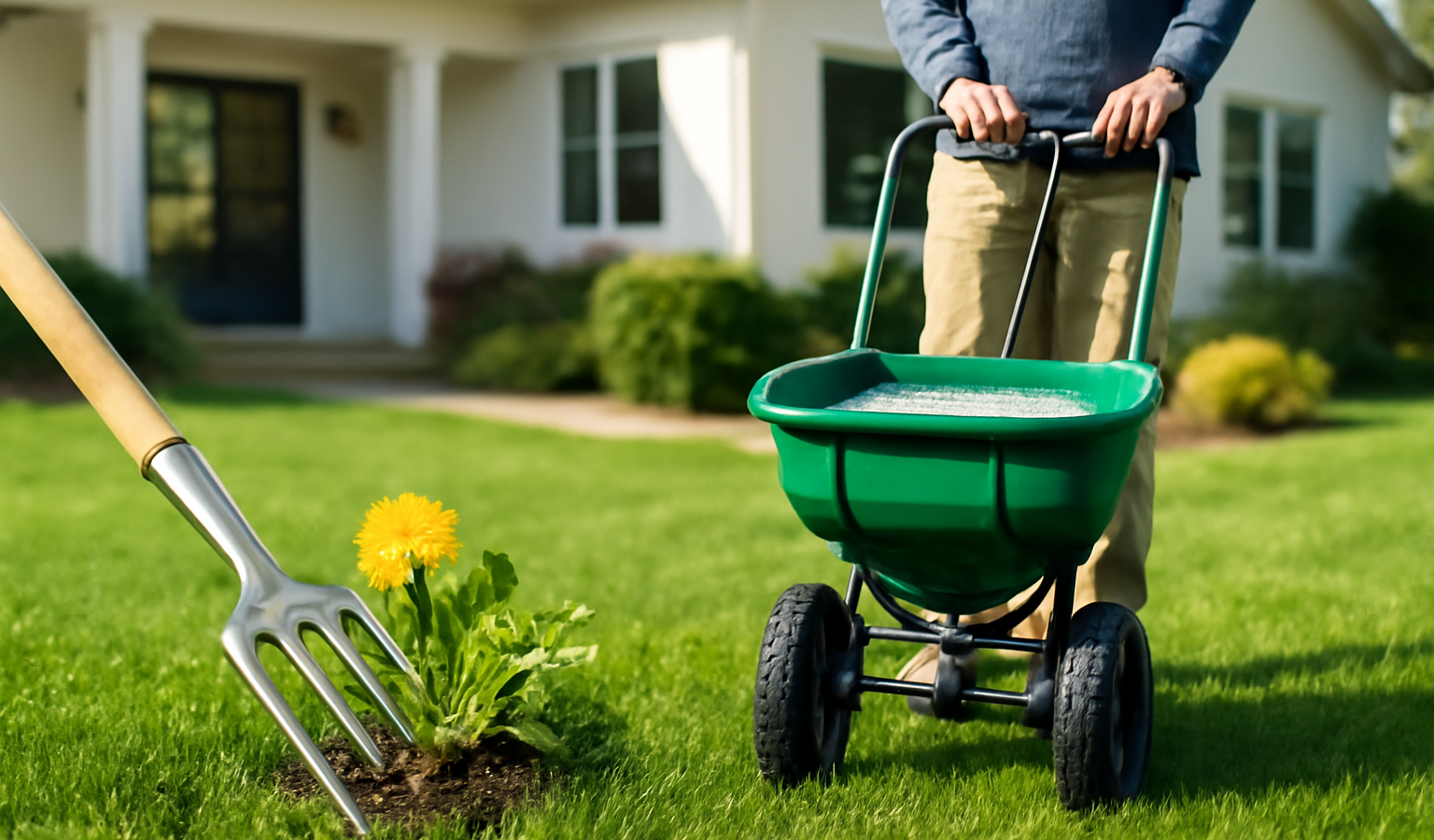
“Weed and feed” promises to fertilize your lawn and kill weeds in a single pass, and the convenience is real. But the question every serious lawn owner eventually asks is whether that combo product actually does both jobs well, or whether you get a better lawn by applying fertilizer and herbicide separately, each at its own ideal time. The short answer: weed and feed is fine for small lawns and casual care, but separate applications almost always produce a healthier, weed-free lawn because grass and weeds rarely want to be treated on the same day. This guide compares the two approaches on timing, effectiveness, cost, and lawn health so you can decide which fits your yard.
Key Takeaways
- Weed and feed combines fertilizer and herbicide in one product, maximizing convenience but compromising the timing of both.
- Separate applications let you fertilize when grass wants feeding and spray weeds when they’re most vulnerable, giving better results.
- The best weed-control timing (early spring for pre-emergent, or actively growing broadleaf weeds for post-emergent) rarely matches the best fertilizing window.
- Combo products waste herbicide over weed-free areas and can stress grass during heat.
- Choose weed and feed for small, casually maintained lawns; choose separate applications for the best long-term turf health.
Quick Comparison at a Glance
| Factor | Weed and Feed (combo) | Separate Applications |
|---|---|---|
| Convenience | High, one pass | Lower, two or more passes |
| Timing precision | Compromised, one date for both jobs | Excellent, each job at its ideal time |
| Weed-control results | Moderate | Best |
| Targeted spot treatment | No, blankets whole lawn | Yes, spray only where needed |
| Herbicide waste | Higher | Lower |
| Cost per application | Often higher per bag | Lower if buying separately |
| Risk to grass/heat stress | Higher if mistimed | Lower with proper timing |
| Best for | Small, casual lawns | Larger lawns, best turf health |
Weed and Feed: One-Pass Convenience
A weed and feed product is exactly what it sounds like: granular fertilizer blended with a herbicide, usually a broadleaf post-emergent like 2,4-D, dicamba, or MCPP that kills dandelions, clover, and similar weeds while feeding the grass. Some products instead pair fertilizer with a pre-emergent that stops crabgrass seed from sprouting. You spread it with a standard broadcast or drop spreader in a single trip across the lawn.
How to use it well
The biggest mistake with combo products is treating them like plain fertilizer. The herbicide half has specific rules. For post-emergent weed and feed, the granules must stick to wet weed leaves to work, so you apply it in the morning when the lawn is damp with dew, and you do not water it in for a day or two. That is the opposite of how you’d treat fertilizer, which you normally water in promptly. Pre-emergent combos, by contrast, must be watered in to activate. Read the label, because the two types want opposite follow-up.
Apply combo products when broadleaf weeds are young and actively growing, typically late spring or early fall for post-emergent types. Avoid them in summer heat (above roughly 85°F), when both the herbicide and the nitrogen can stress or burn the turf. Keep the product off ornamental beds and tree roots; broadleaf herbicides don’t distinguish your dandelions from your perennials.
The core limitation
The fundamental problem is timing. The optimal moment to feed cool-season grass (early fall, with a lighter spring feeding) often does not coincide with the optimal moment to hit weeds, and pre-emergent crabgrass control has a tight early-spring window that has nothing to do with feeding at all. A combo product forces a single compromise date, so one of the two jobs is usually done at the wrong time. You also blanket the entire lawn with herbicide even where there are no weeds, wasting product and putting unnecessary chemical on grass that didn’t need it.
Separate Applications: Right Job, Right Time
The separate approach treats fertilizing and weed control as two distinct tasks, each scheduled for when it works best. You fertilize on a program suited to your grass type, and you deal with weeds on their own timeline, often with a targeted spot-spray rather than a blanket treatment.
Fertilizing on its own schedule
For cool-season lawns (fescue, ryegrass, Kentucky bluegrass), the most valuable feeding is in early fall, when grass is building roots and storing energy, with a lighter feeding in mid-to-late spring. Warm-season lawns (Bermuda, zoysia, St. Augustine) are fed through late spring and summer when they’re actively growing. Decoupling the fertilizer lets you apply the right amount of nitrogen, around one pound per 1,000 square feet per feeding, at the moment the grass can actually use it, which builds density that crowds weeds out on its own.
Targeting weeds when they’re vulnerable
Weed control splits into two strategies, each with its own timing. Pre-emergent herbicide for crabgrass goes down in early spring, when soil temperatures reach about 55°F (often when forsythia blooms), to stop seeds before they sprout, watered in to activate. Post-emergent broadleaf herbicide works best on young, actively growing weeds in spring or fall, applied as a liquid spot-spray straight onto the weeds you can see. Spot-spraying means you use a fraction of the chemical and never dose weed-free turf. This precision is impossible with a granular combo that coats everything.
Separate products also let you match the herbicide to the actual problem, a pre-emergent for crabgrass, a specific broadleaf killer for clover or oxalis, rather than relying on whatever generic blend a combo bag contains. The trade-off is effort: you’re making at least two trips across the yard and tracking two schedules instead of one.
Side-by-Side: Which Should You Choose?
The decision comes down to how much you value convenience versus results, and how big and weedy your lawn is.
- Small lawn, casual care, scattered weeds: Weed and feed is a reasonable, low-effort choice.
- You want the healthiest possible turf: Separate applications win, every time, by letting you nail the timing.
- Crabgrass is your main problem: A standalone pre-emergent in early spring beats any combo, because the window is too specific.
- Only part of the lawn has weeds: Spot-spray separately and skip blanketing the whole yard.
- Hot summer climate: Separate timing lets you avoid feeding and spraying during heat stress.
Whichever route you take, a thick, well-fed lawn is your best long-term weed defense, dense turf simply doesn’t leave room for weeds to establish. For more on building that density, see the Outdoor Living hub and our comparison of sun vs shade grass seed to make sure you’re growing the right grass for your conditions in the first place. If you’re amending or topdressing as part of lawn renovation, our guide on bagged vs bulk soil can help you source material economically.
The Verdict
Separate applications produce a better lawn, full stop. By feeding when the grass wants nitrogen and treating weeds when they’re most vulnerable, often with a targeted spot-spray, you get healthier turf, less wasted herbicide, and fewer weeds over time. Weed and feed earns its place only as a convenience product for small lawns and casual maintenance, where saving a trip across the yard matters more than squeezing out the last bit of performance. If your lawn is large, weedy, or something you genuinely care about, split the jobs; if you just want a quick, good-enough pass on a tidy little yard, a combo bag will do.
Frequently Asked Questions
Is weed and feed bad for my lawn?
Not inherently, but it’s a compromise. The main risks come from mistiming, applying in summer heat above about 85°F can stress or burn turf, and from blanketing the whole lawn with herbicide even where there are no weeds. Used at the right time on a young, growing weed problem, it works fine.
Why are separate applications considered better?
Because grass and weeds rarely want treatment on the same day. Separate products let you fertilize when the grass can actually use the nitrogen and target weeds when they’re most vulnerable, with a precise spot-spray rather than a wasteful blanket pass. The result is healthier turf and less herbicide overall.
When should I apply weed and feed?
For post-emergent (broadleaf) combos, apply in late spring or early fall when weeds are young and growing, in the morning while the lawn is damp so granules stick to leaves, and don’t water it in for a day or two. Pre-emergent combos go down in early spring and must be watered in. Always check your specific label.
Can I just use a pre-emergent and fertilizer separately for crabgrass?
Yes, and it’s the better approach. Crabgrass pre-emergent has a tight early-spring window (soil around 55°F) that almost never lines up with the ideal feeding time, so a standalone pre-emergent applied on its own schedule outperforms any combo product.
Does a healthy lawn really reduce weeds on its own?
Significantly. Dense, well-fed turf shades the soil and leaves no bare ground for weed seeds to germinate, so good fertilizing and mowing habits are themselves a powerful, chemical-free form of weed control over time.