

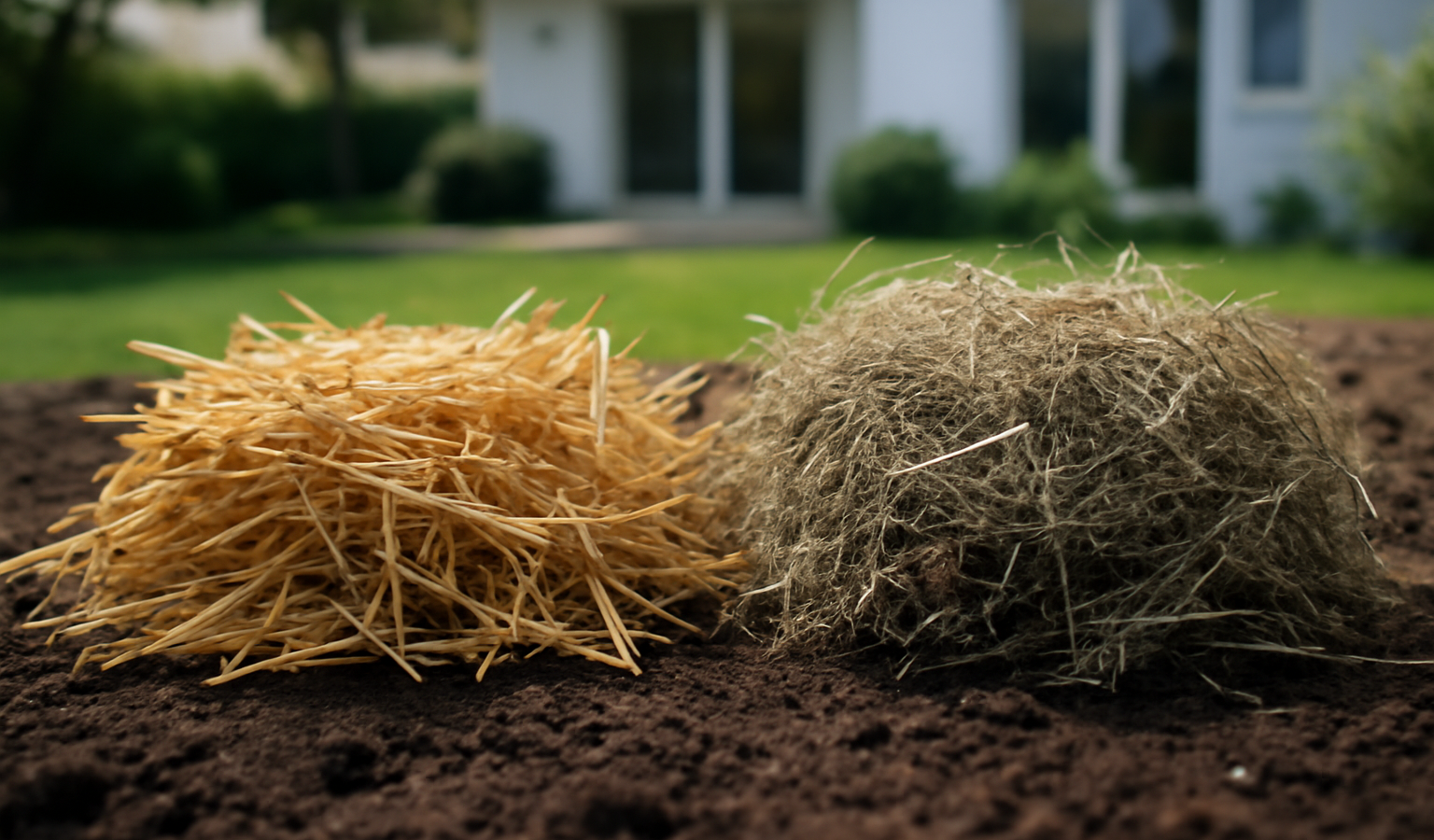
They look almost identical stacked in golden bales at the feed store, and plenty of gardeners use the words interchangeably — but straw and hay are not the same thing, and using the wrong one can fill your beds with weeds or even poison your plants. The short version: straw is the hollow, dried stalk left over after grain is harvested, so it carries few seeds. Hay is an entire grass or legume plant cut and dried as animal feed, seed heads and all. That single difference — what is harvested and when — drives everything about how each performs as mulch. If you have ever mulched a vegetable bed only to watch it sprout a lawn, this is the comparison you needed first.
Key Takeaways
- Straw is the dried stalk left after grain harvest — low in seeds, making it the preferred mulch for vegetable gardens.
- Hay is a whole dried grass or legume plant grown for animal feed — loaded with seeds that sprout into weeds in your beds.
- Straw is the safer garden mulch for weed control; hay is richer in nutrients but high-risk for the average gardener.
- Both can carry persistent herbicide residue from sprayed fields — always source from a clean, trusted supplier.
- Hay still has a place: as livestock feed, in deep-mulch and lasagna systems, or where you actively want the seeds and nutrients.
Quick comparison at a glance
| Factor | Straw | Hay |
|---|---|---|
| What it is | Hollow stalks left after grain harvest | Whole dried grass/legume plant |
| Seed content | Low — few weed seeds | High — full of viable seeds |
| Weed risk in beds | Low | High |
| Nutrient value | Low (mostly carbon/structure) | Higher (nitrogen, especially legume hay) |
| Cost | Usually higher per bale | Often cheaper, more available |
| Decomposition | Slow — lasts a season or more | Faster — breaks down quicker |
| Best garden use | Vegetable beds, paths, seed cover | Deep-mulch systems, compost, feed |
| Herbicide-residue risk | Possible — check source | Possible — check source |
| Moisture retention | Good | Good |
Straw: the clean garden mulch
Straw is what is left after a grain crop — wheat, oats, barley, or rye — is harvested for its seed. The valuable grain heads are gone, leaving behind the dried, hollow stalks. Those hollow tubes are exactly what make straw such a good mulch: they trap air, insulate the soil, hold moisture, and let water and air pass through to the roots. Because the seed was the harvested product, a good bale of straw carries relatively few viable seeds, so it is far less likely to sprout into a weedy mess across your beds.
That low seed content is the number-one reason straw is the standard mulch for vegetable gardens. Spread a two- to four-inch layer between tomato plants, around squash, or over a strawberry bed and it suppresses weeds, conserves water, keeps soil-borne disease from splashing up onto leaves, and keeps fruit clean off the dirt. Straw also makes excellent cover over freshly sown seed and over potatoes you are hilling. It breaks down slowly, so a single application lasts most of a growing season before it needs topping up. Its main downsides are that it adds relatively little nutrition as it decomposes — it is mostly carbon and structure — and it usually costs a bit more per bale than hay.
Hay: nutrient-rich but seed-heavy
Hay is a different product entirely. It is a whole plant — grass like timothy or orchardgrass, or a legume like alfalfa or clover — cut while still green and dried to be fed to livestock. Crucially, hay is usually cut with its seed heads intact, because the leaves, stems, and seeds together make nutritious feed. That means a bale of hay is loaded with viable seeds. Spread it on a garden bed and you are effectively planting those seeds; within weeks you will see grass and weeds germinating right through your mulch. For most vegetable gardeners, that makes plain hay a frustrating choice.
Hay does have genuine advantages. Because it is the whole plant, it contains more nitrogen and nutrients than straw — legume hay like alfalfa is especially rich — so it feeds the soil more as it decomposes, and it breaks down faster. That nutrient value is why hay shines in certain systems: deep-mulch “no-dig” gardening, lasagna-style sheet composting, and as a compost ingredient, where the seed problem is either tolerated, smothered under deep layers, or killed by composting heat. And of course hay’s primary job remains animal feed. It is often cheaper and more widely available than straw, which tempts beginners — but in a tidy vegetable bed, the seeds usually cost you more in weeding than you saved at the feed store.
How to apply straw in the garden
Getting straw right is mostly about depth and placement. Spread a loose two- to four-inch layer over weed-free soil; it will settle to a thinner mat after the first rain, so do not be shy with it. Around transplants like tomatoes and peppers, pull the straw back an inch or two from the stems to keep crowns dry and discourage rot and slugs. Over newly sown seed, a light dusting is enough to hold moisture without blocking emergence — too thick and seedlings cannot push through. For pathways between beds, you can lay it much heavier, since you actually want to smother everything underfoot. As straw breaks down through the season, top it up to keep that weed-blocking depth, and at season’s end you can simply turn the partially rotted straw into the soil or rake it onto the compost pile, where it adds valuable carbon.
One practical tip: buy “straw,” not “stable bedding” or unlabeled bales, and inspect for seed heads. Even straw carries some grain seed — you may see a few volunteer wheat or oat sprouts — but they pull easily and are nothing like the carpet of weeds a hay bale produces. If a few grain sprouts bother you, just hoe them off; they will not reseed once removed.
When hay is actually the better pick
It is worth being fair to hay, because it is not simply “worse straw.” In a thick no-dig or deep-mulch bed — the style popularized by gardeners who pile mulch eight to twelve inches deep — hay’s seeds are buried so far down that few ever reach light, and the extra nitrogen and nutrients it releases as it rots feed the soil more generously than straw does. Spoiled or old hay that animals will no longer eat is especially good for this, often available cheaply or free from farmers. Hay is also a fine “green-ish” layer in sheet composting and a useful nitrogen source in a hot compost pile, where temperatures above 130°F kill most of the weed seeds. The key in every one of these cases is that the seeds are either smothered or cooked — not spread thinly across an open bed where they are guaranteed to sprout.
The herbicide warning that applies to both
There is one hazard that has nothing to do with seeds and affects straw and hay alike: persistent broadleaf herbicides. Some products sprayed on grain and hay fields contain compounds like aminopyralid and clopyralid that survive harvest, drying, and even passage through an animal’s gut into manure. If that contaminated straw, hay, or manure ends up in your garden, it can stunt, curl, and kill sensitive crops — tomatoes, beans, peppers, potatoes — for a year or more, and there is no quick fix. Always ask your supplier whether the field was treated with persistent herbicides, favor sources you trust, and if in doubt, run a simple bioassay by potting a few bean seeds in soil mixed with the material before you spread it everywhere. If your plants show distorted growth after mulching, our guide on why pepper leaves curl can help you tell herbicide damage from other causes.
Which should you choose?
- Mulching a vegetable garden or flower bed: Choose straw. Its low seed content keeps weeds down instead of seeding them in.
- Covering newly sown seed, hilling potatoes, or keeping fruit clean: Straw, every time.
- Running a deep-mulch / no-dig or lasagna bed: Hay can work well — its nutrients feed the soil and deep layers smother sprouting seeds.
- Adding nitrogen-rich green material to a hot compost pile: Hay (especially legume hay) breaks down fast and the heat kills the seeds.
- Feeding livestock: Hay — that’s its real job; straw is bedding, not feed.
- You’re on a tight budget but mulching beds: Resist cheap hay; the weeding will cost you more than the straw would have.
For the everyday gardener, the rule is simple: use straw to mulch the garden, and leave hay for feeding animals or for advanced deep-mulch and composting systems where the seeds are managed. Whichever you pick, confirm it is free of persistent herbicides first — that single question to your supplier protects your whole garden. For more on choosing materials to cover and improve your beds, see our comparison of compost vs mulch.
Frequently Asked Questions
What is the actual difference between straw and hay?
Straw is the dried, hollow stalk left over after grain (wheat, oats, barley) is harvested for its seed, so it carries few seeds. Hay is an entire grass or legume plant cut and dried as animal feed, including its seed heads, so it is full of viable seeds that sprout in garden beds.
Which is better for mulching a vegetable garden?
Straw, by a clear margin. Its low seed content means it suppresses weeds rather than seeding new ones, while it still conserves moisture, insulates soil, and keeps fruit and lower leaves clean. Hay tends to sprout grass and weeds throughout the bed.
Can I use hay as mulch at all?
Yes, in the right system. Hay works in deep-mulch or “lasagna” beds where thick layers smother sprouting seeds, and as a nitrogen-rich compost ingredient where pile heat kills the seeds. Its higher nutrient content is a real plus when the seed issue is managed.
Why did my plants get sick after I added straw or hay?
The likely culprit is persistent broadleaf herbicide residue (such as aminopyralid or clopyralid) carried in from a sprayed field. It causes curled, stunted, distorted growth in tomatoes, beans, and peppers. Always ask your supplier about herbicide use and test questionable material before spreading it widely.
Is straw or hay cheaper?
Hay is often cheaper and more widely available than straw, which tempts beginning gardeners. But in a vegetable bed the weed seeds in hay usually cost far more in labor than you saved, so straw is the better value for clean mulching.