

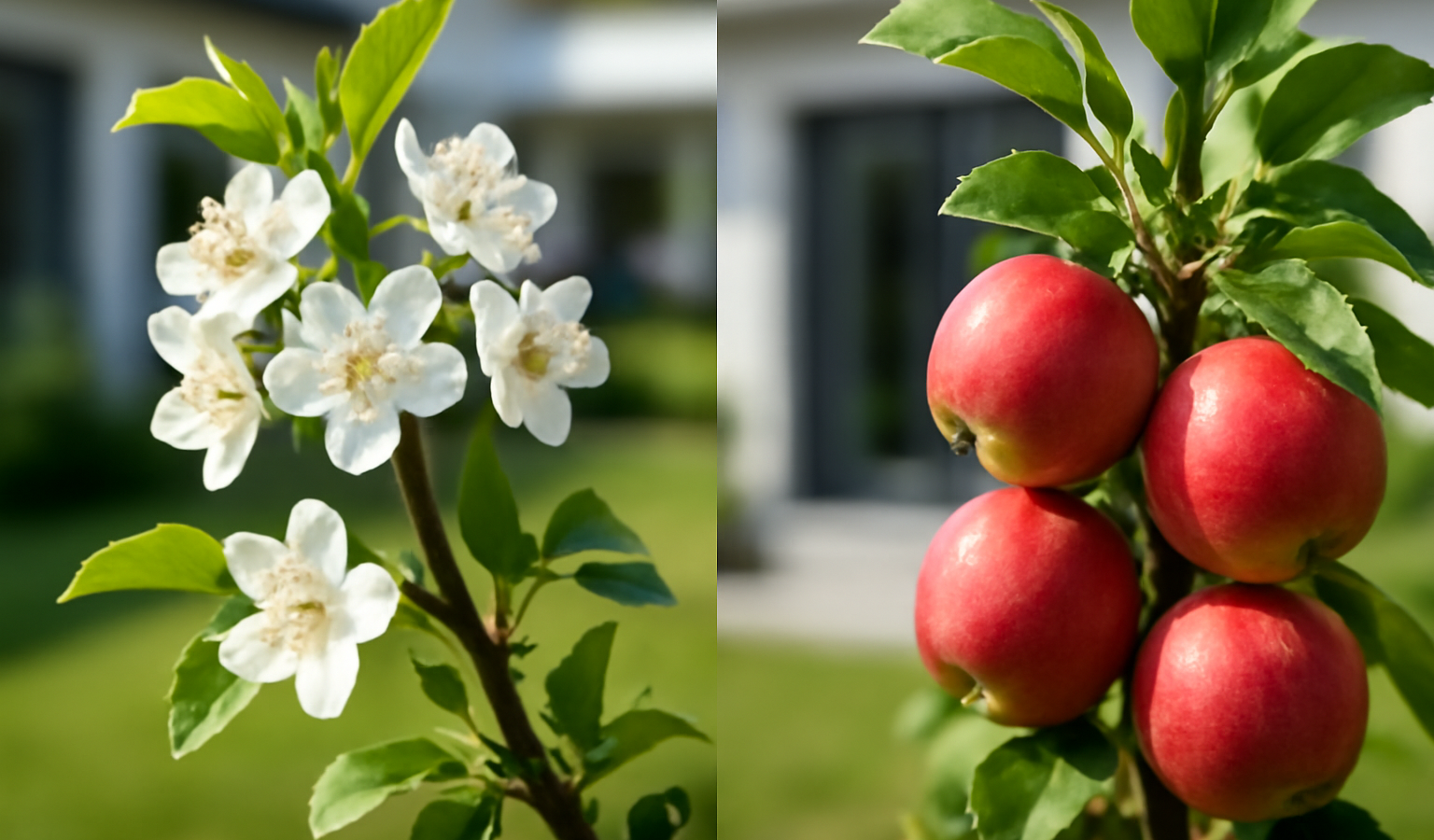
One of the most common reasons a healthy fruit tree blooms beautifully but sets little or no fruit is pollination, specifically, whether the tree can pollinate itself or needs a partner. “Self-pollinating” (self-fertile) trees can set fruit with their own pollen, so a single tree works. “Cross-pollinating” (self-sterile) trees need a second, compatible variety blooming at the same time, with bees to move the pollen between them. Plant a self-sterile variety alone and you will get blossoms and disappointment year after year. This guide explains which fruits fall into each camp and how to plant for a real harvest.
Key Takeaways
- Self-pollinating trees set fruit with their own pollen, so one tree is enough; peaches, sour cherries, apricots, and most figs and citrus are self-fertile.
- Cross-pollinating trees need a second compatible variety nearby; most apples, pears, sweet cherries, and many plums are self-sterile.
- Timing matters: the two varieties must bloom at overlapping times for cross-pollination to work, even if they are compatible.
- Bees do the work: even self-fertile trees fruit better with pollinator activity, so protect and attract bees.
- If your tree blooms but won’t fruit, a missing or non-overlapping pollination partner is a leading cause.
Quick Comparison at a Glance
| Factor | Self-Pollinating | Cross-Pollinating |
|---|---|---|
| Trees needed | One | Two+ compatible varieties |
| Fruit set from own pollen | Yes | No (or poor) |
| Best for small yards | Yes | Harder, needs space or grafts |
| Benefits from a partner? | Often, larger crops | Required |
| Common examples | Peach, nectarine, sour cherry, apricot, most figs, most citrus | Most apples, pears, sweet cherries, many plums |
| Bloom-time overlap | Not critical | Critical |
Self-Pollinating (Self-Fertile) Fruit Trees
A self-pollinating tree carries flowers whose pollen can fertilize the same tree’s own blossoms, so a single specimen will set a full crop without any companion. This is a gift for small gardens, because you get fruit from one tree and you are not forced to find space for a matched partner. The reliably self-fertile group includes peaches and nectarines, sour (tart) cherries, apricots, most European plum types like ‘Stanley’, most figs, most citrus (lemons, oranges, limes), and quince. If your space is tight, leading with these fruits is the simplest path to a harvest.
That said, “self-fertile” does not mean “pollinator-free.” The pollen still has to move from anther to stigma, and bees and other insects do most of that work even within a single tree. A self-fertile tree in a yard with healthy bee activity sets far more fruit than one blooming in cold, wet, windless weather when bees stay home. Many self-fertile varieties also produce noticeably bigger crops if a second compatible variety happens to be nearby, so self-fertile is best read as “will fruit alone, fruits even better with company.”
If you are planning a compact, productive yard, anchoring it with self-fertile trees removes a whole category of failure. Pair that with the small-tree advice in our fruit tree guides and you can get a reliable harvest from a single specimen.
Cross-Pollinating (Self-Sterile) Fruit Trees
Cross-pollinating trees cannot fertilize themselves effectively; their flowers need pollen from a different, compatible variety of the same fruit to set a crop. This group includes most apples, most pears, sweet cherries, and many Japanese plums. Plant a single ‘Honeycrisp’ apple or a lone ‘Bartlett’ pear with no compatible variety within bee range and you will get a tree that flowers every spring and sets almost nothing. This is one of the most common, and most preventable, fruit-growing disappointments.
To make cross-pollination work you need three things. First, two different varieties of the same fruit (two different apple varieties, for instance, not an apple and a pear). Second, compatibility, since a few varieties are “self-sterile and cross-incompatible” with certain partners, and triploid apples like ‘Gravenstein’ and ‘Jonagold’ produce poor pollen and cannot pollinate others, so they need two other varieties around them. Third, and most overlooked, overlapping bloom time. The two trees must flower at the same time for bees to carry pollen between them; an early-blooming apple cannot pollinate a late-blooming one no matter how compatible they are on paper. Nurseries publish bloom-group and pollination charts for exactly this reason.
Solutions when you lack space for two trees
You do not always need two full trees. Options for tight yards include planting a dwarf second variety nearby (dwarfs need only 8-10 feet, so two fit where one standard would), grafting a pollinizer branch of a compatible variety onto your main tree, or buying a multi-grafted “fruit cocktail” or “family” tree that carries several compatible varieties on one trunk. A neighbor’s compatible tree within roughly 50-100 feet can also do the job, since bees range that far, and in some areas crabapples serve as universal apple pollinizers. For squeezing pollination partners into a small footprint, see the container and small-space techniques in our urban gardening guides.
Why Bees Are the Linchpin for Both
Pollination charts mean nothing without pollinators to act on them. Fruit trees are insect-pollinated; the wind does not move their heavy, sticky pollen well. Bees, both honeybees and native mason and bumblebees, are the agents that carry pollen within a self-fertile tree and between cross-pollinating partners. That is why a cold, rainy, or windy bloom period can wreck a crop on otherwise perfectly matched trees: the flowers open, but the bees never fly.
You can stack the odds in your favor. Avoid spraying insecticides during bloom, when you would kill the very pollinators you need. Plant a diversity of flowering plants so bees have reason to be in your yard. Mason bee houses are a cheap, effective way to boost early-spring pollination, since mason bees are active in cool weather when honeybees are sluggish and are extremely efficient on fruit blossoms. And if all else fails, you can hand-pollinate with a small brush, which is genuinely practical for a tree or two.
Troubleshooting: Blooms but No Fruit
If your tree flowers heavily but sets little or no fruit, run through this checklist. Is it a self-sterile variety planted alone, with no compatible partner in bee range? That is the most common cause. If there is a partner, do the two actually bloom at the same time? Mismatched bloom timing silently defeats compatible varieties. Were pollinators active during bloom, or was the weather cold and wet? Did a late frost kill the open blossoms, which can blacken the flower centers? Is the tree being over-fertilized with nitrogen, which pushes leafy growth at the expense of fruit? And is the tree simply too young, since most trees need a few years before they fruit regardless of pollination?
Working through those points usually pinpoints the problem. More often than not, the answer for a mature, healthy, well-cared-for tree that blooms but will not fruit is a missing or non-overlapping pollination partner, which a second compatible variety, a grafted branch, or a nearby tree will fix.
Verdict: How to Plant for a Reliable Harvest
If you have room for only one tree, choose a self-pollinating fruit: a peach, nectarine, apricot, sour cherry, fig, or citrus will give you a crop on its own. This is the foolproof route for small yards, patios, and beginners. Just keep bees welcome, because even self-fertile trees fruit better with pollinators working the flowers.
If you want apples, pears, sweet cherries, or many plums, plan for cross-pollination from the start. Choose two compatible varieties with overlapping bloom times, or use a dwarf partner, a grafted pollinizer branch, or a multi-grafted family tree to fit two varieties into a small space, and lean on a compatible neighbor’s tree if you have one within about 50-100 feet. Get the pollination plan right before you dig, and you will avoid the most frustrating fruit-growing failure: a gorgeous tree in full bloom that never gives you anything to eat.
Frequently Asked Questions
Which fruit trees are self-pollinating?
Peaches, nectarines, sour (tart) cherries, apricots, most European plums, most figs, most citrus, and quince are self-fertile and will set fruit from a single tree. Apples, pears, sweet cherries, and many plums are not.
Can I plant just one apple tree and get fruit?
Usually not. Most apples are self-sterile and need a different, compatible apple variety blooming at the same time nearby. A neighbor’s apple or crabapple within roughly 50-100 feet, a grafted pollinizer branch, or a multi-grafted tree can solve it.
Do self-pollinating trees still need bees?
Yes. Even self-fertile flowers need pollen physically moved from anther to stigma, and bees do most of that work. Self-fertile trees fruit far better with active pollinators and good bloom-time weather.
Why does my fruit tree bloom but never set fruit?
The most common cause is a self-sterile variety with no compatible partner in bee range, or partners that bloom at different times. Late frost, no pollinators during bloom, excess nitrogen, or a too-young tree can also be responsible.
What is a multi-grafted or family fruit tree?
It is a single tree carrying several compatible varieties grafted onto one trunk, so the varieties pollinate each other. It is an excellent way to get cross-pollination and a longer harvest from one tree in a small space.