

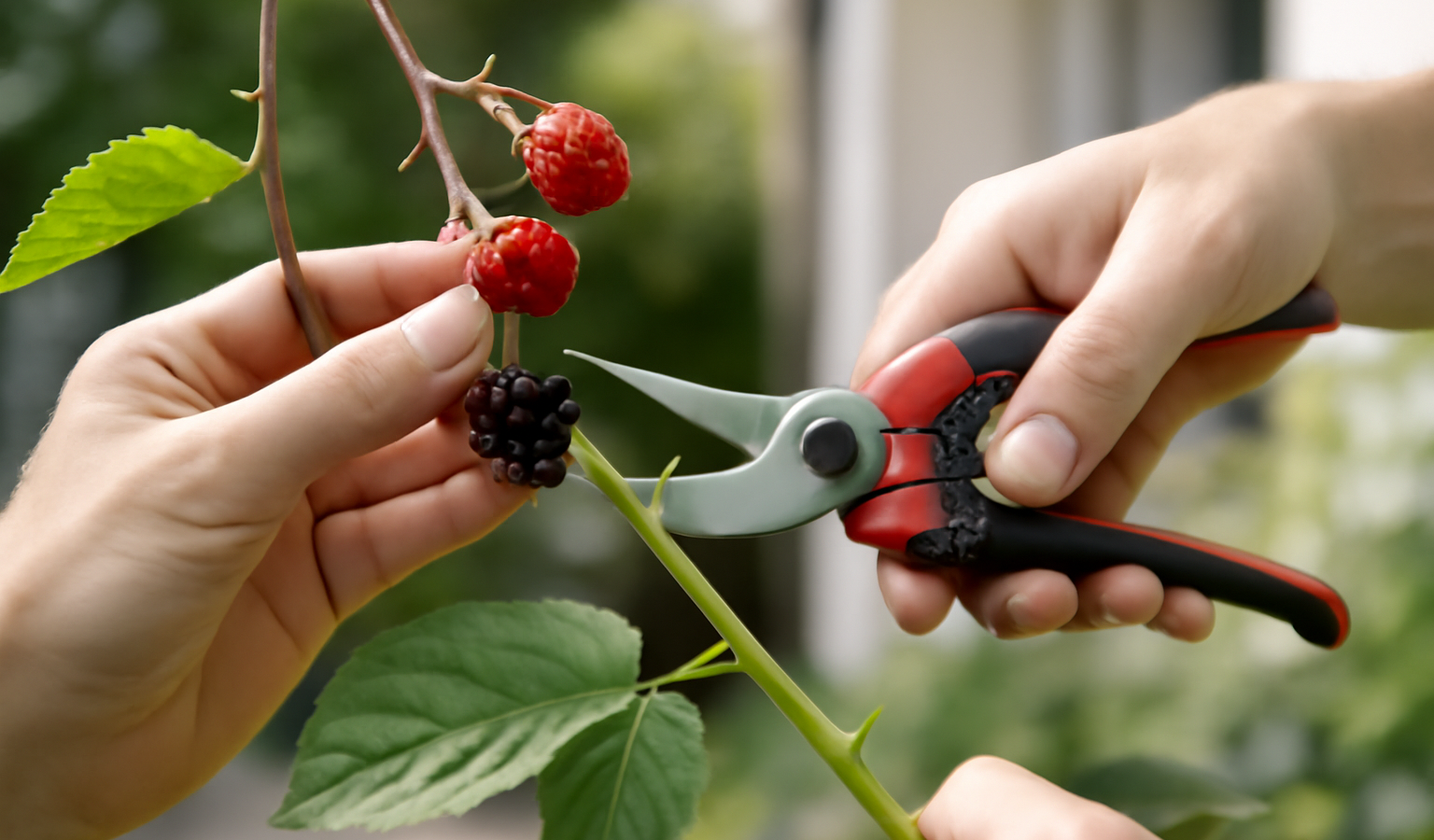
Blackberries fruit on canes that are two years old, so pruning is less about shaping a pretty plant and more about managing a two-year clock. Get the timing and the cuts right and a single row will hand you gallons of berries every July; get them wrong and you end up with a thorny tangle that fruits poorly and harbors disease. The whole job comes down to understanding two words—floricane and primocane—and then doing three short pruning passes a year. This guide walks through exactly which canes to cut, when to cut them, and how to train what is left so picking is easy and the plant stays productive for a decade or more.
Key Takeaways
- Primocanes are this year’s green new canes; floricanes are last year’s canes that flower and fruit this year, then die.
- Cut every floricane to the ground right after it finishes fruiting in summer—those canes will never produce again.
- Tip (head back) primocanes in early summer once they reach 3–4 ft to force fruiting side branches called laterals.
- In late winter, shorten those laterals to 12–18 in and thin to the strongest 4–6 canes per plant.
- Primocane-fruiting (everbearing) varieties can be mowed to the ground for one big fall crop—a much simpler system.
Floricane vs Primocane: The Two-Year Cycle
Almost every pruning mistake with blackberries traces back to not knowing which canes do what. The plant’s crown is perennial and lives for years, but the canes are biennial—each individual cane lives only two seasons. In year one a cane emerges from the crown as a vigorous green shoot. This first-year cane is the primocane. It grows fast, often 4–8 feet, stores energy, and on standard (floricane-fruiting) varieties it does not flower. Over winter that cane hardens, turns brown and woody, and the following spring becomes a floricane. The floricane is what flowers, sets fruit, and gives you the July harvest. As soon as it finishes fruiting, it dies—permanently. Meanwhile, brand-new primocanes are pushing up alongside it to become next year’s floricanes.
So at the peak of summer a healthy blackberry has both cane types present at once: fruiting floricanes and growing primocanes. Your job is to keep them sorted. The easy field test: floricanes are browner, woodier, and carry flowers or berries; primocanes are greener, more flexible, and bare. If you remember nothing else, remember that anything that just fruited is finished and should come out, and anything green and bare is your future crop and should be protected.
Primocane-Fruiting (Everbearing) Types Are Different
A newer class of blackberries—primocane-fruiting or “everbearing” varieties such as Prime-Ark Freedom, Prime-Ark 45, and Prime-Ark Traveler—flower on first-year primocanes in late summer and fall. With these you have a choice. Treat them like standard blackberries for two crops a year (a summer floricane crop plus a fall primocane crop), or simplify radically: in late winter, mow or cut the entire planting to the ground. You sacrifice the early summer crop but get one heavy, clean fall harvest with almost no skilled pruning. For a busy gardener this is the lowest-effort blackberry system that exists, and it sidesteps the floricane-versus-primocane sorting entirely.
The Three Pruning Passes Every Year
Standard blackberries need three short pruning sessions spread across the season. None takes long, but skipping any one of them costs you yield or invites disease.
Pass 1: Early-Summer Tipping (Late May to July)
When the new primocanes reach about 3–4 feet tall for erect types (or longer for trailing types you are training on wire), pinch or snip off the top 1–2 inches of each. This is called tipping or heading. Removing the growing tip stops upward growth and forces the cane to push out side branches—laterals—lower down. Those laterals are where the bulk of next year’s berries will form, so tipping directly multiplies your fruiting wood. Erect blackberries respond best to tipping at roughly 36–42 inches; semi-erect types can be tipped at 4–5 feet. Trailing blackberries are generally not tipped—you let them run and train the long canes on a trellis instead.
Tip on a dry day so the cut surfaces seal quickly, and tip repeatedly through early summer as new canes reach height rather than waiting to do them all at once. A single midseason tipping pass can be the difference between a cane with three weak laterals and one with eight strong ones.
Pass 2: After-Fruiting Floricane Removal (Mid to Late Summer)
The instant a floricane finishes giving up its berries, cut it off at ground level and haul it out. Do not leave a stub. These spent canes are dying anyway, but if you leave them in the row they shade the new primocanes, restrict airflow, and become a reservoir for cane blight, anthracnose, and orange rust. Removing them in summer—rather than waiting until winter—also makes the late-winter pruning far easier because you are no longer untangling dead wood from live wood. Wear thick gauntlet gloves for thorned types and use bypass loppers; carry the cut canes out of the garden and burn or bin them rather than composting, since several blackberry diseases overwinter on debris. Healthy garden landscaping and maintenance always starts with sanitation, and blackberries are no exception.
Pass 3: Late-Winter Cleanup and Lateral Shortening (Feb to Mar)
While the plant is fully dormant—late winter, before buds swell—do the precision pruning. First, thin the canes. A vigorous erect blackberry crown can throw a dozen primocanes, but you only want the 4–6 strongest, thickest canes per plant (or per linear foot of row for hedgerow systems). Remove the rest at the base: anything thin, spindly, broken, winter-damaged, or growing outside the intended row. Crowded rows fruit poorly because light and air can’t reach the center.
Next, shorten the laterals. The side branches you encouraged by summer tipping are now long and will produce more, smaller berries near their tips if left alone. Cut each lateral back to 12–18 inches, leaving roughly 8–12 buds. This concentrates the plant’s energy into fewer, larger, better-flavored berries and keeps fruit within easy reach. Make cuts just above an outward-facing bud. Finish by clearing any remaining dead floricanes you missed in summer.
Trellising and Training
Pruning and trellising go hand in hand because how you support the canes determines how easily you can sort and cut them. Set sturdy end posts (4×4 or steel T-posts) and run galvanized wire between them.
- Erect blackberries: A single wire at 30–36 inches, or a double-wire “clothesline” with wires 18 inches apart, is plenty. The canes are self-supporting; the wire just keeps fruit-laden laterals from flopping.
- Semi-erect types: Use a T-trellis with cross-arms and two wires at 3 and 5 feet. Fan the canes out along the wires.
- Trailing blackberries: Need the most support. Train floricanes along the wires in one direction and bundle the new primocanes in the other direction, or down the center. Separating the two cane types by direction makes after-fruiting removal almost foolproof—you simply cut out the entire fruited side.
Use soft ties or plastic clips, never wire, to attach canes. Good airflow on a trellis dramatically reduces the fungal problems that plague tangled, ground-level brambles.
Tools, Safety, and Sanitation
Sharp bypass pruners handle laterals and thin canes; loppers or a pruning saw deal with thick, woody floricanes at the base. Disinfect blades between plants if you’ve had disease—a wipe with 70% isopropyl alcohol or a 10% bleach dip works. Thorned varieties demand long sleeves and leather gauntlet gloves; thornless cultivars like Triple Crown, Chester, and Apache make the whole job far more pleasant and are worth choosing for a new planting. Always remove and destroy diseased canes rather than composting them, and rake fallen leaves and prunings out of the row each fall.
Common Pruning Mistakes
The most frequent error is cutting everything to the ground in winter on a floricane-fruiting variety—that removes the very canes that would have fruited and leaves you with a barren summer. The second is never tipping primocanes, which yields tall, whippy canes with few laterals and a small crop. Third is leaving spent floricanes standing all season, which crowds the row and spreads disease. Fourth is failing to thin, letting the crown produce 15 weak canes instead of 5 strong ones. Match your cuts to your variety type and the two-year cycle, and these all disappear. If you grow other cane and bush fruit, the same logic of removing spent wood applies—see our broader notes on fruit and berry plant care for crop-specific timing.
Frequently Asked Questions
When is the best time to prune blackberries?
There are three windows: tip primocanes in early summer (late May–July) once they hit 3–4 ft; remove spent floricanes immediately after they finish fruiting in mid-to-late summer; and thin canes plus shorten laterals in late winter (Feb–Mar) while the plant is dormant.
How do I tell floricanes from primocanes?
Floricanes are last year’s canes—browner, woodier, and carrying this year’s flowers and berries. Primocanes are this year’s growth—greener, more flexible, and (on standard varieties) bare with no fruit. Floricanes die after fruiting; primocanes become next year’s floricanes.
Should I cut my blackberries to the ground each year?
Only if you grow a primocane-fruiting (everbearing) variety and want a single simplified fall crop. For standard floricane-fruiting blackberries, mowing everything down removes your fruiting canes and you’ll get no berries that summer.
How many canes should I keep per plant?
Thin to the 4–6 strongest, thickest canes per plant during late-winter pruning. Removing weak and crowded canes improves light penetration and airflow, giving you larger berries and fewer fungal problems.
Why are my blackberries small and seedy?
Often it’s overcrowding and unpruned laterals spreading energy too thin, or heat and water stress during ripening. Thin canes to 4–6, cut laterals back to 12–18 in, and keep plants evenly watered (1–2 in per week) as fruit sizes up. Poor pollination from cool, wet bloom weather can also cause crumbly, seedy fruit.