

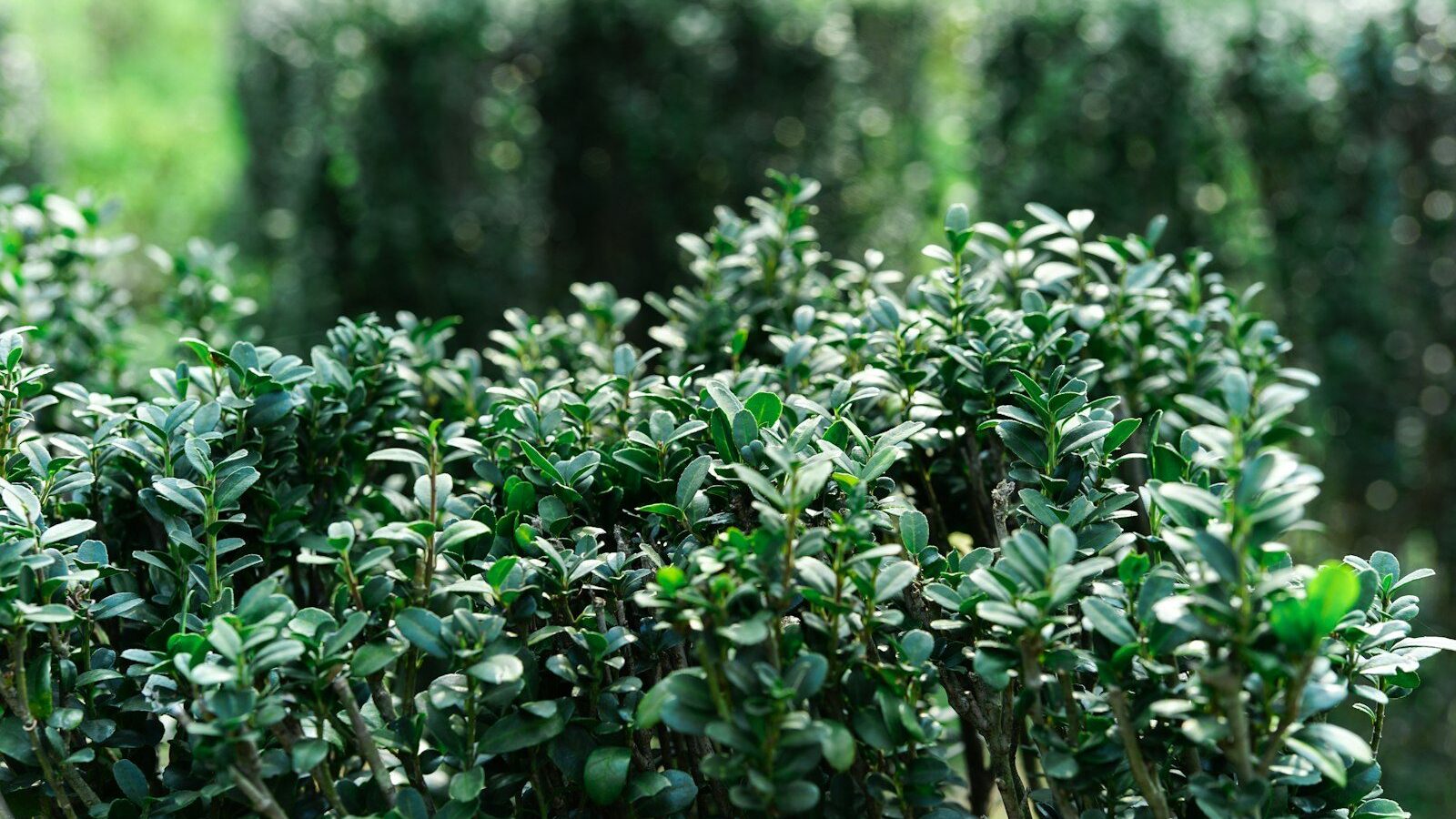
The short version: Green Velvet grows into a soft, rounded mound about 3 to 4 feet tall and wide, so it suits low hedges, foundation plantings and globe shapes. Green Mountain grows upright into a natural cone about 5 feet tall and 3 feet wide, so it suits taller formal hedges, entry pairs and pyramids. Both are hardy Korean-English boxwood hybrids that hold good green color through winter in zones 5 to 8. If you need something smaller or for the hot South, Wintergreen, Winter Gem and Sprinter are the usual alternatives, and we compare them below.
Part of our Trees & Shrubs guide →
In this guide
Key Takeaways
- Choose by shape: Green Velvet is wide and rounded; Green Mountain is narrow and pyramidal.
- Both are reliably hardy in zones 5 to 8 and among the better boxwoods for keeping green color in cold winters.
- Space Green Velvet about 2.5 to 3 ft apart for a hedge and Green Mountain about 2 to 2.5 ft apart.
- Wintergreen and Winter Gem tolerate heat better but tend to bronze in winter; Sprinter is the fastest grower.
- No common boxwood is immune to boxwood blight; good airflow and clean pruning tools matter for all of them.
Green Velvet vs Green Mountain at a Glance
| Trait | Green Velvet | Green Mountain |
|---|---|---|
| Parentage | Buxus sempervirens x B. microphylla var. koreana hybrid | Buxus sempervirens x B. microphylla var. koreana hybrid |
| Natural shape | Rounded mound | Upright cone or pyramid |
| Mature size | 3–4 ft tall x 3–4 ft wide | About 5 ft tall x 3 ft wide |
| Growth rate | Moderate | Moderate |
| USDA zones | 5–8 (often rated to 4 with protection) | 5–8 (often rated to 4 with protection) |
| Winter color | Holds green well | Holds green well; slight bronzing in exposed sites |
| Leaf | Small, glossy, medium green | Small, dark green |
| Hedge spacing | 2.5–3 ft on center | 2–2.5 ft on center |
| Best uses | Low hedges, edging, foundation, globes | Tall formal hedges, entry pairs, cones, topiary |
Shape and Size: The Main Difference
Green Velvet and Green Mountain were bred from the same parents, so their foliage, hardiness and care are very similar. What separates them is how they grow. Green Velvet branches outward as much as up and fills in as a dense, slightly soft-edged mound. Left unpruned it stays roughly as wide as it is tall. That makes it a natural fit for a 2 to 3 foot hedge along a walk, a row under windows, or a set of globes in a border.
Green Mountain grows with a strong central leader and a tapering outline, like a small evergreen tree in miniature. It reaches about 5 feet with a 3 foot spread, and it keeps that conical shape with only light shearing. Use it where you need height without width: flanking a front door, as a formal hedge 4 to 5 feet tall, or as clipped cones in containers. Trying to make Green Velvet into a tall, narrow hedge, or Green Mountain into a low, wide one, means fighting the plant’s habit with constant pruning.
Cold Hardiness and Winter Color
The Korean boxwood parent gives both hybrids good cold tolerance, and most nurseries rate them for zones 5 to 8, with many listing zone 4 in sheltered sites. Their real advantage over many other boxwoods is winter color. Korean and Japanese littleleaf boxwoods often turn bronze, orange or yellowish in cold, sunny, windy winters. Green Velvet and Green Mountain generally stay green, which is why they are so widely planted in the Midwest and Northeast.
Either can still burn in harsh winters, especially on the south and west sides of a house, where low winter sun and wind dry the leaves while the ground is frozen. Water deeply in late fall before the ground freezes, and in exposed spots consider a burlap screen for the first two winters. If yours browns anyway, our guide to why boxwood turns brown separates winter burn from disease.
Using Them for Hedges
For a hedge that knits together in three to four seasons:
- Green Velvet low hedge (2 to 3 ft): plant 2.5 to 3 ft on center. For a faster fill, go 2 ft and shear more often.
- Green Mountain formal hedge (4 to 5 ft): plant 2 to 2.5 ft on center. Shear the sides slightly tapered so the base stays wider than the top and keeps getting light.
- Single row vs double row: a staggered double row 18 inches apart makes a thicker hedge faster, at the cost of more plants.
Shear new growth in late spring once it has hardened slightly, with a lighter touch-up in midsummer. Stop shearing by late summer so new growth can harden before frost. Every few years, thin a few interior branches to let light and air into the center; this matters more for disease prevention than any spray. Our guide to pruning boxwood covers both shearing and thinning in detail.
Other Popular Boxwoods Compared
Green Velvet and Green Mountain are not the only choices. These three show up at most garden centers and solve different problems.
| Cultivar | Type | Size | Zones | Notes |
|---|---|---|---|---|
| Wintergreen | Korean littleleaf boxwood | 2–4 ft x 3–4 ft, rounded | 4–9 | Very cold hardy; small leaves; can bronze in winter |
| Winter Gem | Japanese / Asian littleleaf boxwood | 2–4 ft x 3–4 ft, rounded | 5–9 | Good heat tolerance; larger leaves; bronzes in cold |
| Sprinter | Littleleaf boxwood selection | 2–4 ft x 2–3 ft, upright-rounded | 5–8 (some list 9) | Fast growing; glossy leaves; holds color well |
| Green Gem | Korean-English hybrid | About 2 ft x 2 ft, globe | 4–8 | Slow; compact globe; good winter color |
Wintergreen
Wintergreen is the go-to for very cold sites and for low hedges on a budget, because it grows a little faster than the hybrids and handles zone 4. Its weakness is color: in cold, sunny winters the leaves often take on a yellow-bronze cast that greens up again in spring. If you want a hedge that looks the same in January as in June, a hybrid is the better pick.
Winter Gem
Winter Gem is a littleleaf type that handles Southern heat and humidity better than the English-parent hybrids, which can struggle in hot summers. It is widely planted from the Mid-Atlantic through the Southeast. Like Wintergreen, it bronzes in cold snaps. For zones 7 to 9, Winter Gem is often a safer choice than Green Velvet or Green Mountain.
Sprinter
Sprinter is a newer littleleaf selection marketed on speed: it fills in noticeably faster than traditional boxwoods, with glossy, rounded leaves that hold their green better than most littleleaf types. Its upright-rounded habit sits between Green Velvet and Green Mountain. Plant it 18 to 24 inches apart for a quick low hedge.
Containers, Topiary and Design Uses
Both hybrids do well in large containers, which is how many people first use them: a pair of Green Mountain cones in tall planters beside a front door, or Green Velvet globes in low, wide bowls on a patio. Use a pot at least 18 to 24 inches across with drainage holes, a quality potting mix rather than garden soil, and plan on watering more often than in the ground, since containers dry out fast in summer wind. In zones 5 and 6, container roots are far more exposed to cold than roots in the ground, so move pots against a sheltered wall for winter, wrap them, or choose frost-proof containers and size up the pot to add insulating soil.
For topiary, Green Mountain is the easier starting point for cones, obelisks and spirals because it already grows in that shape. Green Velvet is the better choice for balls and clouds. In mixed borders, both work as the evergreen structure that holds a bed together in winter, with perennials and bulbs filling in around them through the season.
Pests and Diseases to Watch
- Boxwood blight: a fungal disease that causes dark leaf spots, black streaks on stems and rapid leaf drop. Green Velvet and Green Mountain are not considered resistant, and neither are most common cultivars. Buy from reputable nurseries, avoid overhead watering, space plants for airflow and disinfect shears between plants.
- Boxwood leafminer: tiny larvae that cause blistered, yellowed leaves. Common on many cultivars; shearing in late spring removes many infested leaves.
- Boxwood psyllid and mites: cupped leaves and fine stippling. Usually cosmetic; a strong water spray helps with mites.
- Box tree moth: an invasive caterpillar found in parts of the Great Lakes and Northeast that can strip boxwoods quickly. Report suspected sightings to your state agriculture department.
- Root rot: the most common killer in wet, heavy soil. Plant high and keep mulch off the stems.
Boxwoods are reliably deer resistant, which is one reason they are so popular; see our list of deer-resistant shrubs for companions that also hold up to browsing.
Planting and Care for Both
- Site: full sun to part shade. Afternoon shade helps in hot summers and reduces winter burn.
- Soil: well-drained, with a pH around 6.5 to 7.2. Boxwoods dislike acidic, waterlogged soil.
- Planting: spring or early fall. Set the top of the root ball slightly above grade, backfill with native soil and water deeply.
- Watering: about 1 inch a week in the first season, then only during dry spells. Shallow roots dry out quickly in drought.
- Mulch: 1 to 2 inches over the root zone, kept a few inches back from the stems.
- Feeding: a light spring application of a slow-release evergreen fertilizer if growth is pale or slow. Overfeeding causes soft growth prone to winter damage.
For fertilizer options, see our picks for the best evergreen fertilizers, or browse evergreen fertilizer on Amazon. For full planting instructions, see how to grow boxwood, and for more shrub choices, our trees and shrubs guide.
Which Should You Choose?
- If you want a low, rounded hedge or foundation plant, choose Green Velvet.
- If you want a taller formal hedge, entry pair or cones, choose Green Mountain.
- If you garden in zone 4 or a very exposed site, choose Wintergreen, or a hybrid with winter protection.
- If you garden in the hot, humid South (zones 7 to 9), choose Winter Gem.
- If you want a hedge to fill in fast, choose Sprinter.
- If you need a small globe for edging or pots, choose Green Gem.
- If winter color matters most, choose Green Velvet, Green Mountain or Sprinter over Wintergreen and Winter Gem.
Frequently Asked Questions
Which grows faster, Green Velvet or Green Mountain?
They grow at a similar moderate rate, typically a few inches a year once established. Green Mountain gains more height; Green Velvet gains more width.
Can you mix Green Velvet and Green Mountain in one hedge?
It is not ideal for a uniform hedge because their shapes differ. They do pair well in a layered planting, with Green Mountain as vertical accents behind a Green Velvet edge.
How tall can a Green Mountain boxwood get?
About 5 feet tall and 3 feet wide at maturity, though old unpruned plants can exceed that. Regular shearing keeps it at any height below that.
Do Green Velvet boxwoods turn brown in winter?
They hold color better than most boxwoods, but they can still winter burn in sun and wind when the ground is frozen. Deep fall watering and a burlap screen in exposed spots help.
Is Sprinter better than Green Velvet?
Sprinter grows faster and has glossy leaves, so it fills a new hedge sooner. Green Velvet is better proven in cold northern winters. Choose by your zone and how quickly you need coverage.