

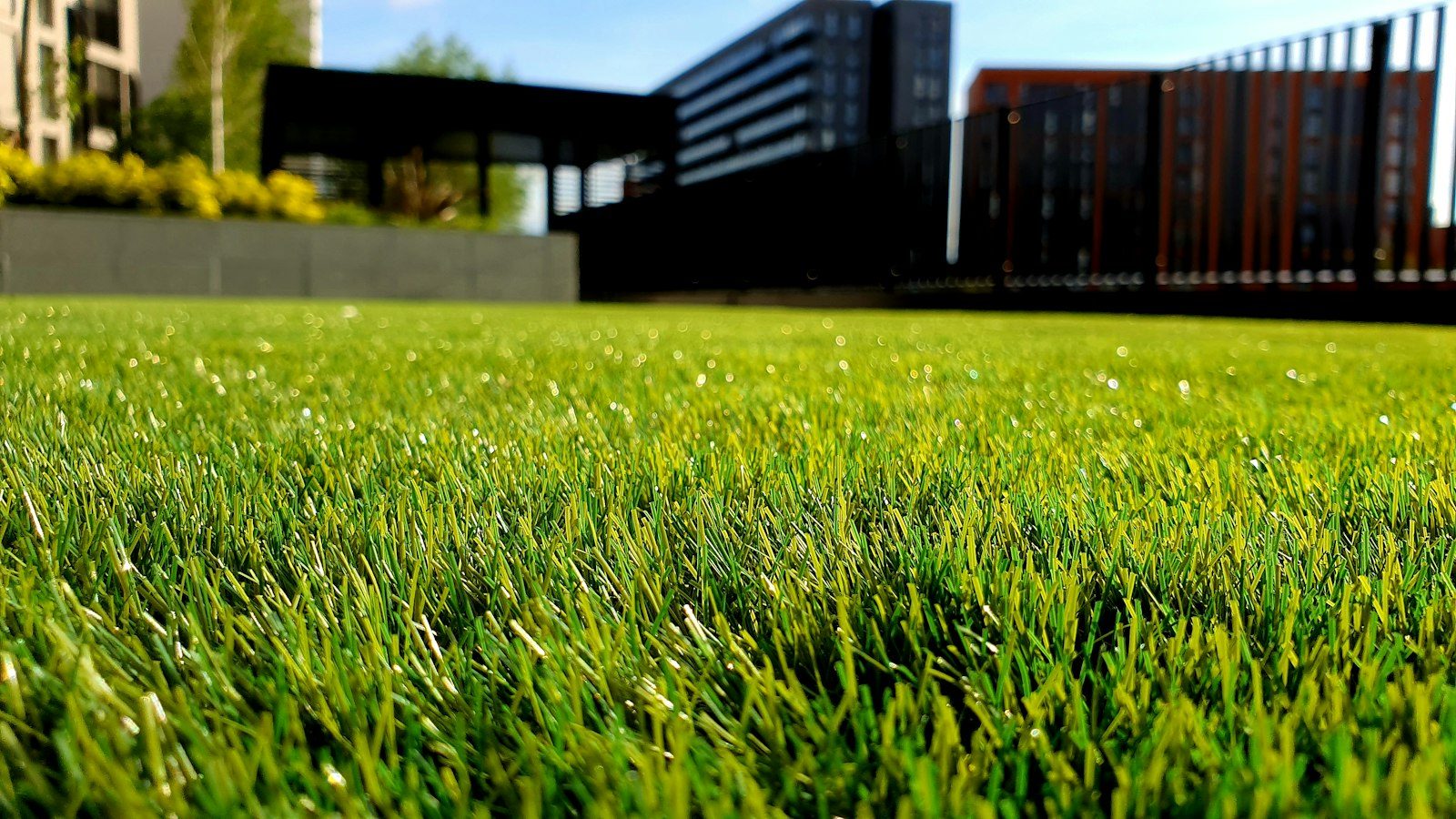
The short verdict: doing your own lawn care is cheaper over time, but it is not cheaper in year one, and it costs you somewhere around 60 to 100 hours a season. Hiring a lawn service costs more every year but saves those hours and removes the guesswork on product timing. For a typical quarter-acre suburban lawn, DIY makes the most sense if you already own a mower and enjoy the work; a professional fertilization and weed control program makes the most sense if your weekends are scarce, your lawn has a problem you have not been able to fix, or you need the yard to look consistently good. Many homeowners land on a hybrid: mow themselves and pay a pro for the treatment program. Below we break down the first-year costs, time, results and risks side by side.
Part of our Lawn Care guide →
In this guide
Key Takeaways
- DIY year one carries equipment costs (mower, spreader, trimmer) that drop away in year two and beyond.
- A full-service lawn company handles mowing and treatments; a treatment-only program covers fertilizer and weed control while you mow.
- DIY time runs roughly 1.5 to 3 hours a week in season for mowing, trimming and watering, plus treatment days.
- Pros win on timing, product access and diagnosis; DIY wins on cost control and flexibility.
- A hybrid approach, mowing yourself and hiring out fertilization and aeration, suits many busy households.
Side-by-Side Comparison
| Factor | DIY lawn care | Lawn service |
|---|---|---|
| Year-one cost | Higher if buying equipment; low in later years | Steady every year; full service costs the most |
| Your time | About 60 to 100 hours per season | A few minutes to schedule and pay |
| Product quality | Retail bags and sprays | Professional-grade products, often custom-blended |
| Timing | Depends on you remembering | Scheduled visits (typically 5 to 8 treatments a year) |
| Diagnosis of problems | Self-taught, trial and error | Technician experience; varies by company |
| Flexibility | Total control over products and schedule | Program-based; organic options cost more |
| Risk | Misapplication, burning, wasted product | Contracts, auto-renewals, inconsistent crews |
| Best for | Hands-on owners, small lawns, tight budgets | Busy owners, large lawns, problem lawns |
What “Lawn Service” Actually Includes
Before comparing costs, be clear about what you are comparing against. The phrase covers three different things:
- Mowing service: weekly or biweekly mowing, edging, trimming and blowing clippings off hard surfaces, usually from spring to fall. Our lawn mowing cost guide covers per-visit pricing.
- Treatment program: a set number of visits a year applying fertilizer, pre-emergent crabgrass control, post-emergent broadleaf weed control and sometimes grub prevention. You still mow.
- Full-service maintenance: both of the above, often with aeration, overseeding, spring and fall cleanups, and leaf removal bundled or added on.
Most of the DIY vs pro decision comes down to the treatment program. Mowing is easy to learn; correctly timing pre-emergent, fertilizer and weed control through the season is where many DIY lawns fall behind.
Year-One Cost: DIY
If you are starting from nothing, DIY’s first year is front-loaded with equipment. These are typical US retail ranges; your totals depend on brand, lawn size and what you already own.
| Item | Typical one-time or annual cost | Notes |
|---|---|---|
| Push or self-propelled mower | $250 to $700 one time | Battery or gas; riding mowers cost far more |
| String trimmer / edger | $100 to $250 one time | Battery kits often share packs with the mower |
| Broadcast spreader | $40 to $120 one time | Needed for granular fertilizer and seed |
| Hand or pump sprayer | $20 to $60 one time | For spot-spraying weeds |
| Fertilizer, 4 applications | $100 to $250 per year | For about 10,000 sq ft of lawn |
| Pre-emergent and weed control | $50 to $150 per year | Crabgrass preventer plus spot spray |
| Grub control (if needed) | $30 to $80 per year | Only where grubs are a known problem |
| Aerator rental and seed | $100 to $200 per year | Fall core aeration and overseeding |
| Fuel or electricity, blades, upkeep | $40 to $120 per year | Blade sharpening, oil, spark plug |
Add it up and year one for a quarter-acre lawn often lands somewhere between about $750 and $1,900 if you are buying all the equipment new, and roughly $320 to $800 a year after that. If you already own a mower and trimmer, year one looks much more like the ongoing figure. Equipment lasts years with basic care, so the comparison tilts toward DIY the longer you stay in the home.
Year-One Cost: Lawn Service
Professional pricing is mostly per visit and scales with lawn square footage and region. These typical ranges are for a lawn around 5,000 to 10,000 square feet.
| Service | Typical price range | Typical annual total |
|---|---|---|
| Mowing, trim and blow | $35 to $75 per visit | $900 to $2,200 for 26 to 30 visits |
| Fertilizer and weed control program | $50 to $100 per visit | $300 to $700 for 5 to 8 visits |
| Core aeration | $100 to $250 per visit | Once a year |
| Overseeding (with aeration) | $150 to $400 add-on | Once a year if needed |
| Grub preventive | $60 to $150 add-on | Once a year if needed |
A treatment-only program typically runs a few hundred dollars a year, while full-service care with mowing commonly lands well over $1,500 a year in most markets and more in high-cost metros or for larger lots. Unlike DIY, that number does not fall in year two. For more detail on one common add-on, see our lawn aeration cost breakdown.
Time: The Cost DIY Hides
Time is where a lawn service earns its money. For a quarter-acre lawn with a walk-behind mower, a realistic DIY season looks like this:
- Mowing, trimming and edging: 1 to 2 hours a week for 26 to 30 weeks, or roughly 30 to 60 hours.
- Watering setup and monitoring during dry spells: 10 to 20 hours.
- Fertilizer and pre-emergent applications, including the trip to the store: 1 to 2 hours each, 4 to 6 times a year.
- Spot-spraying weeds: 3 to 6 hours across the season.
- Fall aeration and overseeding: 4 to 8 hours including rental pickup and return.
- Equipment upkeep: 2 to 4 hours.
That totals roughly 60 to 100 hours. Whether that is a cost depends on you. Some homeowners find mowing relaxing exercise; others would rather spend Saturday mornings elsewhere. If you value your time at even a modest hourly rate, a mowing service can look reasonable on paper. Treatments, by contrast, take relatively few hours, which is why a hybrid approach is so common.
Climate changes the math. In the Deep South and Southwest, warm-season grasses such as Bermuda and St. Augustine can need mowing from March into November, pushing DIY hours toward the high end. In northern states, the mowing season is shorter, but fall leaf cleanup can add another 10 to 20 hours that a full-service company would otherwise handle.
Results: Who Gets the Better Lawn?
A knowledgeable DIYer can match or beat a typical lawn program, because you can tailor products to your grass, water at the right times, and mow at the correct height every week. The DIY lawns that struggle usually miss the pre-emergent window in spring, apply too much nitrogen in summer heat, or misidentify weeds and diseases. A good company brings timing discipline, professional products such as stabilized slow-release nitrogen and combination herbicides, and technicians who have seen your exact problem in a hundred other yards.
Pros do not control everything that matters, though. Mowing height, watering and soil compaction often drive lawn quality more than fertilizer does, and a treatment-only program cannot fix a lawn that is scalped weekly or watered every evening. Our lawn care guide covers the fundamentals that apply whether you hire out or not, and our lawn fertilizer schedule shows the timing a DIY program should follow for cool- and warm-season grass.
Risks and Hassles on Each Side
DIY risks
- Overlapping spreader passes that burn stripes into the lawn.
- Applying weed killer in heat above the label temperature limit and damaging turf.
- Using the wrong product for your grass type, such as atrazine on cool-season grass.
- Storing chemicals safely around kids and pets.
Lawn service risks
- Auto-renewing annual contracts with cancellation hoops.
- Upsells for add-ons you may not need, such as monthly insect sprays.
- Rushed visits and inconsistent crews.
- Less control over what goes on the lawn, unless you ask for product labels.
To reduce service risk, ask for a written list of each visit’s products and timing, confirm whether retreatment for weeds between visits is free, and avoid paying a full year in advance until you have seen a season of results.
Which Should You Choose?
- Choose DIY if you already own a mower, your lawn is under about 10,000 square feet, you are staying in the home several years, and you enjoy the work or want total control over products.
- Choose a full lawn service if your schedule leaves no time for weekly mowing, the property is large, you travel often in summer, or physical limitations make mowing difficult.
- Choose a treatment-only program if you are happy to mow but keep missing pre-emergent timing or losing ground to weeds.
- Choose a one-season trial with a pro if your lawn has a persistent problem, such as recurring brown patches or heavy weeds, and you want a diagnosis before committing.
- Go hybrid if you want most of the savings with fewer headaches: mow and water yourself, and hire out aeration, overseeding and the treatment rounds.
If you decide to go DIY, start small: a quality spreader, a reliable mower and a simple four-step fertilizer schedule get you most of the way. If you decide to hire, get at least three quotes, compare programs by number of visits and what each includes, and ask how the company handles retreatments. Either way, check your soil first; a basic soil test tells you whether your lawn needs lime, phosphorus or just nitrogen, which keeps both DIY and pro programs from wasting product.
Frequently Asked Questions
Is it cheaper to do your own lawn care?
Over several years, usually yes. In year one, buying a mower, trimmer and spreader can make DIY cost as much as or more than a treatment-only service. After that, DIY typically costs a fraction of a full-service program.
How many treatments does a lawn service do per year?
Most fertilization and weed control programs include about 5 to 8 visits from early spring to late fall, with each visit timed to the season, such as pre-emergent in early spring and a high-potassium feeding in late fall.
Can I cancel a lawn care contract?
It depends on the company. Many programs auto-renew each year unless you cancel in writing. Read the agreement before signing and ask whether you can pay per visit instead of prepaying for the season.
Do lawn services use stronger products than I can buy?
Some do. Licensed applicators can buy professional-grade fertilizers and herbicides in bulk, but many homeowner products contain the same active ingredients at similar rates. Timing and correct application matter as much as product strength.
Is a hybrid approach worth it?
For many households, yes. Mowing is the most time-consuming part and the easiest to learn, while treatment timing is where DIY lawns slip. Mowing yourself and hiring out treatments and aeration balances cost and results.