

A light meter is the cheapest way to stop guessing why a fiddle-leaf fig sulks by the window or a pothos stretches toward the glass. For most houseplant owners, a handheld lux and foot-candle meter with a separate or rotating sensor, such as the TopTes TS-710, is the best fit: it reads from very dim corners up to direct sun, switches units with one button and lets you aim the sensor where the leaves actually are. If you run grow lights, a PAR meter tells you what plants can actually use, and if you are siting garden beds, a DLI logger measures a whole day of light instead of a single moment. Below are seven current Amazon listings that cover all three jobs, with the readings to aim for once the meter arrives.
In this guide
- 1. TopTes TS-710 — Best Overall Light Meter for Houseplants
- 2. URCERI MT-92H — Best Split-Sensor Light Meter
- 3. DANOPLUS DP-331 — Best for Awkward Angles
- 4. Dr.meter 1330B-V — Best Simple Classic Meter
- 5. UNI-T UT383 — Best Pocket-Size Light Meter
- 6. AquaHorti AH-Quantuv — Best PAR Meter for Grow Lights
- 7. EvoDevice EVO-20 — Best for Siting Garden Plants
- What to Look For in a Light Meter for Plants
- Target Light Readings for Common Plants
- Frequently Asked Questions
Disclosure: Urban Lotus Project earns a commission from qualifying Amazon purchases made through links on this page, at no extra cost to you.
How we compared: we compared 7 current Amazon listings on what each listing states about measuring range, units, accuracy, sensor design, power and extra functions. We did not test or handle the products, and availability changes.
Key Takeaways
- A lux/foot-candle meter is all most houseplant owners need; one foot-candle equals about 10.76 lux.
- A split or rotating sensor lets you hold the probe at leaf height and angle without shading it with your hand or body.
- Grow-light users get more useful numbers from a PAR (PPFD) meter, which measures the light plants use for photosynthesis.
- A DLI logger sits in place all day and classifies a spot as full sun, part sun, part shade or shade.
- The 3-in-1 soil probes sold as light testers give only rough relative readings; they are not substitutes for a real meter.
| Product | Best for | Key features | Buy |
|---|---|---|---|
| TopTes TS-710 | Best overall for houseplants |
| Buy now →Check current price |
| URCERI MT-92H | Best split-sensor meter |
| Buy now →Check current price |
| DANOPLUS DP-331 | Best for awkward angles |
| Buy now →Check current price |
| Dr.meter 1330B-V | Best simple classic meter |
| Buy now →Check current price |
| UNI-T UT383 | Best pocket-size meter |
| Buy now →Check current price |
| AquaHorti AH-Quantuv | Best PAR meter for grow lights |
| Buy now →Check current price |
| EvoDevice EVO-20 | Best for siting garden plants |
| Buy now →Check current price |
Prices change often; check Amazon for today’s price. As an Amazon Associate we earn from qualifying purchases.
1. TopTes TS-710 — Best Overall Light Meter for Houseplants

Lux and foot-candle meter with a 180-degree rotating sensor, backlit screen, temperature and humidity readings and batteries included.
Check price on AmazonWhy We Like It
- Rotating sensor aims at a window or lamp easily.
- Reads from 0.1 lux, useful in dim rooms.
- Adds temperature and humidity on the same screen.
- Ships with batteries and a soft case.
| Specification | Details |
|---|---|
| Range | 0.1 to 200,000 lux; 0.1 to 20,000 foot-candles |
| Stated accuracy | 3 percent of reading plus 5 digits |
| Sensor | Built-in, rotates 180 degrees |
| Sampling | Every 0.5 seconds |
| Extras | Temperature, humidity, max/min, data hold, backlit 2.25-inch screen |
| Power | 3 AAA batteries, included |
TopTes TS-710 — compressed specs
For someone checking where to put a plant, the TS-710 hits the useful middle ground. The rotating sensor head means you can point it toward the window from the spot where the plant will sit, without awkwardly tilting the whole meter, and the stated low end of 0.1 lux matters more than it sounds: many cheap meters stop registering in the dim back half of a room, which is exactly where you need to know whether a ZZ plant will cope. The listing also names grow-light types it can read, including LED, fluorescent, metal halide and high-pressure sodium, so it doubles as a quick check under a shelf light.
Compared with the split-sensor URCERI below, the sensor is fixed to the body, so your hand is closer to the reading point. Compared with the PAR meter, it measures visible brightness as people see it, not photosynthetic light, which is fine for windowsill decisions but less precise for tuning grow lights. Among the five lux meters on this list, it is the only one whose listing says batteries come in the box and that adds humidity to the readout.
Pros
- Very low minimum reading
- Rotating sensor head
- Temperature and humidity included
- Batteries and case included
Cons
- Measures lux, not PAR
- Sensor not detachable
- Listing notes the temperature sensor needs time to adjust
Check TopTes TS-710 price on Amazon
2. URCERI MT-92H — Best Split-Sensor Light Meter
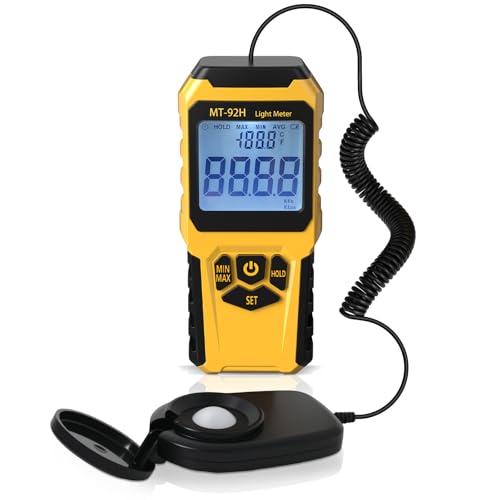
Separate light probe, 0 to 200,000 lux with stated 3 percent accuracy, 0.1 lux resolution and a temperature readout.
Check price on AmazonWhy We Like It
- Detached probe keeps your shadow off the sensor.
- Stated 3 percent accuracy and 0.1 lux resolution.
- Fast 0.5 second refresh.
- Switchable backlight for dark rooms or sun.
| Specification | Details |
|---|---|
| Range | 0 to 200,000 lux |
| Stated accuracy | Plus or minus 3 percent |
| Sensor | Split probe, separate from body |
| Units | Lux or foot-candles; Celsius or Fahrenheit |
| Size and weight | 125 x 56 x 30 mm; 188 g |
| Power | 3 AAA batteries |
URCERI MT-92H — compressed specs
A split sensor is the single most practical feature for plant work. You can rest the probe flat on the soil surface, tuck it into a shelf between pots or hold it at leaf level on the shady side of a plant while you read the display from a comfortable angle. That avoids the most common error with handheld meters: shading the sensor with your own body. The MT-92H pairs that design with the tightest accuracy figure on the shelf and a backlight you can turn off to save battery.
It lacks the humidity readout of the TopTes and its listing does not mention a low-light floor as specific as 0.1 lux in range terms, though it states 0.1 lux resolution. URCERI also has an older one-piece model on the shelf (the SMT912 style meter); the MT-92H is the one to choose if you want the separate probe.
Pros
- Separate probe on a cable
- Tight stated accuracy
- Temperature in either unit
- Listed 2-year warranty
Cons
- No humidity reading
- Lux only, no PAR
- Batteries not stated as included
Check URCERI MT-92H price on Amazon
3. DANOPLUS DP-331 — Best for Awkward Angles

Separable sensor that rotates 360 degrees, four auto ranges to 200,000 lux and a stated 400 to 700 nm spectral range.
Check price on AmazonWhy We Like It
- Sensor separates and rotates a full 360 degrees.
- States a 400 to 700 nm spectral range.
- Auto power off can be disabled for long sessions.
- Four auto-selected ranges.
| Specification | Details |
|---|---|
| Range | 0 to 200,000 lux; 0 to 20,000 foot-candles |
| Stated accuracy | Plus or minus 4 percent plus 10 digits |
| Sensor | Separate, 360-degree rotating |
| Spectral range | 400 to 700 nm |
| Functions | Min/max, data hold, auto range, auto off with disable |
| Weight | 0.33 lb |
DANOPLUS DP-331 — compressed specs
The DP-331 combines a detachable sensor with full rotation, so you can measure light hitting a hanging basket from below, check the underside of a shelf or point the sensor straight up at a ceiling grow light. Its listing is also one of the few to state a spectral range, and 400 to 700 nm happens to match the band plants use for photosynthesis, although the meter still reports in lux rather than PAR units. Being able to disable auto power off is handy if you are walking through a house taking readings room by room.
Its stated accuracy is a little looser than the URCERI and TopTes figures, which makes little practical difference for plant placement, where the gap between low and bright light is several-fold. Choose it over the URCERI if rotation matters more to you than a temperature readout.
Pros
- Detachable, fully rotating sensor
- Spectral range stated
- Auto off can be turned off
Cons
- Slightly looser stated accuracy
- No temperature or humidity
- Battery type not stated in listing
Check DANOPLUS DP-331 price on Amazon
4. Dr.meter 1330B-V — Best Simple Classic Meter

Long-running 0 to 200,000 lux meter with lux and foot-candle switching, peak hold and two readings per second.
Check price on AmazonWhy We Like It
- Straightforward lux and foot-candle toggle.
- Updates twice per second.
- Peak button captures brief bright readings.
- Clear low-battery warning.
| Specification | Details |
|---|---|
| Range | 0 to 200,000 lux |
| Units | Lux or foot-candles |
| Response | 2 readings per second |
| Functions | Peak hold, low battery alert |
| Power | 9V battery |
| Sensor design | not stated in listing |
Dr.meter 1330B-V — compressed specs
The Dr.meter is the no-frills option: a full-range lux meter that does one job and explains it plainly, with the listing pitched directly at gardeners measuring sunlight and indoor light for plants. The peak-hold feature is more useful outdoors than inside, but the twice-per-second update makes it easy to sweep the meter across a windowsill and watch the numbers fall as you move away from the glass.
It runs on a 9V battery, unlike the AAA-powered meters above, and its listing does not describe a rotating or split sensor or state an accuracy figure. Its listed dimensions also make it the bulkiest lux meter here. If you just want reliable relative readings room to room, it does the job; if you want flexibility in sensor placement, pick the URCERI or DANOPLUS.
Pros
- Simple to learn
- Fast update rate
- Peak hold function
Cons
- No accuracy figure in listing
- 9V battery
- Larger than others
- No min/max memory mentioned
Check Dr.meter 1330B-V price on Amazon
5. UNI-T UT383 — Best Pocket-Size Light Meter

Mini lux and foot-candle meter from a test-equipment brand, with backlight, max/min, data hold and auto shutdown.
Check price on AmazonWhy We Like It
- Compact one-piece meter fits a pocket.
- Backlit four-digit screen.
- Max, min and data hold functions.
- Brand known for test instruments.
| Specification | Details |
|---|---|
| Range | 0 to 199,900 lux; 0 to 18,500 foot-candles |
| Stated accuracy | Plus or minus 4 percent plus 8 digits |
| Sampling | 0.5 seconds |
| Functions | Max/min, data hold, overload indicator, auto off |
| Sensor | Built into body |
| In the box | Meter, box, paper manual |
UNI-T UT383 — compressed specs
The UT383 is a small, one-piece meter from a brand that makes multimeters and other test gear, and it is easy to keep in a drawer by the plant shelf. The listing mentions agriculture among its intended uses, and the full set of max, min and hold functions lets you take a reading at plant height, freeze it and then read it in comfort.
Because the sensor sits on the body, you need to hold it at arm’s length and keep your shadow away, which is the usual trade-off with compact meters. Choose it over the Dr.meter if you prefer AAA-size convenience and a smaller footprint; choose a split-sensor model if you measure a lot of awkward spots.
Pros
- Small and light
- Full function set
- Overload indicator
Cons
- Fixed sensor
- Lux only
- Battery type not stated in listing
Check UNI-T UT383 price on Amazon
6. AquaHorti AH-Quantuv — Best PAR Meter for Grow Lights

Measures PAR from 400 to 750 nm plus UVA, shows the blue, green and red share of PAR and logs up to 100 readings.
Check price on AmazonWhy We Like It
- Measures photosynthetic light, not just brightness.
- Breaks PAR into blue, green and red.
- Stores 100 readings for mapping a grow area.
- Adds UVA measurement.
| Specification | Details |
|---|---|
| Measures | PAR (PPFD), 400 to 750 nm |
| Also measures | UVA, 320 to 400 nm |
| Spectrum view | Blue, green and red share of PAR |
| Memory | Up to 100 PAR readings |
| Functions | Hold, multiple display modes |
| Certification | CE stated |
AquaHorti AH-Quantuv — compressed specs
Lux meters are weighted to human vision, which peaks in green and undercounts the deep red and blue that many grow lights emphasize. A PAR meter measures photosynthetic photon flux density (PPFD), the light plants can actually use, in micromoles per square meter per second. That makes the AH-Quantuv the right tool for setting the hanging height of grow lights over seedlings, herbs or a plant shelf. The recording function lets you take readings in a grid across the tray and spot dim corners, and the color breakdown shows whether a full-spectrum light is as balanced as the box claims.
It is the only true PAR meter on the shelf, and it is more specialized than anyone siting a pothos needs. If you only want to know whether a window is bright enough, a lux meter is simpler. If you are working through our indoor grow light guide, this is the meter that turns the guide’s PPFD targets into numbers you can check.
Pros
- True PAR measurement
- Spectrum breakdown
- Reading memory for mapping
- UVA readout
Cons
- Overkill for windowsill checks
- No lux mode mentioned
- Power source not stated in listing
Check AquaHorti AH-Quantuv price on Amazon
7. EvoDevice EVO-20 — Best for Siting Garden Plants

Stake-style meter that accumulates daily light integral and labels a spot full sun, part sun, part shade or shade.
Check price on AmazonWhy We Like It
- Measures a whole day, not one moment.
- Translates DLI into plant-tag sun categories.
- Keeps 10 days of history.
- Starts automatically once placed.
| Specification | Details |
|---|---|
| Measures | Daily light integral, mol per square meter per day |
| Output | Full sun, partial sun, partial shade or shade |
| History | Up to 10 days |
| Placement | Inserted in soil at the test spot |
| Light sources | Sunlight, LED, HPS, CMH |
| Instant reading | No; accumulates over time |
EvoDevice EVO-20 — compressed specs
Plant tags say “full sun” or “part shade,” and a spot reading at noon cannot tell you which one your bed really is, because shade from trees and buildings moves through the day. The EVO-20 solves that by accumulating light from morning to evening and reporting daily light integral, then converting it into the same categories nurseries use. Leave it in a bed for several clear days and you have a real answer for whether that corner can grow tomatoes or should get hostas. It also works under grow lights in a greenhouse.
The listing is clear that it is not an instant meter, so it will not help when you are standing at a window deciding where a pot goes. It complements a lux meter rather than replacing one, and it is the only data-logging, all-day device in this roundup.
Pros
- Whole-day measurement
- Plain-language sun category
- Multi-day history
Cons
- No instant readings
- Needs several days for a fair result
- Battery type not stated in listing
Check EvoDevice EVO-20 price on Amazon
What to Look For in a Light Meter for Plants
Lux, PAR or DLI?
Lux and foot-candle meters measure brightness as the human eye perceives it. They are inexpensive, widely available and perfectly good for comparing spots in your home under daylight. PAR meters measure photons in the 400 to 700 nm band (some extend slightly further) and are the better tool for grow lights, especially red-heavy or purple LEDs that a lux meter misreads. DLI devices total the PAR a spot receives over a whole day, which is what really drives growth. Decide which question you are answering before you buy.
Sensor design
A sensor on a cable or a rotating head lets you measure at leaf height and aim at the light source without your body casting shade. Fixed-sensor meters work, but take readings at arm’s length and check that your shadow is not falling on the dome.
Low-end range
Every lux meter here reaches 200,000 lux at the top, more than direct summer sun. The low end matters more for houseplants. One listing on the shelf notes a minimum detectable level around 2 lux, so check the low figure if you are measuring dim hallways and north rooms.
Skip the soil probe “light” testers
Battery-free 3-in-1 soil testers that add a light setting usually show a coarse scale (one VIVOSUN listing gives 0 to 2,000) rather than calibrated lux. They are fine for moisture checks, but for light decisions a real meter is far more informative.
Target Light Readings for Common Plants
Take readings at the leaves, around midday, on a bright overcast day as well as a sunny one, and use the lower figure as your planning number. These widely used ranges are a starting point; individual plants vary.
| Light level | Foot-candles | Approx. lux | Example plants |
|---|---|---|---|
| Low | 50 to 250 | 500 to 2,700 | ZZ plant, snake plant, cast iron plant, pothos |
| Medium | 250 to 1,000 | 2,700 to 10,800 | Philodendron, peace lily, dracaena, calathea |
| Bright indirect | 1,000 to 2,000 | 10,800 to 21,500 | Fiddle-leaf fig, monstera, rubber plant |
| Direct sun | 2,000 and up | 21,500 and up | Cacti, succulents, citrus, herbs |
Readings fall off quickly with distance from a window, often dropping by more than half within a few feet, which is why a plant that looks close to the glass may still be in low light. For plants that tolerate dim corners, see our list of low-light houseplants, and for broader container care visit our houseplants and containers hub. If a reading shows a spot is too dark, a supplemental light from our best grow lights roundup can close the gap.
Frequently Asked Questions
Can I use a lux meter to measure grow lights?
Yes, for comparisons, but with caution. Lux meters are tuned to human vision and undercount red and blue light, so a purple LED can read low even when it delivers plenty of usable light. For setting grow light height, a PAR meter is more reliable.
How many foot-candles does a low-light houseplant need?
Plants sold as low light generally survive at about 50 to 250 foot-candles, roughly 500 to 2,700 lux. Survival is not the same as growth; most of these plants grow faster and look fuller with more light.
Are phone light meter apps accurate enough?
Phone apps use the front camera or ambient sensor and can be useful for rough comparisons between rooms, but readings vary widely by phone model. A dedicated meter gives consistent numbers you can track over time.
When should I take light readings?
Measure at the plant’s leaves, around midday, and repeat on a sunny and an overcast day and in different seasons. Winter sun is lower and weaker, so a spot that is bright in June may be medium light in January.
What is DLI and why does it matter?
Daily light integral is the total photosynthetic light a spot receives over a day, in moles per square meter. It accounts for both intensity and duration, so it is a better predictor of growth than a single reading. All-day meters like the EVO-20 measure it directly.
For most houseplant owners, start with a lux meter that has a movable sensor, map each room once in summer and again in winter, and place plants by the numbers. Add a PAR meter if you run grow lights seriously, or an all-day DLI logger if your main question is which garden beds really get full sun.