

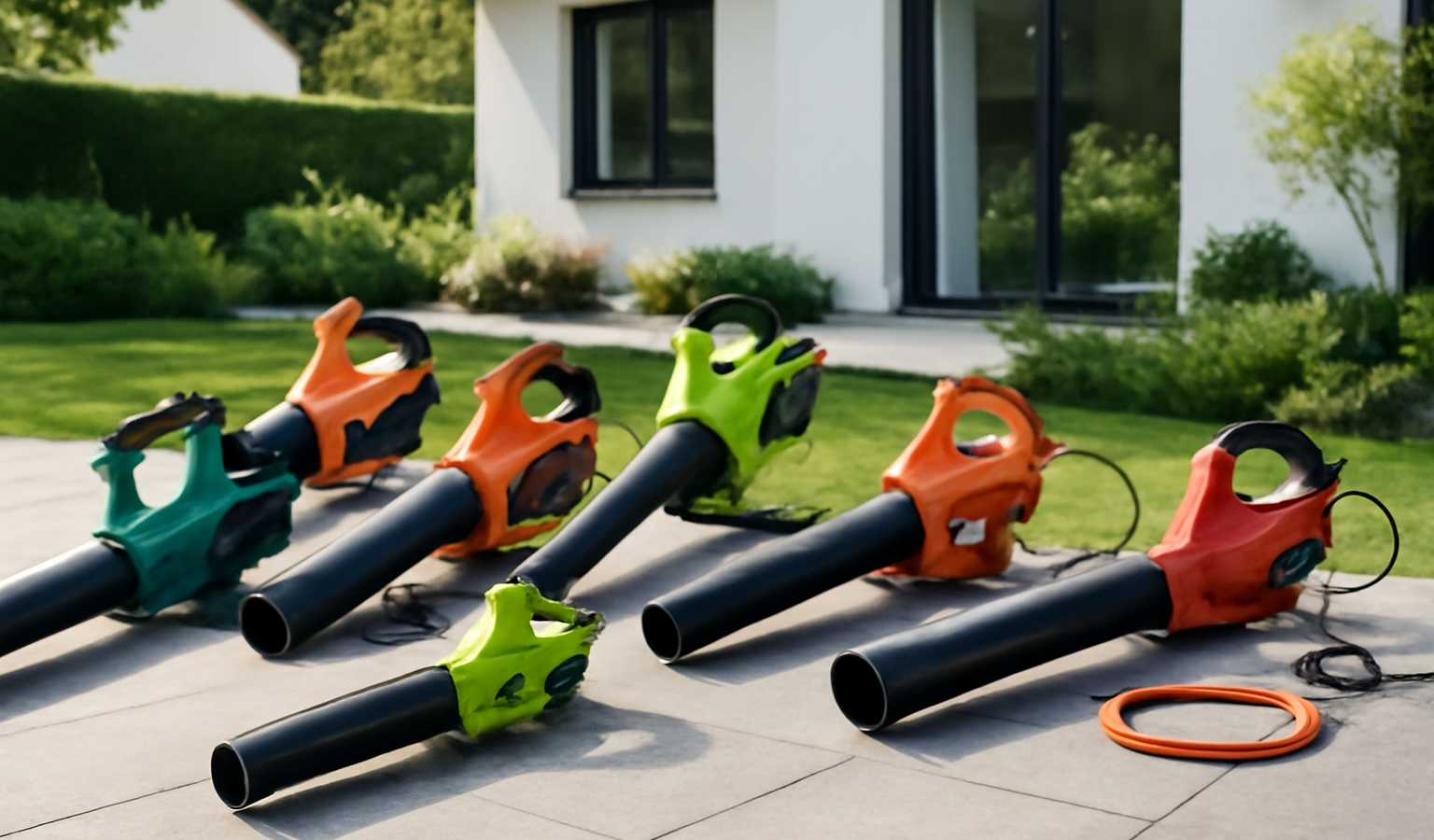
When the leaves start falling, a good leaf blower turns a back-breaking afternoon of raking into a quick, satisfying sweep around the yard. But the market is crowded with cordless handhelds, corded electrics, and powerful backpack models, all shouting numbers like CFM and MPH that don’t always mean what you’d expect. Below we compare eight of the most popular leaf blowers for 2026 across cordless, corded, and backpack designs, then walk you through exactly how to choose the right one for your yard, your budget, and your tolerance for noise.
Some links in this article are affiliate links. As an Amazon Associate we earn from qualifying purchases, at no extra cost to you.
Key takeaways
- CFM (air volume) moves big piles of leaves, while MPH (air speed) dislodges stubborn or wet debris — you want a healthy balance of both, and CFM usually matters more for clearing.
- Cordless battery blowers now rival gas for most home yards, run quieter, and skip the fumes and pull-starts, which is why they dominate our picks.
- The EGO Power+ LB7654 is our overall favorite for raw power and run time, while the Ryobi 40V Whisper Series is the standout for low-noise neighborhoods.
- Corded electric blowers like the Toro PowerJet F700 give you unlimited runtime and great value if you don’t mind a cord, and backpack models suit large properties.
- If you already own batteries from a brand, staying on the same platform saves serious money on your next tool.
| Blower | Best for | CFM & MPH | |
|---|---|---|---|
| EGO Power+ LB7654 | Overall power & run time | 765 CFM / 200 MPH | Check price |
| EGO Power+ LB6504 | Long battery life | 650 CFM / 180 MPH | Check price |
| Ryobi 40V HP Brushless Whisper Series | Low-noise neighborhoods | 730 CFM / 190 MPH | Check price |
| Greenworks 80V | Power for the price | 700 CFM / 170 MPH | Check price |
| Worx WG584 40V Turbine | Mid-size yards | 730 CFM | Check price |
| Toro PowerJet F700 | Corded value & unlimited runtime | 725 CFM / 140 MPH | Check price |
| EGO Power+ 600 CFM Backpack (LB6004) | Large properties | 600 CFM | Check price |
| DeWalt 60V MAX FlexVolt | DeWalt battery owners | 600 CFM / 175 MPH | Check price |
The best leaf blowers reviewed
1. EGO Power+ LB7654 — Best for overall power and run time
The EGO Power+ LB7654 is the blower we’d put in most hands first. It delivers up to 765 CFM with air speeds reaching 200 MPH, which is enough to push large, damp piles of leaves across a lawn without breaking stride. A variable-speed dial lets you ease back to around 260 CFM for delicate work near flower beds, then a turbo button unleashes the full blast when you hit a stubborn drift.
Running on EGO’s 56V ARC Lithium platform, it pairs strong performance with the longest run times we’ve seen from a handheld at this power level, especially with a larger-capacity battery. It’s well balanced for its class, starts instantly, and shares batteries with EGO’s wider range of mowers and trimmers, making it a smart anchor for a cordless yard.
Pros
- Class-leading 765 CFM output with turbo boost
- Long run time on the 56V platform
- Variable-speed dial for fine control
Cons
- Heavier than entry-level handhelds
- Premium price, especially with a large battery
2. EGO Power+ LB6504 — Best for long battery life
If outright runtime matters more to you than chasing the very top CFM number, the EGO Power+ LB6504 is a brilliant choice. In independent testing it was praised as a sturdy, powerful, and easy-to-use blower, with a rechargeable lithium-ion battery that outlasted rivals even at the highest speed setting. For most suburban lots, that means clearing the whole yard on a single charge.
It’s comfortable to hold thanks to an ergonomic handle and a well-judged weight that keeps it maneuverable, and the same 56V batteries slot into EGO’s other tools. With plenty of air volume for everyday leaf duty and that standout endurance, the LB6504 is the model to pick when you’d rather keep blowing than keep charging.
Pros
- Outstanding battery life, even at full power
- Comfortable, well-balanced, easy to use
- Shares the broad EGO 56V battery platform
Cons
- Lower peak CFM than the flagship LB7654
- Still a premium price point
3. Ryobi 40V HP Brushless Whisper Series — Best for low-noise neighborhoods
Noise complaints are the number-one reason blowers get banished to the garage, and the Ryobi 40V HP Brushless Whisper Series is built to solve exactly that. It produces up to 730 CFM and 190 MPH, yet in its quieter whisper mode it runs at around 59 dB — quieter than a normal conversation and far gentler on your ears and your neighbors than a typical gas blower.
The brushless motor is efficient and durable, and Ryobi’s enormous 40V lineup means batteries you buy here power dozens of other yard and power tools. For anyone in a tightly packed neighborhood, an HOA with noise rules, or simply doing early-morning cleanups, this is the blower that lets you get the job done without making enemies.
Pros
- Remarkably quiet for its power output
- Strong 730 CFM / 190 MPH performance
- Huge, affordable Ryobi 40V battery ecosystem
Cons
- Top performance drains the battery faster
- Bulkier than compact handhelds
4. Greenworks 80V — Best for power per dollar
The Greenworks 80V handheld brings serious muscle, delivering around 700 CFM and 170 MPH that make quick work of larger jobs and heavier debris. In head-to-head shootouts it has repeatedly landed near the top for raw power, often at a price that undercuts the premium competition, which makes it a favorite for value-focused buyers who still want gas-like grunt.
The trade-off is noise: testers note it can be loud at full tilt, so hearing protection is wise on long sessions. But the 80V platform spans mowers, trimmers, and snow throwers, so it’s a capable backbone for a fully cordless yard. If you want maximum clearing power without paying flagship money, the Greenworks 80V earns its place.
Pros
- Strong 700 CFM output at a competitive price
- High-voltage 80V platform for demanding tools
- Makes quick work of big, heavy piles
Cons
- Noticeably loud at maximum power
- Fewer tools in the lineup than EGO or Ryobi
5. Worx WG584 40V Turbine — Best for mid-size yards
The Worx WG584 runs on a dual 20V (40V combined) Power Share system and pushes up to 730 CFM through a turbine fan. Three separate speed settings let you dial in the right airflow for the task, and a dedicated Turbo Boost button generates a strong burst of air that’s genuinely useful when you hit a packed, heavy pile on a larger job.
It’s lighter and more maneuverable than some higher-voltage rivals, which makes it comfortable to swing around a mid-size yard for an hour. Worx’s Power Share batteries also cross over to a wide range of the brand’s tools, so if you’ve already bought into the ecosystem, the WG584 is an easy and affordable way to add real blowing power.
Pros
- Strong 730 CFM with a useful Turbo Boost
- Three speed settings for versatile control
- Light, maneuverable, shares Power Share batteries
Cons
- Uses two batteries to reach full output
- Run time depends on battery capacity you pair
6. Toro PowerJet F700 — Best corded for unlimited runtime
Not everyone wants to manage batteries, and that’s where the corded Toro PowerJet F700 shines. It produces up to 725 CFM and 140 MPH straight from the wall, so there’s never a charge to wait for and never a battery to replace. For driveways, patios, and small to mid-size yards within reach of an outlet, that unlimited runtime is hard to beat.
It’s also lightweight and an excellent value compared with battery models of similar output, with variable speed control for finer work. The obvious caveat is the cord itself: you’ll need an outdoor-rated extension lead and a little care to keep it from snagging or unplugging. Manage that, and the F700 is a dependable, fuss-free workhorse.
Pros
- Unlimited runtime, no batteries to buy
- Strong 725 CFM at a great price
- Lightweight with variable speed control
Cons
- Tied to an outlet and extension cord
- Cord can unplug or snag if you’re not careful
7. EGO Power+ 600 CFM Backpack (LB6004) — Best for large properties
For big yards, long driveways, and properties where you’re clearing for half an hour or more, a backpack design takes the weight off your arms and puts it on your shoulders and hips. The EGO Power+ 600 CFM Backpack blower delivers up to 600 CFM with the comfort of a padded harness, so you can keep working long after a handheld would have left your forearm aching.
Reviewers consistently rate EGO’s backpack blowers as among the best battery-powered options for anyone switching away from a gas backpack, thanks to thoughtful controls, a durable build, and quiet, fume-free operation. It runs on the same 56V batteries as the rest of the EGO range, so it slots neatly into an existing cordless lineup for serious acreage.
Pros
- Comfortable harness for long clearing sessions
- Quiet, fume-free alternative to gas backpacks
- Runs on the shared EGO 56V platform
Cons
- Bulkier and pricier than handhelds
- Overkill for small urban yards
8. DeWalt 60V MAX FlexVolt — Best for DeWalt battery owners
If you already have a drawer full of DeWalt FlexVolt batteries, the DeWalt 60V MAX blower is the obvious pick. It delivers around 600 CFM and 175 MPH at a manageable weight, and because it shares the same batteries as DeWalt’s drills, saws, and other cordless tools, you can often buy the bare tool and skip paying for another battery and charger entirely.
Build quality is up to DeWalt’s usual rugged standard, with a comfortable grip and variable speed trigger for everyday leaf and debris clearing. It won’t top the charts on raw CFM, but the convenience and savings of staying on one professional-grade platform make it a genuinely smart buy for existing DeWalt users.
Pros
- Shares FlexVolt batteries across DeWalt tools
- Rugged, professional-grade build
- Sensible weight and variable speed control
Cons
- Lower peak CFM than flagship rivals
- Best value only if you own the platform
Free, no-obligation quote · Connect with a local pro
How to choose a leaf blower
The best leaf blower for you depends on the size of your yard, the kind of debris you face, and how much you care about weight, noise, and runtime. Here’s what to weigh up before you buy.
CFM vs. MPH explained
These are the two headline numbers on every blower, and understanding them is the key to a good purchase. CFM (cubic feet per minute) measures the volume of air the blower moves — think of it as how big a pile you can push at once. MPH (miles per hour) measures the speed of that air, which is what dislodges stuck, matted, or wet leaves from grass and cracks. High MPH with low CFM gives you a thin, fast jet that’s great for stubborn spots but slow at clearing; high CFM with moderate MPH moves large amounts of material efficiently. For most leaf clearing, CFM is the more important figure, but you want a healthy balance of both.
Cordless vs. corded vs. gas vs. backpack
- Cordless battery blowers are now the default choice for most homeowners. They’re quiet, fume-free, start instantly, and modern high-voltage models rival gas. The limits are runtime and the upfront cost of batteries.
- Corded electric blowers like the Toro PowerJet F700 give you unlimited runtime and great value, but tether you to an outlet and an extension cord, so they suit smaller yards near the house.
- Gas blowers still offer the longest continuous runtime and brute power for large or commercial work, but they’re loud, need fuel and maintenance, and are increasingly restricted by local regulations.
- Backpack blowers, such as the EGO LB6004, shift the weight to your shoulders for long sessions on big properties, and now come in capable battery versions as well as gas.
Battery platform
With cordless tools, the battery is often the most expensive part. If you already own batteries from EGO, Ryobi, Worx, DeWalt, or Greenworks, buying a “bare tool” blower on the same platform saves a lot of money and lets you share charges across mowers, trimmers, and drills. It’s worth choosing your ecosystem deliberately, because it shapes every future purchase. Our best cordless string trimmers guide can help you plan a matching set.
Weight and noise
A blower you’ll carry for half an hour needs to be a weight your arm can tolerate, so check the figure with the battery fitted, not just the bare tool. Noise matters too: many areas have ordinances, and a quiet model like the Ryobi Whisper Series (around 59 dB in its quiet mode) lets you work early without disturbing neighbors. For louder, high-power models, wear hearing protection.
Variable speed and turbo
Variable speed control — whether a dial, trigger, or multiple settings — lets you ease off near flower beds and gravel, then ramp up for open lawns. A turbo or boost button, found on models like the EGO LB7654 and Worx WG584, gives a short burst of maximum power for stubborn, packed, or wet piles without running at full tilt the whole time, which also helps conserve battery.
Vacuum and mulch combos
Some blowers double as vacuums that suck up leaves and mulch them into a collection bag, shredding them down to a fraction of their volume for compost or disposal. If you bag your leaves rather than blow them to the curb, a blower-vac-mulcher combo can save a lot of effort, though dedicated blowers are usually lighter and more powerful for pure clearing.
Frequently asked questions
CFM or MPH — which matters?
For clearing leaves, CFM (air volume) generally matters most, because it determines how big a pile you can move at once. MPH (air speed) is what lifts stuck, wet, or matted leaves off the ground. The best blowers offer a strong balance of both, so don’t fixate on a single sky-high number — look at the pairing.
Are cordless leaf blowers powerful enough?
Yes, for the large majority of home yards. Modern high-voltage cordless blowers from EGO, Ryobi, and Greenworks now match or beat many gas models on CFM and air speed, while running quieter and cleaner. Only very large or commercial properties typically still benefit from gas or a battery backpack.
How much CFM do I need for my yard?
Small yards and patios are well served by 400–500 CFM, average suburban lots do nicely with 500–650 CFM, and large properties or heavy, wet leaf loads benefit from 650 CFM and up. When in doubt, a little extra CFM clears faster and lets you work on a lower, quieter setting.
How long do leaf blower batteries last?
Runtime depends on the battery capacity and the speed you use. Expect roughly 15 to 45 minutes on a charge for most handhelds, with far less at full turbo and more at lower speeds. Buying a second battery or a larger-capacity pack is the simplest way to clear a big yard without stopping.
Are leaf blowers loud, and can I reduce the noise?
Many are, but it varies a lot. Battery blowers are generally quieter than gas, and low-noise models like the Ryobi Whisper Series run around 59 dB in quiet mode. Choose a quieter model, use lower speeds when you can, and wear hearing protection on powerful blowers to protect your ears.
Can a leaf blower also vacuum and mulch?
Some can. Blower-vac-mulcher combos suck up leaves and shred them into a bag for compost or disposal, which is ideal if you collect rather than clear to the curb. Pure blowers tend to be lighter and more powerful, so pick based on whether you mostly move or mostly bag your leaves.
Whichever model you choose, the right leaf blower turns fall cleanup from a chore into a quick lap of the yard. To round out your kit, see our guide to essential garden tools, our pick of the best cordless string trimmers, and tips on how to store garden tools so your gear lasts. You’ll find more in our tools & gear section.
Rather hire a lawn pro?
Don’t want to do it yourself? Compare free, no-obligation quotes from vetted local lawn care pros near you.