

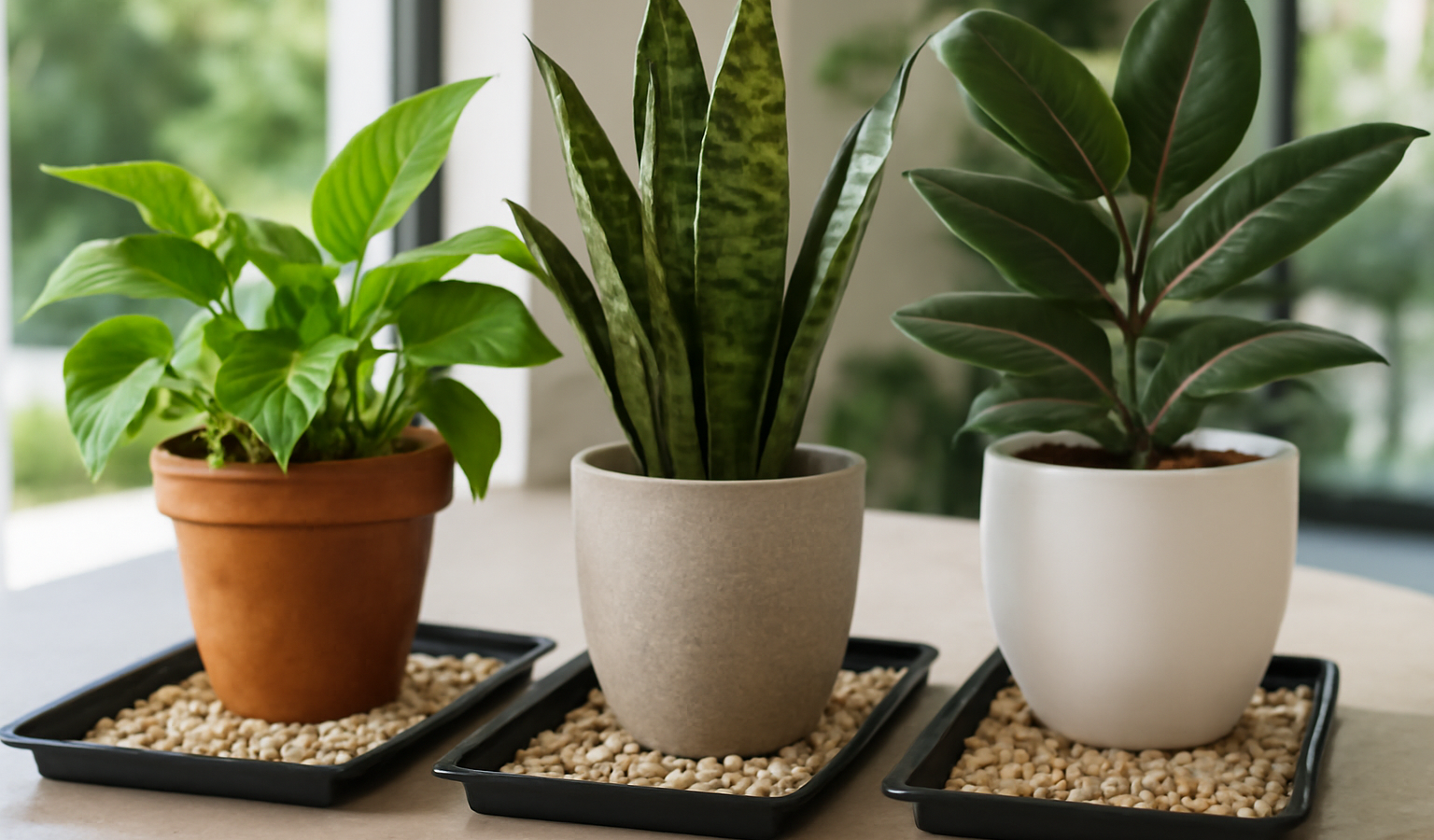
Many of the houseplants we love—calatheas, ferns, orchids, anthuriums, alocasias, nerve plants—come from humid tropical forests and sulk in the dry air of a heated or air-conditioned home, where winter humidity can drop below 30 percent. The classic, low-tech fix is a humidity tray: a shallow tray filled with pebbles and water, set under the pot so that as the water evaporates it raises the moisture in the air immediately around the plant. The pot sits on the pebbles above the waterline, so roots never sit in water (which would cause rot), but the leaves get a gentle local boost in humidity. It’s cheap, silent, needs no electricity, and groups beautifully on a windowsill or plant shelf.
Humidity trays range from simple pebble-filled saucers to slatted “no-pebble” platform trays, decorative ceramic dishes, and tray-plus-humidifier combos for serious tropical collections. This guide compares seven real, widely available options, explains the honest reality of how much each actually helps, and finishes with a buyer’s guide and FAQ so you can match a tray to your plants and your space. For more plant-care gear, see our Tools & Gear hub.
As an Amazon Associate we earn from qualifying purchases. This page contains affiliate links at no extra cost to you.
Key Takeaways
- A humidity tray holds the pot above a reservoir of water on pebbles or a slatted platform, so evaporation raises local humidity while roots stay out of standing water.
- The effect is modest and very local—great for grouping humidity-lovers, but for a whole dry room a humidifier does far more.
- Slatted “no-pebble” platform trays are the easiest to refill and clean; classic pebble trays are cheapest; ceramic trays look best on display.
- Group plants on one large tray to compound the effect, keep the water level just below the pebble tops, and clean regularly to prevent mineral crust and algae.
- For demanding tropicals like calatheas, pair a tray with a small humidifier or a pebble-tray-plus-humidifier combo for the biggest, most reliable boost.
| Product | Best For | Key Spec |
|---|---|---|
| Classic Pebble Humidity Tray (with river stones) | Best simple value | Shallow tray + included pebbles |
| Brussel’s Bonsai Humidity Tray | Best slatted no-pebble tray | Slatted platform over reservoir |
| Large Rectangular Plant Group Tray | Best for grouping plants | Big footprint for multiple pots |
| Ceramic Glazed Humidity Tray | Best decorative | Glazed ceramic, drainage-free |
| Bonsai Drainage / Humidity Tray Set | Best for bonsai & small pots | Multi-size set with mesh |
| Self-Watering Capillary Mat Tray | Best for hands-off watering | Wicking mat reservoir tray |
| Pebble Tray + Mini Humidifier Combo | Best for demanding tropicals | Tray plus small USB humidifier |
1. Classic Pebble Humidity Tray (with River Stones)
The classic pebble tray is the original humidity solution and still the best simple value. It’s a shallow waterproof tray—often sold with a bag of smooth river stones or glass pebbles—that you fill with a layer of stones and water, then set your pot on top so it rests above the waterline. As the water evaporates around the pot it gently lifts the humidity in the air right next to the plant, exactly where the leaves need it. It’s silent, uses no power, costs very little, and can be left running indefinitely with just a top-up of water. For one or two humidity-lovers on a windowsill, it does the job at minimal cost.
The honest reality is that the humidity boost is modest and very localized—it noticeably helps the air immediately around the pot, not a whole dry room. The pebbles need periodic rinsing to clear mineral crust, algae, and dust, and you must keep the water just below the pebble tops so the pot never sits in water and rots. But as a cheap, effective, no-fuss way to comfort a couple of tropical plants, it’s the foundation everything else builds on.
Pros
- Very inexpensive and silent; no electricity
- Often includes the pebbles you need
- Genuinely raises local humidity around the pot
- Set-and-forget with occasional top-ups
Cons
- Boost is modest and very localized
- Pebbles need rinsing to prevent crust and algae
- Easy to overfill so the pot sits in water
2. Brussel’s Bonsai Humidity Tray (Slatted)
The slatted Brussel’s Bonsai humidity tray is the upgrade for anyone tired of fussing with loose pebbles. Instead of stones, it uses a built-in slatted or grated platform that sits above a shallow reservoir, so the pot rests on the slats while water evaporates from below—no pebbles to rinse, refill, or knock around. That makes it dramatically easier to top up and clean: you just lift the platform and rinse the tray. Designed for bonsai but perfect for any humidity-loving houseplant, these trays come in tidy sizes, often with rubber feet to protect furniture, and they look neater than a tray full of stones.
The trade-offs are small. The slatted platform provides slightly less evaporative surface area than a full bed of wet pebbles, so the humidity bump can be a touch less, and the molded plastic trays are functional rather than beautiful. Sizes are also fixed, so you match the tray to the pot rather than the other way around. But for low-maintenance, pebble-free humidity that’s easy to refill and keep clean, the slatted design is the most convenient on the list.
Pros
- No pebbles to rinse or refill—easy to clean
- Slatted platform keeps the pot above water
- Tidy sizes, often with furniture-safe feet
- Quick to top up the reservoir
Cons
- Slightly less evaporative area than wet pebbles
- Plastic trays are functional, not decorative
- Fixed sizes you must match to the pot
3. Large Rectangular Plant Group Tray
The single most effective way to get real humidity from a tray is to group plants together over a big one, and a large rectangular tray is built for exactly that. With a generous footprint you can line up several pots—filling the rest of the surface with pebbles and water—so the combined evaporation, plus the plants transpiring close to one another, creates a noticeably more humid pocket than any single pot on its own. Grouping is the pro trick: humidity-loving plants help humidify each other, and a big shared tray underneath compounds the effect. These trays are usually sturdy, deep enough to hold useful water, and ideal for a plant shelf or wide windowsill.
The downsides are size and weight. A large tray full of pebbles and water is heavy and not very portable, and it takes up a chunk of windowsill or shelf. You also have to keep an eye on the water level across the whole tray and clean a bigger surface. But if you have several tropical plants and want the biggest passive humidity boost without a machine, grouping them on one large tray is the most effective approach here.
Pros
- Groups several plants to compound humidity
- Large evaporative surface for a bigger boost
- Deep enough to hold a useful water reservoir
- Best passive option without a machine
Cons
- Heavy and not portable when full
- Takes up significant shelf or sill space
- Bigger surface to monitor and clean
4. Ceramic Glazed Humidity Tray
If your plants live in a visible spot and you want the tray to look as good as the plant, a glazed ceramic humidity tray is the elegant choice. These are solid, drainage-free glazed dishes—often sold for bonsai and display plants—that you fill with decorative pebbles and water for a tray that reads as part of the decor rather than a piece of plant equipment. The glazed surface is non-porous, so it won’t leak or sweat onto furniture, it wipes clean easily, and the weight gives it a reassuring stability. For a statement plant on a console, mantel, or coffee table, a ceramic tray elevates the whole arrangement.
The compromises are practical. Ceramic is heavier and more breakable than plastic—drop it and it cracks—and it costs more for the same function. Sizes and depths vary, so check it’s deep enough to hold a useful amount of water beneath the pebbles. But for anyone who wants their humidity tray to be beautiful as well as functional, a glazed ceramic dish is a lovely, lasting upgrade that hides its job in plain sight.
Pros
- Attractive glazed finish doubles as decor
- Non-porous; won’t leak or sweat onto furniture
- Wipes clean and feels substantial
- Great for display plants in visible spots
Cons
- Heavy and breakable if dropped
- Pricier than plastic for the same function
- Some are too shallow to hold much water
5. Bonsai Drainage / Humidity Tray Set
For collectors of bonsai, African violets, seedlings, and small pots, a multi-size humidity-and-drainage tray set is the practical, flexible buy. These sets bundle several trays in different sizes—often with mesh inserts or grids—so you can match a tray to each pot rather than forcing one size to fit all, and the same trays catch drainage when you water and hold pebbles and water for humidity the rest of the time. The mesh keeps roots and soil out of the reservoir, and the variety means one purchase covers a whole windowsill of small plants. It’s the efficient way to outfit a growing collection at once.
The trade-offs are that the small individual trays hold only a little water, so each one’s humidity effect is limited and they dry out faster, needing more frequent top-ups. The thin plastic in budget sets is functional rather than premium. But for the gardener juggling lots of small pots who wants the right-sized tray for each—doing double duty as drainage saucers—a multi-size set is genuinely useful and good value.
Pros
- Multiple sizes to match different small pots
- Doubles as drainage saucers when watering
- Mesh keeps soil out of the reservoir
- Good value for outfitting a collection
Cons
- Small trays hold little water; dry out faster
- Limited humidity effect per tray
- Budget plastic feels thin
6. Self-Watering Capillary Mat Tray
A capillary-mat tray is a clever twist that handles humidity and watering at once, which makes it the pick for hands-off care or vacation coverage. The tray holds a reservoir of water beneath a wicking capillary mat; pots sit on the mat and draw moisture up through their drainage holes as the soil dries, while the wet mat surface also evaporates to raise local humidity. It’s especially loved by seed starters and anyone growing thirsty plants, because it keeps the soil evenly moist for days and waters several pots from one reservoir—handy when you’re away.
The caveats matter. Bottom-watering through a mat works best with pots that have open drainage holes and a wicking mix, and it isn’t right for plants that hate constantly damp soil—succulents and cacti can rot. The mat needs periodic washing to stop algae and salt buildup, and the humidity bump, while real, is a secondary benefit to the watering. But for keeping moisture-loving plants evenly hydrated and slightly more humid with minimal effort, a capillary mat tray is a smart, low-fuss system.
Pros
- Waters and humidifies in one system
- Keeps soil evenly moist for days—great for vacations
- Serves several pots from one reservoir
- Loved by seed starters
Cons
- Wrong for succulents and cacti—rot risk
- Mat needs washing to prevent algae and salts
- Humidity is secondary to the watering function
7. Pebble Tray + Mini Humidifier Combo
For demanding tropicals—calatheas, maranta, ferns, and other plants that brown at the edges in dry air—a pebble tray paired with a small USB humidifier is the most reliable way to actually move the needle. The tray handles passive humidity around the pots, while the compact ultrasonic humidifier puts out a real mist of water vapor that lifts the humidity of the whole plant grouping far beyond what evaporation alone can manage. Many of these mini units run quietly off USB, have an adjustable mist and a small tank, and tuck neatly behind a plant cluster, giving you the best of both: passive baseline humidity plus an active boost you can dial up when winter heating dries the air out.
The trade-offs are that the humidifier needs power, refilling, and regular cleaning—ultrasonic units can spread mineral dust if you use hard tap water, so distilled or filtered water is best—and the small tanks run dry in a day or so, needing frequent top-ups. It’s also more to manage than a plain tray. But for fussy humidity-lovers that a tray alone can’t satisfy, the combo is the most dependable answer, and well worth it to keep prized tropicals looking their best. If you’re dialing in care for thirsty foliage plants, our Plants & Flowers hub has plenty of species-specific guides.
Pros
- Active mist plus passive tray—biggest real boost
- Best for demanding tropicals like calatheas
- Compact, quiet USB units tuck behind plants
- Adjustable mist you can dial up in dry winter air
Cons
- Needs power, refilling, and cleaning
- Hard water can spread mineral dust—use distilled
- Small tanks run dry within a day or so
What to Look For in a Humidity Tray
Humidity trays are simple, but a few details decide whether one actually helps your plants or just sits there. Here’s what matters.
Set Realistic Expectations
A humidity tray raises moisture in the air immediately around the pot—useful for the plant sitting on it—but it won’t meaningfully humidify a whole dry room. If your home runs very dry in winter and you grow demanding tropicals, a tray helps but a humidifier (or a tray-plus-humidifier combo) does far more. Buy a tray for what it is: a cheap, silent, local boost, best when you group plants and keep it topped up.
Pebble vs Slatted vs Mat
Classic pebble trays are cheapest and offer lots of evaporative surface, but pebbles need rinsing. Slatted “no-pebble” platform trays are the easiest to refill and clean. Capillary-mat trays add bottom-watering for moisture-loving plants. Pick based on how much fuss you want: pebbles for cheap and effective, slats for low-maintenance, mats if you also want self-watering.
Size, Depth, and Grouping
Bigger trays hold more water and evaporate more, and grouping several plants on one large tray compounds the effect—plants humidify each other. Make sure the tray is deep enough to hold a useful reservoir below the pebble tops, and sized so the pot sits stably above the water. A tray that’s too shallow dries out in a day and barely helps.
Keeping the Pot Above the Water
The whole point is that the pot sits above the waterline on pebbles or slats, so roots never sit in standing water and rot. Keep the water level just below the tops of the pebbles, and check after watering that drainage hasn’t raised the level so the pot is wicking. A tray done wrong waterlogs roots; done right it’s pure benefit.
Cleaning and Water Quality
Standing water grows algae and leaves mineral crust, so rinse the pebbles or wash the tray every couple of weeks. Hard tap water deposits white scale faster; using filtered or distilled water keeps trays (and any humidifier) cleaner. A clean tray looks better and avoids becoming a home for fungus gnats and mineral buildup.
Frequently Asked Questions
Do humidity trays actually work?
Yes, but modestly and locally. As water evaporates from the tray it raises the humidity in the air immediately around the pot, which genuinely helps the plant sitting on it—especially if you group several plants over one large tray so they humidify each other. What a tray won’t do is meaningfully raise the humidity of a whole dry room; for that you need a humidifier. Think of a tray as a cheap, silent, local boost rather than a room-wide fix.
How do you set up a pebble humidity tray?
Spread a layer of pebbles or river stones across a shallow waterproof tray, then add water until it sits just below the tops of the pebbles. Set your pot on top of the pebbles so it rests above the waterline—never in the water. As the water evaporates it humidifies the air around the plant. Top up the water as it evaporates, and rinse the pebbles every couple of weeks to prevent algae and mineral crust.
Should the pot touch the water in a humidity tray?
No. The pot must sit above the waterline on the pebbles or slats so the roots never stand in water, which would cause root rot. Keep the water level just below the tops of the pebbles. If you water your plant from the top and drainage raises the tray’s level, tip out the excess so the pot isn’t wicking water up. The goal is evaporation around the pot, not a soggy pot sitting in a puddle.
Is a humidity tray or a humidifier better?
For one or two plants in a reasonably humid home, a tray is cheaper, silent, and needs no power—plenty. For a whole collection of demanding tropicals like calatheas and ferns in a very dry, heated home, a humidifier does far more because it actively adds water vapor to the air rather than relying on slow evaporation. Many growers use both: a tray for baseline passive humidity and a small humidifier to push it higher when winter heating dries everything out.
How do I keep algae out of my humidity tray?
Algae and mineral crust come from standing water and light. Rinse the pebbles and wash the tray every couple of weeks, change the water regularly rather than just topping it up endlessly, and using filtered or distilled water slows the white scale that hard tap water leaves. Keeping the tray clean also prevents it from becoming a breeding spot for fungus gnats. A quick rinse routine keeps both the tray and the surrounding plants healthier.
For most people, a classic pebble tray—or a slatted no-pebble version if you’d rather skip the rinsing—covers everyday humidity-lovers cheaply and silently, and grouping several plants over one large tray gives the best passive result. If you’re growing fussy tropicals in a dry, heated home, pair a tray with a small humidifier for the boost evaporation alone can’t deliver. Set the pot above the water, keep the tray clean, and your tropical plants will reward you with lush, unblemished leaves through even the driest months.