

The best dethatching rake for most lawns is a 15-inch, dual-sided steel thatch rake with curved tines on one side for pulling thatch and straighter tines on the other for loosening soil, mounted on an adjustable handle long enough that you can work standing upright. Our top pick is the Walensee 15-inch, 19-tine rake with a three-length handle, with options below for deep Bermuda thatch, gentle spring combing, light weight and rolling heads. A manual rake is ideal for small to medium lawns, spot repairs before overseeding and anyone who would rather not rent or store a machine. For large lawns with heavy thatch, an electric dethatcher or rental power rake saves your back, and we cover that choice in the buying guide.
Part of our Lawn Care guide →
In this guide
- 1. Walensee 15-Inch 19-Tine Thatch Rake — Best Overall
- 2. CKLT 62.5-Inch Thatch Rake — Best for Deep or Bermuda Thatch
- 3. Colwelt Spring Tine Thatch Rake — Best Gentle Comb for Live Turf
- 4. YEELOR 17-Inch Thatch Rake — Lightest Wide-Head Rake
- 5. JouZYA Rolling Thatch Rake — Best With Wheels
- 6. WORKPRO 15-Inch Thatch Rake — Best Telescoping Handle
- 7. BARAYSTUS 15-Inch Dual-Side Rake — Best Adjustable Head Angle
- What to Look for in a Dethatching Rake
- When and How to Dethatch
- Frequently Asked Questions
Disclosure: Urban Lotus Project earns from qualifying purchases as an Amazon Associate. If you buy through links on this page we may earn a commission at no extra cost to you.
How we compared: we compared 16 current Amazon dethatching rake listings on what each listing states about head width, tine count and material, handle length and adjustability. We did not test or handle the products, and availability changes.
| Product | Best for | Key features | Buy |
|---|---|---|---|
| Walensee 15-Inch 19-Tine | Best overall |
| Buy now →Check current price |
| CKLT 62.5 Inch | Best for deep or Bermuda thatch |
| Buy now →Check current price |
| Colwelt Spring Tine | Best gentle comb for live turf |
| Buy now →Check current price |
| YEELOR 17-Inch | Lightest wide-head rake |
| Buy now →Check current price |
| JouZYA Rolling Rake | Best with wheels |
| Buy now →Check current price |
| WORKPRO 15-Inch | Best telescoping handle |
| Buy now →Check current price |
| BARAYSTUS 15-Inch | Best adjustable head angle |
| Buy now →Check current price |
Prices change often; check Amazon for today’s price. As an Amazon Associate we earn from qualifying purchases.
Key Takeaways
- Dethatch only when thatch is thicker than about half an inch; a thin layer is normal and helpful.
- Dethatch cool-season grass in early fall or early spring, warm-season grass in late spring to early summer.
- Dual-sided 15-inch heads with curved steel tines are the standard design.
- An adjustable handle that reaches 60 to 70 inches reduces bending for taller users.
- Electric dethatchers or rental power rakes make sense for large lawns or heavy thatch.
1. Walensee 15-Inch 19-Tine Thatch Rake — Best Overall

Dual-sided 15-inch thatch rake with a hardened manganese steel head and a three-length handle.
Check price on AmazonWhy We Like It
- Handle sets to about 40, 55 or 70 inches
- Flip head to dethatch or loosen topsoil
- Quenched manganese steel, powder-coated
- Twist-lock sections break down for storage
| Specification | Details |
|---|---|
| Head width | 15 inches |
| Tines | 19 curved steel, dual-sided head |
| Head material | Quenched manganese steel, powder coated |
| Handle | Stainless steel, about 40, 55 or 70 inches |
| Listed weight | 4.6 pounds |
Walensee BRM-B566 thatch rake — compressed specs
The Walensee follows the proven thatch rake design: a 15-inch head with 19 curved steel tines on one side for lifting dead grass and a second side for loosening the soil surface before seeding. What tips it into first place is the handle. Three set lengths, from about 40 to 70 inches, let a shorter user work with control and a taller user stand upright, and the shorter setting helps on small spot repairs.
Several rakes on this shelf share the 15-inch, 19-tine format, but the Walensee listing is unusually clear about materials and set handle lengths. The listing also reminds buyers that manual dethatching is physical work best done in sections, which is honest advice.
Pros
- Three clear handle lengths up to 70 inches
- Dual-purpose head for thatch and seedbed prep
- Rust-resistant coated steel head
Cons
- Heavier than plastic-bodied rakes
- Head angle is fixed
- Sectional joints need periodic checking
Check Walensee 15-Inch 19-Tine price on Amazon
2. CKLT 62.5-Inch Thatch Rake — Best for Deep or Bermuda Thatch
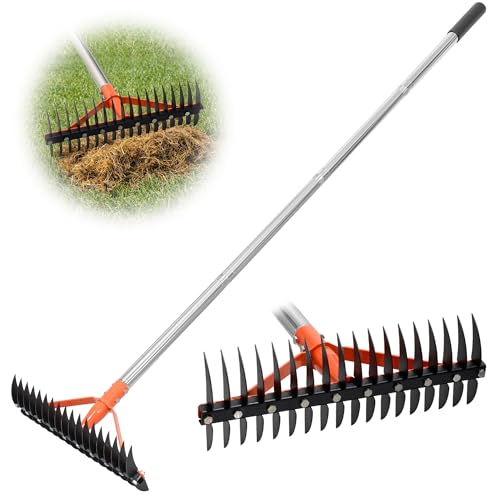
Tempered spring steel tines with a short side for surface debris and a long side for deep thatch.
Check price on AmazonWhy We Like It
- Long tine side reaches deep thatch
- Listing calls out use under Bermuda grass
- Tempered spring steel with anti-rust coating
- Rust-resistant 304 stainless steel screws
| Specification | Details |
|---|---|
| Head width | 15 inches, dual-sided |
| Tines | 18 tempered spring steel |
| Handle | Stainless steel, 34.5, 48.5 or 62.5 inches |
| Grip | Rubber |
| Listed weight | About 4.1 pounds |
CKLT 62inZCP thatch rake — compressed specs
Warm-season grasses like Bermuda and zoysia spread by stolons and can build up dense thatch quickly. CKLT’s listing speaks directly to that, with a long-tine side meant to reach deep thatch without snagging on roots and a short side for surface debris and loosening compacted soil. The tines are tempered spring steel, which should flex rather than bend permanently when they hit a root.
The maximum handle length is 62.5 inches, a little shorter than the Walensee or WORKPRO at 70 inches, so very tall users may bend slightly more. The listing’s technique tip, push forward without lifting and pull back to lift thatch, is the right motion for any thatch rake.
Pros
- Distinct short and long tine sides
- Flexible tempered spring steel
- Stainless hardware resists rust
Cons
- Max handle 62.5 inches
- 18 tines rather than 19
- Fixed head angle
Check CKLT 62.5 Inch price on Amazon
3. Colwelt Spring Tine Thatch Rake — Best Gentle Comb for Live Turf

Thin, round, curved spring steel tines that comb thatch out rather than stabbing into soil.
Check price on AmazonWhy We Like It
- Round spring tines glide like a comb
- Short pulling strokes, like raking leaves
- 61 inch length keeps you upright
- Doubles as a pine needle rake
| Specification | Details |
|---|---|
| Tines | Thin, round, curved spring steel |
| Overall length | 61 inches |
| Head width | Wide head; exact width not stated in listing |
| Construction | Thickened steel, anti-rust finish |
| Grip | Soft rubber |
Colwelt 0057S thatch rake — compressed specs
Flat-bladed thatch rakes dig in hard, which is great for heavy thatch but rough on a lawn you only need to freshen up. The Colwelt takes the opposite approach: thin, round spring steel tines that slip between grass blades and pull up loose thatch and debris with light strokes. It suits cool-season lawns in spring, when you want to lift winter debris and matted grass without tearing tender new growth.
It is a single-sided tool, so you do not get the soil-loosening side found on the Walensee, CKLT and BARAYSTUS, and the handle is not adjustable. For heavy, compacted thatch, one of the dual-sided rakes or a power rake will work faster.
Pros
- Gentle on healthy grass
- Easy, natural raking motion
- Useful for pine needles and leaves
Cons
- Single-sided head
- Fixed 61 inch length
- Slower on very heavy thatch
Check Colwelt Spring Tine price on Amazon
4. YEELOR 17-Inch Thatch Rake — Lightest Wide-Head Rake

Wide 17-inch head with 21 pairs of spring steel tines and a plastic body, about 2.5 pounds.
Check price on AmazonWhy We Like It
- Lightest listed weight among our picks
- 17 inch head, wider than the 15 inch norm
- Closely spaced hooked spring steel tines
- Dual-screw head connection
| Specification | Details |
|---|---|
| Head width | 17 inches |
| Tines | 21 pairs, manganese spring steel |
| Body | UV-resistant PP engineering plastic |
| Handle | Segmented stainless steel, up to 66 inches |
| Weight | About 2.5 pounds |
YEELOR YLUS1173 thatch rake — compressed specs
At roughly 2.5 pounds, the YEELOR weighs about half as much as the all-steel rakes here, which makes a real difference over a long session. The 17-inch head covers more ground per stroke, and the closely spaced hooked tines lift thatch, moss, leaves and pine needles with little downward pressure. It is a good match for lighter thatch, regular grooming and users who find heavy steel rakes tiring.
The trade-off is the plastic body. It is light and UV resistant, but it will not take the same abuse as a solid steel head on rocky ground or very compacted thatch, and there is no soil-loosening side.
Pros
- Very light to handle
- Wide 17 inch coverage
- Fine tines for grooming and moss
Cons
- Plastic body less rugged than steel
- Single-sided head
- Less bite on heavy thatch
Check YEELOR 17-Inch price on Amazon
5. JouZYA Rolling Thatch Rake — Best With Wheels

Thatch rake with rolling wheels and a head angle adjustable from 0 to 15 degrees.
Check price on AmazonWhy We Like It
- Wheels help it glide across the lawn
- Head angle adjusts from 0 to 15 degrees
- Double-sided teeth for thatch and soil
- Handle extends up to 68 inches
| Specification | Details |
|---|---|
| Head width | 15 inches, double-sided |
| Tines | 18 steel teeth |
| Wheels | Rolling wheels on head |
| Head angle | Adjustable 0 to 15 degrees |
| Handle | Stainless steel, about 38 to 68 inches |
JouZYA TCQ-M-L rolling thatch rake — compressed specs
This is the only rake among our picks with wheels on the head. The rollers let you push it back to the start of each stroke without lifting or dragging, which can reduce strain over a larger area. The adjustable angle lets you set the tines shallow for grooming or steeper for deeper raking.
Wheels add a little complexity and can roll over the thinnest thatch layers rather than biting in, so set the angle to suit the job. It is a good pick for users with back or shoulder strain who still want a manual tool.
Pros
- Rolling head reduces effort
- Adjustable tine angle
- Dual-sided teeth
Cons
- Weight not stated in listing
- Wheels add moving parts
- 18 tines rather than 19
Check JouZYA Rolling Rake price on Amazon
6. WORKPRO 15-Inch Thatch Rake — Best Telescoping Handle

15-inch thatch rake with a telescoping 40 to 70 inch handle and adjustable head angles.
Check price on AmazonWhy We Like It
- Telescoping handle from 40 to 70 inches
- Adjustable head angles
- Rubberized non-slip grip
- Detaches for storage and transport
| Specification | Details |
|---|---|
| Head width | 15 inches |
| Tines | Count not stated in listing |
| Handle | Telescoping, 40 to 70 inches |
| Head angle | Adjustable |
| Listed weight | About 4.1 pounds |
WORKPRO W153027A thatch rake — compressed specs
Sectional handles come in fixed steps; a telescoping handle lets you set any length between 40 and 70 inches. That is handy if more than one person in the house uses the rake, or if you switch between dethatching open lawn and working close around beds. WORKPRO also lists adjustable head angles, a feature shared with the JouZYA and BARAYSTUS.
The listing is thinner on detail than others, with no tine count or tine material beyond high-strength metal, so it is harder to compare directly on the head itself.
Pros
- Infinitely adjustable handle length
- Adjustable head angle
- Comfortable rubber grip
Cons
- Tine count and material not listed
- Telescoping lock must be kept tight
- No dual-sided head stated
Check WORKPRO 15-Inch price on Amazon
7. BARAYSTUS 15-Inch Dual-Side Rake — Best Adjustable Head Angle

Dual-sided rake with 19 heat-treated carbon steel tines and a head angle that adjusts on both sides.
Check price on AmazonWhy We Like It
- Head angle adjusts on both sides
- Heat-treated carbon steel tines
- Tool-free assembly per listing
- Also spreads seed and levels topdressing
| Specification | Details |
|---|---|
| Head width | 15 inches, dual-sided |
| Tines | 19 curved heat-treated carbon steel |
| Handle | 3-section stainless steel, up to 58.5 inches |
| Finish | Anti-rust powder coating |
| Listed weight | 3.3 pounds |
BARAYSTUS JDUS1145 thatch rake — compressed specs
Being able to tilt the head lets you match the tines to your posture and the job, which reduces wrist strain over a long session. The BARAYSTUS adds that adjustment to the familiar 15-inch, 19-tine dual-sided format, and at 3.3 pounds listed it is lighter than most all-steel options here. The second side loosens and levels soil, which is useful when you are dethatching to overseed.
Its handle tops out around 58.5 inches, the shortest maximum among our picks that list one, so it is better suited to average-height users or close work.
Pros
- Adjustable head angle
- Lighter all-steel head
- Dual-sided for thatch and soil
Cons
- Shorter max handle length
- Sectional joints need checking
- Not ideal for very tall users
Check BARAYSTUS 15-Inch price on Amazon
What to Look for in a Dethatching Rake
Manual rake vs electric dethatcher
| Factor | Manual thatch rake | Electric dethatcher or power rake |
|---|---|---|
| Best lawn size | Small to medium lawns, spot repairs | Medium to large lawns |
| Thatch level | Light to moderate | Moderate to heavy |
| Effort | High; physical work | Low to moderate |
| Control | Very precise around beds and edges | Faster but less precise |
| Storage | Breaks down small | Takes floor space; rentals avoid this |
If you are deciding between tools, our explainer on scarifier vs dethatcher breaks down the machines, and how to power rake a lawn covers using a rental.
Tines
Flat, curved steel tines bite hard and pull heavy thatch; thin, round spring tines comb gently. Hardened or tempered steel resists bending. Most rakes on this shelf have 18 or 19 tines on a 15-inch head.
Dual-sided heads
A second side with straighter blades loosens soil and roughs up bare spots for overseeding, saving you a separate tool.
Handle length and weight
Taller users should look for handles that reach 66 to 70 inches. Lighter rakes, around 2.5 to 3.5 pounds, are easier over a long session; heavier all-steel rakes dig in with less downward pressure.
When and How to Dethatch
Check thatch by cutting a small wedge of turf; if the spongy brown layer between the soil and green blades is more than about half an inch, it is time. Dethatch cool-season lawns such as fescue, bluegrass and ryegrass in early fall or early spring, and warm-season lawns such as Bermuda, zoysia and St. Augustine in late spring to early summer when they are actively growing. Mow a little lower than usual first, rake in two directions, collect the debris, then water and overseed thin spots. Our full guide on how to dethatch a lawn walks through each step, and dethatching vs aerating explains when compaction, not thatch, is the real problem. For the full seasonal routine, see our lawn care guide, and for more yard and garden projects, visit the vegetable gardening hub.
Frequently Asked Questions
Do dethatching rakes really work?
Yes, for light to moderate thatch on small and medium lawns. They lift dead grass and debris so air, water and fertilizer reach the soil. Heavy thatch over a large area is faster with a power rake.
When should I use a thatch rake?
Use it when thatch is thicker than about half an inch: early fall or early spring for cool-season grass, late spring to early summer for warm-season grass. Avoid dethatching dormant or drought-stressed lawns.
Will a dethatching rake damage my lawn?
It will pull some live grass and make the lawn look rough for a week or two, which is normal. Healthy, actively growing grass recovers quickly, especially if you water and overseed afterward.
What is the difference between a thatch rake and a leaf rake?
A thatch rake has stiff, sharp, curved steel tines that dig into the thatch layer. A leaf rake has flexible tines that sweep the surface and will not remove embedded thatch.
How often should I dethatch?
Most lawns need it only every year or two, when thatch exceeds about half an inch. Fast-spreading warm-season grasses may need it more often than bunch-type cool-season grasses.