

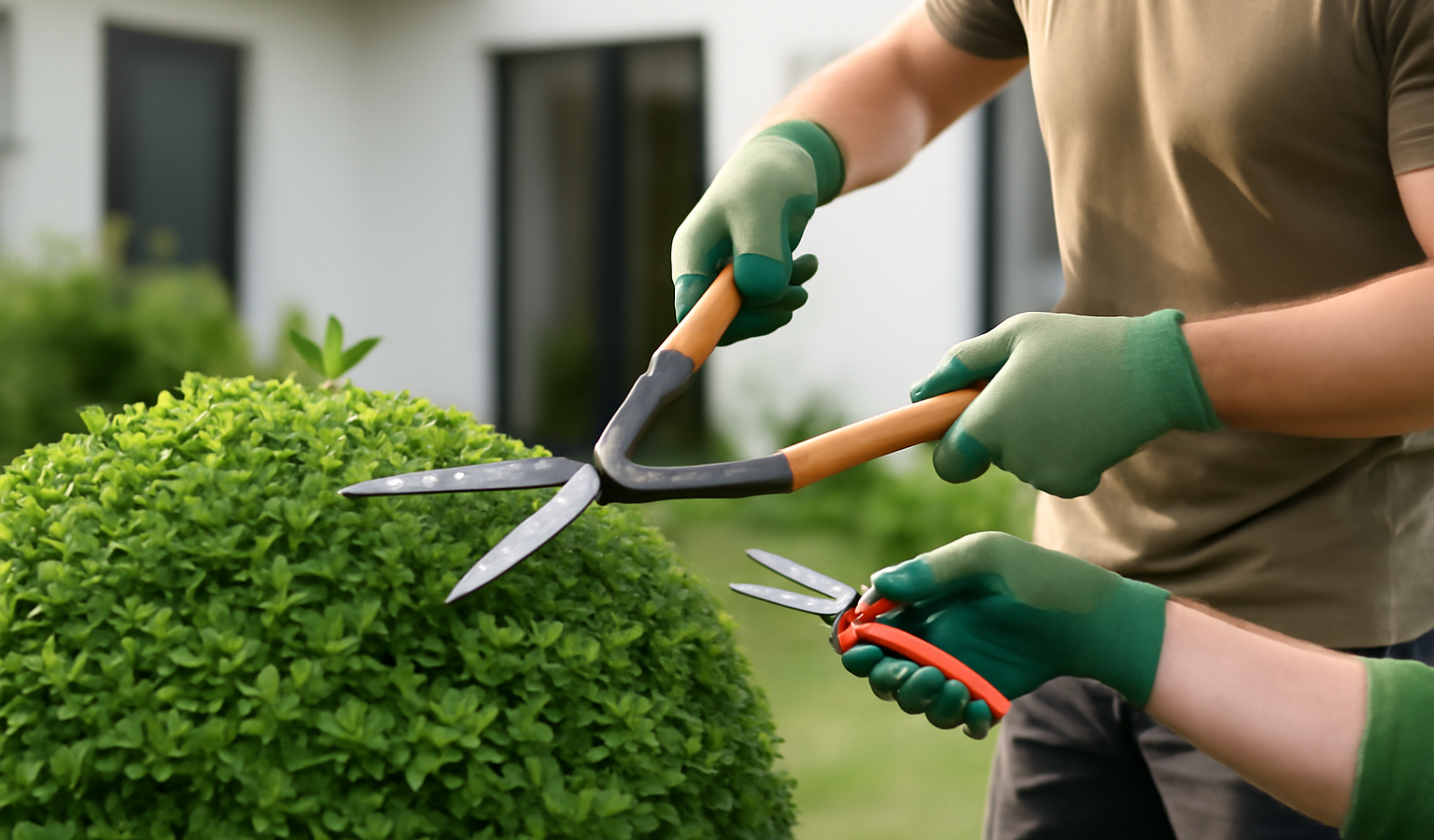
Here is the short answer before you pick up a tool: pruning is the selective cutting of individual branches back to a bud, node, or branch junction to shape a plant’s structure and improve its health, while shearing is the non-selective cutting of the outer surface of a plant to a uniform shape. Pruning asks you to look at each stem and decide where the cut belongs. Shearing ignores individual stems entirely and clips everything at the same plane, the way a barber runs clippers across a flat-top haircut. Both have a place in the garden, but they are not interchangeable, and using the wrong one is the single most common reason a shrub ends up dense on the outside, hollow in the middle, and flowering poorly.
The reason the distinction matters comes down to how plants respond to a cut. When you shear, you slice across dozens of stems at once, and each cut tip responds by pushing several new shoots right behind the cut. Repeat that a few times and you build a thick green wall of twiggy growth on the surface. That outer shell shades the inside of the plant, the interior leaves give up and drop, and you are left with a hollow, leggy shrub that cannot be cut back hard without exposing bare brown sticks. Pruning, by contrast, opens the plant up. Removing whole branches at their origin lets light and air reach the interior, which keeps the inside leafy, reduces disease, and preserves the plant’s natural form.
So which does your shrub need? In most home landscapes, the honest answer is that the majority of shrubs want pruning, not shearing. Shearing is reserved for a narrow set of jobs: formal hedges, topiary, and a few tight evergreens grown specifically for crisp geometric lines. If you are not deliberately growing a clipped hedge or a piece of living sculpture, you almost certainly want to prune. This guide walks through the difference, the tools, the timing by bloom season, and a simple decision rule you can apply to any plant in your yard.
Key Takeaways
- Pruning is selective — you cut individual branches back to a bud, node, or junction to guide structure and health.
- Shearing is non-selective — you clip the outer surface to a uniform shape, used mainly for formal hedges and topiary.
- Shearing builds a dense outer shell that shades out the interior, leaving the inside bare and leggy over time.
- Formal hedge or topiary? Shear it. Specimen, flowering, or informal shrub? Prune it.
- Prune spring bloomers right after they flower; prune summer bloomers in late winter or early spring before growth starts.
- Shear formal hedges with a slight batter — wider at the base — so light reaches the bottom and the hedge stays full to the ground.
| Feature | Pruning | Shearing |
|---|---|---|
| Cut type | Selective — individual branches cut to a bud, node, or junction | Non-selective — outer surface clipped to a uniform plane |
| Tools | Bypass pruners, loppers, hand saw | Manual hedge shears or electric/cordless hedge trimmer |
| Goal | Shape structure, improve health, control size while keeping natural form | Create and maintain a crisp, uniform geometric surface |
| Effect on interior | Opens the plant; light and air reach the center, interior stays leafy | Builds a dense outer shell that shades the interior bare and leggy |
| Best plants | Flowering shrubs, roses, hydrangeas, fruit trees, most informal shrubs | Formal hedges, boxwood, privet, yew, topiary |
| Timing | Tied to bloom season; dormant season for many shrubs | 2–3 times across the growing season for fast hedges |
| Skill level | Higher — you decide each cut | Lower to maintain shape, but easy to do lasting harm |
Pruning: the selective cut
Pruning is a decision made one branch at a time. You look at the plant, identify a stem that needs to go or needs to be shortened, and you place a deliberate cut. There are two basic moves. A thinning cut removes an entire branch back to its point of origin — to the main stem, to a larger branch, or all the way to the ground. Thinning reduces density without stimulating a flush of regrowth, and it is the cut that keeps a shrub open and natural. A heading cut shortens a branch back to a bud or side shoot; it stimulates the buds just below the cut to grow, making the plant bushier near that point. Good pruning leans heavily on thinning cuts and uses heading cuts sparingly and with purpose.
When you do make a heading cut, place it about a quarter inch above an outward-facing bud, sloping the cut at a slight angle away from the bud. The outward-facing bud sends the new shoot away from the center of the plant rather than into it, which keeps the interior open. Cut too far above the bud and you leave a stub that dies back and invites rot; cut too close or into the bud and you damage the growth you wanted to keep. A clean, slightly angled cut just above the bud sheds water and heals fast.
Before any shaping, work through the three D’s: remove anything dead, diseased, or damaged. These cuts can be made in any season and almost always improve the plant. Next, take out branches that cross and rub against each other, since the wounds they create are open doors for disease. Only after the plant is clean do you start shaping for size and form. Use bypass pruners — the kind with two blades that slide past each other like scissors — for stems up to about half an inch; loppers for branches up to roughly an inch and a half; and a pruning saw for anything thicker. Anvil pruners crush stems and are best left for deadwood.
For old, overgrown, twiggy shrubs, the cure is renewal pruning. Each year, cut about one-third of the oldest, thickest stems all the way down to the base. Over three years you completely replace the shrub’s framework with younger, more vigorous wood, and you do it without ever leaving the plant looking butchered. This gradual approach works beautifully on lilac, forsythia, spirea, weigela, dogwood, and most multi-stemmed deciduous shrubs. Roses, hydrangeas, fruit trees, and the great majority of informal flowering shrubs all want pruning rather than shearing — they are grown for their flowers, fruit, and graceful habit, none of which survive a hedge trimmer.
Shearing: the surface cut
Shearing has exactly one job: producing and maintaining a crisp, uniform surface. It is the right tool for formal hedges, clipped boxwood, privet, yew, and topiary — plants you deliberately grow as architecture rather than as individuals. With hedge shears or an electric trimmer, you run the blade across the surface and clip every stem it touches to the same plane. The result is the smooth green wall or geometric form that formal design depends on. Plants that take well to shearing share a trait: they have small leaves and dense, twiggy growth, and they reliably bud out from older wood, so they recover quickly from repeated cuts.
The downside is real and worth understanding before you commit a plant to it. Every shearing cut triggers a burst of new shoots right at the surface, so the outer few inches grow steadily denser. That dense shell shades the interior, the inner leaves die from lack of light, and the plant becomes hollow — green only on the outside, brown sticks within. Once a sheared shrub is hollow, you cannot cut it back hard to reduce its size, because there is no living foliage inside to regrow. This is why a sheared hedge tends to creep larger every year: each pass has to start just outside the previous one.
You fight this two ways. First, shear with a slight batter — keep the hedge wider at the base than at the top, sloping the sides inward as they rise. A battered hedge lets sunlight reach the bottom, so it stays full all the way to the ground instead of going bare and bony at the base. A hedge sheared straight up and down, or worse, wider at the top, shades its own lower half into decline. Second, shear at the right frequency. A fast-growing hedge such as privet needs clipping two to three times across the growing season — typically once in late spring, again in midsummer, and a light touch-up in early fall — to hold a clean line. Slower plants like boxwood and yew may need only one or two passes a year.
Timing: cut on the plant’s schedule
Timing matters most for flowering shrubs, because cutting at the wrong moment removes the very buds that would have become flowers. The rule turns on when a shrub sets its flower buds. Spring bloomers — forsythia, lilac, azalea, rhododendron, weigela, and most early-flowering shrubs — form their buds on old wood the previous summer and fall. Prune them right after they finish flowering, usually within a few weeks of the blooms fading. That gives the plant the rest of the season to grow and set next year’s buds. Prune them in winter and you cut off the entire spring show.
Summer bloomers — panicle hydrangea (Hydrangea paniculata), smooth hydrangea, butterfly bush, and roses — flower on new wood that grows the same season. Prune these in late winter or early spring, before new growth begins, while the plant is still dormant. They will push fresh shoots and bloom on that new growth. A useful shorthand: if it blooms before about mid-June, prune just after flowering; if it blooms after, prune in late winter. When you are unsure which type you have, prune right after the flowers fade and you will rarely go wrong.
One timing rule applies to both pruning and shearing: avoid cutting right before a hard frost. Late-summer and early-fall cuts push tender new growth that has no time to harden off before cold weather, and that soft growth gets damaged or killed by the first freeze. Stop shearing hedges by late summer in cold-winter regions so the new growth firms up before frost arrives.
Which does YOUR shrub need?
Strip away the detail and the decision comes down to one question: are you growing this plant as a piece of formal geometry, or as itself? If you want a clipped hedge, a boxwood ball, a privet wall, or a topiary spiral — a deliberate, uniform shape — then shear it, and commit to keeping up the schedule and the batter. If you are growing a flowering shrub, a specimen plant, or any informal shrub for its natural form, its blooms, or its fruit, then prune it. Reach for bypass pruners and loppers, work the three D’s first, thin to open the interior, and time your cuts to the bloom season.
The trap most people fall into is shearing plants that should be pruned — running a trimmer over a hydrangea, a spirea, or a viburnum because it is faster than thinking through individual cuts. It works for a season or two, then the shrub turns into a dense, hollow lollipop that flowers poorly and cannot be brought back without cutting it to the ground. If you have inherited a shrub in that state, switch to renewal pruning: remove a third of the oldest stems at the base each year and stop shearing, and within three seasons you will have a healthy, open plant again. The same logic governs many garden choices between a quick surface fix and a deliberate cut — see our guide to deadheading vs cutting back for the parallel decision on perennials.
The verdict
Pruning and shearing are not competing techniques; they are tools for two different goals. Shearing maintains formal shapes on a small group of small-leaved, densely budding plants, and it does that one job well as long as you batter the sides and keep to a schedule. Pruning does everything else — and “everything else” covers the vast majority of shrubs in a typical yard. For nearly any flowering or specimen shrub, selective pruning gives you a healthier, longer-lived, better-blooming plant than a hedge trimmer ever will. Match the cut to the plant’s purpose, time it to its bloom season, and your shrubs will reward you for years. For more on building and maintaining a healthy planted landscape, browse our outdoor living hub, and if hedges are your focus, our boxwood care guide covers shearing those formal evergreens in detail.
Frequently Asked Questions
Is shearing bad for shrubs?
Shearing is not inherently bad — it is essential for formal hedges and topiary. It becomes a problem when used on plants meant to grow naturally, because repeated surface cuts build a dense outer shell that shades the interior bare and leggy. Use shearing only on formal hedges, boxwood, privet, yew, and topiary; prune everything else.
Can I shear my hydrangea to keep it small?
No. Shearing a hydrangea removes flower buds and creates a dense, hollow shape that blooms poorly. To control size, prune selectively instead — for panicle and smooth hydrangeas, cut back in late winter; for bigleaf types that bloom on old wood, prune right after flowering and thin out the oldest stems.
Why is the inside of my hedge brown and bare?
That hollow interior is the classic result of years of shearing without a batter. The dense outer surface shades the inside until interior leaves die. Fix it by shearing the sides wider at the base than the top so light reaches the bottom, and on plants that bud from old wood, cut back hard in stages to force new interior growth.
What is the difference between a thinning cut and a heading cut?
A thinning cut removes an entire branch back to its origin, reducing density while keeping the plant open and natural. A heading cut shortens a branch back to a bud, stimulating bushy regrowth just below the cut. Good pruning relies mostly on thinning cuts and uses heading cuts sparingly and deliberately.
When should I prune spring-flowering shrubs like lilac and forsythia?
Prune spring bloomers right after they finish flowering, within a few weeks of the blooms fading. They set next year’s flower buds on old wood over the summer, so pruning in winter would remove the entire spring display. Summer bloomers that flower on new wood are pruned in late winter instead.