

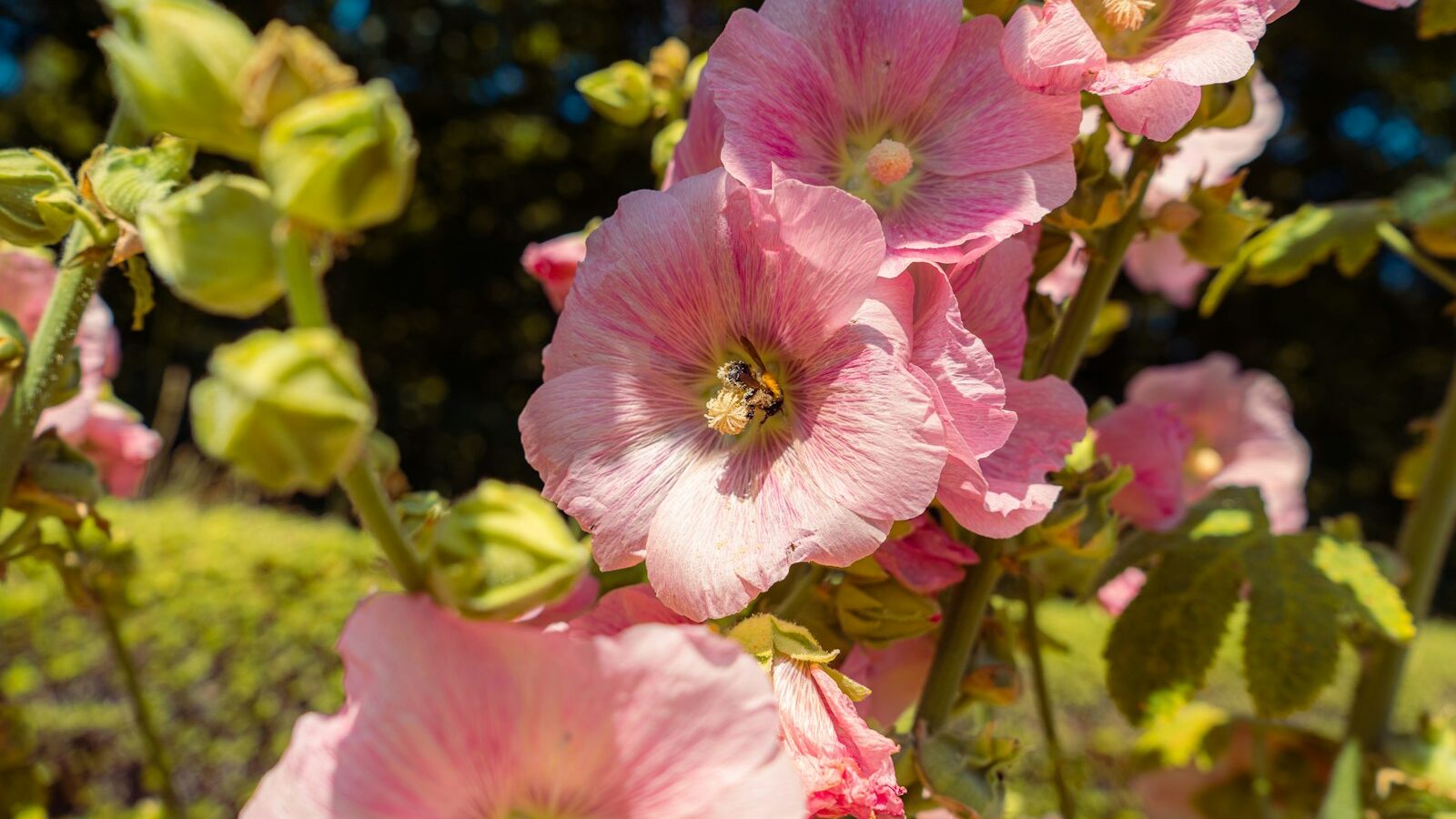
Few flowers say “cottage garden” quite like the hollyhock. These towering biennials send up spires of papery, saucer-shaped blooms that can reach 8 feet tall, nodding over fences and doorways in shades of pink, crimson, white, yellow, and an almost-black burgundy. They are easy to grow from seed, beloved by bees, and once you have them in the garden they tend to stick around by self-sowing year after year.
Hollyhock quick facts
- Tall biennial/short-lived perennial (up to 8 ft)
- Full sun; plant against a wall/fence for support
- Self-seeds readily once established
- Water at the base — rust is the big issue
- Pollinator favorite
As an Amazon Associate we earn from qualifying purchases.
Hollyhocks (Alcea rosea) belong to the mallow family, the same group that gives us hibiscus and okra, and you can see the family resemblance in their broad, open flowers. They are a classic “vertical accent” plant — best used at the back of a border or along a wall, where their height adds drama without shading out smaller plants. If you love this kind of tall, romantic flower, they pair beautifully with other cottage-garden uprights like how to grow foxgloves. For the full picture on growing ornamentals, see our pillar plant & flower care guide.
Understanding the biennial cycle
The single most important thing to understand about hollyhocks is that most are biennials — they live for two years and have a distinct two-stage life cycle. Getting this right saves a lot of confusion about why a plant “isn’t blooming.”
- Year one: The seed germinates and grows a low rosette of large, rounded leaves. It puts all its energy into roots and foliage and usually does not flower.
- Year two: The plant bolts upward, sending up its tall flower spire, blooms through summer, sets seed, and then typically dies.
Some varieties are sold as short-lived perennials and may flower the first year if started early indoors, and a few will linger for three or four years. But the practical takeaway is this: to have hollyhocks in bloom every single year, sow seed two years running. Once you have done that, self-seeding usually keeps the cycle going on its own — you will find new rosettes popping up around the parent plants each spring.
Choosing a site: sun, soil, and a wall to lean on
Light and soil
Hollyhocks want full sun — at least six hours of direct light a day, and more is better. In too much shade they grow leggy, flower poorly, and become far more prone to disease. The soil should be rich and well-drained. Hollyhocks are hungry plants thanks to their size, so dig in plenty of compost or well-rotted manure before planting. They tolerate a range of soil types but dislike sitting in soggy ground over winter, which can rot the crown.
Plant against a wall or fence
There is a reason you so often see hollyhocks growing right up against the side of a house or along a fence. A solid structure behind them provides natural shelter from wind — which can snap or flatten those tall spires — and gives you something to tie the stems to for support. A warm, sunny, south- or west-facing wall is the classic hollyhock spot. Position plants 18 to 24 inches apart so air can circulate freely, which is your first line of defense against rust (more on that below).
Sowing and planting hollyhocks
Hollyhocks are most often grown from seed, which is inexpensive and germinates readily. You can find a wide range of colors and heights in hollyhock seeds online, from old-fashioned singles to ruffled doubles.
When and how to sow
- Direct sowing: Sow outdoors in late spring or early summer where the plants are to grow. Press the large, flat seeds just under the surface — they germinate best with a little light and warmth.
- Starting indoors: Start seed 6 to 8 weeks before your last frost if you want a head start; some plants will then bloom in their first year.
- Transplanting: Hollyhocks form a deep taproot and resent root disturbance, so transplant while young and handle the rootball gently.
- Spacing: Final spacing of 18 to 24 inches keeps air moving between plants.
Seedlings sown in summer will form rosettes by fall, overwinter, and flower the following summer — the natural biennial rhythm. In mild climates you can also sow in early fall.
Staking, watering, and feeding
Staking the tall spires
At 6 to 8 feet, hollyhocks almost always need support, especially in exposed gardens or after heavy rain that weighs the flowers down. Set a sturdy stake or cane beside each spire as it grows and tie the stem loosely at intervals with soft twine, leaving a little slack so the stem can flex without snapping. A good set of plant stakes makes this easy. Plants grown right against a wall or fence can often simply be tied to a screw eye or trellis instead.
Watering at the base
Water hollyhocks deeply and regularly during their first season and through dry spells, aiming for consistently moist (not waterlogged) soil. The golden rule: always water at the base of the plant, never over the leaves. Wet foliage is exactly what rust spores need to take hold, so keeping the leaves dry — ideally watering in the morning so any splashes dry quickly — dramatically reduces disease pressure. A layer of mulch around the base conserves moisture and keeps soil from splashing up onto the lower leaves.
Feeding
Because they grow so large, hollyhocks appreciate rich soil and a feed. Work compost in at planting and give an all-purpose granular feed in spring as growth resumes. Avoid pushing them with heavy high-nitrogen fertilizer, which produces soft, sappy growth that is more susceptible to rust.
Managing hollyhock rust — the classic problem
If you grow hollyhocks, you will eventually meet hollyhock rust (Puccinia malvacearum), the disease that defines the plant. It shows up as bright orange-yellow pustules on the undersides of leaves, with corresponding yellow spots on the upper surface. Badly affected leaves brown, shrivel, and drop. Rust rarely kills a hollyhock outright, but it disfigures the foliage and weakens the plant. It is so common that many gardeners simply accept a bit of it and focus on keeping the worst at bay.
How to manage rust
- Space and airflow: Wide spacing and a sunny, open position help leaves dry quickly and slow the spread.
- Water at the base: As above — dry foliage is the single best preventive measure.
- Remove infected leaves: Pick off and bin (do not compost) the lower, spotted leaves as soon as you see them. Removing the bottom foliage entirely on tall plants is a common tactic since it hides behind upper growth and flowers.
- Clean up in fall: Cut down and dispose of all old stems and leaves at the end of the season so spores cannot overwinter in the debris.
- Treat if needed: In severe cases a fungicide for rust applied early and repeated through the season can keep new growth cleaner. Always follow the label.
- Start fresh: Because rust persists in the soil and on self-sown seedlings, some gardeners treat hollyhocks as a short-term crop and raise new, clean plants from seed in a fresh spot every couple of years.
Deadheading, self-seeding, and pollinators
Deadheading
Removing faded flowers as they go over keeps the spire looking tidy and can coax a longer display. However, there is a trade-off: if you deadhead everything, you prevent the plant from setting the seed it needs to self-sow. Many gardeners deadhead the spent lower flowers for appearance but leave the topmost seed pods to ripen and scatter. The flat, coin-shaped seeds are easy to collect from the dry pods if you would rather sow them yourself or share them.
Self-seeding
Left to their own devices, hollyhocks self-seed enthusiastically. This is how a single planting becomes a permanent fixture: each year’s plants drop seed that germinates nearby, so even though individual plants are short-lived, the colony keeps renewing itself. Simply thin or transplant the seedlings to where you want them in spring.
Attracting pollinators
Hollyhocks are a genuine pollinator magnet. Their large, open flowers offer easy access to abundant pollen and nectar, drawing bumblebees, honeybees, and other beneficial insects all summer; you will often see a bee emerge dusted yellow from head to toe. Single-flowered varieties are far better for wildlife than the ruffled doubles, whose extra petals get in the way. They are a natural fit for a wildlife planting — see our roundup of the best plants for pollinators for companions. The tall spires also make striking, if short-lived, additions to a vase, so they earn a place among the best cut flowers to grow.
Toxicity and skin-irritation note
Hollyhocks are generally considered non-toxic and even have a long history of use in herbal teas, and the flowers are technically edible. However, the plant’s fine hairs and leaves can cause contact dermatitis — an itchy skin rash — in sensitive people, much like its mallow relatives. It is a good idea to wear gloves and long sleeves when handling, staking, or cutting back hollyhocks, particularly if you have sensitive skin. Keep handling of any plant material sensible around curious children and pets even when a plant is low-toxicity.
Frequently asked questions
Why didn’t my hollyhocks flower this year?
Most hollyhocks are biennials. In their first year they only form a leafy rosette and won’t bloom until their second summer. If you planted from seed this spring, be patient — flowers should arrive next year, and self-sown seedlings will keep the cycle going after that.
Are hollyhocks perennials or annuals?
Most are biennials, living two years: leaves the first year, flowers the second, then setting seed and dying. Some varieties behave as short-lived perennials for three or four years, and a few bloom the first year if started early indoors. Because they self-seed so freely, an established planting acts almost perennial.
How do I get rid of hollyhock rust?
You can’t eliminate it entirely, but you can manage it: water only at the base to keep leaves dry, space plants for good airflow, remove and bin infected lower leaves promptly, clear away all debris in fall, and use a rust fungicide in bad cases. Raising fresh seedlings in a new spot every couple of years also helps.
Do hollyhocks need staking?
Usually yes. At 6 to 8 feet tall they are easily flattened by wind or heavy rain. Tie each spire loosely to a sturdy stake, or grow them against a wall or fence and tie them to a trellis or screw eye for built-in support.
Are hollyhocks poisonous?
Hollyhocks are considered largely non-toxic and the flowers are even edible, but the plant’s hairs and foliage can cause an itchy skin rash (contact dermatitis) in some people. Wear gloves and long sleeves when handling them, and keep sensible boundaries around children and pets.