

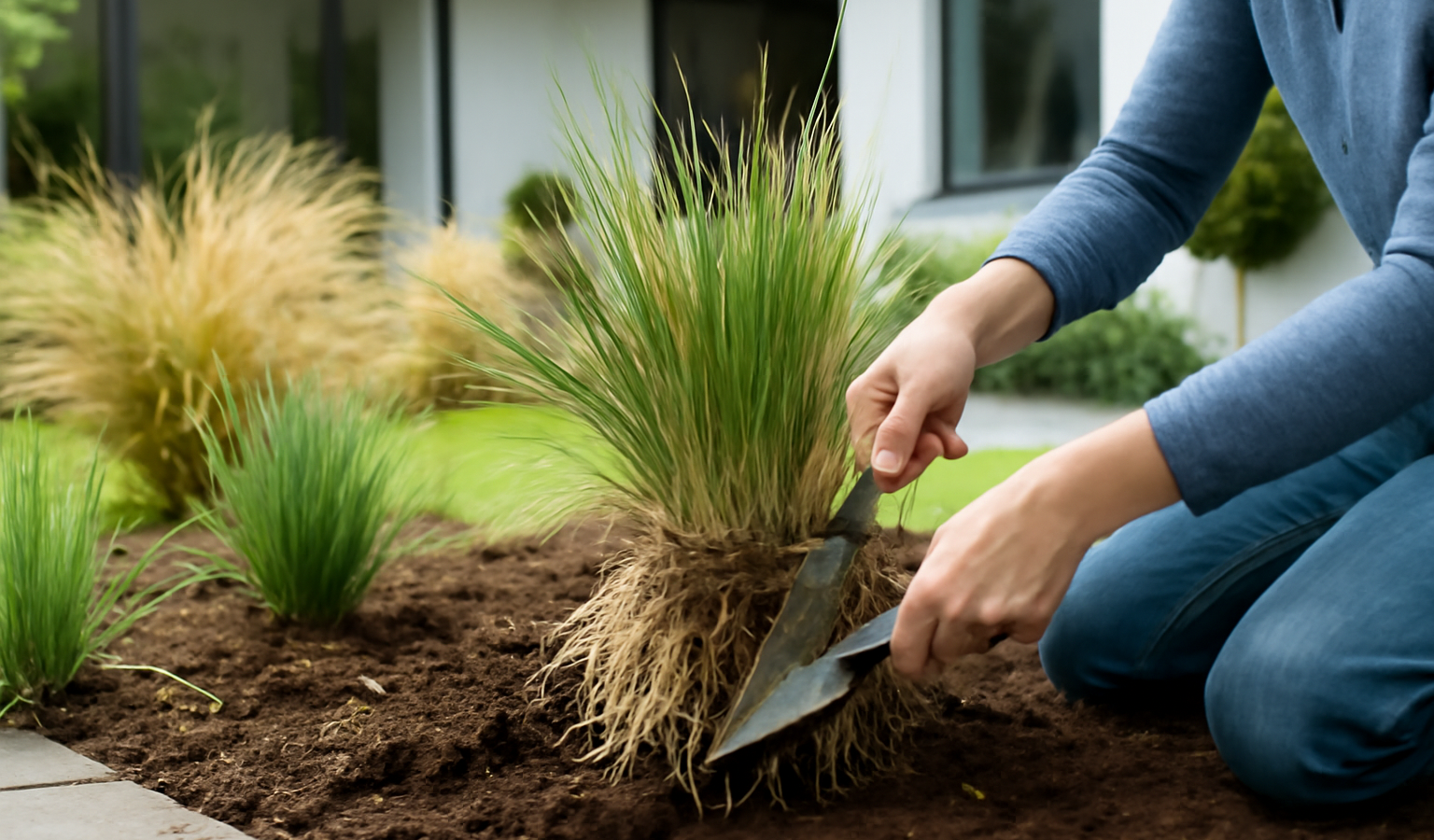
Ornamental grasses are some of the most forgiving plants in the garden, but they do not stay tidy forever. Give a clump of miscanthus or switchgrass a few good seasons and it will reward you with a fountain of foliage and feathery plumes. Give it a few more, and that same clump starts thinning out in the middle, flopping over at the edges, and crowding everything around it. The fix is almost always the same: dig it up and split it apart. Learning how to divide ornamental grasses correctly is the single most useful skill for keeping these plants vigorous, well-shaped, and productive for decades rather than years.
Dividing is not complicated, but the two things people get wrong are timing and force. Cut into a warm-season grass in the wrong month and you can set it back a full year or kill it outright. Try to slice through a mature miscanthus root ball with a flimsy trowel and you will be there until dark, swearing. This guide walks through exactly when to divide each major type of grass, how to recognize when a clump is asking to be split, and the practical, dirt-under-the-fingernails technique that gets the job done without wrecking your back or your plant. Everything here assumes you want strong divisions that establish fast, not sad little tufts that limp through their first season.
Key Takeaways
- Divide warm-season grasses (miscanthus, switchgrass, fountain grass, big bluestem) in spring as new growth begins, after cutting old foliage back.
- Divide cool-season grasses (blue fescue, feather reed grass, tufted hair grass) in early spring or early fall, never in midsummer heat.
- The classic signal is a dead, hollow center surrounded by a living ring, the “donut” look, plus flopping and reduced vigor, usually every three to four years.
- Cut foliage back to four to six inches first, dig the whole root ball, discard the dead center, and split into fist-sized or larger sections with healthy roots and shoots.
- Replant at the same depth right away, water deeply, mulch, wear gloves, and keep divisions moist until established.
Why Ornamental Grasses Need Dividing
Most clumping ornamental grasses grow outward from the center, year after year. New shoots and roots form around the perimeter while the oldest growth, in the middle, slowly dies out. Eventually you end up with a ring of living grass surrounding a patch of dead, woody, hollow material. Gardeners call this the donut, and once you have seen it you will spot it everywhere. The dead center cannot photosynthesize, cannot send up new plumes, and contributes nothing except a place for water to pool and rot to start.
Beyond the donut, an overgrown clump simply runs out of room. The crowded center stems compete with each other for light and nutrients, so individual blades get weaker and thinner. That is why an old clump tends to flop open in the middle after rain or wind, splaying outward like a flower vase that has been knocked sideways. Dividing solves all of this at once. You remove the dead material, relieve the crowding, and reset the plant to a vigorous young state. As a bonus, every division you take is a free new plant. One mature miscanthus can easily yield four to eight strong starts.
Signs a Clump Is Ready
You do not need to divide on a fixed schedule, but watching for these signs will tell you when the time has come. Most vigorous species want dividing every three to four years; slower growers can go five or more.
- Dead or hollow center: the unmistakable donut, with living grass forming a ring around a bald or rotted middle.
- Flopping and splaying: the clump opens up from the center and the outer blades lean outward instead of standing upright.
- Reduced vigor: fewer flower plumes, shorter blades, paler color, and slower spring green-up than in past years.
- Outgrowing its space: the grass has swallowed its neighbors, blocked a path, or simply gotten wider than you ever intended.
- Weak emergence: in spring, growth comes up unevenly, with gaps where the old center used to be productive.
Timing: When to Divide Ornamental Grasses
Timing is the part most people botch, and it matters more here than with almost any other perennial. The rule comes down to one question: is your grass a warm-season grass or a cool-season grass? They have opposite growth rhythms, so they want to be divided at different times. Get this wrong and even a perfect technique will not save the plant. Get it right and the divisions barely notice they have been moved.
Warm-Season Grasses: Divide in Spring
Warm-season grasses do their growing in the heat of summer and go dormant once cold weather arrives. This group includes the big garden workhorses: miscanthus (maiden grass, silver grass), panicum (switchgrass), pennisetum (fountain grass), and andropogon (big bluestem), along with little bluestem and prairie dropseed. They wake up late in spring and put on most of their bulk from June through September.
Divide these in spring, right as new green growth begins to push up from the base. The window opens after the soil has started to warm and you can clearly see the new shoots, usually anywhere from a few inches of fresh growth onward. The first job is to cut last year’s dead foliage back to the ground; old miscanthus stalks are tough and tan, and clearing them gives you a clean view of the crown and somewhere to grip. Spring division gives a warm-season grass the entire long growing season ahead to rebuild its roots before winter, which is exactly what it needs. Avoid dividing these in fall: a freshly split warm-season grass heading into dormancy has no time to establish and is far more likely to heave out of the ground or rot over winter.
Cool-Season Grasses: Early Spring or Early Fall
Cool-season grasses do most of their growing in the cooler shoulders of the year, spring and fall, and tend to slow down or even sulk in the peak of summer heat. This group includes festuca (blue fescue), calamagrostis (feather reed grass, including the popular ‘Karl Foerster’), deschampsia (tufted hair grass), and helictotrichon (blue oat grass). They green up early, often staying semi-evergreen in mild zones, and many flower in late spring or early summer.
Divide these in early spring or early fall, while temperatures are mild and the plant is actively rooting. Early spring, just as growth resumes, is ideal in most regions. Early fall works well too, giving roots six to eight weeks to settle before hard frost, and is often the better choice in hot southern climates where spring slides quickly into brutal heat. The one time to avoid is the middle of summer. Dividing a cool-season grass during a July heat wave stresses an already-stressed plant; the divisions struggle to make new roots in dry, baking soil and frequently fail. If you have a feather reed grass that needs splitting and it is mid-August, just wait a month.
If you are in the habit of cutting things down on a seasonal rhythm, the same logic that drives how to cut back perennials in fall applies to deciding when grasses can be touched: work with the plant’s dormancy, not against it. Your USDA hardiness zone shifts these windows by a few weeks. Gardeners in zones 8 and 9 can divide cool-season grasses well into fall; those in zones 4 and 5 should finish fall division by early September so roots establish before the ground freezes.
Tools and Preparation
Mature ornamental grasses build dense, fibrous, surprisingly hard root masses. A switchgrass or miscanthus clump that has been in the ground five years can be as tough as a tree stump, and ordinary garden tools will bounce right off it. Match your tools to the size of the job before you start so you are not improvising halfway through.
- Sharp spade: your primary tool for digging the root ball and slicing through small to medium clumps. A flat, sharp-edged digging spade beats a rounded shovel here.
- Soil knife (hori-hori): excellent for cutting medium clumps and trimming divisions into clean sections.
- Two garden forks, back-to-back: the classic low-damage method. Drive both forks into the center of a clump and lever the handles apart to pry it in two without slicing roots to ribbons.
- Pruning saw or old handsaw: the most reliable way to cut through a dense, woody crown on a large clump.
- Axe or hatchet: for genuinely tough, woody centers, a few clean chops do what a spade cannot.
- Chainsaw or reciprocating saw: reserved for huge, long-established miscanthus that defeats everything else. Yes, gardeners really do this, and it works.
Always wear stout gloves. The blades of many ornamental grasses, miscanthus especially, have fine serrated edges that will slice your hands and forearms like paper cuts. Long sleeves are not a bad idea either. Have your replanting holes roughly prepared and a hose or watering can ready before you dig, because grass divisions dry out fast once their roots are exposed to air and sun.
How to Divide Ornamental Grasses Step by Step
Once the timing is right and your tools are ready, the actual process is straightforward. Work on a cool, overcast day if you can, and try to get divisions back in the ground the same day. The whole sequence, from first cut to final watering, is below.
Step 1: Cut the Foliage Back
Before you touch a spade, cut the entire clump down to four to six inches above the crown. For warm-season grasses being divided in spring, you are removing last year’s dead stalks; for cool-season grasses you are trimming living foliage. Either way, cutting back does three things: it gives you a clear, unobstructed view of the crown, it removes the top-heavy foliage that would otherwise flop in your face and stress the roots, and it makes the clump far easier to handle and lift. Use hand pruners, hedge shears, or a string trimmer for big jobs. Bundle tall grasses with twine first so they come off in one tidy bunch.
Step 2: Dig the Entire Root Ball
Drive your sharp spade straight down all the way around the clump, a few inches outside the visible crown, cutting a clean circle. Then lever from several points to pop the whole root ball free and lift it out of the ground. For a big grass this is heavy work, so loosen it fully on all sides before trying to heave it up. If the clump is too large to lift, that is fine, you can divide it in place. The goal is to get the root mass either out of the hole or at least loose enough to work on.
Step 3: Discard the Dead Center
Knock or hose off enough soil to see the structure of the crown. On an older clump you will find that telltale dead, woody, often hollow center surrounded by a living ring. Cut it out and throw it away, it will never grow well again, and replanting it just sets you up to divide again sooner. Keep only the vigorous outer growth where the roots are pale and firm and the shoots are green and healthy.
Step 4: Split Into Sections
Now divide the living material into sections. For small or moderate clumps, a sharp spade or soil knife will slice through cleanly. For dense, tough root balls, choose the right weapon from your kit: a pruning saw, an axe or hatchet, two forks levered back-to-back, or a chainsaw for the truly monstrous miscanthus. Do not be timid; healthy grass roots take a lot of abuse and recover. Aim for divisions that are at least fist-sized, and larger if you want fuller plants faster. Each section must have both healthy roots and several healthy shoots, or it will not grow. Tiny scraps with a single shoot can survive, but they take years to amount to anything, so err on the side of bigger pieces. The same generous-piece principle applies whether you are splitting grasses or following how to divide irises and other rhizomatous perennials.
Step 5: Replant Promptly at the Same Depth
Get divisions back in the ground as quickly as possible, the same day if you can, before the roots dry out. Plant each section at the same depth it grew at originally; the crown, where shoots meet roots, should sit right at soil level, never buried deep or perched too high. Burying the crown invites rot, while planting too shallow exposes roots and dries the plant out. Set the division in its hole, backfill with the soil you removed, and firm it gently to eliminate air pockets. If you are not replanting immediately, keep divisions in shade with their roots wrapped in damp burlap or sitting in a bucket of water.
Step 6: Space, Water, and Mulch
Space your new divisions according to the mature size of the variety, not the size of the little division in front of you. A grass that will eventually be three feet wide needs that much room, so check the expected spread and give compact fescues a foot or so while large miscanthus may want four to six feet between plants. Water each division in deeply right after planting to settle the soil and connect roots to moisture. Then spread a two- to three-inch layer of mulch around (not on top of) the crown to hold moisture and moderate soil temperature. Thoughtful placement and spacing pay off for years; if you are reworking a bed, it is worth thinking about the whole planting scheme and how the grasses fit your broader outdoor living space.
Aftercare: Helping Divisions Establish
The first several weeks after dividing are what determine success. A division has lost a chunk of its root system, so it cannot pull water from the soil as efficiently as an established plant. Your job is to bridge that gap by keeping the root zone consistently moist, never bone-dry and never waterlogged, until new roots take hold. For most grasses that means deep watering every few days during dry spells for the first month or two, tapering off as you see fresh growth signaling the plant has re-established.
Hold off on fertilizer at planting time. Ornamental grasses are not heavy feeders, and pushing fast top growth before the roots can support it does more harm than good. If anything, a light feeding the following spring is plenty. Skip cutting the new divisions back again that first season; let them keep whatever foliage they regrow so they can photosynthesize and rebuild reserves. By the second year, a well-placed division will be indistinguishable from a plant that was never moved, and within two to three years it will be a full, vigorous clump ready to start the cycle over again.
One last practical note: keep an eye on the weather after fall division in colder zones. Newly set divisions can heave out of the ground during freeze-thaw cycles before their roots anchor them. A good mulch layer reduces this, and if you see a division pushed up, simply press it back down on a thawed day. With the right timing, sharp tools, and a willingness to be a little ruthless with that dead center, dividing ornamental grasses turns one tired plant into a flush of healthy new ones, year after year.
Frequently Asked Questions
How often should I divide ornamental grasses?
Most vigorous clumping grasses benefit from division every three to four years, though slower growers can go five or more. Rather than counting years, watch for the signs: a dead or hollow center, flopping foliage, fewer flower plumes, and a clump that has outgrown its space. When you see those, it is time, regardless of the calendar.
Can I divide ornamental grasses in summer?
It is best avoided, especially for cool-season grasses, which sulk in midsummer heat and struggle to make new roots in hot, dry soil. Warm-season grasses prefer spring division. If you must move a grass in summer, do it on a cool, overcast day, keep the divisions heavily watered, and expect a slower, riskier recovery than spring or fall division would give.
What is the best tool for dividing a large, tough grass clump?
For dense, woody root balls like an old miscanthus or switchgrass, a sharp spade alone often is not enough. A pruning saw or old handsaw cuts cleanly through the crown, an axe or hatchet handles the woodiest centers, and two garden forks levered back-to-back pry clumps apart with less root damage. For truly enormous clumps, gardeners genuinely do use a chainsaw, and it works.
How big should each division be?
Each division should be at least fist-sized and include both healthy roots and several healthy green shoots. Larger sections establish faster and look fuller sooner, so when in doubt, go bigger. Tiny single-shoot scraps can survive but take years to fill out. Always discard the dead, woody center entirely and keep only the vigorous outer growth.
Why do my divisions keep dying after I replant them?
The usual culprits are wrong timing, dried-out roots, or poor watering. Make sure you are dividing warm-season grasses in spring and cool-season grasses in early spring or fall, not midsummer. Replant the same day so roots never dry out, set the crown at the original soil depth, water deeply, mulch, and keep the soil consistently moist for the first month or two until you see new growth.