

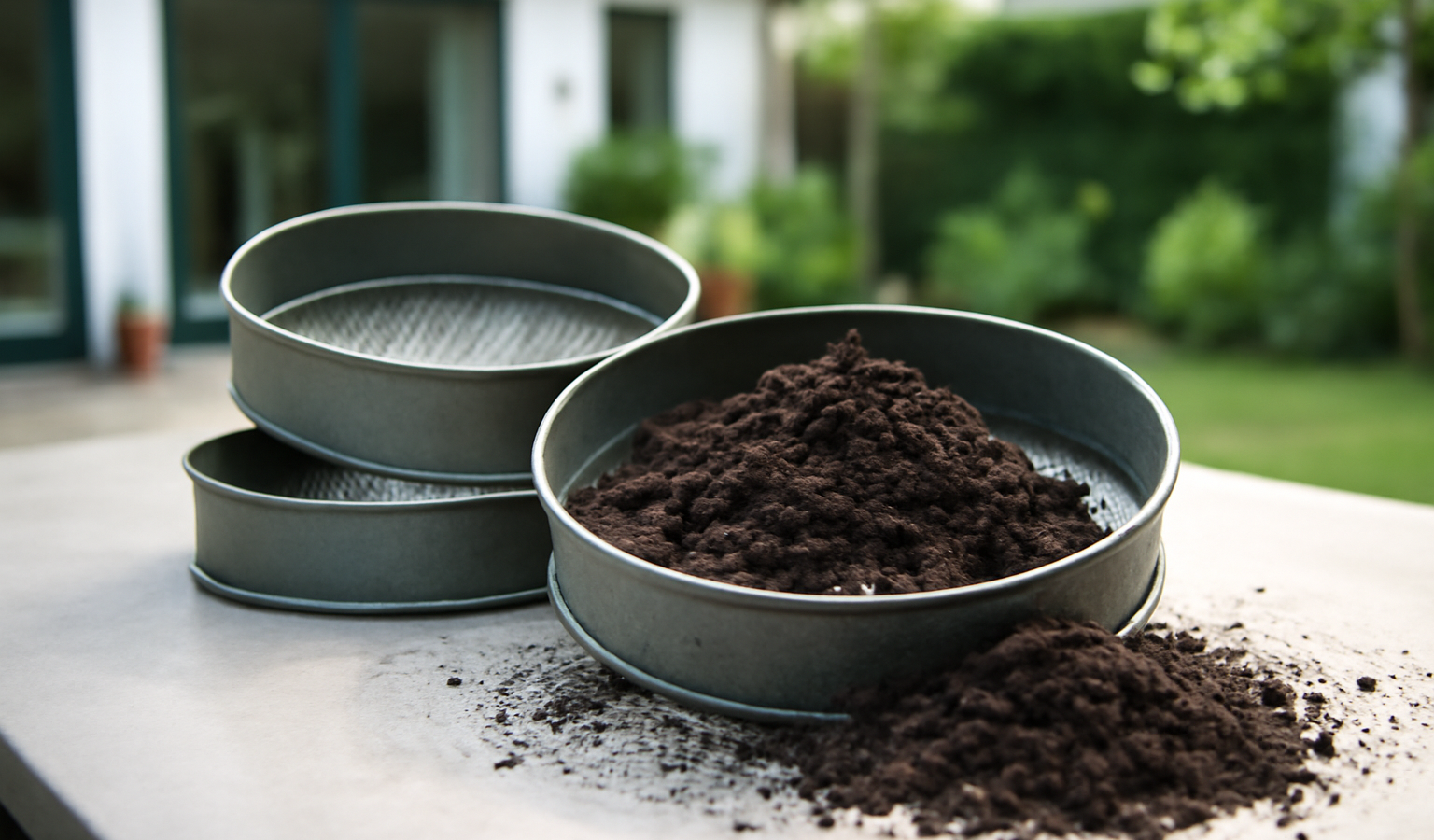
A garden sieve — or “riddle,” if you learned to garden in Britain — is one of those tools that seems optional until you own one, and then you wonder how you screened compost without it. Run finished compost, leaf mould, or garden soil through a sieve and you pull out the sticks, stones, and half-rotted chunks, leaving a fine, crumbly material perfect for seed sowing, top-dressing a lawn, potting on, or filling module trays. The mesh size sets what you get: a coarse 1/2-inch screen for general soil cleanup, a fine 1/4-inch or smaller for seed compost.
The catch is that cheap sieves fall apart fast — stapled mesh pulls loose, thin frames bow under a load of wet soil, and undersized hand sieves make a big job miserable. After screening a lot of compost across the seasons, I have settled on seven sieves that earn their place, spanning traditional round hand riddles, large bucket-top and wheelbarrow models for volume, and interchangeable-mesh kits for gardeners who want one tool to do everything. Here is what works, with honest notes on durability, mesh, and ergonomics.
As an Amazon Associate we earn from qualifying purchases. This page contains affiliate links at no extra cost to you.
Key Takeaways
- Mesh size sets the job: 1/2 in (12 mm) for general soil and compost cleanup, 1/4 in (6 mm) for potting, and 1/8 in or finer for seed compost.
- For volume, go big: bucket-top and wheelbarrow-sized sieves let you screen straight into your container instead of holding a heavy hand sieve.
- Interchangeable-mesh kits give you several grades in one frame and are the most versatile choice for a do-everything gardener.
- Build quality lives in the mesh attachment. Welded or clamped stainless mesh outlasts stapled or glued screens, which pull loose under wet soil.
- Stainless steel is the durability winner; galvanized steel is a fine cheaper middle ground; plastic is light and rust-free but cracks in cold or under heavy loads.
| Sieve | Best For | Key Spec |
|---|---|---|
| Burgon & Ball Stainless Garden Riddle | Premium all-round hand sieving | Stainless, ~15 in, 8 mm mesh |
| Garland Bucket-Top Riddle | Screening into a bucket | Fits standard bucket, 9 mm mesh |
| VIVOSUN 3-Frame Sifter Set | Multiple mesh grades | 1/4, 1/8, 1/16 in stainless screens |
| Tierra Garden Wood-Frame Riddle | Traditional galvanized riddle | Beechwood frame, galvanized mesh |
| ESOW Stainless Soil Sieve Kit | Interchangeable mesh value kit | 3 stainless screens, one frame |
| Bosmere Plastic Garden Sieve | Light budget hand sieving | Plastic, ~14 in, ~7 mm mesh |
| Garland Maxi Riddle (Wheelbarrow) | High-volume over a wheelbarrow | Large rectangular, rests on barrow |
1. Burgon & Ball Stainless Steel Garden Riddle
The Burgon & Ball stainless riddle is the one I hand to anyone who wants a hand sieve that will outlast them. The frame and the roughly 8 mm mesh are both stainless steel, and the mesh is welded into the rolled rim rather than stapled, so there is no staple to pull loose and no rust line to bleed onto your compost. At around 15 inches across it is the classic round riddle size — big enough to be efficient, small enough to control with two hands while you shake.
The 8 mm mesh is a true all-rounder: fine enough to clean compost for potting and top-dressing, coarse enough not to clog with slightly damp material. It is RHS-endorsed and priced accordingly — this is the premium pick, not the bargain. The only real limitation is that, like any single-mesh hand sieve, it is one grade only; for fine seed compost you will want a finer screen as well.
Pros
- All-stainless — will not rust or stain compost
- Welded mesh, no staples to pull loose
- Versatile 8 mm all-purpose mesh
- Comfortable classic 15-inch hand size
Cons
- Premium price
- Single mesh grade — no fine seed screen
- Hand-held, so heavy on big-volume jobs
2. Garland Bucket-Top Garden Riddle
The genius of the Garland bucket-top riddle is that it rests on the rim of a standard garden bucket, so you sieve directly into the container instead of holding a sieve over it with one hand while you scoop with the other. You load soil on top, work it through with your hand or a block, and the screened material drops straight into the bucket while stones and debris stay on the mesh. It transforms compost screening from a two-handed balancing act into a one-handed task.
The mesh is roughly 9 mm — a good general grade for potting compost and soil cleanup. The frame is tough molded plastic, which keeps it light and rust-free, though it is not as rigid as steel under a really heavy, wet load. It is sized for the common large garden bucket; check that it matches your bucket’s rim diameter before buying. For anyone who pots on a lot, this is one of the most genuinely useful designs here.
Pros
- Rests on a bucket — sieve straight into your container
- Frees a hand for loading and working soil through
- Light, rust-free plastic frame
- Sensible 9 mm general-purpose mesh
Cons
- Plastic flexes under heavy wet loads
- Must match your bucket’s rim diameter
- Single mesh grade only
3. VIVOSUN 3-Frame Stainless Soil Sifter Set
The VIVOSUN set takes a different approach: three separate stainless-steel-framed sifters with different mesh grades — roughly 1/4 inch, 1/8 inch, and 1/16 inch — that nest together. The idea is to run material through progressively finer screens, ending with a near-powder fine enough for the smallest seeds or for making your own seed-starting mix. The stainless frames and mesh resist rust and the screens are crimped securely into the rims.
These are smaller, square-ish sifters rather than big garden riddles, which makes them ideal for bench work — bonsai soil, cactus mix, seed compost, even for sifting amendments. That same size is the limitation: they are slow for screening a whole wheelbarrow of compost. Think of this as a precision set for potting and propagation, not a bulk soil tool. For seed-starting work it pairs perfectly with good technique on germination, which we cover in our guide to why seeds fail to germinate.
Pros
- Three mesh grades down to ~1/16 inch
- All-stainless, rust-free, securely crimped mesh
- Nesting design for progressive sifting
- Ideal for seed compost, bonsai, and cactus mix
Cons
- Small size — slow for bulk compost
- Bench tool, not a garden riddle
- Finest screen clogs with damp material
4. Tierra Garden Wood-Frame Garden Riddle
For gardeners who want the traditional look and feel, the Tierra Garden riddle pairs a steam-bent beechwood frame with galvanized steel mesh — the classic English riddle that has changed little in a century. The wide wooden rim is comfortable to grip and shake, the round shape balances well in two hands, and the galvanized mesh (around 8–9 mm) is the right all-purpose grade for compost and soil. There is a genuine pleasure to using a well-made wooden riddle that the plastic and all-metal tools do not match.
The trade-off is maintenance. Wood needs to be stored dry or it will eventually swell, crack, and loosen the mesh; galvanized steel resists rust but not forever, especially once the coating is scratched. Treat it like a good hand tool — clean it, dry it, store it under cover — and it lasts for years. Neglect it outdoors over a wet winter and it will not. A lovely tool for someone who cares for their kit.
Pros
- Classic steam-bent beechwood frame, comfortable to grip
- All-purpose galvanized mesh for soil and compost
- Well-balanced traditional round shape
- Repairable and long-lived with care
Cons
- Wood swells and cracks if stored wet
- Galvanized mesh rusts once scratched
- Single mesh grade
5. ESOW Stainless Soil Sieve Kit (Interchangeable Mesh)
The ESOW kit answers the “I want every mesh grade but not three separate sieves” wish with one stainless frame and three interchangeable screens that drop in and lock — typically a coarse, medium, and fine (around 1/4, 1/8, and 1/12 inch). Swap the screen to match the job: coarse for cleaning soil and compost, fine for seed mix. The stainless frame and screens resist rust, and the single-frame design stores more compactly than a set of separate sieves.
At a mid-range price it is excellent value for the versatility. The compromises: it is a smaller bench-and-bucket sieve rather than a big garden riddle, so it is not the fastest for wheelbarrow volumes, and the screen-swap mechanism, while handy, is one more thing that can wear or come loose over years of grit. For most home gardeners juggling potting, propagation, and occasional soil cleanup, this one-frame-many-meshes approach is the smart buy.
Pros
- Three mesh grades in one frame — very versatile
- Stainless steel resists rust
- Stores compactly versus separate sieves
- Good mid-range value
Cons
- Smaller size — slow for big volumes
- Swap mechanism is an extra wear point
- Screens can shift loose under heavy loads
6. Bosmere Plastic Garden Sieve
The Bosmere plastic sieve is the honest budget hand riddle — a roughly 14-inch molded sieve with about 7 mm mesh, light enough that a child can use it and rust-proof by nature. The molded plastic mesh is part of the frame, so there is nothing to staple, glue, or pull loose, which is actually a durability advantage over cheap stapled-metal sieves. For general compost and soil screening on a budget, it does the basic job perfectly well.
Where it gives ground is rigidity and cold tolerance. Loaded with heavy wet soil it flexes more than a steel frame, and plastic grows brittle in freezing temperatures — leave it out in a hard frost and a drop on a path can crack it. The mesh grade is also fixed and on the coarser side, so it is no use for fine seed compost. As a light, cheap, rust-free workhorse for occasional screening, though, it is hard to argue with the price.
Pros
- Cheapest pick and totally rust-free
- Molded mesh — nothing to pull loose
- Very light and easy to handle
- Fine for occasional general screening
Cons
- Flexes under heavy wet loads
- Grows brittle and cracks in freezing cold
- Fixed coarse mesh — no fine seed grade
7. Garland Maxi Riddle (Wheelbarrow Sieve)
When you are screening compost by the barrow-load, hand sieves stop making sense and a large wheelbarrow sieve takes over. The Garland Maxi is a big rectangular riddle designed to rest across the top of a wheelbarrow so you shovel material onto it and rub it through, with the fines dropping straight into the barrow and the debris staying on top. The large surface area means you process far more soil per minute than any hand sieve, and you never bear the weight — the barrow does.
The mesh is a general-purpose grade suited to compost and soil cleanup rather than fine seed work. The frame is sturdy molded plastic; it is bulky to store and, like all plastic, less rigid than steel under the heaviest loads. For making your own screened topsoil or compost for beds and top-dressing — work that pairs well with the screening tips in our guide to why compost won’t break down — it is the volume tool that saves your back. Browse more screening and prep gear on the Tools & Gear hub.
Pros
- Rests on a wheelbarrow — no weight to hold
- Large surface screens high volume fast
- Great for making screened topsoil and compost
- Sturdy molded frame
Cons
- Bulky to store
- Plastic flexes under the heaviest loads
- General-purpose mesh only, not for seed compost
How to Choose a Garden Sieve
Decide what you are screening and how much of it. A gardener who tops-dresses a lawn and screens a wheelbarrow of compost needs a different tool from one who sifts seed mix on a potting bench. Match the sieve format — hand riddle, bucket-top, bench sifter, or wheelbarrow — to your volume, then match the mesh to your material.
Mesh size guide
As a rule: 1/2 inch (about 12 mm) for general soil cleanup and removing stones; 3/8 inch (9–10 mm) as an all-purpose grade for compost and potting; 1/4 inch (6 mm) for finer potting and module trays; and 1/8 inch (3 mm) or finer for seed-starting compost. Finer mesh clogs faster, especially with damp material, so let compost dry slightly before screening it through a fine grade.
Material and build
Stainless steel is the durability champion — it will not rust or stain compost, and welded stainless mesh never pulls loose. Galvanized steel is a cheaper middle ground that lasts well until the coating is scratched. Plastic is light and rust-free but flexes under heavy loads and turns brittle in cold. Whatever the material, the mesh-to-frame join is the part that fails first: welded or crimped beats stapled or glued every time.
Ergonomics and volume
The single biggest comfort upgrade is taking the weight off your arms. A bucket-top sieve or a wheelbarrow riddle lets the container hold the load while you work soil through, which turns a tiring two-handed shake into an easy push. For small precision jobs, a stainless bench sifter or interchangeable-mesh kit is worth more than raw size. Buy for the job you actually do most, and a second sieve later for the exception.
Frequently Asked Questions
What mesh size should a garden sieve be?
For general soil cleanup and removing stones, use about 1/2 inch (12 mm). An all-purpose 3/8 inch (9–10 mm) suits compost and potting. Drop to 1/4 inch for fine potting and 1/8 inch or smaller for seed-starting compost. Finer mesh clogs faster with damp material.
What is the difference between a garden sieve and a riddle?
They are the same tool. “Riddle” is the traditional British term for a garden sieve — usually the round, hand-held kind with a wooden or metal frame. Both screen soil and compost to remove stones, sticks, and lumps.
Can I sieve wet soil or compost?
You can, but it is much harder — wet material clumps and clogs the mesh, especially fine grades. Let soil and compost dry slightly first so it crumbles and falls through cleanly. A coarse mesh tolerates dampness better than a fine seed screen.
Are stainless steel sieves worth the extra cost?
For frequent use, yes. Stainless will not rust or stain your compost, and welded stainless mesh does not pull loose like stapled screens. If you only sieve occasionally, a galvanized or molded-plastic sieve does the job for less.
What can I use a garden sieve for besides soil?
Plenty: screening finished compost, sifting leaf mould, making seed-starting and potting mixes, separating bonsai and cactus grit, top-dressing lawns, and even cleaning stones out of gravel. Interchangeable-mesh kits cover the widest range of these jobs.
Pick the format that matches your volume and a mesh that matches your material, and a garden sieve quickly becomes one of the most-used tools in the shed. For most gardeners a good all-purpose hand riddle plus, eventually, a fine bench sifter or a wheelbarrow model covers everything from seed mix to bulk compost.