


A bed bug spray will not solve an infestation on its own. Bed bugs hide in seams, cracks, outlets and furniture joints where sprays never reach, their eggs are resistant to many insecticides, and many populations have developed resistance to common pyrethroids. What a good labeled spray does is kill bugs you can reach, leave a residual on the surfaces they cross, and back up the non-chemical steps that do most of the work: hot-drying bedding and clothes, vacuuming, encasing mattresses and box springs, and reducing clutter. Used that way, the right products help a lot. Our top pick is Harris Toughest Bed Bug Killer, a ready-to-use liquid that lists its EPA registration number, kills eggs and pyrethroid-resistant strains, and claims residual control for up to 16 weeks. For quick spot treatments, the Ortho Home Defense Max aerosol is the easiest to apply, and for cracks, wall voids and outlets, Harris diatomaceous earth with a puffer tip is the powder to pair with any spray. Always follow the product label exactly; it is the law, and it tells you where you can and cannot spray. For the full treatment plan, start with our guide on how to get rid of bed bugs.
Part of our Pest Control guide →
In this guide
- Before You Buy: Sprays Are One Part of the Plan
- 1. Harris Toughest Bed Bug Killer — Best Overall
- 2. Ortho Home Defense Max Bed Bug Killer Aerosol — Best Aerosol
- 3. Harris 5 Minute Bed Bug Killer — Best Fast Contact Kill
- 4. MGK CrossFire Bed Bug Concentrate — Best Concentrate
- 5. BASF PT Alpine Flea and Bed Bug Killer — Best for Egg-Hatch Control
- 6. Hot Shot Bed Bug Killer 32 oz — Best Water-Based Seam Spray
- 7. Harris Diatomaceous Earth 8 oz — Best Powder for Cracks and Voids
- Buyer’s Guide: Choosing and Using Bed Bug Sprays Safely
- Frequently Asked Questions
Disclosure: Urban Lotus Project is reader-supported. As an Amazon Associate we earn from qualifying purchases, at no extra cost to you.
How we compared: we compared 15 current Amazon bed bug control listings on what each listing states (active ingredients, egg and resistant-strain claims, residual period, where it can be applied and EPA registration where shown), and set aside traps, foggers and products that did not present as labeled insecticides; we did not test or handle the products, and availability changes.
| Product | Best for | Key features | Buy |
|---|---|---|---|
| Harris Toughest Bed Bug Killer | Best overall residual liquid |
| Buy now →Check current price |
| Ortho Home Defense Max Aerosol | Best aerosol for spot treatment |
| Buy now →Check current price |
| Harris 5 Minute Bed Bug Killer | Best fast contact kill |
| Buy now →Check current price |
| MGK CrossFire Concentrate | Best concentrate for big jobs |
| Buy now →Check current price |
| BASF PT Alpine Flea and Bed Bug | Best for egg-hatch control |
| Buy now →Check current price |
| Hot Shot Bed Bug Killer 32 oz | Best water-based seam spray |
| Buy now →Check current price |
| Harris Diatomaceous Earth 8 oz | Best powder for cracks and voids |
| Buy now →Check current price |
Prices change often; check Amazon for today’s price. As an Amazon Associate we earn from qualifying purchases.
Before You Buy: Sprays Are One Part of the Plan
Bed bug control works in layers. Confirm you have bed bugs first; our guide to signs of bed bugs shows what to look for. Then launder and hot-dry all bedding and clothing from affected rooms, vacuum seams and floors and empty the vacuum outside, install zippered encasements on the mattress and box spring, and pull the bed away from walls. Sprays come after, aimed at bed frames, baseboards, furniture joints and the specific spots the label allows. Powders go into cracks, voids and behind outlet covers. Most infestations need repeat treatments over several weeks because eggs hatch in batches.
We left foggers (“bug bombs”) off this list even though one appears on the shelf. Fog settles on exposed surfaces and does not penetrate the cracks and seams where bed bugs hide, and misused foggers are a fire and health hazard. Sticky traps are useful for monitoring but are not a treatment. For more on choosing between DIY and professional help, see our pest control guide.
1. Harris Toughest Bed Bug Killer — Best Overall

Ready-to-use gallon liquid, EPA registered, labeled to kill eggs and pyrethroid-resistant bed bugs with up to 16 weeks of residual.
Check price on AmazonWhy We Like It
- Longest residual claim on the shelf, up to 16 weeks
- Kills all life stages, including eggs
- Targets pyrethroid-resistant strains
- EPA registration number printed in the listing
- Odorless and non-staining
| Specification | Details |
|---|---|
| Form | Ready-to-use liquid, 128 fl oz |
| Residual | Up to 16 weeks |
| Life stages | Adults, nymphs and eggs |
| Resistant strains | Labeled for pyrethroid-resistant bed bugs |
| EPA Reg. No. | 1021-2597-3 |
| Use sites | Bedrooms, living areas, baseboards, cracks and crevices |
Harris Toughest Bed Bug Killer — compressed specs
Harris Toughest combines the three claims that matter most for a DIY bed bug spray: it kills eggs, it is labeled for pyrethroid-resistant strains, and it leaves a long residual, up to 16 weeks per the listing, on the surfaces bugs travel across. That residual is what catches bugs emerging from hiding after you treat. A full gallon is enough to treat a bedroom thoroughly and repeat applications as the label allows. It is also one of only three listings on the shelf to print its EPA registration number, which you can look up to read the full label before buying.
Compared with the aerosols below, a trigger-spray gallon is slower for quick crack-and-crevice shots but more economical and better for treating long runs of baseboard and bed frames. Pair it with a powder for voids and outlets.
Pros
- Long stated residual
- Egg and resistant-strain claims
- Registration number listed
Cons
- Active ingredients not named in the listing
- Trigger sprayer is slow for deep cracks
- Label limits where it can go on bedding
Check Harris Toughest Bed Bug Killer price on Amazon
2. Ortho Home Defense Max Bed Bug Killer Aerosol — Best Aerosol
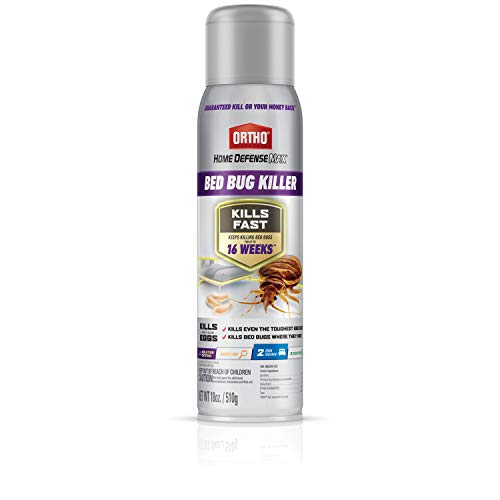
18 oz spot-treatment aerosol for pyrethroid-resistant bed bugs and eggs, with residual up to 16 weeks on non-porous surfaces.
Check price on AmazonWhy We Like It
- Aerosol reaches into joints and crevices quickly
- Kills eggs and resistant bed bugs, per listing
- Residual up to 16 weeks on non-porous surfaces
- Part of a three-step trap, spray and powder system
| Specification | Details |
|---|---|
| Form | Aerosol, 18 oz |
| Residual | Up to 16 weeks on ceramic and other non-porous surfaces |
| Life stages | Bed bugs and eggs |
| Resistant strains | Labeled for pyrethroid-resistant bed bugs |
| Other pests listed | Fleas, brown dog ticks, carpet beetles, clothes moths and more |
| Use sites | Bed frames, headboards, floors, carpeting (spot treatment) |
Ortho Home Defense Max Aerosol — compressed specs
When you find a cluster of bugs in a bed frame joint or along a headboard, an aerosol gets product in fast. Ortho’s listing is specific about where and how: spot-treat bed frames, headboards, floors and carpeting once bugs are detected. The residual claim of up to 16 weeks applies to non-porous surfaces like ceramic, so expect a shorter effective period on fabric and unfinished wood. It also lists a range of other pests, which helps if fleas or carpet beetles are part of the picture.
Ortho positions this as step two in a system with a detection trap and a crack-and-crevice powder. A 1-gallon ready-to-use Ortho bed bug spray with a Comfort Wand is also on the shelf and is better for larger areas, including mattress seams, tufts and folds as a spot treatment.
Pros
- Fast, targeted aerosol application
- Egg and resistant-strain claims
- Covers several other indoor pests
Cons
- Long residual applies to non-porous surfaces
- One can covers limited area
- Aerosol overspray needs ventilation
Check Ortho Home Defense Max Aerosol price on Amazon
3. Harris 5 Minute Bed Bug Killer — Best Fast Contact Kill
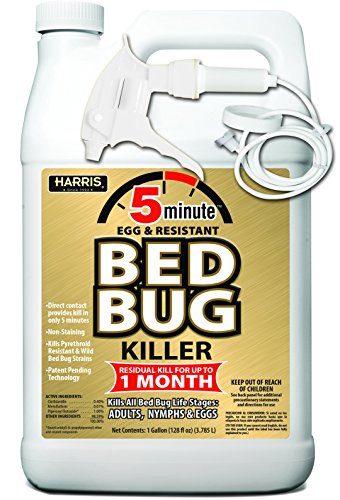
Gallon spray combining metofluthrin, clothianidin and piperonyl butoxide; kills on contact in 5 minutes with a 1-month residual claim.
Check price on AmazonWhy We Like It
- Lists all three active components
- Five-minute kill after direct contact
- Mixed modes of action for resistant bugs
- EPA registration number listed
| Specification | Details |
|---|---|
| Form | Ready-to-use liquid, 128 oz |
| Actives | Metofluthrin, clothianidin, plus piperonyl butoxide synergist |
| Kill time | 5 minutes after direct contact, all life stages |
| Residual | 1 month (EPA label claim, per listing) |
| EPA Reg. No. | 1021-2793-3 |
| Odor and staining | Odorless, non-staining |
Harris 5 Minute Bed Bug Killer — compressed specs
This is the most transparent listing on the shelf about what is in the bottle. It combines a pyrethroid (metofluthrin) with a neonicotinoid (clothianidin) and a synergist (piperonyl butoxide), and using different classes of insecticide together is a common strategy against resistant bed bug populations. The five-minute kill claim applies to bugs hit directly. Its residual claim is one month, shorter than Harris Toughest, so it is the better choice for direct hits on bugs you find and the Toughest formula the better choice for residual barrier treatment.
Many people keep one of each: a fast contact spray for live bugs during inspections, and a long-residual product for bed frames and baseboards.
Pros
- Actives clearly listed
- Multiple modes of action
- Fast stated contact kill
Cons
- Shorter residual than Harris Toughest
- Contains a neonicotinoid; keep strictly indoors per label
- Large gallon jug is awkward for spot work
Check Harris 5 Minute Bed Bug Killer price on Amazon
4. MGK CrossFire Bed Bug Concentrate — Best Concentrate

Professional concentrate with two actives and a synergist; 13 oz makes one gallon and is approved for direct mattress application.
Check price on AmazonWhy We Like It
- Professional product, labeled for resistant strains and eggs
- Approved for direct application to mattresses
- One bottle makes a gallon of finished spray
- Non-staining formula
| Specification | Details |
|---|---|
| Form | Concentrate, 13 oz |
| Yield | 1 gallon finished spray per bottle |
| Actives | Two actives plus a synergist (names not stated in listing) |
| Life stages | All, including eggs |
| Mattress use | Approved for direct application |
| Use sites | Residential, institutional and commercial indoor |
MGK CrossFire Concentrate — compressed specs
CrossFire is marketed to pest control professionals and is the strongest pick here for people dealing with an established infestation or treating several rooms. Like the Harris 5 Minute formula, it uses multiple active ingredients with a synergist, and the listing says it kills pyrethroid-resistant strains at all life stages, starting within minutes. Its approval for direct application on mattresses sets it apart from sprays limited to frames and floors.
You need a clean pump sprayer to mix and apply it, and you must measure carefully according to the label. Some states restrict sale or use of certain professional products, so check before ordering.
Pros
- Professional-grade formula
- Mattress application approved
- Economical concentrate format
Cons
- Requires mixing and a sprayer
- Actives not named in the listing
- May face state restrictions
Check MGK CrossFire Concentrate price on Amazon
5. BASF PT Alpine Flea and Bed Bug Killer — Best for Egg-Hatch Control
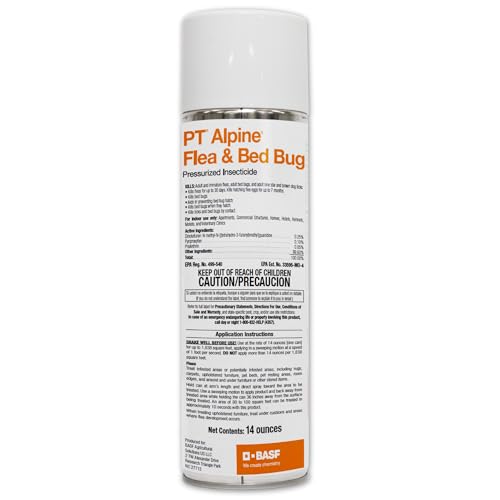
Professional 14 oz aerosol with dinotefuran and a second active that targets hatching eggs; treats up to 2,625 square feet.
Check price on AmazonWhy We Like It
- Second active aids in preventing egg hatch
- Detailed list of where to apply
- Dries quickly without soaking fabric
- Labeled for luggage seams and pockets
| Specification | Details |
|---|---|
| Form | Ready-to-use aerosol, 14 oz |
| Main active | Dinotefuran |
| Surface control | Up to 3 weeks |
| Egg hatch | Targets hatching eggs for up to 7 months, per listing |
| Coverage | Up to 2,625 sq ft |
| Mattress use | Edges, tufts, folds, sides and seams only |
BASF PT Alpine — compressed specs
PT Alpine gives the most detailed application map on the shelf: room perimeters at the wall-floor junction, behind and inside furniture, headboards and box springs, mattress edges and seams, carpet and wall coverings, and even luggage pockets and wheels. Its dinotefuran active is a non-pyrethroid, useful where resistance is a concern, and the listing says its dual actives target hatching eggs for months while giving up to three weeks of surface control. It is the best pick for treating luggage after travel and for following up on egg-laden areas.
The label limits mattress application to edges, tufts, folds, sides and seams, not the whole surface, and the listing notes state restrictions may apply.
Pros
- Non-pyrethroid main active
- Egg-hatch control claim
- Very specific application guidance
Cons
- Shorter surface residual than the Harris and Ortho picks
- State restrictions may apply
- Flea claims dominate the listing
Check BASF PT Alpine Flea and Bed Bug price on Amazon
6. Hot Shot Bed Bug Killer 32 oz — Best Water-Based Seam Spray
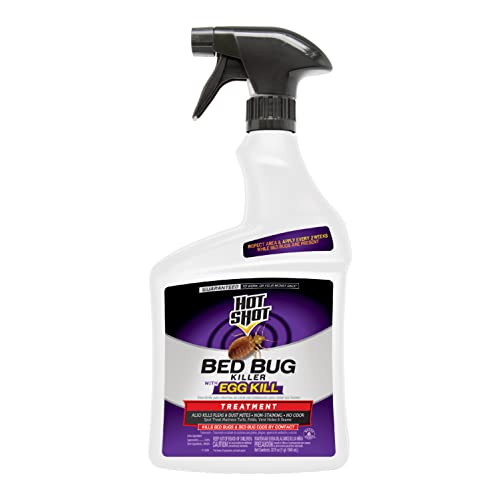
Water-based, non-staining trigger spray for mattress tufts, folds and seams that kills bed bugs, eggs, fleas and dust mites.
Check price on AmazonWhy We Like It
- Labeled for mattress tufts, folds, buttons and seams
- Kills bed bugs and their eggs
- Water-based, no odor, non-staining
- Clear reapplication interval of two weeks
| Specification | Details |
|---|---|
| Form | Ready-to-use trigger spray, 32 oz |
| Life stages | Bed bugs and eggs |
| Other pests | Fleas (adult and larvae), dust mites |
| Application | Spray until damp, not saturated |
| Reapplication | Every two weeks while bed bugs are present |
| Resistant strains | Not stated in listing |
Hot Shot Bed Bug Killer — compressed specs
Mattress seams, piping, tufts and buttons are where bed bugs cluster, and not every spray is labeled for them. Hot Shot’s water-based formula is aimed squarely at those spots, with simple instructions: spray until damp, inspect and reapply every two weeks while bugs are present. That two-week cycle matches the time it takes eggs to hatch, which is why repeated treatment matters. The listing also frames the spray as part of a full treatment cycle rather than a one-shot fix.
It does not claim effectiveness against pyrethroid-resistant strains, so if a first round fails, switch to one of the multi-active or non-pyrethroid products above.
Pros
- Labeled for mattress seams and tufts
- Clear reapplication schedule
- No odor or staining
Cons
- No resistant-strain claim
- No residual period stated
- Small bottle for whole-room use
Check Hot Shot Bed Bug Killer 32 oz price on Amazon
7. Harris Diatomaceous Earth 8 oz — Best Powder for Cracks and Voids

EPA-registered freshwater diatomaceous earth with a built-in puffer tip for cracks, outlets and wall voids.
Check price on AmazonWhy We Like It
- Puffer tip places a thin dust in tight spots
- EPA registration number listed
- Pure DE with no additives, per listing
- Kills mechanically, so resistance is not an issue
| Specification | Details |
|---|---|
| Form | Dust with puffer tip, 8 oz |
| Ingredient | 100% freshwater diatomaceous earth |
| How it works | Abrades and dehydrates insects on contact |
| Longevity | Effective while it stays dry |
| EPA Reg. No. | 3-18 |
Harris Diatomaceous Earth — compressed specs
Sprays cannot go into electrical outlets, wall voids or deep cracks behind baseboards, but a light puff of dust can. Diatomaceous earth kills by damaging the insect’s waxy outer layer so it dries out, a physical action that pyrethroid resistance does not affect. It works slowly, typically over days, so it is a supporting layer rather than a knockdown. Harris’s small bottle with a narrow puffer tip is the right format: you want a barely visible film, not piles, which bugs avoid. Our guide to diatomaceous earth for bed bugs explains placement and safety.
The shelf also has a 4 lb Safer Home DE and two DE-with-peppermint products. The large bag needs a separate duster, and the peppermint products did not show an EPA registration in their listings, so the Harris bottle is the most convenient labeled choice for indoor bed bug use.
Pros
- Reaches voids and outlets
- Unaffected by insecticide resistance
- Built-in applicator
Cons
- Slow acting
- Loses effect when wet
- Dust can irritate lungs; avoid breathing it
Check Harris Diatomaceous Earth 8 oz price on Amazon
Buyer’s Guide: Choosing and Using Bed Bug Sprays Safely
Read the label before you buy
The label is a legal document. It lists exactly where a product may be applied (bed frames, baseboards, mattress seams only, or not on mattresses at all), how much to use, how often to reapply and how long to stay out of treated rooms. Look for an EPA registration number, which lets you read the full label online. Never use outdoor or agricultural insecticides indoors or on bedding.
Contact vs residual
Contact sprays kill bugs you hit. Residual sprays leave an active film that keeps killing bugs that crawl over it later. You want both: residual for frames, baseboards and furniture where bugs travel, contact for live bugs you find.
Plan for resistance
Many bed bug populations shrug off single pyrethroid products. Products labeled for resistant strains, multi-active formulas and non-pyrethroid actives like dinotefuran, plus mechanical dusts like DE, give you different modes of action. If one product is not working after two or three applications, switch to a different class.
Safety basics
- Keep children and pets out of treated rooms until surfaces are dry or for the label’s reentry time.
- Ventilate during and after aerosol use; turn off pilot lights and ignition sources as labels direct.
- Never spray pillows, sheets or anything a label does not list.
- Do not overapply; more product does not mean faster results and increases exposure.
When to call a professional
Call a licensed pest control company if bugs are in multiple rooms, if you live in an apartment where they can move between units, if DIY efforts over four to six weeks have not reduced bites and sightings, or if anyone in the home is highly sensitive to bites or chemicals. Professionals can use whole-room heat treatment and products not available to consumers. Our comparison of DIY vs professional bed bug treatment and our breakdown of bed bug treatment cost will help you decide.
Frequently Asked Questions
Can a bed bug spray get rid of bed bugs by itself?
Rarely. Sprays work best combined with laundering and hot-drying bedding, vacuuming, mattress encasements, reducing clutter, dusts for cracks and repeat treatments over several weeks. Heavy infestations often need a professional.
Can I spray bed bug killer on my mattress?
Only if the label allows it and only where it says. Some products, like MGK CrossFire, are approved for direct mattress application; others, like PT Alpine, are limited to seams, tufts and edges. Never spray sheets or pillows unless the label specifically lists them.
Do bed bug sprays kill eggs?
Some do. Harris Toughest, Ortho Home Defense Max, Harris 5 Minute, MGK CrossFire and Hot Shot list egg kill, and PT Alpine targets egg hatch. Still plan on repeat treatments, since some eggs survive.
Do bed bug foggers work?
They are generally not effective against bed bugs because the fog does not reach the cracks, seams and voids where the bugs hide. Targeted sprays and dusts are more effective and safer.
How often should I spray for bed bugs?
Follow each label’s reapplication interval. Many treatment plans repeat every one to two weeks for several cycles to catch newly hatched nymphs; the Hot Shot label, for example, calls for every two weeks while bugs are present.