

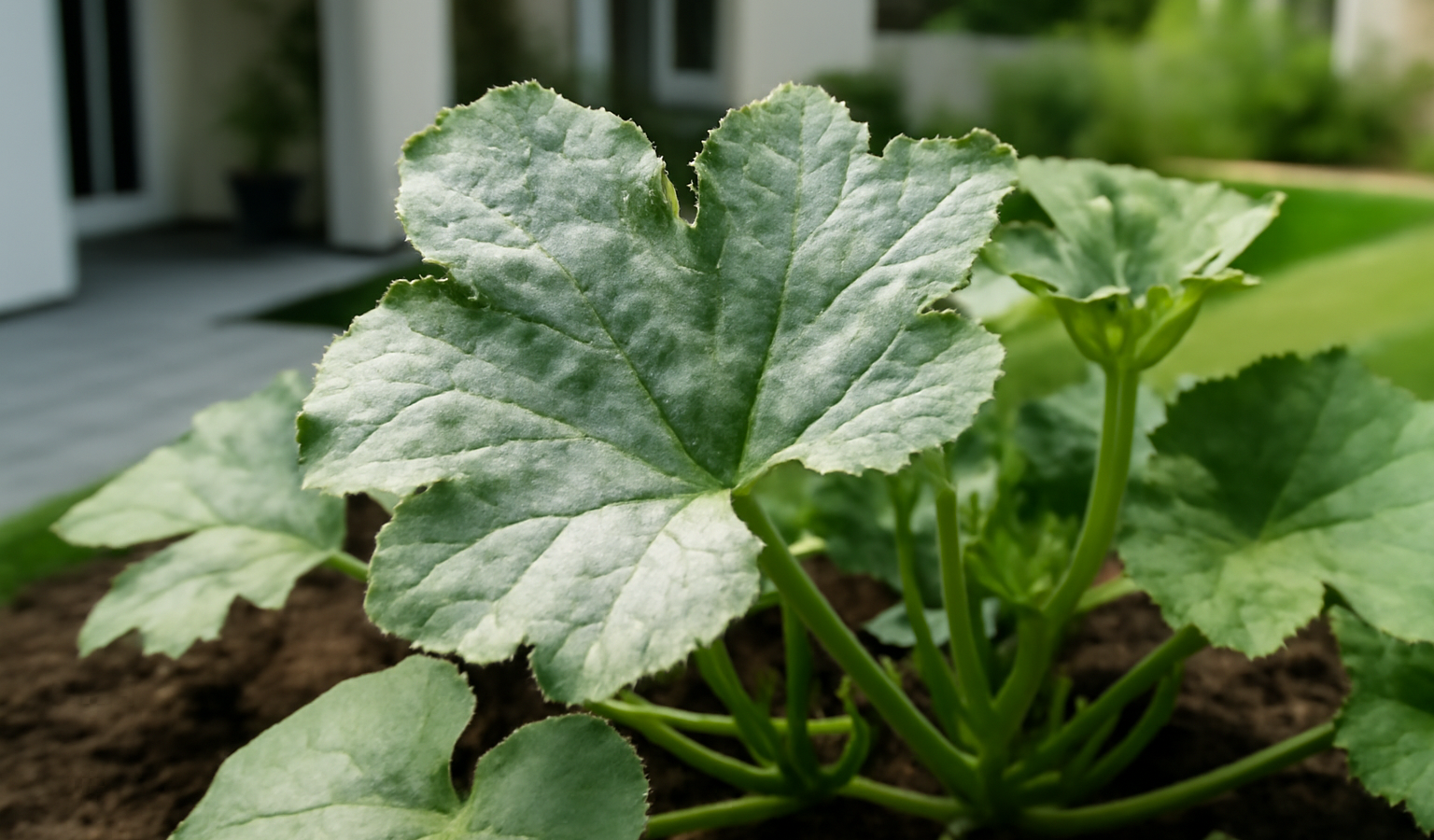
You walk out to the garden, coffee in hand, and your once-deep-green squash plants look like someone dusted them with flour overnight. White leaves on squash are one of the most common panic-inducing sights for vegetable gardeners, and for good reason: in the vast majority of cases, that white coating is powdery mildew, a fungal disease that spreads fast and can cut your harvest short by weeks. But not every white patch is a disease. Some squash and zucchini varieties come with naturally silvery markings that look alarming but are completely harmless. Sunscald, bleaching, nutrient problems, and a separate disease called downy mildew can all muddy the diagnosis too. Getting the cause right matters, because the fix for powdery mildew (fungicide and airflow) does absolutely nothing for sunscald or genetic variegation, and treating healthy variegated leaves with sulfur is a waste of your time and money. This guide walks through the five things most likely to turn your squash leaves white, how to tell them apart with confidence, and exactly what to do for each one.
Key Takeaways
- Powdery mildew is the cause about 80% of the time: a dusty white coating that rubs off and starts on older, shaded lower leaves.
- If the white pattern is silver-grey, follows the veins symmetrically, and will not rub off, it is harmless varietal variegation, not disease.
- Treat powdery mildew early with neem oil, potassium bicarbonate, sulfur, or a diluted milk spray; reapply every 7 to 10 days.
- Sunscald produces dry, papery bleached patches only on the most exposed upper leaves, usually after a sudden heat spike.
- Prevention beats cure: space plants 3 to 4 feet apart, water at the soil line in the morning, and choose mildew-resistant varieties.
Cause 1: Powdery Mildew (the most likely culprit)
If your squash leaves are turning white, powdery mildew is the first and most probable explanation. It is caused by several species of fungi (most commonly Podosphaera xanthii and Erysiphe cichoracearum) that thrive in exactly the conditions squash loves: warm days between 60 and 80 degrees Fahrenheit, high humidity, moderate shade, and crowded foliage. Unlike most fungal diseases, powdery mildew does not need wet leaves to germinate, which is why it shows up even during dry spells and why it is so stubbornly common on cucurbits like squash, zucchini, pumpkins, and cucumbers. It typically appears in mid to late summer once plants are large and dense, and it spreads on the wind from plant to plant and garden to garden. Left untreated, it reduces photosynthesis, weakens the plant, shrinks your fruit, and can defoliate a vine within a few weeks.
How to diagnose
Look at the texture and the pattern. Powdery mildew starts as small, circular, dusty-white or pale-grey spots, almost like talcum powder or flour scattered on the leaf surface. The single most reliable test is to rub a white patch gently with your finger: powdery mildew smears and partially lifts off, leaving green leaf underneath, whereas variegation and sunscald will not budge. The disease usually begins on the older, lower, shaded leaves first, then climbs upward and outward as spores spread. You will often find it on both the top and underside of leaves, and eventually on stems and leaf stalks. Early on, the green tissue beneath stays healthy; as it advances, affected leaves yellow, then turn brown, dry, and brittle. If the white is concentrated on shaded interior leaves and is spreading day by day, you almost certainly have powdery mildew.
How to fix
Act fast, because mildew is far easier to slow than to reverse. Start by removing and bagging the worst-affected leaves (never compost them) to lower the spore load, but do not strip more than about a third of the plant at once or you will stress it. Then choose a fungicide. Potassium bicarbonate is the most effective organic option; mix roughly 1 tablespoon per gallon of water with a few drops of liquid soap as a spreader, and it actively kills existing colonies rather than just preventing new ones. Neem oil works as both a fungicide and broad protectant at about 2 tablespoons per gallon, though it can scorch leaves if applied in hot midday sun, so spray in the early morning or evening; our comparison of neem oil versus insecticidal soap explains when each makes sense. Sulfur fungicides are powerful but must not be used within two weeks of an oil spray or above 90 degrees, as the combination burns foliage. A budget-friendly home remedy is a milk spray: mix 1 part milk to 9 parts water and apply weekly in sunlight, which appears to trigger a mild antifungal reaction. Whatever you pick, coat both leaf surfaces thoroughly and reapply every 7 to 10 days, and after rain, until conditions cool.
Cause 2: Natural Silvery Variegation and Markings
Before you reach for the fungicide, take a breath, because plenty of squash and zucchini varieties are simply born with white or silvery markings, and treating them as disease is a classic beginner mistake. Many cultivars, including a great number of zucchini and summer squash, naturally display silver-grey blotches, flecks, or marbling along the veins and between them. This is genetic variegation, not infection. It is most pronounced on cultivars bred for it and tends to be more visible in cooler weather or on plants grown in lower light. The pattern can look surprisingly bold, sometimes covering a third of the leaf, which is precisely why it sends so many gardeners into a panic. The good news is that variegation is entirely cosmetic and has no effect whatsoever on plant health, yield, or fruit quality.
How to diagnose
The defining clue is consistency and permanence. Variegation appears symmetrically, following the leaf veins in a repeatable pattern across many leaves, including the youngest new growth, and it is present from the moment the leaf unfurls rather than creeping in over time. Crucially, it does not rub off, no matter how hard you press, because the silvery look comes from tiny air pockets in the leaf tissue itself. The colour reads as a flat, metallic silver-grey rather than the dusty, raised, three-dimensional powder of mildew. If every leaf on the plant, old and new, shows the same neat pattern that has not changed in days and will not smear under your finger, you are looking at normal variegation. Check the seed packet or variety name if you saved it, since described traits will often confirm it.
How to fix
There is nothing to fix, and that is genuinely the correct answer. Do not spray, do not prune, and do not change your watering. Applying sulfur or oil to healthy variegated leaves only risks phytotoxic burn and wastes product. The single useful action is to confirm the diagnosis so you stop worrying: photograph a few leaves, compare them against the variety description, and check whether the pattern stays stable over the next week. If it remains unchanged and refuses to rub off, enjoy it as a feature. Many gardeners come to appreciate the ornamental look once they realize the harvest is unaffected. If you want to learn more about reading symptoms across different crops, the Plants & Flowers hub collects diagnostic guides for the most common garden vegetables and ornamentals.
Cause 3: Sunscald and Leaf Bleaching
Squash leaves can also turn white from sun damage, a problem that becomes common during heat waves or right after transplants and seedlings move from a sheltered spot into full, intense sun without hardening off. Sunscald, sometimes called leaf bleaching or sun scorch, happens when more light energy hits the leaf than the chlorophyll can handle. The pigment breaks down and the affected tissue fades from green to pale yellow to bone-white, eventually drying out. It is especially likely on the largest, flattest, most horizontal leaves at the top of the canopy that take the brunt of midday sun, and it can be triggered or worsened when water droplets on leaves act like tiny magnifying lenses, or when a plant is already drought-stressed and cannot cool itself by transpiring.
How to diagnose
Location and texture give it away. Sunscald shows up on the upper, fully exposed leaves rather than the shaded interior ones favoured by mildew, which is the exact opposite distribution. The white areas are flat, dry, papery, and often bleached right through to a tan or beige colour, sometimes with crispy brown edges, and they do not have the raised dusty coating of mildew. The damage is fixed once it appears: it does not spread leaf to leaf the way a fungus does, though new scald can occur on new leaves if the conditions persist. Timing is another tell. If the bleaching appeared suddenly after a hot, bright spell or right after you moved seedlings outdoors, sun is the likely culprit. The patches will not rub off because the tissue is genuinely dead.
How to fix
You cannot un-bleach a scorched leaf, so the goal is to prevent further damage and support recovery. During extreme heat, drape 30 to 50 percent shade cloth over plants from late morning through mid-afternoon, which can drop leaf temperature by several degrees. Keep soil consistently moist with deep morning watering so the plant can transpire and cool itself, and add a 2 to 3 inch layer of mulch to buffer soil moisture and temperature. Always harden off seedlings over 7 to 10 days before planting them into full sun, increasing exposure gradually. Avoid overhead watering in the heat of the day, since droplets focus sunlight and worsen burn. Lightly damaged leaves with only small white patches can stay on the plant and keep photosynthesizing; remove only leaves that are mostly dead.
Cause 4: Nutrient and Water Stress
Sometimes white or very pale leaves signal that the plant is struggling internally rather than fighting an external attacker. Squash are heavy feeders, and deficiencies in nitrogen, iron, magnesium, or other nutrients can cause leaves to lose their deep green and fade toward pale yellow-white. Iron deficiency in particular causes interveinal chlorosis, where the tissue between the veins turns nearly white while the veins themselves stay green, and it shows up first on the newest leaves. Overwatering, poor drainage, compacted roots, and incorrect soil pH (which locks up nutrients even when they are present) can all produce the same washed-out look. Cold soil early in the season slows root uptake and can mimic deficiency too. These are stress symptoms, and the plant is telling you something about its growing conditions.
How to diagnose
Look at where the paleness appears and whether there is any coating. Nutrient stress produces an even, flat discolouration of the whole leaf or a clean green-vein-on-white pattern (chlorosis), with no powder, no fuzz, and nothing that rubs off. Nitrogen shortage typically pales the oldest, lowest leaves first and may yellow them uniformly, while iron and other micronutrient issues hit the youngest top leaves with that vein-contrast pattern. Check your watering: soggy, waterlogged soil or, conversely, bone-dry soil both cause stress. A cheap soil test or pH meter is worth its weight here, since squash prefer a pH around 6.0 to 6.8, and values outside that range cause hidden lockout. If the plant is otherwise free of spots and powder but looks generally washed out and lacks vigour, suspect stress.
How to fix
Correct the underlying condition rather than just masking the symptom. First fix watering: aim for deep, even moisture, letting the top inch of soil dry between waterings, and improve drainage if the bed stays soggy. For a clear nitrogen shortage, side-dress with a balanced organic fertilizer or a diluted fish emulsion, but avoid overdoing nitrogen, which pushes lush foliage at the expense of fruit and actually makes plants more susceptible to powdery mildew. For interveinal chlorosis, a chelated iron foliar spray gives a faster response than soil amendment, and correcting pH with sulfur (to lower) or lime (to raise) addresses the root cause over time. A 2 to 3 inch mulch layer and a topdressing of finished compost steady both moisture and nutrient supply. Improvement in new growth within one to two weeks confirms you had a stress problem rather than a disease.
Cause 5: Downy Mildew (the look-alike to rule out)
Downy mildew is frequently confused with powdery mildew because of the similar name, but it is a different organism (a water mould, Pseudoperonospora cubensis) and it behaves differently. While it tends to show yellow angular patches on the upper leaf surface, the underside develops a fuzzy growth that can look greyish, purplish, or whitish, especially in humid morning conditions, which leads gardeners to file it under white leaves. It loves cool, wet, humid weather and genuinely needs leaf moisture to spread, unlike powdery mildew. It is worth ruling out because the management overlaps but is not identical, and downy mildew can move through a planting devastatingly fast once it arrives, often killing leaves rather than just dusting them.
How to diagnose
Flip the leaf over and look at both sides together. The hallmark of downy mildew is yellow, angular spots on top that are bounded by the leaf veins, giving them a blocky, geometric shape, paired with a fuzzy down on the underside directly below those spots. Powdery mildew, by contrast, makes round white spots on the upper surface and is not confined by veins. Downy mildew growth is more of a soft fuzz or felt than a dry powder, and it appears most reliably after cool, wet, foggy nights. If you see green-and-yellow mosaic-like patches with fuzz underneath rather than uniform surface powder, and your weather has been damp and cool, downy mildew is the more likely diagnosis.
How to fix
Downy mildew is tougher to control than powdery mildew, so prioritize prevention and act decisively. Improve airflow aggressively, water only at the soil line, and never wet the foliage, since leaf moisture is what the pathogen needs to spread. Remove and bag infected leaves immediately. Copper-based fungicides are the main organic option and work best applied preventively before symptoms explode; potassium bicarbonate and neem give weaker results against downy mildew than they do against powdery, so do not rely on them alone. Because spores blow in on the wind and overwinter poorly in cold climates, planting resistant varieties and timing your crop to avoid the cool, damp shoulder seasons is often the most practical defense. If an infection is advanced and spreading fast, removing the worst plants to protect the rest may be the realistic call.
How to Prevent White Squash Leaves
Most cases of white squash leaves are preventable with good cultural habits, and prevention is far less work than treatment. Start with spacing: give bush squash at least 2 to 3 feet and vining types 3 to 4 feet, because crowded plants trap humid, stagnant air that both powdery and downy mildew adore. Good airflow is your single best defense, so site plants where breezes reach them and prune a few interior leaves mid-season to open up dense canopies. Water at the soil line with drip or a soaker hose, and do it in the early morning so any splashed foliage dries quickly; overhead evening watering is an open invitation to disease. Choose mildew-resistant varieties whenever you can, as many modern squash and zucchini cultivars carry genetic resistance that dramatically reduces outbreaks. Feed in moderation, since excess nitrogen produces soft, mildew-prone growth, and keep plants unstressed with consistent moisture and mulch so they can defend themselves. Rotate cucurbits to a new bed each year and clear away old vines at season’s end to break disease cycles. Finally, scout your plants twice a week; catching the first few white spots and spraying preventively, including organic options covered in our look at diatomaceous earth versus neem oil, is what separates a minor blemish from a defoliated vine. None of these steps is difficult, and together they make white leaves a rare event rather than an annual battle.
Frequently Asked Questions
Can I still eat squash from a plant with powdery mildew?
Yes. Powdery mildew affects the leaves and stems, not the fruit, so the squash itself is perfectly safe to eat once washed. The disease only reduces yield by weakening the plant, so harvest normally while you treat the foliage.
How do I know if it is powdery mildew or just normal variegation?
Rub the white area gently with your finger. Powdery mildew smears and partly lifts off, starts on shaded lower leaves, and spreads over days. Variegation is a flat silver-grey pattern along the veins, appears on new and old leaves alike, and will not rub off.
Does milk spray actually work on powdery mildew?
It can help as a mild preventive and early treatment. A 1-to-9 milk-to-water mix applied weekly in sunlight appears to reduce mildew, likely through an antifungal reaction. It is less reliable than potassium bicarbonate but is cheap and worth trying on light infections.
Will powdery mildew kill my squash plant?
It rarely kills a mature plant outright, but untreated it can defoliate vines within a few weeks, sharply reducing fruit size and number and shortening the harvest. Caught early and managed, plants usually keep producing through the season.
How often should I spray fungicide for white squash leaves?
Reapply every 7 to 10 days for active powdery mildew, and again after heavy rain washes product off. Once cooler, drier conditions arrive, you can stretch the interval. Always coat both the top and underside of leaves for full coverage.