

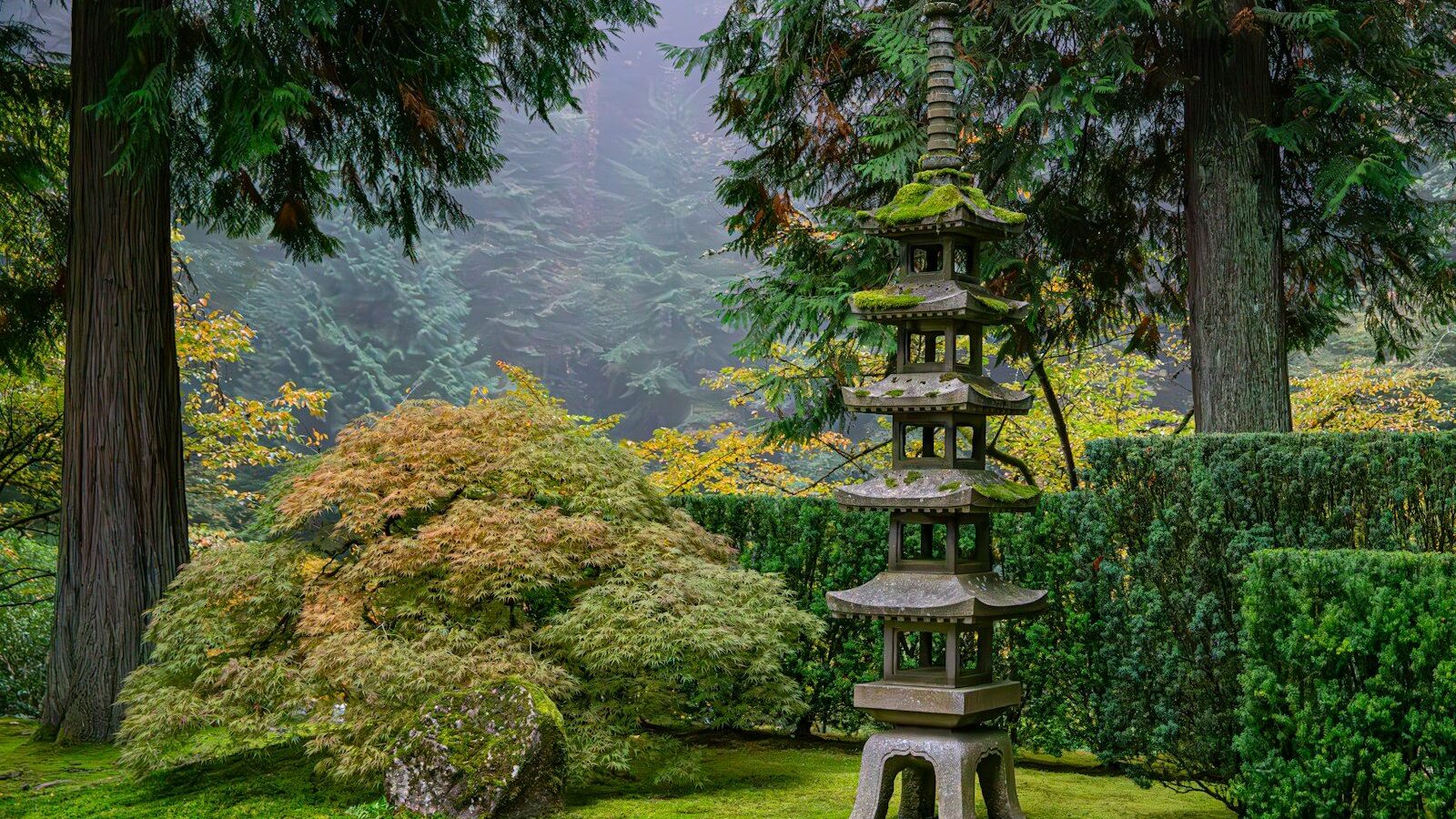
A Japanese-style garden is built on a few well-chosen trees: an evergreen pine or conifer as the permanent backbone, a Japanese maple for texture and fall color, and one flowering tree, usually a cherry or apricot, for a short burst of spring bloom. In most of the US (zones 5 to 8) the classic Japanese species grow well. Gardeners in colder or hotter climates can still get the look with substitutes that share the same form. Below are the best trees by role, with zones and mature sizes, followed by how to place them so the garden reads as calm and natural rather than crowded.
Part of our Trees & Shrubs guide →
In this guide
- Quick Reference: Trees by Role and Zone
- Japanese Maples: The Signature Tree
- Pines: The Evergreen Backbone
- Conifers for Screening and Background
- Flowering Trees: Cherries and Apricots
- Four-Season Small Trees
- Larger Shade Trees
- Options for Cold and Hot Climates
- How to Place Trees in a Japanese-Style Garden
- Pruning to Keep the Japanese Look
- Planting Tips
- Frequently Asked Questions
Key Takeaways
- Anchor the design with evergreens: pines, hinoki cypress or Japanese cedar.
- Use Japanese maples as the main deciduous accent; choose size by variety.
- Limit flowering trees to one or two so the bloom is an event, not a constant.
- Most classic species suit zones 5–8; use substitutes in zones 3–4 and 9.
- Place trees asymmetrically, in odd numbers, layered from foreground to background.
Quick Reference: Trees by Role and Zone
| Tree | Role | USDA zones | Typical mature size |
|---|---|---|---|
| Japanese maple (Acer palmatum) | Focal accent, fall color | 5–8 | 4–25 ft, by variety |
| Japanese black pine (Pinus thunbergii) | Evergreen backbone, cloud pruning | 6–8 | 20–30 ft in gardens; less with pruning |
| Japanese red pine (Pinus densiflora) | Evergreen, picturesque trunk | 4–7 | 30–40 ft; dwarf forms available |
| Japanese white pine (Pinus parviflora) | Soft-textured evergreen | 5–7 | 20–30 ft; many dwarf cultivars |
| Hinoki cypress (Chamaecyparis obtusa) | Evergreen screen and accent | 5–8 | Dwarf 3–6 ft to species 50+ ft |
| Japanese cedar (Cryptomeria japonica) | Tall evergreen background | 6–8 | 40–60 ft; dwarf forms available |
| Yoshino cherry (Prunus x yedoensis) | Spring bloom | 5–8 | 30–40 ft wide-spreading |
| Weeping Higan cherry (Prunus subhirtella ‘Pendula’) | Weeping spring accent | 5–8 | 20–30 ft |
| Japanese flowering apricot (Prunus mume) | Late-winter bloom | 6–9 | 15–20 ft |
| Katsura tree (Cercidiphyllum japonicum) | Shade tree, fall scent | 4–8 | 40–60 ft |
| Japanese stewartia (Stewartia pseudocamellia) | Four-season small tree | 5–7 | 20–30 ft |
| Japanese snowbell (Styrax japonicus) | Early summer bloom | 5–8 | 20–30 ft |
Japanese Maples: The Signature Tree
Few trees say “Japanese garden” as clearly as Acer palmatum. Varieties range from mounding, lace-leaf weepers 4 to 6 feet tall to upright trees over 20 feet, so you can find one for a courtyard or a large yard. A few reliable choices:
- Bloodgood: upright, deep red leaves all season, about 15–20 ft. See our Bloodgood Japanese maple care guide.
- Sango Kaku (coral bark): bright coral-red winter stems that light up a bare garden; see coral bark Japanese maple care.
- Tamukeyama and Crimson Queen: red lace-leaf weepers, 6–10 ft, ideal beside water or a stone.
- Osakazuki: green summer leaves turning an intense scarlet in fall.
Japanese maples prefer morning sun and afternoon shade in hot regions, moist but well-drained soil and protection from drying wind. They struggle in zone 9 heat and in exposed zone 4 sites. For a full comparison of varieties, see Japanese maple varieties, and for planting and care, how to grow a Japanese maple.
Pines: The Evergreen Backbone
In traditional Japanese gardens, pines symbolize longevity and are shaped over years by candle pinching and needle thinning into layered “cloud” forms, a practice called niwaki. They keep the garden structured in winter.
- Japanese black pine: the classic garden pine, tolerant of salt spray and wind, good for coastal gardens in zones 6–8. Stiff, dark needles and a rugged trunk.
- Japanese red pine: orange-red bark and an often leaning, irregular trunk. Hardier than black pine. Umbrella and dwarf forms suit small gardens.
- Japanese white pine: shorter, blue-green, twisted needles in soft tufts. Many dwarf cultivars make excellent specimen trees in small spaces.
- Substitutes: Eastern white pine (zones 3–8), Scots pine (3–7) and mugo pine (3–7) can all be pruned into Japanese-style forms and are easier to source in much of the country.
Conifers for Screening and Background
Hinoki cypress has glossy, fan-shaped sprays of foliage and a graceful, layered habit. Dwarf forms such as ‘Nana Gracilis’ stay compact for decades, while the species grows into a large tree. Japanese cedar (Cryptomeria) offers a tall, soft-textured background and fast screening; dwarf types like ‘Globosa Nana’ work as rounded accents. Both prefer moist, well-drained soil and some shelter from hot afternoon sun and winter wind. Our guide to types of cedar trees covers related options, including deodar cedar for warmer zones.
Flowering Trees: Cherries and Apricots
Flowering cherries are the emotional peak of the Japanese garden year, but their bloom lasts only a week or two. Use one, or two at most, as a seasonal focal point. Yoshino cherry carries pale pink to white single flowers and grows large and wide, so it needs space. Kwanzan offers heavy, double pink flowers and an upright vase shape around 25–30 feet. Weeping Higan cherry is the best choice beside a pond or as a standalone specimen. See how to grow cherry blossom trees.
Japanese flowering apricot (Prunus mume) blooms in late winter, often January to March depending on zone, with fragrant pink, red or white flowers on bare branches. It is a good flowering choice for zones 7 to 9, where cherries can bloom poorly after mild winters.
Four-Season Small Trees
- Japanese stewartia: white camellia-like flowers in early summer, orange-red fall color and stunning mottled, exfoliating bark in winter. Needs moist, acidic soil and afternoon shade in hot regions.
- Japanese snowbell: hanging white bell flowers in late spring under horizontal branches; plant it near a path or on a slope so you can look up into it.
- Kousa dogwood: flowers after leaves emerge in late spring, red fruit and good fall color; more disease-resistant than native flowering dogwood.
- Japanese tree lilac: creamy summer flowers and cherry-like bark, hardy to zone 3; one of the best options for cold climates.
Larger Shade Trees
On bigger lots, one shade tree sets the canopy that the smaller trees sit under. Katsura tree has rounded, heart-shaped leaves that turn apricot and gold in fall and smell faintly of burnt sugar. Ginkgo, an ancient tree long planted at Japanese temples, turns bright gold and is hardy in zones 3 to 9; plant a male cultivar to avoid foul-smelling fruit. Japanese zelkova offers a vase-shaped form similar to elm in zones 5 to 8.
Options for Cold and Hot Climates
| Climate | Instead of | Try |
|---|---|---|
| Zones 3–4 | Japanese black pine | Eastern white pine, Scots pine, mugo pine pruned niwaki-style |
| Zones 3–4 | Japanese maple | Korean maple (Acer pseudosieboldianum) or Tatarian maple (check local invasive lists) |
| Zones 3–4 | Flowering cherry | Japanese tree lilac, hardy crabapples |
| Zone 9 | Hinoki cypress and Japanese cedar | Podocarpus (yew pine), deodar cedar |
| Zone 9 | Flowering cherry | Prunus mume, crape myrtle with a pruned, multi-trunk form |
Avoid running bamboo unless it is fully contained by a deep rhizome barrier; clumping bamboos are a safer alternative for the look of a bamboo grove.
How to Place Trees in a Japanese-Style Garden
Asymmetry and odd numbers
Avoid pairs and straight rows. Plant in groups of one, three or five, arranged as uneven triangles where one tree is dominant, one secondary and one subordinate. This mirrors how trees grow in nature.
Layering for depth
Put tall evergreens such as Japanese cedar or pines at the back, mid-size trees such as stewartias and cherries in the middle, and low maples, dwarf pines and shrubs in front. Fine-textured plants in the background and coarser ones in front make a small garden feel deeper.
Focal points and borrowed scenery
Place your most striking tree, often a weeping maple or a pruned pine, where it relates to a feature: leaning over a pond, framing a stone lantern or marking a bend in a path. Use trees at the edges to frame a distant view or hide a neighbor’s shed. This technique of incorporating views beyond the garden is called shakkei, or borrowed scenery.
Scale and spacing
Plan for mature width, not nursery size. A Yoshino cherry can spread 30 feet or more; a dwarf hinoki may stay under 6 feet for decades. In small courtyards, choose dwarf conifers and lace-leaf maples, and plan to prune annually to keep the composition in proportion. Keep large trees at least 10 to 15 feet from foundations.
For layout ideas beyond trees, including stone, water, moss and paths, see how to create a Japanese garden and our Japanese garden ideas. For general tree selection, planting and pruning, the trees and shrubs hub has more.
Pruning to Keep the Japanese Look
Tree choice gets you halfway; pruning does the rest. Japanese-style pruning aims to reveal the trunk and branch structure, open the canopy so light and air pass through, and create horizontal layers. For deciduous trees such as maples, stewartias and cherries, remove crossing, inward-growing and rubbing branches, and thin crowded shoots rather than shearing the outside. Do structural work on maples in late winter while you can see the branch pattern, and prune cherries just after flowering or in dry summer weather to limit disease entry.
For pines, the yearly rhythm is to pinch or cut back new candles by half to two-thirds in late spring to keep growth compact, then thin old needles in fall so each branch pad shows clear layers. It takes several years to build the cloud-pad structure, but it is what turns an ordinary pine into the centerpiece of a Japanese garden. If a tree outgrows its spot despite pruning, it is usually better to replace it with a smaller cultivar than to fight it every year.
Planting Tips
- Plant in early fall or early spring so roots establish before summer heat.
- Dig twice as wide as the root ball but no deeper; set the root flare at or slightly above grade.
- Mulch 2 to 3 inches deep, keeping mulch off the trunk.
- Water deeply once or twice a week through the first two growing seasons.
- Begin structural pruning in late winter for deciduous trees; pinch pine candles in spring.
Frequently Asked Questions
What is the most common tree in a Japanese garden?
Pines and Japanese maples are the most common. Pines provide the evergreen structure, often shaped by years of pruning, while Japanese maples supply texture and seasonal color.
Can I make a Japanese garden in a cold climate?
Yes. In zones 3 and 4, use hardy pines like Eastern white, Scots or mugo pruned into layered forms, Japanese tree lilac, Korean maple and hardy crabapples to capture the same look.
What is a good small tree for a Japanese courtyard?
A lace-leaf Japanese maple such as Crimson Queen or Tamukeyama, or a dwarf Japanese white pine or hinoki cypress. All stay compact and look good up close.
How many trees should a Japanese garden have?
Fewer than most people expect. Small gardens often use one focal tree with two supporting trees or large shrubs. Group plantings in odd numbers and leave open space around them.
Do cherry trees grow well in the South?
Flowering cherries can grow in zone 8, but bloom may be weaker after mild winters, and they are prone to heat and pest stress. In zones 8 and 9, Prunus mume is often a more reliable flowering choice.