

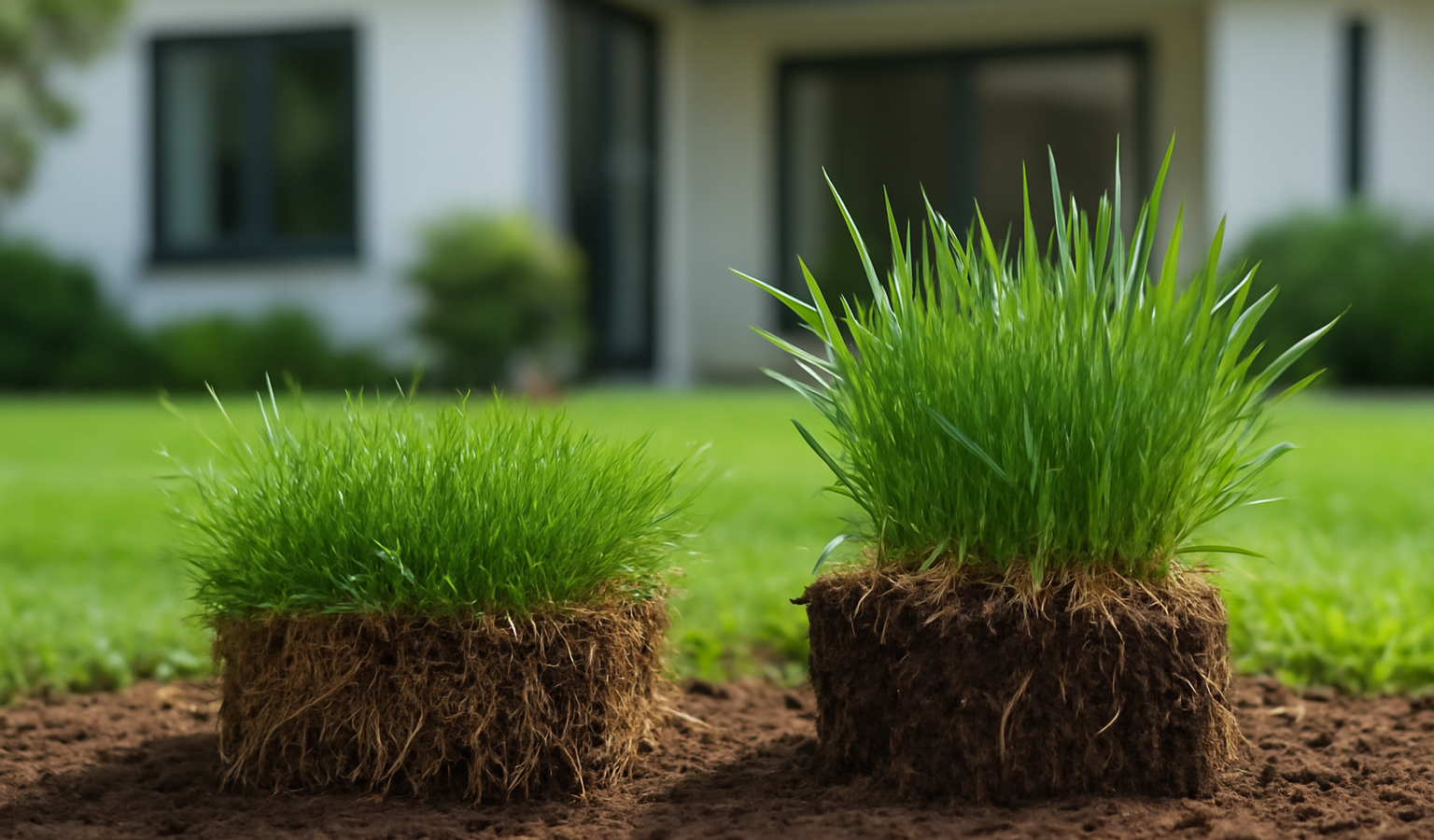
If you garden anywhere in the northern half of the United States, your two best cool-season lawn options usually come down to Kentucky bluegrass and turf-type tall fescue. They look broadly similar from the curb, both green up in spring and fall, and both are sold in nearly every big-box and seed-supplier blend. But under the hood they behave very differently. Kentucky bluegrass spreads by underground rhizomes and knits into a dense, self-repairing carpet, while tall fescue grows in clumps from a deep root system that shrugs off summer heat and drought. Choosing wrong means years of fighting your own lawn, so it pays to match the grass to your site before you ever open a seed bag.
Key Takeaways
- Kentucky bluegrass spreads by rhizomes, self-repairs, and gives the classic dense, fine-bladed lawn — but it needs more water, full sun, and higher maintenance.
- Tall fescue grows in clumps with deep roots, tolerating heat, drought, shade, and foot traffic far better with much less fuss.
- For the transition zone and hot, dry, or partly shaded yards, turf-type tall fescue is usually the smarter pick.
- For cooler northern climates, irrigated lawns, and homeowners who want a flawless showpiece, Kentucky bluegrass wins on looks and recovery.
- Many of the best lawns are a blend — fescue for toughness with 10–20% bluegrass for self-repair.
Quick comparison at a glance
| Factor | Kentucky Bluegrass | Tall Fescue |
|---|---|---|
| Growth habit | Spreads by rhizomes; self-repairing | Clumping (bunch-type); fills slowly |
| USDA zones / climate | Zones 3–7, cool northern climates | Zones 4–9, including the transition zone |
| Heat tolerance | Poor — goes dormant in summer heat | Excellent — deep roots stay green |
| Drought tolerance | Low to moderate; needs irrigation | High; roots reach 2–3 ft deep |
| Shade tolerance | Poor — wants 6+ hrs full sun | Good — handles light to moderate shade |
| Foot traffic / wear | Moderate, but recovers well | High wear tolerance; slow to recover |
| Mowing height | 2.5–3 in | 3–4 in |
| Water needs | 1.5–2 in/week in summer | 1–1.25 in/week |
| Maintenance level | High (fertilizer, water, overseeding) | Low to moderate |
| Establishment from seed | Slow — 14–30 days to germinate | Fast — 7–12 days to germinate |
Kentucky bluegrass: the classic carpet lawn
Kentucky bluegrass (Poa pratensis) is the grass most people picture when they imagine a perfect lawn: fine to medium blades, a rich blue-green color, and a thick, springy surface. Its signature trait is rhizomes — underground stems that creep sideways and send up new shoots. That habit is why a bluegrass lawn knits itself into a seamless carpet and, critically, why it self-repairs. Tear a divot out with a soccer cleat or a dog’s claws, and the surrounding plants will fill the gap on their own within a few weeks during the growing season.
That self-healing is the single biggest reason sod farms and sports fields lean on bluegrass. It also makes it forgiving for high-use family lawns, as long as you can meet its needs. And those needs are real. Bluegrass has a shallow root system compared with fescue, so it dries out fast and goes dormant — turning straw-brown — during summer heat and drought unless you irrigate. It wants at least six hours of direct sun; in shade it thins and surrenders to weeds and moss. It is also the hungriest of the cool-season grasses, typically needing 3–4 pounds of nitrogen per 1,000 square feet per year, split across spring and fall feedings.
Where bluegrass shines
Bluegrass is at its best in cooler northern states — the upper Midwest, the Northeast, the Mountain West, and the Pacific Northwest — where summers are milder and you have irrigation or reliable rainfall. If you want a showpiece lawn, you are willing to mow, feed, and water on a schedule, and your yard gets full sun, bluegrass rewards the effort with a density and color that fescue simply cannot match. It also handles cold winters beautifully, greening up early in spring.
Bluegrass weak spots
The downsides are heat, drought, and shade — plus a slow, fussy start. Bluegrass seed can take two to four weeks to germinate, so it is easy for weeds to colonize bare soil first. Many homeowners in hot or dry regions plant a pure bluegrass lawn, fail to keep up with the watering, and end up with a brown, patchy disappointment by August. It is also more prone to thatch buildup and to diseases like summer patch and dollar spot when stressed.
Tall fescue: the tough, low-fuss workhorse
Turf-type tall fescue (Festuca arundinacea, now often classed as Lolium arundinaceum) is the grass for people who want a green lawn without babying it. Modern turf-type cultivars are a world away from the coarse old “K-31” pasture fescue — they are finer-bladed, darker green, and far denser. Their defining feature is a deep, aggressive root system that can reach two to three feet down. Those roots tap moisture and nutrients well below the surface, which is exactly why fescue stays green through heat and drought when bluegrass has long since gone dormant.
Fescue is a bunch-type grass: it grows in clumps and does not spread by rhizomes (it has only weak short stems at best). That has one practical consequence — it does not self-repair the way bluegrass does. If you wear a path or kill a patch, you have to overseed it to fill in, because the surrounding plants will not creep over. To keep a fescue lawn looking thick, most people overseed every fall, which is a quick job and far less work than the watering and feeding a bluegrass lawn demands all season.
Where fescue shines
Tall fescue is the default cool-season choice for the transition zone — that band across the mid-Atlantic, the Carolinas, Tennessee, Kentucky, the Ozarks, and northern Texas where it is too hot for bluegrass and too cold for reliable warm-season grass. It also wins anywhere with poor or compacted soil, partial shade, heavy foot traffic, or limited irrigation. Set your mower at 3 to 4 inches, water about an inch a week, feed it once or twice a year, and a fescue lawn stays presentable with minimal intervention. It germinates fast — often within a week — so it establishes quickly and crowds out weeds.
Fescue weak spots
Because it does not spread, fescue can develop a clumpy, uneven look over time if it thins, and bare spots stay bare until you reseed. Individual plants are also a bit coarser than bluegrass, so the finest, most manicured look is harder to achieve. In the coldest northern climates fescue is less winter-hardy than bluegrass and can suffer winterkill in harsh, snowless cold.
Maintenance, cost, and establishment
Day to day, fescue is the cheaper lawn to run. It needs roughly 1 to 1.25 inches of water per week versus the 1.5 to 2 inches bluegrass demands in summer heat, and it gets by on half the fertilizer. Mowing is similar for both, though fescue’s taller cut means slightly less frequent mowing and better weed shading. For establishment, fescue’s fast germination gives you a usable lawn in weeks; bluegrass tests your patience and your weed control. If you are renovating a tired lawn, see our guide on why grass turns brown and how to fix it before you decide whether the problem is the grass type or your care routine. For overall lawn strategy, the Outdoor Living hub collects our full lineup of lawn and landscape guides.
Which should you choose?
The right answer depends almost entirely on your climate and how much work you want to do.
- You live in the transition zone (mid-Atlantic, Carolinas, Tennessee, Oklahoma, northern Texas): Choose tall fescue. It is the only cool-season grass that reliably survives those hot summers.
- You have hot summers, limited irrigation, or you hate watering: Tall fescue, hands down — its deep roots keep it green when bluegrass browns out.
- Your yard has partial shade: Tall fescue tolerates light to moderate shade; bluegrass needs full sun.
- You live in the cool North (upper Midwest, Northeast, Mountain West, PNW) with irrigation and full sun: Kentucky bluegrass gives the densest, finest, best-looking lawn and self-repairs from wear.
- You have kids and pets tearing up the turf: Bluegrass self-heals divots; fescue takes the wear but needs overseeding to recover.
- You want the lowest-maintenance lawn possible: Tall fescue, every time.
For many homeowners the best move is to stop thinking either/or. A blend of about 80–90% turf-type tall fescue with 10–20% Kentucky bluegrass gives you fescue’s toughness and drought resistance plus just enough bluegrass to self-repair and fill thin spots. That combination is hard to beat across most of the cool-season and transition regions. Once you have your lawn dialed in, you might tackle the borders too — our guide on compost vs mulch covers what to put around the beds that frame it.
Frequently Asked Questions
Can I mix Kentucky bluegrass and tall fescue in the same lawn?
Yes, and it is one of the most popular blends sold. A mix of about 80–90% turf-type tall fescue with 10–20% Kentucky bluegrass combines fescue’s heat and drought tolerance with bluegrass’s self-repairing rhizomes, giving a tough lawn that still fills in thin spots on its own.
Which grass is more drought tolerant?
Tall fescue, by a wide margin. Its roots reach two to three feet deep and pull moisture from far below the surface, so it stays green through dry spells. Kentucky bluegrass has shallow roots, dries out faster, and goes dormant and brown without regular irrigation.
Does tall fescue spread and fill in bare spots?
Not really. Tall fescue is a bunch-type grass that grows in clumps and does not creep by rhizomes, so it will not crawl over bare patches. To keep a fescue lawn thick, overseed thin or worn areas every fall.
Which one is better for shade?
Tall fescue handles light to moderate shade much better than Kentucky bluegrass, which really needs six or more hours of direct sun to stay dense. In shady yards bluegrass thins out and gets invaded by moss and weeds.
How tall should I mow each grass?
Mow Kentucky bluegrass at about 2.5 to 3 inches and tall fescue a bit higher, around 3 to 4 inches. The taller fescue cut shades the soil, conserves moisture, and helps the lawn crowd out weeds during summer heat.