

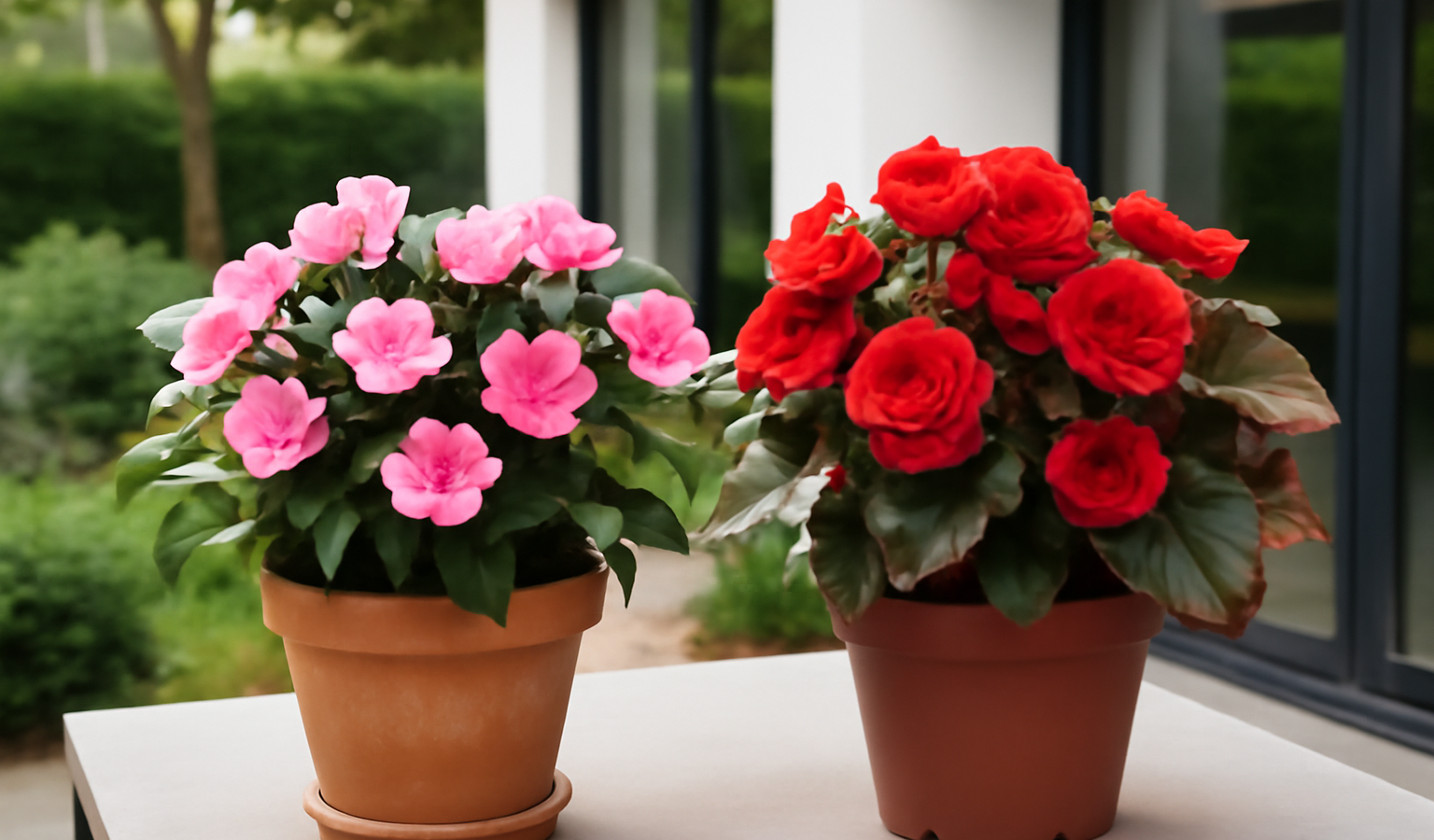
If you have a shady bed that needs color, the two names that come up first are impatiens and begonias. Both bloom for months in part to full shade, both shrug off the kind of low light that defeats petunias and marigolds, and both are sold as cheap six-packs every spring. But they are not interchangeable. Impatiens (the classic Impatiens walleriana) give you the densest, most saturated carpet of color of any shade annual, but they collapse in drought and were nearly wiped out by downy mildew a decade ago. Begonias—whether fibrous wax begonias or tuberous types—are tougher, more sun-tolerant, and disease-resistant, but they bloom a little thinner and cost more per plant. The right pick depends on how much light you actually have, how reliable your watering is, and whether downy mildew is a problem in your area.
Key Takeaways
- Deepest shade: Classic Impatiens walleriana bloom heaviest in true shade; begonias prefer part shade with a few hours of filtered sun.
- Toughest: Wax begonias tolerate more sun, heat, and missed waterings; impatiens wilt fast when dry.
- Disease: Downy mildew can wipe out I. walleriana overnight—choose SunPatiens, New Guinea impatiens, or begonias where it is common.
- Color: Impatiens win on density of bloom and sheer flower count; tuberous begonias win on flower size and showy doubles.
- Both are warm-season annuals: Plant after your last frost, in Zones 2–11 as annuals; neither survives a freeze.
Quick comparison
| Trait | Impatiens (walleriana) | Begonias (wax / tuberous) |
|---|---|---|
| Best light | Part to full shade | Part shade to part sun |
| Bloom density | Heaviest—solid carpet | Moderate; larger individual flowers |
| Drought tolerance | Poor—wilts fast | Good (wax), moderate (tuberous) |
| Heat tolerance | Moderate | Good (wax) |
| Disease risk | High—downy mildew | Low |
| Spacing | 8–12 in | 6–12 in |
| Height | 6–18 in | 6–18 in |
| Hardiness | Annual (perennial Zone 10–11) | Annual (tuberous lifted to overwinter) |
Impatiens: the shade-color champion
Standard garden impatiens, Impatiens walleriana, are the reason so many gardeners think of “shade” and “color” together. No other annual produces such a uniform sheet of bloom in genuinely low light—a north-facing bed under a deck, the dim strip along a fence, the floor of a maple grove. They flower in white, pink, coral, salmon, red, lavender, and bicolors, and a well-grown bed reads as almost solid color from June until frost with no deadheading required; spent flowers drop cleanly on their own.
The trade-off is that impatiens are thirsty and soft. Their stems are succulent and brittle, holding a lot of water, so when the soil dries they wilt dramatically within hours—and on a hot afternoon a flat planted in the morning can be face-down by lunch. They recover if you water promptly, but repeated wilting stunts them and invites stem rot. Plan on consistent moisture: an inch of water a week in the ground, daily checks for containers in summer. They are heavy feeders too; a balanced liquid fertilizer every two weeks, or a slow-release granule at planting, keeps the color coming.
The downy mildew problem
Around 2011–2013, a devastating water mold, Plasmopara obducens, swept through North American and European gardens and made I. walleriana nearly unplantable in many regions. The symptoms are sneaky: leaves yellow and curl, a white fuzzy coating appears on the undersides, and then the entire plant defoliates and collapses within days, leaving bare stems. The spores overwinter in soil, so an infected bed can reinfect new plants the following year. If you have lost impatiens this way before, do not replant walleriana in the same spot.
The good news is that breeders responded. New Guinea impatiens (Impatiens hawkeri) and the SunPatiens series are resistant to this mildew, take far more sun, and offer bigger flowers and bolder foliage—at a higher price. There are also newer mildew-resistant walleriana lines like the Beacon and Imara series worth seeking out. If mildew is not an issue where you live, classic impatiens remain the cheapest, most floriferous choice for deep shade.
Begonias: the tougher, more flexible pick
“Begonia” covers several very different plants, and knowing which type you are buying matters more than the begonia-vs-impatiens question itself.
Wax (fibrous) begonias
Wax begonias (Begonia semperflorens) are the small, mounding bedding plants with glossy round leaves—green or bronze—and clusters of white, pink, or red flowers. They are the toughest mainstream shade annual you can buy: they tolerate part sun (especially the bronze-leaved kinds), recover from a missed watering, resist disease, and bloom non-stop without deadheading. They do not carpet as densely as impatiens, but they are nearly foolproof, making them the smart default for low-maintenance beds and for gardeners who travel.
Tuberous begonias
Tuberous begonias are the showstoppers—large, rose-like or camellia-like double flowers up to 4 inches across, in vivid colors, often on trailing stems perfect for hanging baskets. They demand more: cool roots, rich well-drained soil, protection from hot afternoon sun, and they sulk in high heat and humidity. Their tubers can be lifted and stored over winter, so they are technically reusable. For containers in a sheltered, part-shade spot, nothing beats them—but they are a project, not a plant-and-forget annual.
Dragon Wing and Rieger types
Worth a mention: Dragon Wing and similar angel-wing hybrids bridge the gap, offering big arching plants with abundant red or pink flowers, good heat tolerance, and more sun tolerance than impatiens. They are a strong choice for large containers and mass plantings where you want impatiens-style impact with begonia-style toughness.
Color and design uses
For mass plantings where you want a seamless sheet of one color—the front of a shaded foundation bed, a long border under trees, a woodland edge—classic impatiens are unbeatable; plant a single color en masse and the effect is striking. They also do beautifully in window boxes and hanging baskets, spilling and mounding with constant bloom. Begonias suit a more mixed approach: wax begonias make tidy, uniform edging and bedding ribbons, while tuberous and Dragon Wing types are designed to be focal points in containers, their large flowers and arching stems carrying a pot or basket on their own. If you like to combine textures, both pair well with shade foliage like coleus, caladium, and ferns, with begonias’ glossy leaves adding their own foliage interest even between bloom flushes.
Cost and availability
Budget is a real factor in bedding-plant choices because you often buy by the flat. Classic walleriana impatiens are the cheapest of all, sold in inexpensive six-packs everywhere in spring, which is part of why they became the default shade annual for decades. Wax begonias are similarly affordable and widely available. The premium options cost more per plant: New Guinea impatiens and SunPatiens are typically sold individually in larger pots at a noticeably higher price, and named tuberous begonias—especially as started tubers or specialty hanging types—are the priciest of the group. When you are filling a large area, the math favors the cheaper massed annuals; for a few statement containers, paying up for SunPatiens or tuberous begonias is easy to justify.
Growing conditions side by side
Both are warm-season annuals: wait until your soil has warmed and all danger of frost has passed before setting them out—usually mid-to-late spring depending on your zone. Both want rich, organic, well-drained soil and benefit from a couple of inches of compost worked in. Space impatiens 8–12 inches apart so they knit into a carpet; space wax begonias 6–12 inches. Mulch both lightly to hold moisture and keep weeds down.
The single biggest practical difference is water discipline. Impatiens punish neglect immediately and visibly; begonias forgive it. If you garden in containers or have a busy schedule, that alone may decide the matter. If you want to compare other shade-tolerant options for the same bed, our guide on hosta vs heuchera shade foliage covers the leafy companions that pair beautifully with either of these bloomers, and the Plants & Flowers hub has more annual care guides.
The verdict
For the deepest shade and the most color per dollar, classic impatiens win—provided downy mildew is not a problem in your area and you can keep them watered. Nothing else carpets a dim bed so completely. For toughness, sun flexibility, and reliability, wax begonias win; they are the plant-and-forget choice for busy gardeners and the safe pick wherever mildew has struck. For dramatic container displays in a sheltered part-shade spot, tuberous begonias are unmatched. A practical compromise that sidesteps the whole debate: plant SunPatiens or New Guinea impatiens for mildew-proof, sun-tolerant impatiens-style color, or Dragon Wing begonias for begonia toughness with impatiens impact. Match the plant to your light, your watering habits, and your local disease pressure, and either genus will reward you with months of bloom.
Frequently Asked Questions
Can impatiens and begonias take full sun?
Classic Impatiens walleriana cannot—they scorch and stop blooming in hot afternoon sun. SunPatiens and New Guinea impatiens tolerate full sun with enough water. Wax begonias, especially bronze-leaved varieties, handle part sun well; tuberous begonias need afternoon shade.
Which blooms more, impatiens or begonias?
Impatiens produce the heaviest, most uniform carpet of bloom in shade. Begonias bloom steadily but with fewer, often larger flowers. For sheer flower density in deep shade, impatiens win; for big individual flowers, tuberous begonias win.
Do I need to deadhead either one?
No. Both are “self-cleaning”—spent flowers drop on their own and the plants keep blooming without deadheading, which is a big reason both are so popular for low-maintenance beds and containers.
What is wrong with my impatiens collapsing suddenly?
If leaves yellow, curl, develop white fuzz underneath, and the plant defoliates within days, it is downy mildew. Remove and discard infected plants (do not compost), and replant with resistant New Guinea impatiens, SunPatiens, or begonias instead.
Can I overwinter either plant?
Wax begonias and impatiens can be brought indoors as houseplants or kept as cuttings, but most gardeners treat them as annuals. Tuberous begonias are designed to be lifted—dig the tubers after the first frost, cure, and store them dry and cool over winter.