

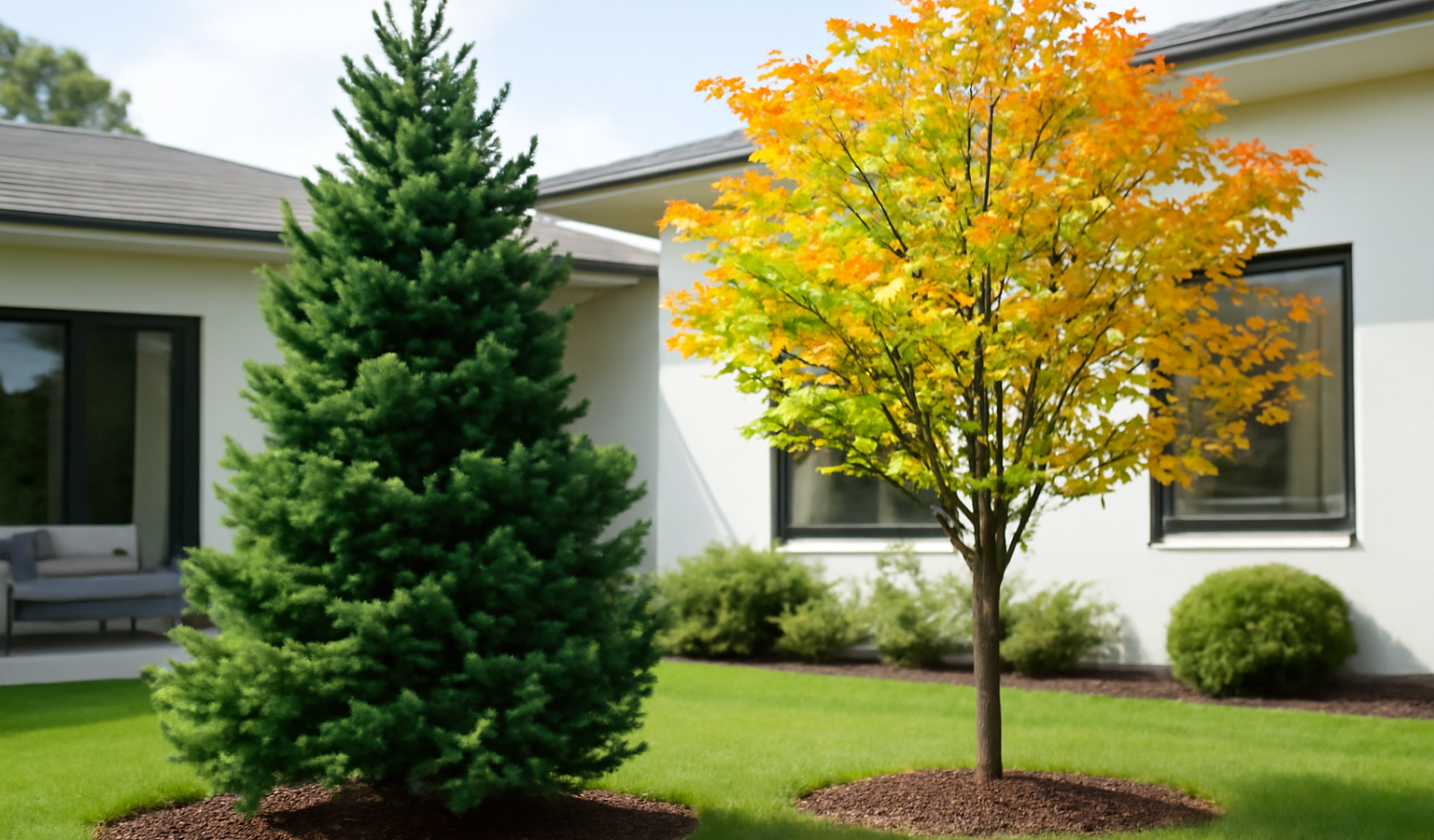
If you want a screen that blocks the neighbor’s window in January, plant evergreens; if you want fall color, spring flowers, and winter sun on your patio, plant deciduous. That is the whole decision in one sentence — but most good yards end up using both, and where you put each one matters more than which “team” you pick. Evergreens hold their foliage through all four seasons and give you a solid, year-round wall of green. Deciduous trees and shrubs drop their leaves every autumn, trading winter privacy for seasonal drama and a flood of low-angle sun when you want it most. Below is how the two groups actually behave in the ground, with spacing, growth rates, and hardiness numbers so you can match the right plant to the right job.
Key Takeaways
- Evergreens give 12-month privacy and windbreak; deciduous plants only screen from roughly May through October.
- Deciduous trees let warm winter sun reach the house, then leaf out to shade it in summer — a real energy advantage on the south and west sides.
- Evergreens carry far heavier snow and ice loads; their dense canopy can split or topple in storms if poorly sited or limbed up wrong.
- Deciduous plants deliver fall color, flowers, and fruit, but cost you weeks of leaf cleanup each autumn.
- Most evergreen conifers grow slowly to moderately (6–24 in./yr); fast deciduous shade trees can add 24–36 in./yr.
- The best screens layer both: an evergreen backbone for year-round cover plus deciduous plants for seasonal interest and wildlife.
| Feature | Evergreen | Deciduous |
|---|---|---|
| Year-round screening | Yes — full 12 months | No — bare Nov–Apr in most zones |
| Winter sun reaching house | Blocked | Allowed through (passive solar gain) |
| Fall color & flowers | Limited (some berries/bloom) | Strong — peak fall and spring display |
| Leaf cleanup | Minimal (steady light needle drop) | Heavy 4–8 week autumn cleanup |
| Typical growth rate | Slow–moderate, 6–24 in./yr | Moderate–fast, 12–36 in./yr |
| Snow/ice load risk | Higher — dense evergreen canopy | Lower in winter (bare branches) |
| Wildlife value | Winter cover & nesting | Nectar, fruit, fall seed |
Evergreens: Year-Round Cover and Windbreak
“Evergreen” covers two very different looks. The first is the needled conifers — spruce, pine, fir, arborvitae, Leyland cypress, and false cypress. The second is the broadleaf evergreens — holly, boxwood, rhododendron, mountain laurel, cherry laurel, and many viburnums — which keep wide, glossy leaves rather than needles. Both share the defining trait: they replace foliage gradually all year instead of dropping it all at once, so the plant never goes bare. That single fact is why evergreens are the default choice for privacy, property-line screening, and winter wind protection. When the deciduous world is a tangle of gray sticks in February, an evergreen hedge is still a solid green wall.
Screening and spacing
For a true privacy screen, spacing depends on the plant’s mature width, not its size at the nursery. Emerald Green arborvitae (mature 3–4 ft wide, 12–15 ft tall, USDA zones 3–7) goes in at 2–3 ft on center for a tight wall, or 3–4 ft if you can wait a couple of seasons for it to knit together. Green Giant arborvitae is a beast by comparison — 30–50 ft tall, 12–20 ft wide, hardy in zones 5–7, and one of the fastest evergreens at up to 3 ft per year — so space it 5–8 ft on center and give it room. Leyland cypress wants 6–10 ft spacing and reaches 40–60 ft. The classic mistake is planting fast screens too close: they overcrowd, shade out their own lower branches, and brown out in the middle within a decade. Read the mature width tag and trust it.
Snow, ice, and wind load
The same dense foliage that makes evergreens good screens makes them vulnerable in winter storms. A loaded canopy of wet snow or ice acts like a sail and a weight at the same time, and multi-stemmed arborvitae and upright junipers are notorious for splaying open or snapping at the crotch. In heavy-snow regions, choose single-leader forms, tie or loosely band multi-stem arborvitae in late fall, and gently broom snow upward off branches rather than knocking it down. Site large evergreens where a failure won’t land on the roof or a fence. Pines and spruces with strong central leaders handle load better than soft, columnar shrubs. Wind is the flip side of the same coin: a well-placed evergreen windbreak on the north or northwest side can noticeably cut winter wind chill against the house.
Maintenance and wildlife
Evergreens are low-cleanup but not no-cleanup — needles and old leaves drop steadily, just never in one big October dump. Most need only light shaping; broadleaf evergreens like boxwood and holly take shearing well, while many conifers do not regenerate from bare old wood, so never cut a spruce or pine back past its green growth. For wildlife, evergreens shine in winter: dense interior branches give birds critical cover and nesting sites when everything else is exposed, and hollies and junipers carry berries that feed birds through the cold months. If you want guidance on keeping a formal evergreen hedge crisp without ruining its health, see our breakdown of pruning vs. shearing.
Deciduous: Seasonal Drama and Winter Sun
Deciduous trees and shrubs run on a calendar. They leaf out in spring, work all summer, blaze in fall, and stand bare and architectural through winter. This group includes most of the plants people fall in love with: maples and oaks for shade and fall color, dogwood and serviceberry for spring bloom and fall fruit, hydrangea, lilac, viburnum, and ninebark for the shrub border, plus crapemyrtle, redbud, and Japanese maple as showpieces. What they give up in winter screening, they pay back in four-season change — and in a feature evergreens can’t offer: they let the sun back in.
The winter-sun advantage
This is the most underrated reason to plant deciduous. A leafy deciduous tree on the south or southwest side of a house casts deep shade in summer, cutting cooling load and keeping the patio usable in July. The same tree drops its leaves in fall, so in December and January — when the sun rides low and you actually want it — warm light pours through the bare branches onto the windows and walls. Evergreens block that light year-round, which is great for a north-side windbreak and bad for a south-facing window. Used deliberately, deciduous shade trees are a passive-solar tool: shade when it’s hot, sun when it’s cold.
Growth rate and fall color
Deciduous shade trees include some of the fastest growers available — red maple and many oaks add 13–24 in. a year, hybrid poplars and silver maple can push past 36 in., though the fast, soft-wooded species are also the weakest and messiest. For color, sugar maple and red maple (zones 3–8) deliver orange-to-scarlet fall foliage, oaks bring deep russet and bronze, and serviceberry, fothergilla, and itea light up in fall while flowering in spring. Hydrangeas (many hardy to zone 3–4) bloom for weeks in summer. None of this exists on a row of arborvitae. If you want a yard that announces the season, deciduous plants carry the show.
The leaf-cleanup tradeoff
Be honest about autumn. A mature shade tree drops a serious volume of leaves over a four-to-eight-week stretch, and they have to go somewhere — mowed-and-mulched back into the lawn, raked into beds as free leaf mulch, or hauled off. Wet leaves left on turf or hardscape smother grass and turn slick. Many gardeners turn the chore into an asset by shredding leaves for compost and bed mulch, which feeds the soil for free. Still, if you genuinely won’t keep up with cleanup, lean more heavily on evergreens and fewer big deciduous canopies near paths and gutters.
How to Choose — and Why You Probably Want Both
Start with the job. If the goal is to block a specific year-round eyesore or a winter wind, the answer is evergreen — full stop. If the goal is shade, seasonal beauty, or wildlife forage and you don’t need winter privacy in that spot, deciduous wins. Then layer in site facts: a south or west exposure where you want summer shade and winter warmth argues for a deciduous canopy; a north or northwest property line exposed to cold wind argues for an evergreen belt. Factor in snow load (favor strong-leader evergreens or deciduous in heavy-snow country), cleanup tolerance, and how fast you need results.
The strongest landscapes combine the two in a layered screen. Set an evergreen backbone along the line you want covered all year — arborvitae, holly, or spruce. In front of and between them, weave deciduous shrubs and a small flowering tree or two for spring bloom, fall color, and berries. The evergreens guarantee privacy in February; the deciduous layer keeps the screen from looking like a flat green fence and feeds pollinators and birds across the seasons. A mixed screen is also more resilient — one pest or disease can wipe out a monoculture hedge, but a varied planting shrugs it off. For more on stitching screens, beds, and seating areas into a coherent yard, browse our outdoor living guides, and for plant-by-plant picks see the plants and flowers library.
One last practical note: match every plant to your USDA hardiness zone and your actual soil and light before you buy. A rhododendron will sulk and yellow in dry alkaline soil and full afternoon sun; a sun-loving lilac won’t bloom in shade. Evergreen or deciduous, the plant that thrives is the one suited to your site — so check the zone range, mature size, sun needs, and drainage on the tag, and space for the mature width, not the nursery pot.
Frequently Asked Questions
Which gives faster privacy, evergreen or deciduous?
For year-round privacy, fast evergreens win because they screen in every season. Green Giant arborvitae and Leyland cypress can add up to 3 ft per year and form a solid wall. Some deciduous shrubs grow faster, but they leave you exposed all winter, so they only solve the problem half the year.
Do evergreens really hold leaves forever?
No — they shed and replace foliage gradually all year, so they always look full but are never truly bare. Older interior needles and leaves drop steadily, which is why you’ll find light needle litter under a pine year-round rather than one big autumn pile.
Will an evergreen hedge block winter sun from my house?
Yes. Because evergreens keep dense foliage year-round, a tall hedge on the south or southwest side will shade the house in winter when you’d rather have the warmth. For those exposures, a deciduous tree is usually smarter — summer shade, winter sun.
Are evergreens more likely to break in snow and ice?
Often yes. Their dense canopy catches and holds snow and ice, which can splay multi-stem arborvitae or snap weak crotches. Choose single-leader forms, loosely band columnar shrubs before winter, and gently broom heavy snow upward off the branches.
Can I mix evergreen and deciduous in one screen?
Absolutely, and it’s the best approach. Use an evergreen backbone for guaranteed year-round cover, then layer deciduous shrubs and a flowering tree in front for fall color, blooms, and wildlife. The mix looks better and resists pests and disease far better than a single-species hedge.